Weekend links 270

ufo.jpg

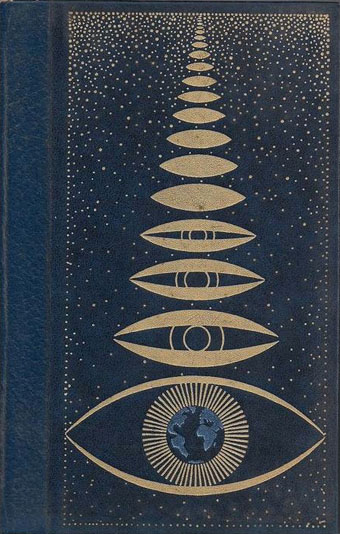
Cover design for UFOs and Extra-Terrestrials in History (four vols, 1978) by Yves Naud.

Come To The Sabbath, “a festival of dark arts delving into the influence of Black Magick, Witchcraft, Demonology and Satanism in pop culture”, takes place at Apiary Studios, 458 Hackney Road, London, from Tues 18th–Sun 23rd August.

• “Visitors, if there had ever been any, would have said that the little town of Mansfield was haunted.” Showdown is a previously unpublished short story by Shirley Jackson.

• “A sandbox stealthy immersive sim in a surreal, horror-y world inspired by writers like Burroughs and Ballard…” Alice O’Connor previews the forthcoming computer game, Tangiers.

Sometime in the late 1960s, the artist Robert Smithson took a trip to southwestern Ohio. He saw the Great Serpent Mound there and decided that he would make a great spiral too. […] Because the Great Salt Lake’s levels vary several feet from year to year, and also from season to season, Spiral Jetty is not always visible even if you make the trip to Utah. You could go out to Spiral Jetty and find that the entire earthwork is invisible underwater. When Robert Smithson created this earthwork in 1970, he did not care if it could be easily seen or who owned it. And so, even today, no one knows to whom Spiral Jetty really belongs. To view it requires a pilgrimage.

Stefany Anne Goldberg on earthworks, new and ancient, and the art of disappearance

• “Commercial book cover design is a minor portion of Gorey’s award-winning legacy, but not a lesser art.” Steven Heller on Edward Gorey: cover designer.

• “You are accepted,” he says, “by the genre that can accept you.” Samuel R. Delany talked to Peter Bebergal about being an outsider in the world of science fiction.

A battle of Witts: A brief look at ‘Taboos’ and the work of The Passage. Mark Griffiths on a great, if seldom-remembered, Manchester band.

• “Hispanic photomonteur Josep Renau aimed Technicolor jets of scorn at the mirage of US consumerist culture,” says Rick Poynor.

• Because the internet is really big… Kelli Anderson reworks the Eames’ The Powers of Ten using imagery found via Google searches.

Against Nature is a forthcoming musical adaptation of Huysmans’ À Rebours by Marc Almond, Jeremy Reed and Othon.

“What makes a film noir?” Adam Frost & Melanie Patrick have an infographic for you.

• Mixes of the week: Gizehcast #20 by LCC, and Jenny Hval‘s WEIRD Quietus mix.

• Mysterium Tremendum: Russell Cuzner on The Strange World of Lustmord.

• The charming march of the Penguin Books logo.

Cosey Fanni Tutti: Agent Provocateur

Dark Times (Peel Session) (1980) by The Passage | XOYO (1982) by The Passage | Revelation (1982) by The Passage
The Living Grave by David Rudkin

rudkin.jpg

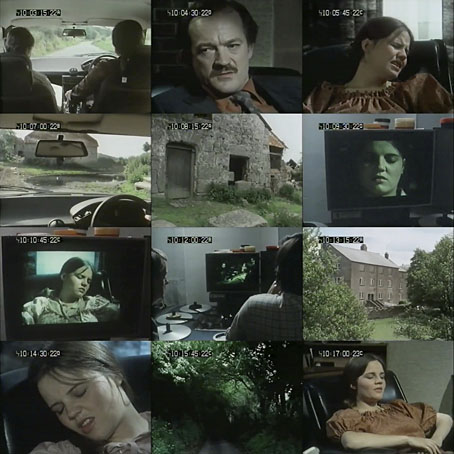
Having recently discovered two episodes from the BBC’s long-running Leap in the Dark series (In the Mind’s Eye, and Alan Garner’s To Kill a King), I was hoping the episode written by David Rudkin might turn up eventually. And here it is, posted to YouTube last month. Leap in the Dark, which ran from 1973 to 1980, was unusual for series dealing with the paranormal in the way it combined documentary episodes with fictional ones. The Living Grave (1980) is a skillful blend of both fact and fiction; Rudkin’s website describes it thus:

Based on documentary transcripts: the hypnotist Joe Keaton “regresses” Pauline, a Merseyside nurse, back beyond her birth to an earlier life – she starts to speak as Kitty, a maidservant on 18th century Dartmoor, who is made pregnant and hangs herself. To this day, on Kitty’s unconsecrated grave at a lonely forkroads, flowers are still left by an unknown hand.

I intercut the hypnosis scenes with glimpses of the life and death of Kitty herself as “her” voice was describing them – but with the camera as Kitty’s point of view, and so never seeing her, and using the locations as they are now. This was to avoid the inertia of mere illustration, creating instead a simultaneity of the two time-frames, and a sense of Kitty’s experience still present in the landscape today.

In May this year I wrote a lengthy essay about Rudkin’s dramas (more about that later) so The Living Grave has additional relevance beyond its cult interest. For a half-hour film it’s a more impressive piece than White Lady, a longer original drama that Rudkin wrote and also directed in 1987. Where White Lady is surprisingly inert, The Living Grave features familiar Rudkin touches, especially the voice of the unseen “haunted man” whose words are the closest thing to the speech in the stage plays. After spending some time tracing Rudkin’s recurrent use of sacred monuments, whether churches or stone circles, the shots of Dartmoor megaliths were especially notable. In the essay I sketched a comparison between Rudkin and Alan Garner, two writers who share concerns with the way the deep past of the British Isles impresses itself on the present, especially in a rural context. As noted above, Garner wrote an episode of Leap in the Dark, and there’s a further connection here in Lesley Dunlop who plays the hypnotised nurse, Pauline; two years before, Dunlop was Jan in Garner’s excellent TV adaptation of his novel, Red Shift. The hypnotist in The Living Grave is played by Ian Hogg, a friend of Rudkin’s who played Arne in Penda’s Fen, and has appeared in a number of the writer’s other dramas for stage and radio.

Previously on { feuilleton }
In the Mind’s Eye
To Kill a King by Alan Garner
Afore Night Come by David Rudkin
White Lady by David Rudkin
Red Shift by Alan Garner
Penda’s Fen by David Rudkin
David Rudkin on Carl Dreyer’s Vampyr

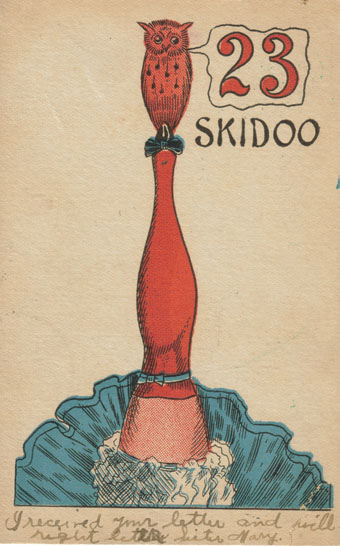
23 Skidoo

1: A slang phrase

skidoo1.jpg

Postcard via.

From the Oxford English Dictionary:

skidoo, v. N. Amer. slang. (ski’du:) Also skiddoo. [Orig. uncertain, perh. f. skedaddle v.]

2. In catch-phrases. a. Used as an exclamation of disrespect (for a person). Esp. in nonsense association with twenty-three. (temporary.)

1906 J. F. Kelly Man with Grip (ed. 2) 99 As for Belmont and Ryan and the rest of that bunch, Skidoo for that crowd when we pass. Ibid. 118 ‘I can see a reason for ‘skidoo’,’ said one, ‘and for ‘23’ also. Skidoo from skids and ‘23’ from 23rd Street that has ferries and depots for 80 per cent. of the railroads leaving New York.’ 1911 Maclean’s Mag. Oct. 348/1 Surrounded by this conglomerate procession as I went on my way, the urchins would yell ‘Skidoo,’ ‘23 for you!’

b. spec. as twenty-three skidoo: formerly, an exclamation of uncertain meaning; later used imp., go away, ‘scram’.

1926 C. T. Ryan in Amer. Speech II. 92/1, I really do not recall which appeared first in my vocabulary, the use of ‘some’ for emphasis or that effective but horrible ‘23-Skiddoo’—perhaps they were simultaneous. 1929 Amer. Speech IV. 430 Among the terms which the daily press credits Mr. Dorgan with inventing are:…twenty-three skiddoo (go away). 1957 W. Faulkner Town iii. 56 Almost any time now Father would walk in rubbing his hands and saying ‘oh you kid’ or ‘twenty-three skidoo’. 1978 D. Bagley Flyaway xi. 80 This elderly, profane woman…used an antique American slang… I expected her to come out with ‘twenty-three, skidoo’.


2: An esoteric poem by Aleister Crowley

[23]

SKIDOO

What man is at ease in his Inn?
Get out.
Wide is the world and cold.
Get out.
Thou hast become an in-itiate.
Get out.
But thou canst not get out by the way thou camest in. The Way out is THE WAY.
Get out.
For OUT is Love and Wisdom and Power.
Get OUT.
If thou hast T already, first get UT.
Then get O.
And so at last get OUT.

From The Book of Lies (1912/13)


3: A film by Julian Biggs

biggs.jpg

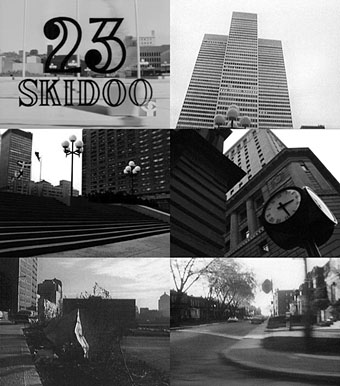
23 Skidoo (1964).

If you erase the people of downtown America, the effect is bizarre, not to say disturbing. That is what this film does. It shows the familiar urban scene without a soul in sight: streets empty, buildings empty, yet everywhere there is evidence of recent life and activity. At the end of the film we learn what has happened.


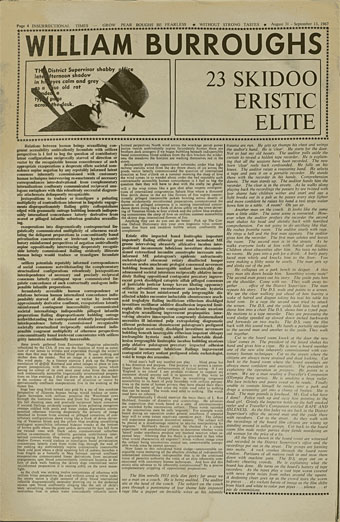
4: 23 Skidoo Eristic Elite by William Burroughs

skidoo2.jpg

International Times, issue 18, Aug 31–Sept 13, 1967.

From Burroughs proceed to Illuminatus! (1975) by Robert Shea and Robert Anton Wilson, and many subsequent derivations.


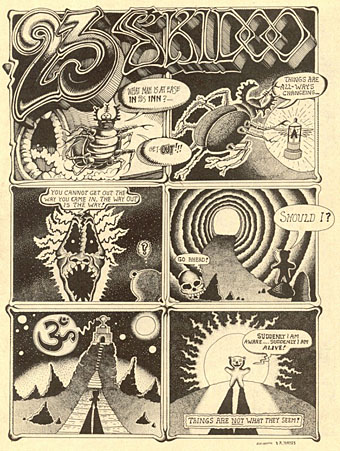
5: A one-off comic strip by Rick Griffin and Rory Hayes

skidoo3.jpg

From Bogeyman Comics #2 (1969).


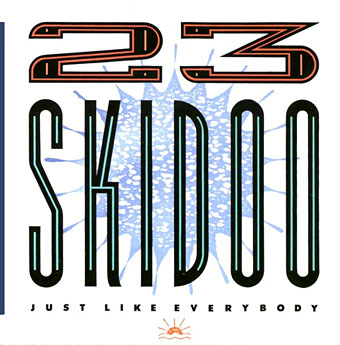
6: A music group

skidoo4.jpg

Just Like Everybody (1987). Design by Neville Brody.

Website | Discography


7: A poetry collection by Eckhard Gerdes

skidoo5.jpg

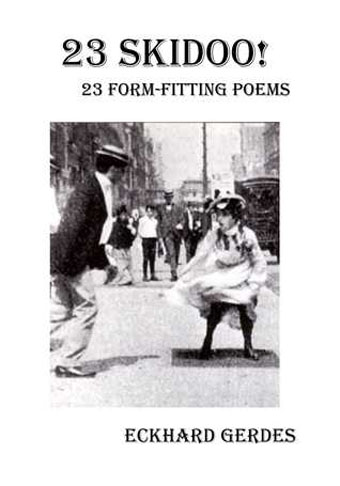
23 Skidoo! 23 Form-Fitting Poems (2013) by Eckhard Gerdes.

Previously on { feuilleton }
Seven Songs by 23 Skidoo
23 Skidoo by Julian Biggs
Neville Brody and Fetish Records

Weekend links 264

dakin.jpg

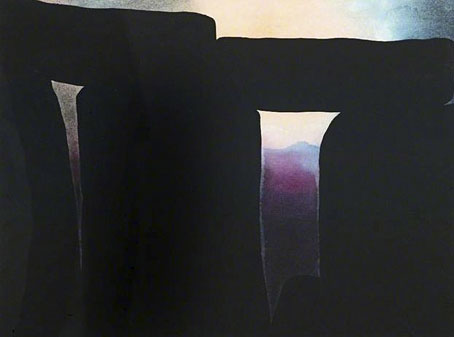
Stonehenge Suite, No.10 (1977) by Malcolm Dakin.

• “Part of me always wanted to write a teatime drama. That’s something that I wanted to get out of my system,” says director Peter Strickland. The results may be heard here. In the same interview there’s news that Strickland will be adapting Nigel Kneale’s The Stone Tape for radio later this year.

• “He was, as one obituary stated in terms unusually blunt for the time, ‘not as other men’.” Strange Flowers on the eccentric and profligate Henry Cyril Paget (1875–1905) aka The Dancing Marquess.

• “Please tell Mr Jagger I am not Maurits to him.” MC Escher rebuking The Rolling Stones. The artist is the subject of a major exhibition at the National Galleries of Scotland from June 27th.

Often mentioned in the same breath as works of James Joyce and Samuel Beckett, Ó Cadhain’s novel is, in some ways, even more radically experimental. For starters, all the characters are dead and speaking from inside their coffins, which are interred in a graveyard in Connemara, on Ireland’s west coast. The novel has no physical action or plot, but rather some 300 pages of cascading dialogue without narration, description, stage direction, or any indication of who’s speaking when.

Niamh Ní Mhaoileoin on the newly-translated Cré na Cille (The Dirty Dust) by Máirtín Ó Cadhain

Paul Woods examines “10 Edgy Properties No Film Producer Dared To Touch
(Yet)”. No. 2 is David Britton’s Lord Horror.

Mallory Ortberg ranks paintings of Saint Sebastian “in ascending order of sexiness and descending order of actual martyring”.

The Sign of Satan (1964): Christopher Lee in a story by Robert Bloch for The Alfred Hitchcock Hour.

Sympathy For The Devil – The True Story of The Process Church of the Final Judgment.

• At Dangerous Minds: Paul Gallagher on the seedy malevolence of Get Carter (1971).

• Mix of the week: Sonic Attack Special – Earth by Bob’s Podcasts.

Sanctuary Stone (1973) by Midwinter | The Litanies Of Satan (1982) by Diamanda Galás | Sola Stone (2006) by Boris

More Spare things

spare.jpg

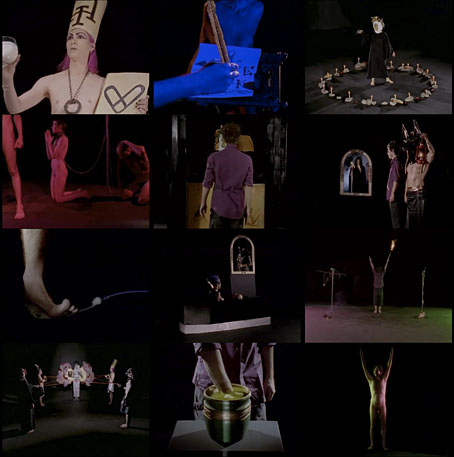
A couple of Austin Spare-related news items arrive in the same week so it’s worth linking again to Earth: Inferno (2003), a short film by Mor Navón & Julián Moguillansky based on the book by Austin Osman Spare. This is a production I have to damn with faint praise by being pleased that Spare is the focus of the work while being disappointed in the film as a whole. Despite the elaborate costumes, careful tableaux and copious nudity, Earth: Inferno confirms that an occult film needs to be more than a record of people dressing up and gesturing hieratically. If nothing else, occult rituals transform the perceptions of those involved, and this quality should be represented or implied in any film dealing with magical operations. The films of Kenneth Anger and Derek Jarman show different approaches, with the raw image transformed by superimposition, exaggerated grain, accelerated/decelerated motion, and so on. Inauguration of the Pleasure Dome and In the Shadow of the Sun are examples to follow. And now the news:

Lost Envoy: The Tarot Deck of Austin Osman Spare, edited by Jonathan Allen & Mark Pilkington. Out later this year from the fabulous Strange Attractor.

Surrealism, Austin Osman Spare and the Occult Underground of 1890s and 1990s London:

Nadia Choucha discusses the context and evolution of her ground-breaking book, Surrealism and the Occult, first published in 1991. The book traces the evolution of Surrealist ideas and situates them within the occult currents of fin-de-siècle European culture, revealing how these currents infused the work of various thinkers and artists in their quest for the ‘marvellous’. The work of Austin Osman Spare is also discussed as a way of comparing and contrasting his methods and techniques with those of the Surrealists. With the 25th anniversary of the publication of the book approaching, this evening will also present an analysis of the work as occurring within a unique historical and cultural moment.

Jun 23rd, 6:30 pm–8:00 pm at the Last Tuesday Society, London.

Previously on { feuilleton }
A Book of Satyrs by Austin Osman Spare
Spare things
Dreaming Out of Space: Kenneth Grant on HP Lovecraft
MMM in IT
Abrahadabra
Murmur Become Ceaseless and Myriad
New Austin Spare grimoires
Austin Spare absinthe
Austin Spare’s Behind the Veil
Austin Osman Spare