Max Ernst’s favourites

ernst1.jpg

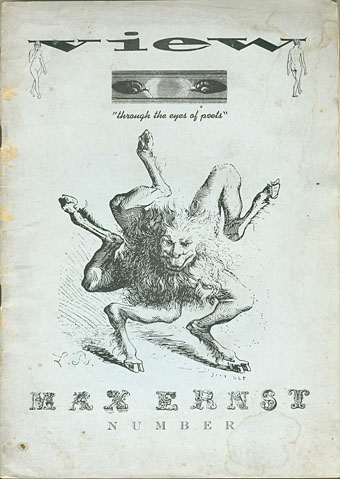
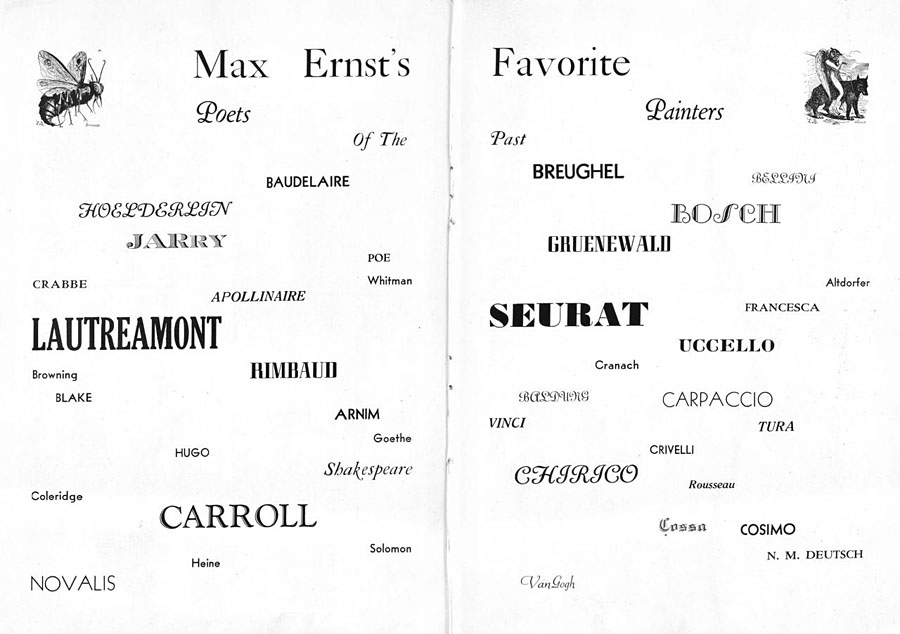
The cover for the Max Ernst number of View magazine (April, 1942) that appears in Charles Henri Ford’s View: Parade of the Avant-Garde was one I didn’t recall seeing before. This was a surprise when I’d spent some time searching for back issues of the magazine. The conjunction of Ernst with Buer, one of the perennially popular demons drawn by Louis Le Breton for De Plancy’s Dictionnaire Infernal, doubles the issue’s cult value in my eyes. I don’t know whether the demon was Ernst’s choice but I’d guess so when many of the De Plancy illustrations resemble the hybrid creatures rampaging through Ernst’s collages. Missing from the Ford book is the spread below which uses more De Plancy demons to decorate lists of the artist’s favourite poets and painters. I’d have preferred a selection of favourite novelists but Ford was a poet himself (he also co-wrote an early gay novel with Parker Tyler, The Young and Evil), and the list is still worth seeing.
ernst2.jpg

Poets: Charles Baudelaire, Friedrich Hölderlin, Alfred Jarry, Edgar Allan Poe, George Crabbe, Guillaume Apollinaire, Walt Whitman, Comte de Lautréamont, Robert Browning, Arthur Rimbaud, William Blake, Achim von Arnim, Victor Hugo, Johann Wolfgang von Goethe, William Shakespeare, Samuel Taylor Coleridge, Lewis Carroll, Novalis, Heinrich Heine, Solomon (presumably the author of the Song of Solomon).

Painters: Pieter Bruegel the Elder, Giovanni Bellini, Hieronymus Bosch, Matthias Grünewald, Albrecht Altdorfer, Georges Seurat, Piero della Francesca, Paolo Uccello, Lucas Cranach the Elder, Hans Baldung, Vittore Carpaccio, Leonardo Da Vinci, Cosimo Tura, Carlo Crivelli, Giorgio de Chirico, Henri Rousseau, Francesco del Cossa, Piero di Cosimo, NM Deutsch (Niklaus Manuel), Vincent van Gogh.

I’ve filled out the names since some of the typography isn’t easy to read. Some of the choices are also uncommon, while one of them—NM Deutsch—is not only a difficult name to search for but the attribution has changed in recent years. The list of poets contains few surprises but it’s good to see that Poe made an impression on Ernst; the choice of painters is less predictable. Bruegel, Bosch and Rousseau are to be expected, and the same goes for the German artists—Grünewald, Baldung—whose work is frequently grotesque or erotic. But I wouldn’t have expected so many names from the Italian Renaissance, and Seurat is a genuine surprise. As for Ernst’s only living contemporary, Giorgio de Chirico, this isn’t a surprise at all but it reinforces de Chirico’s importance. If you removed Picasso from art history de Chirico might be the most influential painter of the 20th century; his Metaphysical works had a huge impact on the Dada generation, writers as well as artists, and also on René Magritte who was never a Dadaist but who lost interest in Futurism when he saw a reproduction of The Song of Love (1914). Picasso’s influence remains rooted in the art world while de Chirico’s disquieting dreams extend their shadows into film and literature, so it’s all the more surprising that this phase of his work was so short lived. But that’s a discussion for another time.

Previously on { feuilleton }
Viewing View
De Plancy’s Dictionnaire Infernal
Max Ernst album covers
Maximiliana oder die widerrechtliche Ausübung der Astronomie
Max and Dorothea
Dreams That Money Can Buy
La femme 100 têtes by Eric Duvivier
Weekend links 509

occult.jpg

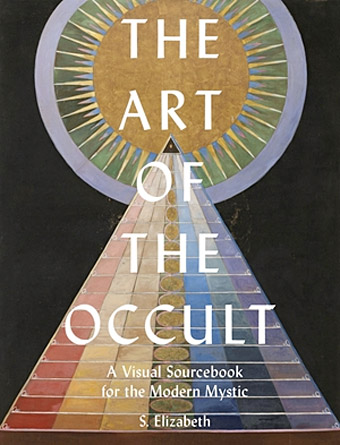
The Art of the Occult: A Visual Sourcebook for the Modern Mystic by S. Elizabeth. The book will be published in September by White Lion Publishing, and includes some work of mine.

• “The structure of the film as a memory palace consists of scenes intercutting different movies, depicting similar situations lived by the same actors in similar locations and, yes, similar sexual positions building over the course of its run-time.” Memory Palace: on Ask Any Buddy and the Golden Age of Gay Porn. Caden Mark Gardner writes on a kaleidoscopic, experimental archive piece of gay pornography. • Related: Paul P., the artist making dreamy paintings from vintage gay erotica.

• At Dennis Cooper’s: Spotlight on…Terry Southern The Magic Christian (1959), and Bill Hsu presents…High Anxiety: tense, dark films from 2010-2019 (for fans of Robert Aickman and Brian Evenson).

Green (1986) by Hiroshi Yoshimura, a welcome reissue of an album of minimal electronica. More green: The Green Fog by Guy Maddin has been on Vimeo for a while.

• Mixes of the week: Time is on our hands by Beautify Junkyards, and Textural Hominini Cognition by The Ephemeral Man.

• How John Waters and Mink Stole made Pink Flamingos, and Mink Stole on the inside story of John Waters’ greatest films.

Viktor Wynd: “I was offered a mummified arm—but I didn’t have €2,000 on me”.

• At Dangerous Minds: the solitary Surrealism of Gertrude Abercrombie.

Cats and Domino

Webcam in Italia

The Green Chinese Table (1988) by Seigen Ono | Green Water (1996) by Coil | Green Evil (1997) by Paul Schütze

Weekend links 508

lee-nova.jpg

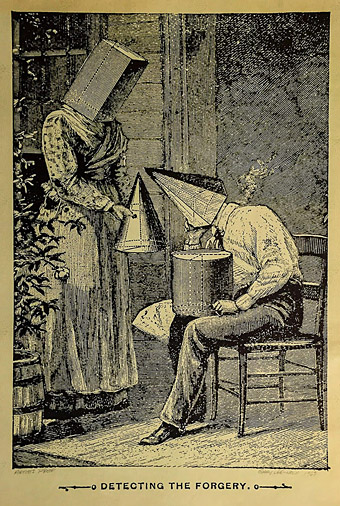
Detecting the Forgery (1967), a collage print by Gary Lee-Nova.

• Nigel Kneale’s adaptation of Susan Hill’s The Woman in Black was given a UK TV screening in 1989, followed by a brief video release after which it was buried for years, and subsequently overshadowed by the later (inferior) big-budget feature film. Network will be releasing the Kneale version on blu-ray in May. I wrote about the TV film a while ago.

• At the BFI: David Parkinson on 10 essential films featuring the late Max von Sydow, a welcome riposte to obituaries that headlined the often mediocre Hollywood fare that Von Sydow elevated with his minor roles. And at the same site, John Berra on where to begin with the martial arts films of King Hu.

• “Enthusiasts Archive, an artistic project by Neil Cummings and Marysia Lewandowska, is the result of extensive research amongst the remnants of amateur film clubs in Poland under socialism. It is a critical archive of amateur films found, restored and made available online.”

Stephen Calloway, co-curator of the Tate Britain Aubrey Beardsley exhibition, and drag performer Holly James Johnston sit down to tea to discuss the “dos and don’ts” of dandyism according to the artist.

• Mutinous Jester: The Collage Novels of Akbar Del Piombo by Gregory Stephenson. Related: Fuzz Against Junk: The Saga of the Narcotics Brigade (1959) by Akbar Del Piombo.

• Michael Richey on chindogu, the useless inventions of Kenji Kawakami.

• From farting to fornication: John Boardley on early print censorship.

Douglas A. Anderson on a case of plagiarism in Weird Tales.

• Mix of the week: mr.K’s Soundstripe vol 3 by radioShirley.

How To Get To Spring is a new album by Jon Brooks.

Rufus Wainwright‘s favourite music.

• At Dennis Cooper’s: Occultists.

Spring Rounds From The Rite Of Spring (1975) by Alice Coltrane | Springlight Rite (1981) by Irmin Schmidt & Bruno Spoerri | Spring Returns (1999) by Isao Tomita

Weekend links 503

kausch.jpg

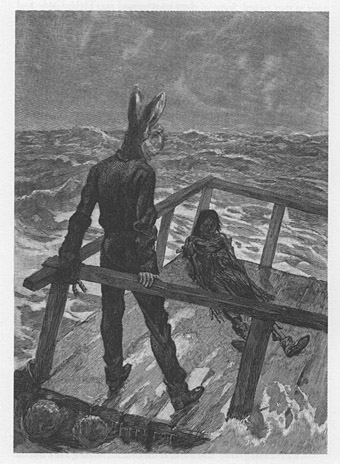
Rabbit Man with Skull Lady (1998) by Allan Kausch.

• “They were the first generation that said, ‘Fuck it, we’re not going to be intimidated.’ They weren’t going to make specifically pro-gay statements, but they were the first generation to really live that out. If you look at the Alternative Miss World, it’s a kind of gender-fuck, it’s almost like the English version of the Cockettes.” Jon Savage speaking in a piece by Alex Petridis about “Them” (Kevin Whitney, Luciana Martinez de la Rosa, Duggie Fields, Derek Jarman, Zandra Rhodes, Andrew Logan et al). Related: Andrew Logan in Andrew’s Adventures in Loganland.

• Sex, Satanism, Manson, Murder, and LSD: Kenneth Anger tells his tale. “Anger rarely if ever veers from the script as he is a man who has carefully controlled his myth and reputation for decades,” says Paul Gallagher.

• “Don’t even think about operating heavy machinery while listening to this mix.” The latest Dave Maier collection of recent ambient drift, drone-works and beatless atmospherics.

It is by no means easy to track or trace relationships between women, past or present. Women’s relationships with other women are often disguised: by well-documented marriages to men, by a cultural refusal to see what is in full view or even to believe such relationships exist. In a world built by and for men and their pursuits, a woman who loves women does not register—and is not registered, i.e., written down. Reasons for this layer one upon the other: A lesbian purposely hides her identity and remains closeted. A lesbian refuses to call herself a lesbian, disidentifying from the term and its associations for reasons personal or political. A woman does not know she is a lesbian—because she does not ever have a relationship with another woman, or because she is not aware that the relationships she engages in could be called lesbian. I didn’t call myself one for several years. Or, as in Carson’s case, her own self-understanding and identification are difficult to determine because of the efforts of those who outlived her and pushed her into the closet.

Jenn Shapland on the closeting of Carson McCullers

• At The Paris Review: The Collages of Max Ernst. Related: Kolaj: A directory of collage books.

Adam Scovell on the deathly hinterlands of Georges Franju’s Eyes without a Face.

• When Dorothy Parker got fired from Vanity Fair, by Jonathan Goldman.

• At Dennis Cooper’s: The Proto-Psychedelic Art of CG Jung’s Red Book.

• The abstract, single-stroke paintings of Daigoro Yonekura.

Adam Gopnik on the seriousness of George Steiner.

Caligula MMXX

The Ballad Of Dorothy Parker (1987) by Prince | Lotus Collage (1979) by Laraaji | Death Collage (1992) by Snakefinger & The Residents

The Last Ritual

sidor.jpg

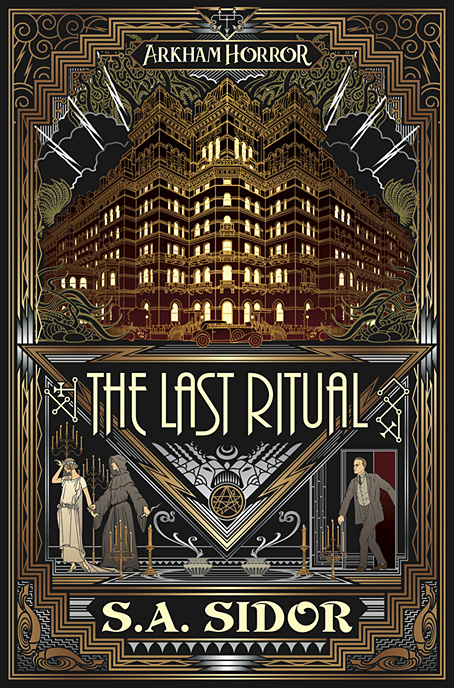
Starting the new year with a new cover, and another from the plethora I was working on last year. Art Deco occultism is the theme this time, a satisfying combination since the rectilinear Deco style is a good match for the sigils and thaumaturgic diagrams you find in grimoires. The publisher is Aconyte Books, a new imprint launched a year ago to produce novels that complement the games created by parent company, Asmodee UK. Arkham Horror is an Asmodee game with a Lovecraftian theme, and S.A. Sidor’s novel is set in the game’s world:

Aspiring painter Alden Oakes is invited to join a mysterious art commune in Arkham: the New Colony. When celebrated Spanish surrealist Juan Hugo Balthazarr visits the colony, Alden and the other artists quickly fall under his charismatic spell. Balthazarr throws a string of decadent parties for Arkham’s social elite, conjuring arcane illusions which blur the boundaries between nightmare and reality. Only slowly does Alden come to suspect that Balthazarr’s mock rituals are intended to break through those walls and free what lies beyond. Alden must act, but it might already be too late to save himself, let alone Arkham (more).

The design of the cover combines the look of much Art Deco metalwork, especially bronze door and grille designs, with the kind of inlay you see on Deco furniture and the more lavish leatherbound books of the period. Part of the brief was to show a magic ritual taking place but I thought it wouldn’t do to make the figures look too realistic, hence the stylised poses; George Barbier rather than Weird Tales. Another request in the brief was to incorporate the Yog-Sothoth sigil from the Simon Necronomicon (the bronze circle under the title). I think I’ve said before that the symbols in the Simon Necronomicon tend to be used a lot today as though they’re the only ones available, even though the book is only one of several unofficial attempts to imagine the contents of Lovecraft’s notorious grimoire. I’ve always favoured the George Hay-edited Necronomicon so the symbol at the top of the cover is the Yog-Sothoth sigil from the Hay volume.

The Last Ritual will be published in August 2020.

Elsewhere on { feuilleton }
The Lovecraft archive