Weekend links 641

coin.jpg

For mysterious and eldritch reasons the Republic of Palau has minted a Cthulhu-themed 20 dollar coin. Via.

• “Pre-gap tracks are a CD-specific phenomenon, paralleled only by DVD Easter Eggs, or hidden levels in a computer game. On the one hand, they’re only possible digitally, on the other, they seem to be an attempt to add some mystique to a circle of plastic.” Daryl Worthington on the 40th anniversary of the Digital Audio Compact Disc. Regular readers will know that CD has been, and remains, my favourite musical format for reasons I won’t bother arguing here. Related: Wikipedia’s list of albums with tracks hidden in the pregap. Also: “There’s endless choice, but you’re not listening”: fans quitting Spotify to save their love of music.

• “Meek’s use of sound effects and swathes of ghostly reverb, woven into seemingly innocuous pop songs and rock and roll instrumentals—as if the BBC Radiophonic Workshop was directed by Phil Spector—created a sense of the sublime and hinted at strange realities beyond our own.” Mark Pilkington explores the strange world of Joe Meek.

• “Structured as a ‘dream within a dream’, the narrative weaves together mythological, biblical, and occult references to construct a universe filled with ruinous landscapes and orgiastic celebrations.” Demetra Vogiatzaki on the enigmas, architectural and otherwise, presented by Hypnerotomachia Poliphili (1499).

The man who made this absurd noir was answerable neither to studio nor Shakespeare, but only his own monumental whims. Thus, Mr. Arkadin sends Citizen Kane (1941) through the looking glass—the action transposed to post–World War II Spain and given a spin somewhere between metaphysics and megalomania…

If Jean Cocteau’s Orpheus recast myth as pulp, Mr. Arkadin elevates pulp to myth. It is the most Borgesian of Welles’s movies. Writing in Cahiers du cinéma, the young Eric Rohmer compared Mr. Arkadin to Jules Verne and Fantômas: It creates something that is ­nearly impossible today: a romantic fiction that involves neither the future nor any removal from one’s usual surroundings…

J. Hoberman writing in 2006 about Orson Welles’ Mr. Arkadin (1955). I was rewatching the film earlier this week in its guise as Confidential Report, the version re-edited by its producer to try and create something with greater commercial appeal. I’ve yet to see the recent restoration but even in its butchered form it’s a fascinating piece of work

Early Cormac McCarthy interviews rediscovered: “Between 1968 and 1980, he gave at least 10 interviews to small local papers in Lexington, Kentucky and east Tennessee, a region where he lived and had friends.”

• New music: Perceptions by Model Alpha (Jonathan Fitoussi & Julie Freyri), and Epektasis by Nicklas Barker.

Dreams of Space: Books and Ephemera; “Non-fiction children’s space flight stuff 1945–1975”.

• At Dennis Cooper’s: Roget Malot presents…Spirit Photography Day.

• Mix of the week: A mix for The Wire by FOQL.

Spirit (1978) by Frédéric Mercier | Spirit (1990) by Jah Wobble’s Invaders Of The Heart | Spirit Level (Lost In Space) (1992) by Horizon 222


Weekend links 639

alphaville.jpg

Japanese poster for Alphaville (1965).

Peter Bogdanovich: I think we’d better have your thoughts on Godard.

Orson Welles: Well, since you’re so very firm about it. He’s the definitive influence if not really the first film artist of this last decade, and his gifts as a director are enormous. I just can’t take him very seriously as a thinker—and that’s where we seem to differ, because he does. His message is what he cares about these days, and, like most movie messages, it could be written on the head of a pin. But what’s so admirable about him is his marvellous contempt for the machinery of movies and even movies themselves—a kind of anarchistic, nihilistic contempt for the medium—which, when he’s at his best and most vigorous, is very exciting.

• RIP JLG. I was watching Alphaville again just two weeks ago after a DVD turned up in the local charity shop. Still the only Godard film I like 100% but “liking” seems beside the point. His influence today is everywhere, so fully absorbed into the language of cinema that people barely notice it.

• “The things that cause my gaze to linger are usually the portraits or landscapes that spark a feeling of unease, disquiet and discomfort. A shadow amongst the summer trees, a lurking silhouette reflected in a perfect blue iris, a vibrant flower in the early stages of decay.” S. Elizabeth talking to Beautiful Bizarre about her new book, The Art of Darkness: A Treasury of the Morbid, Melancholic and Macabre.

• Allow John Waters (again) to dictate your film viewing with a Letterboxd list of his favourite films, based on comments in his writings and interviews. On the subject of Godard, Waters’ Crackpot book contains a whole chapter about Hail Mary.

• Astor’s Electrical Future: Iwan Rhys Morus explores a vision of the year 2000 recounted in A Journey in Other Worlds (1894), a “scientific romance” by John Jacob Astor IV, with illustrations by Daniel Carter Beard.

• Strange Attractor has announced a Kickstarter campaign to fund the publication of an Austin Osman Spare Tarot deck.

• At Wormwoodiana: The Parrot, the Unicorn and the Golden Dragon: Some 17th Century Booksellers’ Signs.

• At Bandcamp: Andy Thomas on Chris Watson‘s post-Cabaret Voltaire career in nature recordings.

• A new outlet for cinematic obscurities: Radiance Films.

Alphaville (1978) by Klaus Schulze | Alphaville (1979) by The Monochrome Set | Alphaville (1999) by Scanner

Weekend links 636

frey.jpg

Untitled painting by Oliver Frey based on The Wild Boys by William Burroughs.

• RIP Oliver Frey, a prolific illustrator and comic artist whose art for UK computer magazines in the 1980s made a lasting impression on a generation of games players, hence this obituary at Eurogamer. On this site, however, Frey is also remembered for his artistic alter-ego “Zack” (previously), an equally prolific creator of comic-strip erotica for Britain’s few gay-porn mags at a time when any such material being sold in the UK ran the risk of police seizure or even a court appearance. For a while, Zack’s Rogue and Tom of Finland’s Kake were rare examples of assertive, unashamedly lustful gay characters with strips of their own, which makes Oliver Frey something of a pioneer, and a daring one at that.

• “The title characters were a trio of boys named Jupiter Jones, Pete Crenshaw, and Bob Andrews, who live in the fictional California town of Rocky Beach, not far from Hollywood, on the coast…” Colin Fleming on the satisfyingly spooky adventures of Robert Arthur Jr’s Three Investigators. I was never as obsessive as Fleming was but I read all of the books about the trio that I could find in our local library.

• “Though its inimitable visual style has safeguarded it as a quintessential cult film most at home behind a shroud of pot smoke, the influence of Koyaanisqatsi has been sweeping.” Josef Steen on 40 years of Godfrey Reggio’s Koyaanisqatsi.

• “Putting it simply, coincidences and curiosities and chance encounters happen when people go looking for zodiacs.” Mark Valentine on Britain’s terrestrial zodiacs.

• At Literary Hub: Marguerite Duras on writing the screenplay for Alain Resnais’s Hiroshima Mon Amour.

• New/old music: a reissue of Solar Maximum by Majeure.

• New music: Kerber Remixes by Yann Tiersen.

• At Dennis Cooper’s: Ingrid Caven Day.

• Threnody To The Victims Of Hiroshima (1959-61) by Krzysztof Penderecki | Memory Of Hiroshima (1973) by Stomu Yamash’ta | Hiroshima Mon Amour (1977) by Ultravox!

The Rejected Sorcerer

borges1.jpg

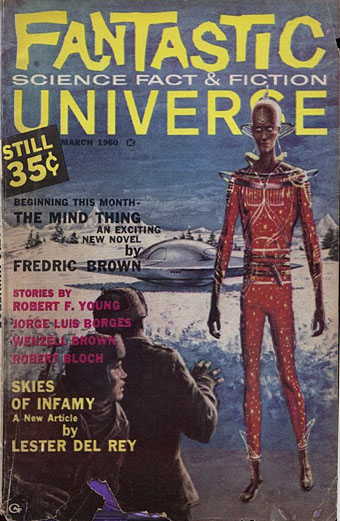
Cover art by Ed Emshwiller.

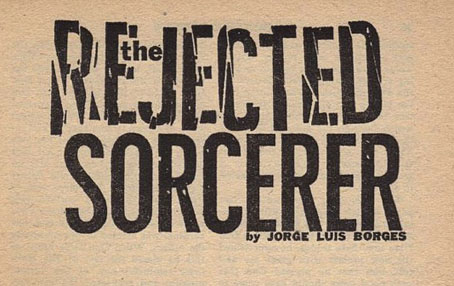
More Borges. While checking the details of yesterday’s post I discovered this oddity, an American SF magazine that published a two-page Borges story in March 1960, and put the author’s name on the cover even though few of the magazine’s readers would have heard of him at the time. The issue, which turned out to be the final one, lacks an editorial page so there’s no indication as to how the story found its way there. The story itself concerns an encounter in modern-day Spain between two men, one of them an established magician (in the occult sense), the other a neophyte hoping to gain similar powers. The piece is as much a moral fable as a work of fantasy, and as such appears out of place in a magazine with flying-saucer artwork on its exterior and a Virgil Finlay illustration inside (not for the Borges, unfortunately).

borges2.jpg

I thought at first that I might not have read this one before, the title wasn’t familiar but the story was one I recognised immediately. I was also surprised to find that I have it in four different collections under different titles, and with two of the printings appearing at first to disguise the author. In Black Water: An Anthology of Fantastic Literature (1983), edited by Alberto Manguel, the story appears as The Wizard Postponed, with the writer given as “Juan Manuel”; in The Book of Fantasy (1988), an updated version of the Antología de la Literatura Fantástica edited in 1940 by Borges, Adolfo Bioy Casares and Silvina Ocampo, the same piece appears as The Wizard Passed Over, with the author credited as “Don Juan Manuel”. The latter turns out to be the original author, a medieval Spanish writer, although “original” here is a debatable term when the story is Manuel’s adaptation of a piece he found in a book of Arabian tales. Borges rewrote this together with several other short reworkings which appear in the Etcetera section at the end of A Universal History of Infamy, its third appearance on my shelves (once again as The Wizard Postponed).

The fourth appearance is in the Collected Fictions (1998), or the cursed volume as I tend to think of it. I often feel bad about traducing the efforts of translator Andrew Hurley every time Borges is mentioned here but this story provides a good example of why his work is so unsatisfying to readers familiar with the stories from older editions. In its original Spanish the story is El brujo postergado, a short title for which The Wizard Postponed or The Wizard Passed Over would seem like reasonable analogues. Hurley expands this to The Wizard That Was Made to Wait, a lumbering, graceless phrase that’s typical of the lumbering gracelessness elsewhere in Collected Fictions. These tin-eared translations are the ones approved by the Borges estate so they’re present in all the reprints of the past 20 years. Fortunately for readers, most of Borges’ books were widely reprinted in English translations that the author approved, and some of which he even assisted with. Reject the conjurations of maladroit sorcerers, that’s my advice.

Previously on { feuilleton }
The Immortal by Jorge Luis Borges
Borges on Ulysses
Borges in the firing line
La Bibliothèque de Babel
Borges and the cats
Invasion, a film by Hugo Santiago
Spiderweb, a film by Paul Miller
The Library of Babel by Érik Desmazières
Books Borges never wrote
Borges and I
Borges documentary
Borges in Performance

Weekend links 626

conformist.jpg

Czech poster for Bernardo Bertolucci’s The Conformist. Art and design by Miroslav Pechánek, 1972.

• “Acknowledgements are not part of the novel; in fact, they break the spell the author has spent 200 or more pages weaving. We should take a book on its merits, knowing as little about the author as possible. As one reader put it to me, ‘the end of a book is time for thinking about the book, not for an acceptance speech’.” John Self on dedications and acknowledgements.

• Mixes of the week: a Power Ambient mix by A Strangely Isolated Place, and a mix for The Wire by Nexcyia.

• At Spoon & Tamago: 3D-scanned stones create vessel for human-made interventions.

Weeks turned into months. Slowly it dawned on me that I was performing the role of Boswell for a man who might be: a) a put-on maestro or arcane troll; b) a fiction writer slash performance artist; or c) a lunatic. But by his own admission King had tagged me with a familiar spirit. Whether or not he was telling the truth was irrelevant at this point. I could feel something squatting on my soul. I needed to see what it was.

Kent Russell on looking for demons in a disenchanted world

• A trailer for Mad God, Phil Tippett’s 30-years-in-the-making animated feature.

• New music: Vesta by Azu Tiwaline, and Right, Right, Right by Nils Frahm.

• At Dennis Cooper’s: Max Hattler Day.

• “Marcel Duchamp was not a thief.”

• RIP Jean-Louis Trintignant.

Demons Of Rage (1972) by Nik Raicevic | Shall Come Forth The Demons (1991?) by Yuri Morozov | Angels Of Darkness, Demons Of Light (2011) by Earth