Eco calls on Cthulhu

eco2.jpg

In which Umberto Eco nods fleetingly to the Cthulhu Mythos near the end of his second novel, Foucault’s Pendulum. I’d show you more of the relevant passage (below) but it’s rather spoilerish if you haven’t read the book. This turned up during a re-reading, my first since the novel appeared in paperback in 1990. A reference like this doesn’t stand out as much as it might elsewhere, not when the text that precedes it is stuffed to the gills with esoterica. Several hundred pages of occult history made me forget that Eco had hauled Lovecraft into his compendious fabulation along with everything else.

eco1.jpg

Ishmael Reed was responsible for returning me to Eco’s novel as a result of an earlier re-read of Mumbo Jumbo, Reed’s fictional account of voodoo, jazz, politics and many other things in the America of the 1920s. Eco was already in mind prior to this since I’d been working my way through his essays and lectures. (As I still am. He wrote a lot of the things.) Mumbo Jumbo‘s exploration of occult knowledge and occult conspiracy summoned vague memories of Foucault’s Pendulum, which made me realise that I didn’t remember very much at all about Eco’s novel even though both books share an interest in the tangled history of the Knights Templar. To the top of the pile it went.

It’s been interesting reading Eco’s novel again. For a start, it was funnier than I remembered, although this may be a result of my being much more familiar with the publishing business than I was in 1990. The story concerns a trio of men who work for a small publishing house in Milan, a division of which is devoted to the works of self-financing authors or “SFAs”. A vanity press in other words. A potential SFA turns up with a crank book rather similar to The Holy Blood and the Holy Grail, then abruptly disappears without collecting his manuscript. Curiosity, idleness and invention inspire the trio to improve upon the manuscript’s occult conspiracy in a manner that knits together just about every aspect of Western mysticism there is, and even some of the Eastern ones: Rosicrucianism, alchemy, the Kabbalah, Atlantis, the Illuminati, ley lines, the Hollow Earth, Stonehenge, etc, etc; it’s all in there. This is the thing they eventually call “the Plan”, a kind of Unified Field Theory of esoteric knowledge, and a contrivance whose fabrication is assisted by further SFA manuscripts arriving as candidates for a new line of “Hermetic” books. Problems arise for the publishers when their elaborate intellectual game ends up being taken for a serious revelation by a group of fanatical mystics. Eco’s novel demonstrates the pleasures of creative apophenia—the trio are continually challenging each other to fit a new piece of historical data into their scheme—while also acting as a warning that any halfway plausible Plan has the potential to be taken seriously by credulous cranks. As Lia, the novel’s voice of reason, says:

People are starved for plans. If you offer them one, they fall on it like a pack of wolves. You invent, and they’ll believe. It’s wrong to add to the inventings that already exist.

Eco explored this phenomenon more seriously in a later novel, The Prague Cemetery, which invents an author for the notorious Protocols of the Elders of Zion, a Plan whose conspiratorial claims continue to fuel anti-Semitism the world over. The internet has only accelerated Plan-construction, and I imagine Eco would have been simultaneously fascinated and appalled by the feeble imaginings of that ex-football player with the lizard obsession, and the shambling, frothing Q-mob with their Very Important jpegs. (What is it the latter are always saying? “Trust the Plan”… And having mentioned Mr Icke, I just put his name into Google only to find that the latest extract from his Twitter feed has him talking about the Holy Grail. Welcome to the Crank Zone.)

Continue reading “Eco calls on Cthulhu”

Weekend links 666

solar.jpg

Muy Mago (Portrait of Aleister Crowley) (1961) by Xul Solar.

• “…snails amaze with their capacity to move so far, to spread so widely, while doing so little. This, it seems to me, is one of the real marvels of snail biogeography. Individuals do not need to exert great effort because natural selection has acted for them, acted on them, acted with them, to produce these beings that are so unexpectedly but uniquely suited to a particular form of deep time travel, drifting. From such a perspective, rather than being any kind of deficiency, the highly successful passivity of snails might be seen as a remarkable evolutionary achievement.” Thom van Dooren on how snails cross vast oceans.

• “Slow art has layers. And this is why it requires time and effort. We should see this as a good and necessary thing. If this is a kind of obstacle in the way of easy assimilation then it is an obstacle that is integral to the value of the thing itself. The mind is calmed, or disturbed, or made exultant by the art that rewards us for our goodwill and our capacity to take our time.” In Praise of Slow Art by Chris Horner.

• “I have set naturalism and the supernatural in binary opposition but perhaps there is a third way. Let’s call it the supranatural stance…” Paul Broks explores the roots of coincidence.

• At Unquiet Things: The art of Hector Garrido, an illustrator who specialised in the Gothic staple of women in gowns fleeing at night from sinister mansions.

• “The writer Jorge Luis Borges once referred to his friend the artist Xul Solar as ‘one of the most singular events of our era’,” writes Miriam Basilio.

• At Spoon & Tamago: Japanese craftsmanship meets Pokemon at Kanazawa’s National Crafts Museum.

• At Public Domain Review: Martin Frobenius Ledermüller’s Microscopic Delights (1759–63).

• New music: Rest Of Life by Steve Roach.

The Four Horsemen (1972) by Aphrodite’s Child | Supper’s Ready (1972) by Genesis | Six Six Sixties (1979) by Throbbing Gristle

Gandalf’s Garden magazine

gandalf01.jpg

Issue One.

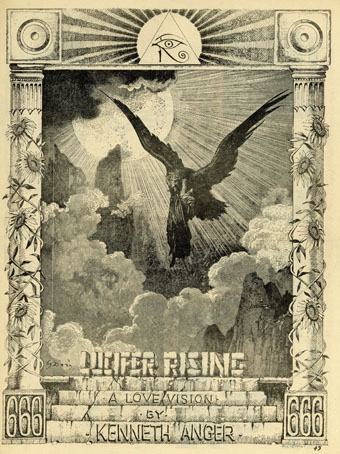
It’s taken a while but this short-lived underground magazine has finally been scanned and posted online. (It’s actually been available since 2019 but I only just discovered it.) Gandalf’s Garden was a small British publication, edited by Muz Murray, that preferred the definition “overground” to “underground”. Six issues were published in London from 1968 to 1969. There was also an affiliated shop of the same name situated in the World’s End area of Chelsea.

gandalf02.jpg

Issue Two.

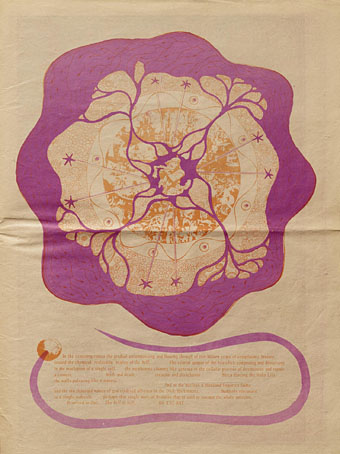
Having only seen a few sample pages before now it’s been good to look through the magazine’s entire run. The editorial attitude was very different to the often strident and aggressive Oz, with whom it shared a cover artist, John Hurford. Political revolution was a recurrent obsession in the pages of Oz—for some of the writers, anyway—and for a few months seemed like a tangible possibility following the events in Paris in May, 1968. The political stance of Gandalf’s Garden was more concerned with a revolution in the head, reflecting the philosophical side of hippy culture: Eastern religion, occultism, Earth mysteries and so on; issues four to six were subtitled “Mystical Scene Magazine”. The most well-known contributor was BBC radio DJ John Peel who wrote a short column for the first couple of issues, a reminder that the Peel public persona in the late 1960s was very different from the sardonic champion of all things punk ten years later. “Never trust a hippy” unless that hippy can make you famous by playing your singles on his radio show…

gandalf03.jpg

Issue Three.

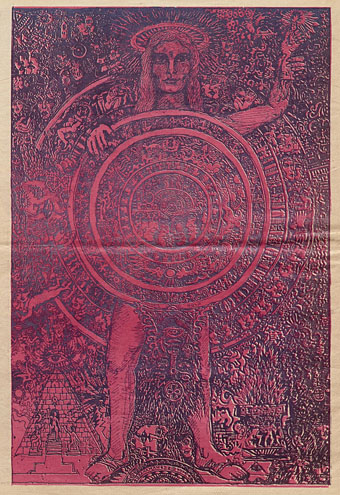
Peel doesn’t say much about music in his columns, but music was a staple subject of the underground mags, so Gandalf’s Garden has interviews with the Third Ear Band, Marc Bolan, The Soft Machine and Quintessence. Meanwhile, Donovan pops up in the letters page, sending the staff good wishes and his greetings to “Lemon” Peel.

gandalf04.jpg

Issue Four.

There’s also a letter from Brinsley Le Poer Trench, 8th Earl of Clancarty, asking to be put on the magazine’s mailing list. Trench was a notable flying-saucer obsessive (previously) who I expect would have enjoyed the features by Colin Bord about the UFO worshippers of the Aetherius Society, and the lost continent of Mu. I only found out recently that Bord began his writing and photography career in these pages (see this Wormwoodiana post which leads to this interview with Janet Bord). Janet and Colin Bord put together a series of popular guides in the 1970s and 80s to Britain’s mystic and mythic sites, good books on the whole if you approach them with a sceptical frame of mind. The Bords never ventured as far into the crankosphere as John Michell but they follow the Michell thesis about Alfred Watkins’ ley lines being channels of “Earth energy” rather than trading routes. (Archaeologists have never accepted any of these theories.) The readers of Gandalf’s Garden were the target audience for this kind of thing—issue four has a feature about Katharine Maltwood’s spurious but fascinating “Glastonbury Zodiac”—and sure enough there’s an ad for Michell’s landmark treatise, The View Over Atlantis, in the final issue. In this respect the magazine was probably ahead of its time, folding just as a wave of general interest in all manner of esoteric subjects was about to break. With better funding (and a replacement for its franchise-baiting title) Gandalf’s Garden might have found a niche as an early New Age publication.

gandalf05.jpg

Issue Five.

gandalf06.jpg

Issue Six.

Previously on { feuilleton }
Oz magazine online
The Trials of Oz
Early British Trackways
The art of John Hurford

Weekend links 664

warburton.jpg

Caduceus: Tarot Card Study – Love by Holly Warburton.

• The week in stage magic: Ken Carbone, writing about playing cards and graphic design, points the way to an hour of Ricky Jay demonstrating his miraculous abilities with a pack of cards. Elsewhere, Erik Ofgang asks “Who was Mr. Electrico, the sideshow magician who inspired Ray Bradbury—then vanished?”

The 1980 Floor Show – Uncut / Unedited: 8 Hours of David Bowie in Ziggy Stardust guise performing for American TV cameras at The Marquee, London, in October 1973. That’s more Bowie than most people would want—there’s a lot of repetition—but it’s good to know things like this can still surface.

• “A supernova has gone out,” says David Grundy about the late Wayne Shorter. Also this: “Sci-fi fan Shorter suggested the title to [Weather Report’s] second album I Sing The Body Electric, taken from Walt Whitman via Ray Bradbury.”

• “We need to get away from thinking of ourselves as machines… That metaphor is getting in the way of understanding living, wild cognition.” A long read by Amanda Gefter about the secret life of plants, and “4E” cognitive science.

• “…why take a soft approach to safety when you can scare the sensible into the next generation with some of the most effective horror shorts of all time?” Ryan Finnegan on the notorious PIFs (public information films) of the 1970s.

• “I am increasingly of the Lynchian mindset of ‘never explain’…” Lynda E. Rucker talking to Steven Duffy about her latest story collection, Now It’s Dark.

• James Balmont presents a brief introduction to the mind-altering cinema of Sogo Ishii.

• At Spoon & Tamago: Hidari: An epic wooden puppet samurai stop-motion film.

• Old music: Musique De Notre Temps (1976) by Éliane Radigue.

• Steven Heller’s font of the month is Juma.

Body Electric (1982) by The Sisters Of Mercy | Super-Electric (1991) by Stereolab | Electric Garden (Deep Jazz In The Garden Mix) (2013) by Juan Atkins & Moritz von Oswald

Parapsychology by Moebius

moebius04.jpg

I always enjoy seeing illustrations by Moebius but they haven’t always been easy to find, even today when his international popularity has grown but his comics still overshadow his work in other areas. La Parapsychologie et Vous, a book by Paule Salomon and Charlie Cooper, was published in 1980 and illustrated throughout by Moebius. According to a note by Jean-Marc Lofficier, Moebius had been introduced to Salomon by Jean-Paul Appel-Guéry, a French New-Age figure who I think may be the “guru” whose influence over Moebius in the 1980s is referred to rather scathingly by Jodorowsky in the Moebius Redux documentary.

moebius01.jpg

Whatever the circumstances that led to the commission, I love these illustrations which manage to honour the theme of the book while being typical products of their creator’s imagination. It’s also good to see further examples of Moebius adding screentone (aka Letratone or Zip-A-Tone) to his drawings. Moebius and Jodorowsky’s The Eyes of the Cat (1978) was created using the same technique, but elsewhere his black-and-white art is usually shaded by hand, if it’s shaded at all.

moebius09.jpg

All these illustrations are taken from Chaos (1991), a collection of Moebius illustrations and other one-off pieces which may be seen in full here. I’ve not seen a copy of La Parapsychologie et Vous so I can’t say whether this is a complete set of drawings; there’s at least one other picture, showing someone floating in a chair, that seems to be from the same series. In addition to book reprints, the drawings were also reprinted a few years ago as a portfolio set for collectors.

moebius07.jpg

Continue reading “Parapsychology by Moebius”