
Weekend links 739

burr.jpg

New Moon and Evening Star (c.1932) by George Elbert Burr.

• If you’re eager to see a physical copy of the forthcoming Moon and Serpent Bumper Book of Magic then Alan Moore World has screengrabs from a teaser video posted by US distributors Penguin/Random House to the social-media pit formerly known as Twitter. I’ve yet to receive a copy myself so I’m pleased to see the foil overlay on the cover looking as eye-catching as I’d hoped. Library Journal gave the book a starred review earlier this month.

• At Bandcamp: George Grella profiles Material, Bill Laswell’s long-running polycultural ensemble. Two of the albums on this list are all-time favourites of mine.

• Mix of the week: DreamScenes – August 2024 at AmbientBlog.

The Book of Sand by Jorge Luis Borges: A Hypertext.

• At Unquiet Things: Owls, Bats, and Moths in Art.

• At Dennis Cooper’s: Varvara Stepanova Day.

Jon Hopkins’ favourite music.

• RIP Gena Rowlands.

Desert Sands (1958) by Eugene LaMarr and His Magic Accordion | Grains Of Sand (1989) by Opal | Infinite Sands (1997) by Robert Henke

Weekend links 738

rossetti.jpg

How They Met Themselves (1860) by Dante Gabriel Rossetti.

• At Igloo magazine: Justin Patrick Moore interviews inventor and electronic music composer Don Slepian about his life and work.

• At The Washington Post (archived link): Michael Dirda in praise of weird fiction, horror tales and stories that unsettle us.

• At The Daily Heller: Tina Touli’s explosively twirling typography. Steven Heller’s font of the month is Doublethink.

• At Colossal: Dreams and memories form and dissipate in Tomohiro Inaba’s delicate iron sculptures.

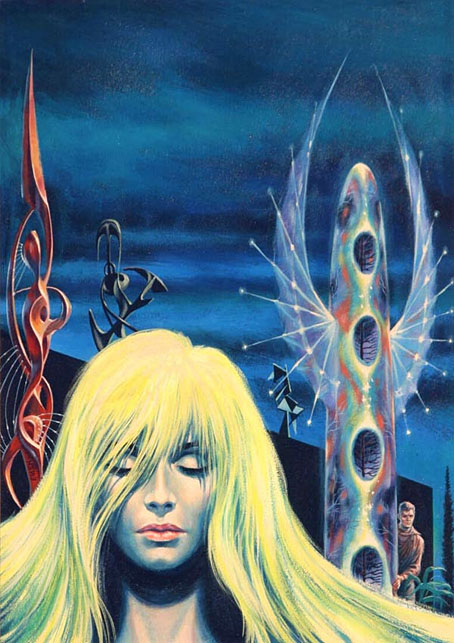
• At Unquiet Things: Jerome Podwil’s captivating cover art.

• New music: Strangeness Oscillation by 137.

• At Dennis Cooper’s: Craig Baldwin’s Day.

Brìghde Chaimbeul’s favourite albums.

Penguin Series Design

Double Image (1971) by Joe Zawinul | Double Flash (1999) by Leftfield | Double Rocker (2001) by Stereolab

Weekend links 737

pinkfloyd.jpg

The Massed Gadgets of Auximines – Pink Floyd – in stereo concert with the “Azimuth Co-ordinator”. Design by Hipgnosis, 1969.

• At Rond1900: Sander Bink explores the life of another obscure Dutch Symbolist, Léonard Sarluis (1874–1949): artist, friend of Oscar Wilde and lover of Alfred Jarry.

• At Spoon & Tamago: Manga artist Hirohiko Araki pays tribute to Osaka station’s history and culture with new public art sculpture.

• At Public Domain Review: Scenes of reading on the early portrait postcard by Melina Moe and Victoria Nebolsin.

• At Dennis Cooper’s: 33 films that either faked ingesting LSD or did.

• At Bandcamp: Blissful Noise, Bad Vibes: A Doomgaze Primer.

• Mix of the week: Azimuth Coordinator by Tarotplane.

• New music: Global Transport by Monolake.

• The Strange World of…Gay Disco.

Speak & Glitch

Postcard From Jamaica (1967) by Sopwith Camel | Postcards Of Scarborough (1970) by Michael Chapman | An Unsigned Postcard (1991) by Tuxedomoon

Weekend links 736

jupiter.jpg

South Polar Map of Jupiter by the Cassini spacecraft, 2000.

• “A ghostly train journey on a forgotten branch line transports a son, Jozef, visiting his dying Father in a remote Galician Sanatorium. Upon arrival Jozef finds the Sanatorium entirely moribund and run by a dubious Doctor Gotard who tells him that his father’s death, the death that has struck him in his country has not yet occurred, and that here they are always late by a certain interval of time of which the length cannot be defined. Jozef will come to realise that the Sanatorium is a floating world halfway between sleep and wakefulness and that time and events cannot be measured in any tangible form.” The Quay Brothers have finished their third feature film, Sanatorium Under the Sign of the Hourglass, a combination of live action and animation which is being premiered next month at the Venice film festival. No sign of a trailer as yet but the curious can prime themselves by watching (or rewatching) the Quays’ Street of Crocodiles—their first adaptation of Bruno Schulz—or Hourglass Sanatorium, the first screen adaptation of Schulz’s stories by Wojciech Has.

• “No one is sure when the tremendous whirl—the largest and longest-lived storm in our current solar system, with a diameter wider than planet Earth and wind speeds of more than 260 miles per hour—began. Or why it’s red. Or even who first observed it…” Katherine Harmon Courage on Jupiter’s Great Red Spot.

• New music: Bórdice by Nestor, and Nightfall by Trentemøller, the latter with a video swiping shots from Maya Deren’s Meshes of the Afternoon. Nice song but musicians really need to stop plundering independent film-makers when they want some visual embellishment.

• At The Daily Heller: Steven Heller talks to Drew Friedman about Friedman’s new book of caricatures, Schtick Figures.

• Mixes of the week: A mix for The Wire by Miaux, and Isolatedmix 127 by David Douglas & Applescal.

• DJ Food’s latest psychedelic trawl is a collection of book covers, puzzles, etc, designed by Peter Max.

• At Unquiet Things: Vic Prezio’s Gothic book covers.

• At Dennis Cooper’s: Morgan Fisher Day.

Jupiter (1990) by NASA Voyager Space Sounds | Jupiter! (Feed Your Head Mix) (1994) by System 7 | Jupiter Collision (2002) by Redshift

Weekend links 735

wyeth.jpg

The Adventure of the Giant Squid (c.1939) by NC Wyeth.

• Mix of the week is a superb XLR8R Podcast 860 by Kenneth James Gibson. Elsewhere there’s DreamScenes – July 2024 at Ambientblog, and Deep Breakfast Mix 267 at A Strangely Isolated Place.

• A trailer for a restored print of Time Masters (1982), the second animated feature by René Laloux, with character designs/decor by Moebius. Now do Gandahar.

• Coming soon from Strange Attractor: Music From Elsewhere: Haunting Tunes From Mythical Beings, Hidden Worlds, and Other Curious Sources by Doug Skinner.

Not only a prolific lyricist, Lovecraft considered his main vocation to be poetry. And at its best, his verse can be judged an apt expression of his philosophical vision, in which cosmic horror embodies the predicament of all sentient beings in a meaningless universe. That Lovecraft’s poetry never reaches the heights attained by such Modernists as T.S. Eliot or Ezra Pound should not diminish the fact that his is verse that, in the most archaic of ways, advances a startlingly modern metaphysic, a poetic encapsulation of what Thomas Ligotti in The Conspiracy Against the Human Race describes as an affirmation that the universe is a “place without sense, meaning, or value.” Lovecraft, with his antiquated prosody and his anti-human ethics, presented readers with a type of counter-modernist poetry. Ironically, he is the radical culmination of William Carlos Williams’s injunction of “No ideas but in things;” he is an author for whom there are only things. Graham Harman in Lovecraft and Philosophy describes Lovecraft as a “violently anti-idealist” who “laments the inability of mere language to depict the deep horrors his narrators confront.” Unpleasant stuff, for sure. It is verse that at best exemplifies something that controversial poet Frederik Seidel called for in the Paris Review: “Write beautifully what people don’t want to hear.”

Ed Simon on The Unlikely Verse of HP Lovecraft

• Among the new titles at Standard Ebooks, the home of free, high-quality, public-domain texts: The Case of Charles Dexter Ward, by HP Lovecraft.

• At Spoon & Tamago: An ethereal bubble emerges from a Japanese townhouse.

• New music: The Head As Form’d In The Crier’s Choir by Sarah Davachi.

Mabe Fratti’s favourite albums.

Bubble Rap (1972) by Can | Bubbles (1975) by Herbie Hancock | Reverse Bubble (2014) by Air