Opening the Seven Gates of Transcendental Consciousness

burchette1.jpg

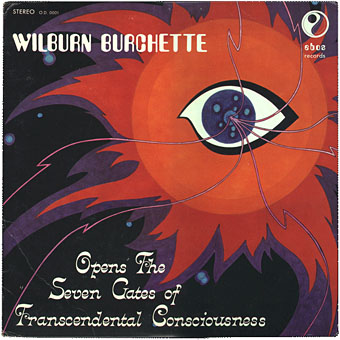
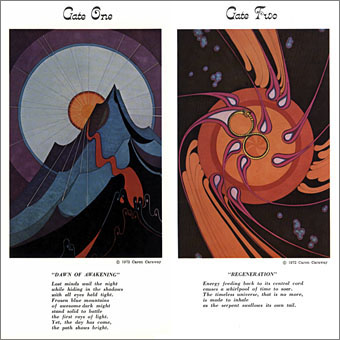
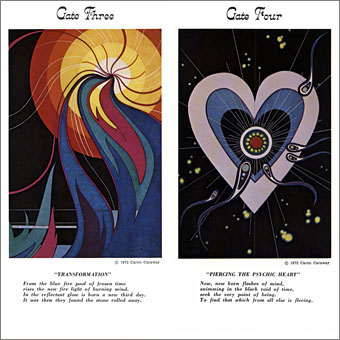
Wilburn Burchette Opens The Seven Gates Of Transcendental Consciousness (1972). Art by Caren Caraway.

For the next two weeks I’ll be playing out the end of the year with a 2-CD compilation from Light In The Attic, I Am The Center (Private Issue New Age Music In America, 1950–1990), 20 tracks of ambient/meditation music, most of which has never been widely distributed before. The “New Age” label is a thing I’ve loathed for years so buying this has meant trashing a decades-long embargo; it helps to examine your prejudices now and then.

burchette2.jpg

New Age in the 1970s referred, among other things, to the oft-promised, seldom-evident “Age of Aquarius”, a term vague enough to be used on albums by Steve Hillage, Manuel Göttsching and others without referring to anything specific. In the 1980s it was taken up by publishers as a marketing label, a catch-all for anything “spiritual” or mildly occult. (I can’t imagine the Goetic Demons ever being called New Age, even if you sprayed them pink.) Out went all the witchy strangeness of the occult boom of the 1970s—spiky typefaces, magical primers sold like Dennis Wheatley novels—in came a profusion of pastel shades, airbrushed pyramids and sparkly, crystal things. Having a fondness for the witchy strangeness I wasn’t impressed. I was even less impressed when New Age became a prevalent label for a style of instrumental music which was too obtrusive to be ambient (in the Brian Eno sense of the word), and also too bland and unassertive to be either jazz or electronica. The popularity of labels such as Windham Hill meant that the large record chains started using New Age as another catch-all label, this time for anything that wouldn’t fit the rock, jazz or folk categories. Along with Windham Hill releases you’d find Eno’s ambient recordings, Harold Budd, Jon Hassell, various German things like Cluster, and anything else that resisted easy labelling. The way the music business tries to hammer everything into a small number of boxes has always been annoying but this seemed like a major insult, hence my loathing of the term.

burchette3.jpg

I Am The Center is a curious album in that it embraces both the recent New Age music label while also harking back to the spiritual yearnings of the 1970s. The general effect is of an impossible collision between the Harold Budd of Pavilion of Dreams, Steve Hillage’s Rainbow Dome Musick, and the lighter moments of Alice Coltrane. Many of the tracks are so good I’ve been searching through Discogs.com to discover more about the artists which is how I came across this album art from Wilburn Burchette. Witch’s Will is Burchette’s track on I Am The Center, from his Guitar Grimoire (1973) album. Looking through his discography, with its attention-grabbing titles and cover art, it’s surprising that his albums haven’t yet been reissued. This will no doubt change soon, especially when his music is like an American equivalent of Achim Reichel’s spacey guitar improvisations. The sleeve and booklet art for Wilburn Burchette Opens The Seven Gates Of Transcendental Consciousness is by Caren Caraway, and the album features notes by the indefatigable UFO/paranormal researcher Brad Steiger. They really don’t make them like this any more.

Joe Muggs enthused about I Am The Center last month for FACT. As I said about the Outer Church album earlier this year, compilations provide an invaluable service in concentrating the attention on overlooked or under-examined areas of music. I’m looking forward to seeing what emerges in the wake of this one.

Continue reading “Opening the Seven Gates of Transcendental Consciousness”

Weekend links 190

lipton.jpg

Seam Stress (1987) by Laurie LiptonThe Drawings of Laurie Lipton is out now from Last Gasp.

• The Quietus continues to be essential reading: John Doran talks to Richard H Kirk about Cabaret Voltaire | Sarah Angliss, musician and inventor of music machines, talks to Stuart Huggett | “…the most overt literary lodestar for The Art Of Falling Apart is John Rechy, trailblazing chronicler of the gay underbelly of hustlers and queens zig-zagging across America, and author of Numbers, the book from which Soft Cell’s song takes its name.” Matthew Lindsay looks back at Soft Cell’s second (and best) album.

• “The English have something of a tradition where they like to scare you out of your mind at Christmas, a kind of sobering up of the senses by forces that seem to be beyond them.” Colin Fleming on The Signal-Man by Charles Dickens. More ghosts: Lisa Kerrigan explains why she loves Nigel Kneale’s 1989 TV adaptation of The Woman in Black by Susan Hill, and the BFI resurrects The Mistletoe Bough (1904), “the oldest film version of a classic Christmas ghost story”.

• “…the story is filled with a whole mess of embarrassed and embarrassing euphemisms for (ahem) big dick—stiff language, so to speak, like ‘bludgeon,’ like ‘giant concupiscence’ and ‘ostentatious organ.'” Steven Cordova on A Visit to Priapus and Other Stories by Glenway Wescott.

• “Never produced, the screenplay for The Way to Santiago is credited to Orson Welles. A quick look at the text leaves no doubt it was the work of the Citizen Kane filmmaker when he was at the peak of his arrogant brilliance. The script begins: ‘My face fills the frame.'”

• If you’re at all interested in the current state of the British musical underground, the end-of-year lists at Ears For Eyes are worth your attention.

Pee-wee’s (Remastered) Christmas Adventure: An interview with Paul Reubens. Related: Grace Jones sings Little Drummer Boy for Pee-wee.

• “I’m like a drag queen at Halloween.” John Waters on his favourite time of year: Christmas.

• Mix of the week: Secret Thirteen Mix 099, an “(anti)Christmas mix” by Robert Curgenven.

• The British Library makes over a million free-to-use images available at Flickr Commons.

• Lost in Translation: Notes on adapting Ballard by Calum Marsh.

MR James at Pinterest.

Book Map by Dorothy.

Martin (1983) by Soft Cell | Ghost Talk (1985) by Cabaret Voltaire | For Laika (2011) by Spacedog

Weekend links 188

blackwell.jpg

The Baron in the Trees (2011), a book-cut sculpture by Su Blackwell.

Kurt Andersen at Vanity Fair examines the latest claims that Vermeer used a combination of lenses and mirrors to aid the creation of his remarkable paintings. David Hockney caused a considerable fuss in 2006 when he made similar assertions. Andersen recounts how Tim Jenison (who isn’t an artist) decided to test the hypothesis by building a replica of the room from Vermeer’s The Music Lesson (1662–65) which he then painted with the assistance of a lens-and-mirror apparatus. I’m agnostic on this issue, and don’t regard it as a devaluing of the work of Vermeer (or any other artist) if some special apparatus was used to help create the paintings; artists for centuries have been using whatever technology was available.

One point which isn’t mentioned in the article: lens optics were being developed to a high standard in the Netherlands during Vermeer’s time. One of the developers of the microscope, Antonie van Leeuwenhoek, was a contemporary of Vermeer’s in Delft, and is even alleged to be portrayed in some of the artist’s paintings.

• Before Alfred Hitchcock’s film and Daphne Du Maurier’s short story, The Birds was an “eerie yet satirical and rather metaphysical novel” by Frank Baker, inspired in part by Arthur Machen. Michael Dirda reviews a new edition. Related: “The Day of the Claw: A Synoptic Account of Alfred Hitchcock’s The Birds“, an essay by Ken Mogg examining avian menace through the ages.

Kevin Brownlow and Carl Davis on how they brought Abel Gance’s 270-minute silent masterwork, Napoleon (1927), back to the screen.

Finally, he was asked about the growth of surveillance and the militarization of the police.

“The phenomenon itself shouldn’t be surprising—the scale was surprising—but the phenomenon itself is as American as apple pie,” Chomsky said. “You can be confident that any system of power is going to use technology against its enemy: the population. Power systems seek short-term domination and control, not security.”

Matthew Robare on “American Anarchist” Noam Chomsky in (of all places) The American Conservative.

• “Why the hell wouldn’t I?” Evan J. Peterson on reading/performing his poetry in public, and his new book, The Midnight Channel.

The adversaria of Google Books: captured mark of the hand and digitization as rephotography.

• No surprise that the rabies-haunted town of Scarfolk is soon to have its history fixed in print.

Mazzy Star made a rare TV appearance last week, playing a song from their recent album.

The Sorcerer Blog is obsessively devoted to William Friedkin’s cult film.

• Unexpected Artefacts: Pushing the envelope with Bristol’s Emptyset.

• Mix of the week: Secret Thirteen Mix 097 by Lee Gamble.

• At PingMag: Ryokudo—Tokyo’s Green Roads.

Norman Records’ Top 50 albums of 2013.

Birds Of Fire (1973) by Mahavishnu Orchestra | Attack Of The Killer Birds (2006) by Émilie Simon | One Thousand Birds (2012) by Six Organs of Admittance

Weekend links 187

delia.jpg

Delia Derbyshire (2007) by Iker Spozio.

Whatever you think of Doctor Who, Delia Derbyshire’s recording of Ron Grainer’s theme tune is a landmark piece of electronic music. Those glassy electronic tones still sound unique today, not least for their having been created using rudimentary oscillators and much laborious tape editing. In Radiophonic Workshop: the shadowy pioneers of electronic sound, Joe Muggs looks at the history of the BBC’s electronic composers. If you’re a Radiophonic-head then the Alchemists of Sound TV documentary from 2003 is essential viewing.

There’s more (there’s always more): Delia Derbyshire – Sculptress of Sound: part one of a seven-part radio documentary about the great electronic music composer, and Blue Veils and Golden Sands, Martyn Wade’s radio play about Delia. Related: Delia-Derbyshire.org, Delia Derbyshire: An audiological chronology and A History of the Doctor Who theme. And don’t miss: Silence Is Requested In The Ultimate Abyss (1969) by Welfare State and White Noise, an incredible slice of electro-psychedelia from the John Peel Presents Top Gear album.

• “Why don’t books for grown-ups have illustrations any more?” asks Christopher Howse. Some of them do, this past week I’ve been finishing a new series of illustrations for a story anthology.

• From 2006: Ian Penman on cigarettes, espionage, and the masterful (and superior) television adaptation of Tinker, Tailor, Soldier, Spy.

It was Malcolm [McLaren] who suggested that the main characters be a boy who looks like a girl who looks like a boy and vice versa. What was strange was that, actually, in 1985 this was nobody’s vision of the fashion industry. Since then, fashion and fascism have crept closer: you’ve got John Galliano doing his promotional bits for the Third Reich, you’ve got Alexander McQueen killing himself, you’ve got Versace and that horrible, violent stalker coming for him. Since it was written, almost all of it has come true apart from the nuclear winter, but I think we’re working on that. The actual society that the story happens in is much more like the society we have now than culture was in 1985.

Alan Moore on Fashion Beast, Situationism, and why he hates superheroes.

• KW Jeter talks about his latest novel, Fiendish Schemes, and the “cultural juggernaut” that is steampunk.

• Grit and Social Dynamics in Smoke Ghost: Elwin Cotman on the weird fiction of Fritz Leiber.

The Secret Lives of the Vatican’s Gay Cardinals, Monks, and Other Clergy Members.

Don Cherry & Organic Music Theatre, live in the RAI TV studios, 1976.

• Otherworldly Art and Photography: Mlle Ghoul finds the best things.

• From 1998: Rahma Khazam on composer Bernard Parmegiani.

• Mix of the week: Marshland: The Mix by Hackneymarshman.

• “Let’s colonize the clouds of Venus,” says Ian Steadman.

J. Hoberman on David Cronenberg’s Visual Shock.

The Delian Mode (1968) by Delia Derbyshire | Tom Baker (1981) by The Human League | Doctor Who? (1984) by Doctor Pablo & The Dub Syndicate

L’Araignéléphant

kamler.jpg

L’Araignéléphant (1967) is another of the strange animations made by Piotr Kamler in the 1960s and 1970s, this one being a 9-minute piece concerning the travails of “the spiderelephant”. As with Kamler’s Le labyrinthe, the music is by the French electroacoustic composer Bernard Parmegiani whose death was announced this week, hence the link. Parmegiani had a varied career which included scores for a number of other films (among them a Jan Lenica short, A, which I’ve not been able to find), and more commercial music than people at his serious end of the composition scale usually produce.

Ubuweb has a selection of Parmegiani’s longer compositions, one of which, Pop’eclectic (1969–1973), chops up pop and classical recordings (spot the Small Faces!) in a manner which would become commonplace a decade or so later with the advent of sampling. The Kamler films, meanwhile, are all available on a single DVD where the narration for L’Araignéléphant—which doesn’t explain very much—is subtitled.

Previously on { feuilleton }
Psyché Rock
Le labyrinthe and Coeur de secours
Chronopolis by Piotr Kamler