Kenneth Grant, 1924–2011

grant.jpg

Kenneth Grant by Austin Spare (c. 1951).

Kenneth Grant, writer and occultist, died last month but the event was only announced this week. He’ll be remembered for the nine fascinating occult treatises he wrote from 1972 to 2002, and for continuing the work of Aleister Crowley as head of the Ordo Templi Orientis, a position which became fraught in later years as various occult factions disputed his authority. Having collected occult books for much of the 1980s I find his name calls out from the shelves more than many other writers; as well as authoring his own works he edited all the major Crowley texts with Crowley’s executor John Symonds, presenting them in authoritative editions for a new readership.

Grant proved a very loyal champion of people he admired, significantly so in the case of Austin Osman Spare whose work he collected, exhibited and republished from the 1950s on. It was Grant’s position as one of the many advisors for Man, Myth & Magic in 1970 which resulted in the part-work encyclopedia using one of Spare’s stunning drawings as the cover picture for its first issue. That effort alone gave Spare an audience far beyond anything he received during his lifetime, and Grant ensured the magazine featured Spare’s work in subsequent issues. Grant’s occult works made liberal use of unique illustrations by his wife, Steffi Grant, Austin Spare and others. The books were singular enough even without their pages of curious artwork, a beguiling and sometimes incoherent blend of western occult tradition, tantric sex magick and hints of cosmic horror which were nevertheless always well-written, annotated and crammed with technical detail. Alan Moore in 2002 examined the experience of an immersion in Grant’s mythos with a wonderful review he called “Beyond our Ken“. He notes there the influence of HP Lovecraft, another of the visionary figures who Grant championed throughout his life.
between.jpg

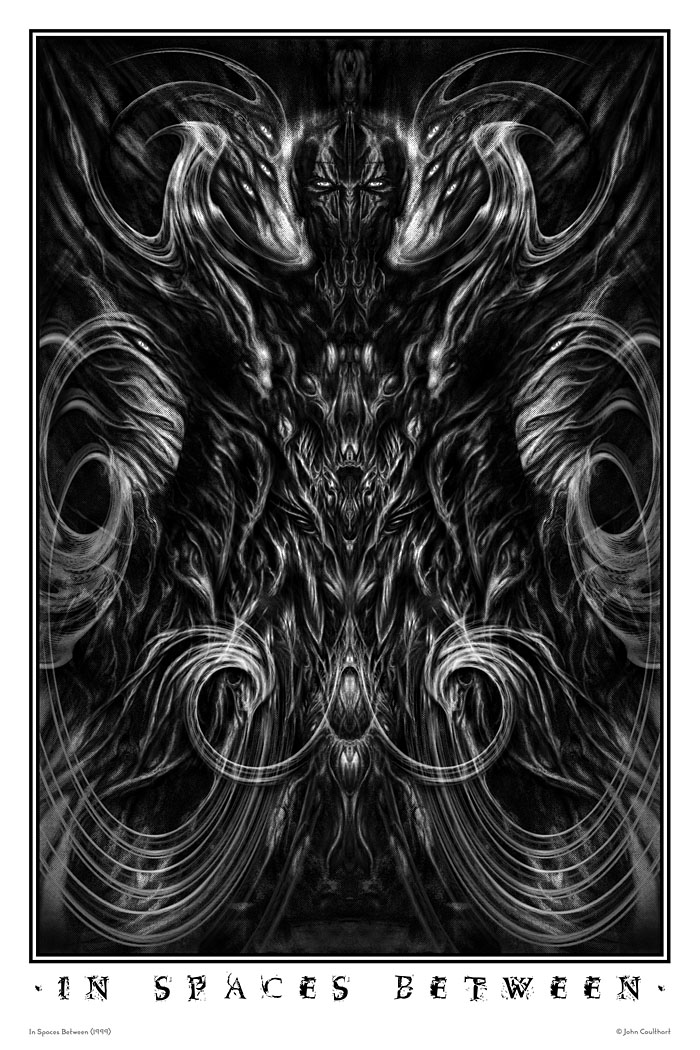
In Spaces Between from The Great Old Ones (1999).

And speaking of Lovecraft, I’ve often wondered whether Kenneth Grant ever saw a copy of my Haunter of the Dark collection. For the opening of the Great Old Ones Kabbalah sequence which Alan Moore and I created for the book I added an extra piece of art entitled In Spaces Between, a reference to Coil via an epigraph from Grant’s Outside the Circles of Time (1980) which I borrowed for the facing page:

For there are Thrones under ground
And the Monarchs upon them
Reign over Space and Beyond

Invoke Them in Darkness, Outside
The Circles of Time

In Silence, in Sleep, in Conjurations
Of Chaos, the Deep will respond…

Coil aficionados will recognise those words as the origin of some lines from Titan Arch (1991):

There are Thrones under ground
And Monarchs upon them
They walk serene
In spaces between

Grant followed his epigraph with another quote, from Lovecraft’s Necronomicon.

In addition to Alan Moore’s Grant review, Fulgur have a detailed Kenneth Grant bibliography on their pages. They were also the publishers in 1998 of Zos Speaks! Encounters with Austin Osman Spare by Kenneth and Steffi Grant, a memoir and celebration of Spare’s work which revealed this trio of remote astral voyagers to be human beings after all. The book is currently out of print but it’s essential for anyone interested in Austin Spare or, for that matter, Mr and Mrs Grant.

Previously on { feuilleton }
• New Austin Spare grimoires
• Austin Spare absinthe
• Aleister Crowley on vinyl
• Austin Spare’s Behind the Veil
• Austin Osman Spare
Deutsche Kunst und Dekoration #5

dkd05-01.jpg

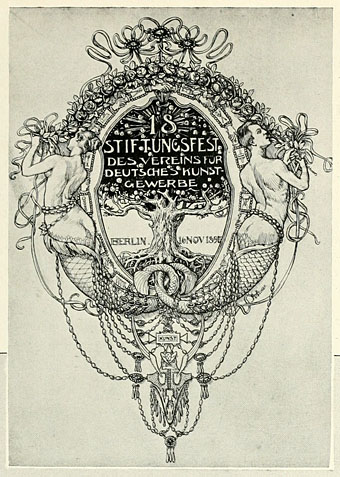
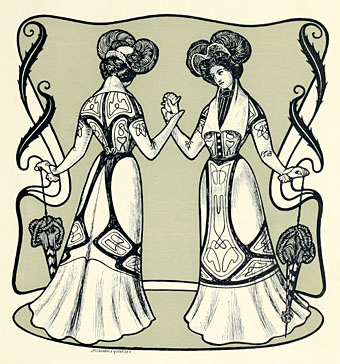
Continuing the delve into back numbers of Deutsche Kunst und Dekoration, the German periodical of art and decoration. Volume 5 covers the period from October 1899 to March 1900, and the Art Nouveau style is in full flower at this point, as it was across most of Europe. This is also the place at which the journal becomes so laden with impressive design work that it’s impossible to easily do justice to over 300 pages of contents. Anyone wanting to see more is encouraged to download the whole thing as either page scans or a PDF. As before I’ve tended to concentrate on the graphic material but this issue also features more lavish interior designs, a range of jewellery, and ponderous monumental architecture including proposals for some of Germany’s many Bismarck Towers. Examples follow below. There’ll be more DK&D next week when we take a trip to the Exposition Universelle in Paris.

dkd05-02.jpg

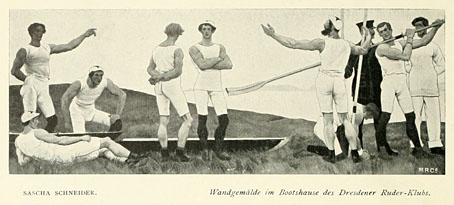
Sascha Schneider was Karl May’s favourite illustrator and one of the few openly gay artists in Germany at the time. He’s represented here with a small feature on his paintings among which there’s this depiction of a team of strapping oarsmen.

dkd05-03.jpg

Continue reading “Deutsche Kunst und Dekoration #5”

Deutsche Kunst und Dekoration #4

dkd04-01.jpg

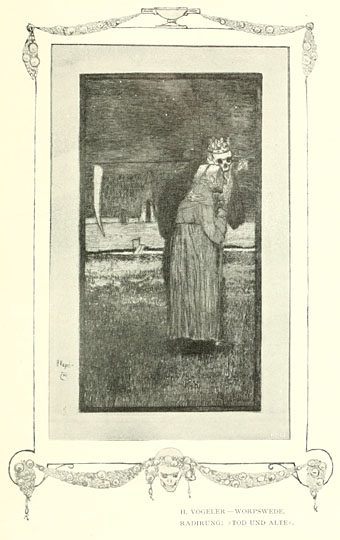
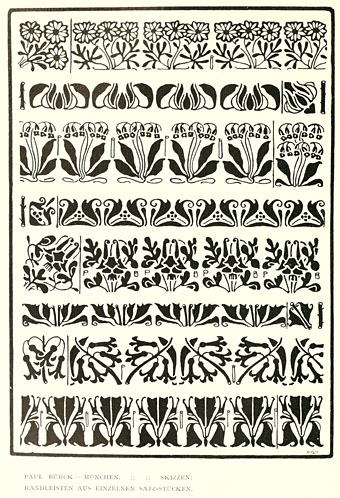
Continuing the delve into back numbers of Deutsche Kunst und Dekoration, the German periodical of art and decoration. There isn’t a volume 3 in the Internet Archive collection, hence the jump in the series to volume 4 which covers the period from April–September 1899. This edition features a few more familiar names beginning with artist and illustrator Heinrich Vogeler whose illustrated edition of Oscar Wilde stories was featured here last year. Vogeler’s work isn’t always to my taste although I liked his Wilde drawings; the Tod und Alte piece above is an exception to his usual work of this period rather than the rule. Elsewhere there’s a feature on the graphic designs of Paul Bürck, a profile of Dutch Symbolist Jan Toorop and a report on the Dresden art exhibition of 1899 which includes an array of beautiful Art Nouveau interiors. As with all such idealised exhibition displays, they point the way to a future that was never to be.

More DK&D next week.

dkd04-02.jpg

dkd04-03.jpg

Continue reading “Deutsche Kunst und Dekoration #4”

Passage 14

passage14.jpg

It’s that time of year again when my good friend Ed Jansen unveils the latest edition of Passage, his Dutch-language webzine:

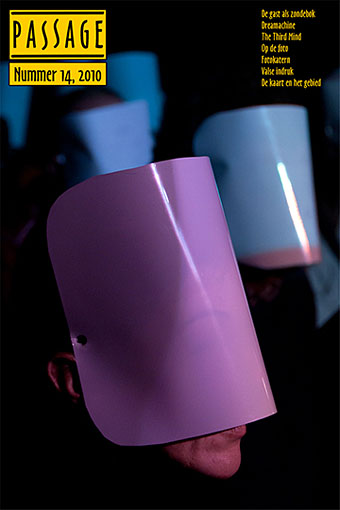
The 14th issue of Passage contains articles about language, the dreamachine of Brion Gysin, the collaboration of Gysin with William Burroughs and Ian Sommerville (The Third Mind), a recently discovered photograph of Arthur Rimbaud’s presence in Aden, lots of photos of exhibitions and performances of artists in and around The Hague, about the experiences of Louis-Ferdinand Céline in the First World War and the latest novel of Michel Houellebecq. The purpose behind everything we write and make is to give the reader a sense of direction towards the unknown, towards the North-West Passage that leads to a new world.

The cover picture is a photo of the audience at a Dreamachine-inspired presentation by Matthijs Munnik about which we’re told:

In my performance I also make use of the flicker effect, but I have more control over it. In my performance, the audience wears white plastic masks, this way they look into a ganzfeld, a totally white field during the performance. In my set up, I use beamers, projecting light on the audience’s masks, completely immersing them in the light and colors of the projection.

I play an 8 minute live composition, based on the varying effects of different frequencies of flicker, colour, binaural beats and sound. During the performance every spectator will see something different, varying patterns and colours, created within their own brains.

And speaking of the Dreamachine, Nick Hydra left a comment in an earlier post with the news that visitors to the Wellcome Collection’s High Society exhibition in London have the opportunity to trip out with one of Brion Gysin’s flicker machines until the end of February.

Previously on { feuilleton }
• Brion Gysin let the mice in
• Passage 13
• Passage 12
• Passage 11
• Passage 10

Weekend links 43

broadcast.jpg

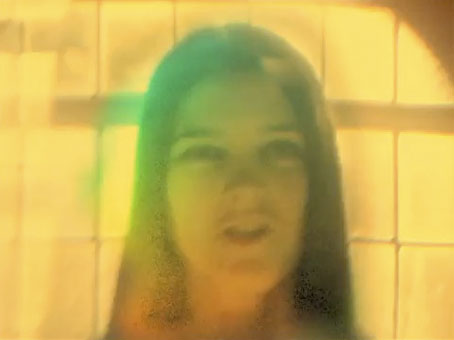
From the video for I See, So I See So by Broadcast.

• RIP Trish Keenan of Broadcast. Tributes here and here. The Broadcast/Focus Group collaboration …investigate Witch Cults of the Radio Age was The Wire‘s album of the year for 2009. Joseph Stannard interviewed Trish Keenan and James Cargill in October of that year.

• Who Knows What Tomorrow Might Bring, a new pay-what-you-please Arthur mixtape. Also at Arthur, Sunday Lectures by Freeman House here, here, here and here.

• Cormac McCarthy’s description of American pioneers in Suttree (1979) kept coming to mind during the past week:

Where hunters and woodcutters once slept in their boots by the dying light of their thousand fires and went on, old teutonic forebears with eyes incandesced by the visionary light of a massive rapacity, wave on wave of the violent and the insane, their brains stoked with spoorless analogues of all that was, lean aryans with their abrogate semitic chapbook reenacting the dramas and parables therein and mindless and pale with a longing that nothing save dark’s total restitution could appease.

• Born This Way: “A photo/essay project for gay viewers (male and female) to submit pictures from their childhood (roughly ages 4 to 14), with snapshots that capture them, innocently, showing the beginnings of their innate LGBT selves. It’s nature, not nurture!”

• Mischievous street art characters. Chris Marker wouldn’t want us to forget Monsieur Chat. Speaking of Chris Marker, there’s Plato’s Cave as Kino: Owl’s Legacy Excerpt & Becoming Imperceptible.

With the point of a knife Dr. LeBaron took from the little round box a small quantity of a dark, greenish-colored gum, which, as it was passed from one to another for inspection, gave off an agreeable, aromatic odor. Then, as he was engaged in filling two capsules from the box, he explained:

“As le docteur read from ze book of Monsieur Richet, ze favoreet méthode in ze Orient ees to take ze Haschisch by ze smoke in ze Persian pipe—ze hookah, ze nargileh. But zey also take eet in ze great varieté. Ze principal kind zat come to ze market of Europe, ees zat I show you—ze Haschisch, an’ ve take eet like ze dose of quinine,” said he, as he handed a well-filled capsule to both Smith and Arnold.

Throwing back his head, Smith bolted his dose without ceremony, and Arnold immediately followed his example.

Haschisch: A Novel (1886) by Thorold King. Related: Haschisch Hallucinations (1905) by HE Gowers.

• Dan Hill’s personal report from the drowned world of Brisbane. Related: Hayley Campbell recalls swimming in the city’s hazardous floodwaters when she was a wild child. Also: Canoeing in McDonald’s.

• Cabinet Card Backmarks, florid advertisements from Victorian cabinet photos. Callum James made a post on the subject in 2008 and has a Flickr set showing his discoveries.

• The Brothers Quay made a public information film about AIDS in 1996. (Now deleted from YouTube…boo!)

• The secret stories of book inscriptions. Related: The Book Inscriptions Project.

• Ani, Turkey: City of 1001 Churches, all of them abandoned and ruined.

• Vulgar Army: Octopus in Propaganda and Political Cartoons.

• Designer John Gall makes collages in his spare time.

• Phantasmaphile at Tumblr.

• Witch Cults and I See, So I See So, both by Broadcast & The Focus Group.