Tony Grubhofer’s Exposition Universelle sketches

grubhofer01.jpg

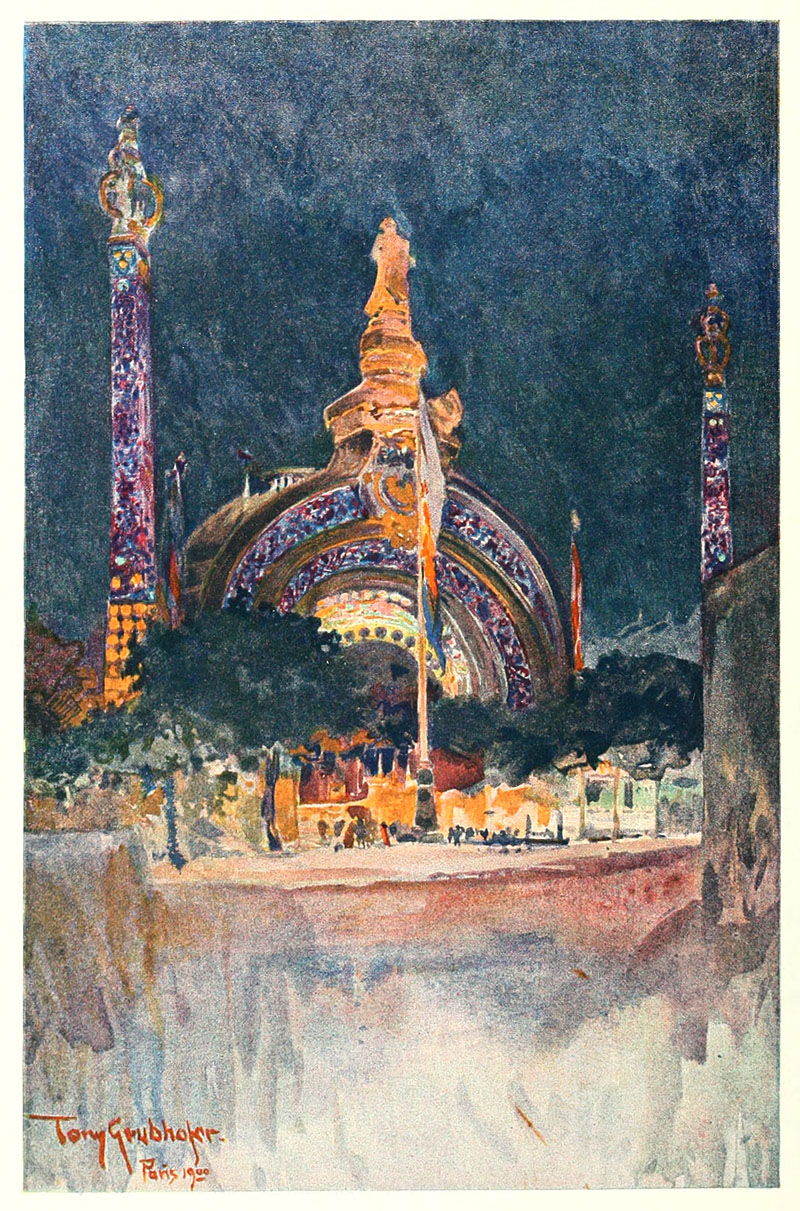
The Exposition gateway.

In a blizzard of work this month I finished another project with a Victorian theme (not more Steampunk!) which I won’t reveal just yet as I dislike spoiling the surprise for publishers. Part of the preparation involved yet more trawling through scanned volumes at the Internet Archive, looking this time at British art magazines from the 1890s. As with the German magazines of the period, some of these are more interesting than others: The Magazine of Art, for example, has its moments but for the most part it’s a champion of the stodgily dull, conservative fare which no one would ever want to revive today. Their columnists also hated the Decadents; I found a wonderful rant against Aubrey Beardsley’s art from 1897 which suggested that the artist and others like him ought to stop poisoning the soul of the nation and emigrate to France. Poor Aubrey only had a year to live, and, as things turned out, ending up dying in that iniquitous nation. I think it’s fair to say he’s had the last laugh.

grubhofer02.jpg

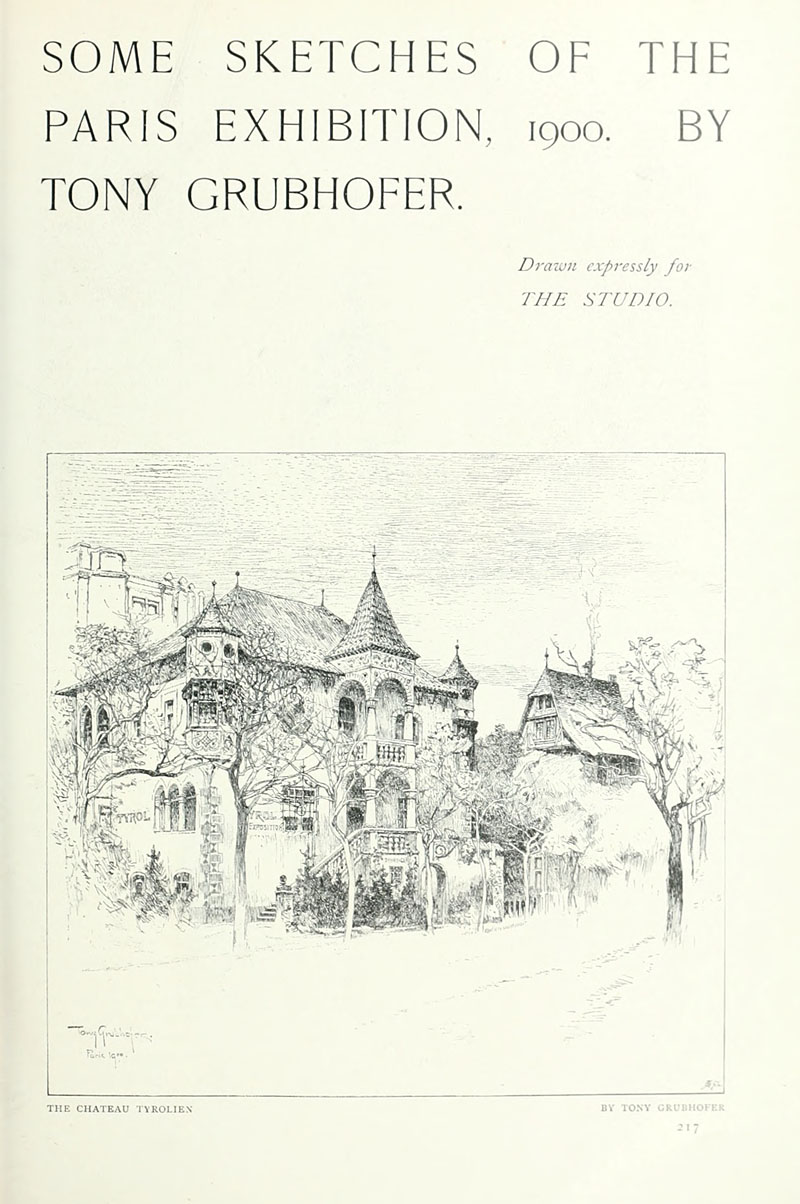
The Chateau Tyrolien.

The Studio magazine, on the other hand, was very sympathetic to the Decadents and Symbolists in general, and to Beardsley in particular, who had his work featured in the first number of the magazine in 1893. The drawings in this post are a surprise find in one of the numbers for 1900, and concern that locus of everything The Magazine of Art loathed: Paris! We’re back again at the Exposition Universelle, a subject which has been explored here on so many occasions I’m surprised I keep finding anything new that’s worthy of mention.

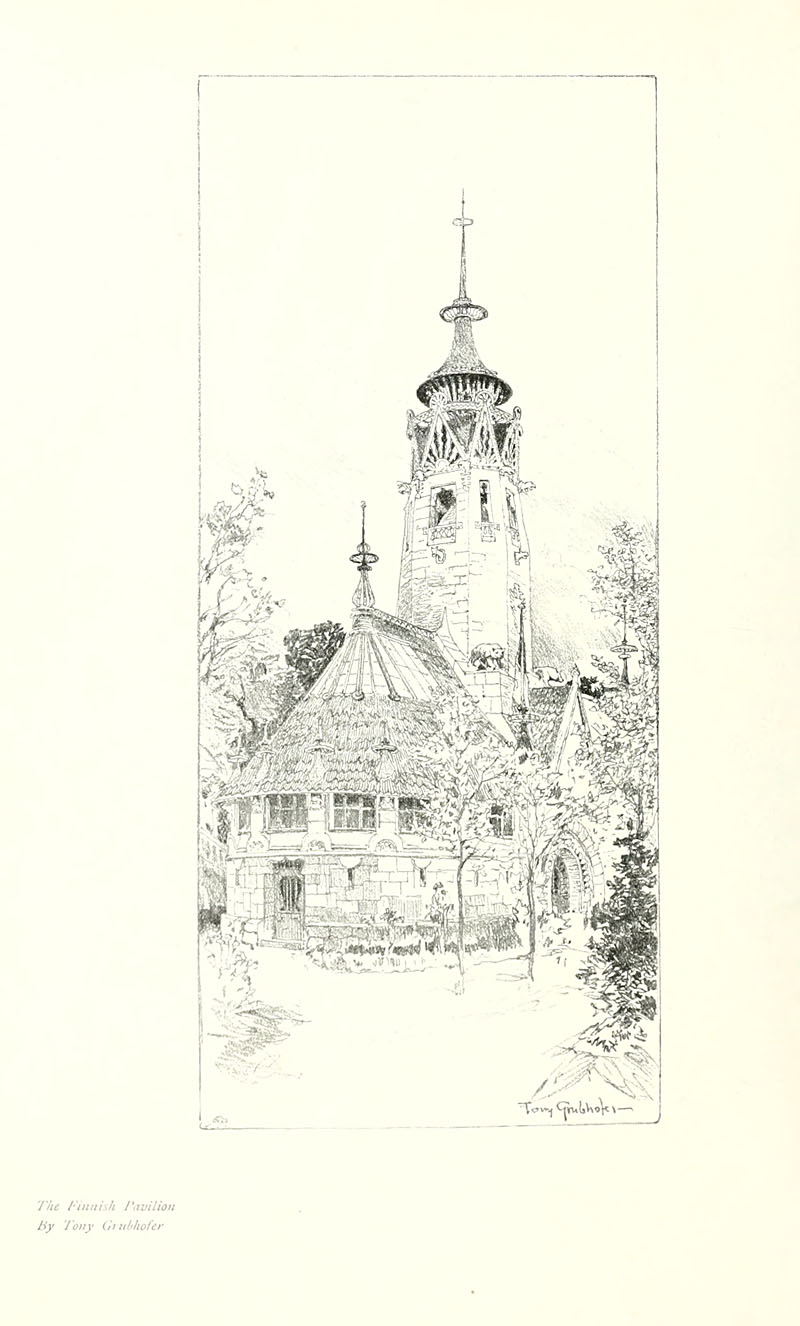
Tony Grubhofer (1854–1935) was apparently an Austrian artist who in these drawings manages to crop his views so selectively that many of them don’t look like they’re part of an exposition in one of the world’s capital cities. Of interest for me are his watercolour of René Binet’s monumental gate, which gives an idea of how the structure would have looked at night illuminated by the novelty of electric light, and his view of Eliel Saarinen’s Finnish pavilion which he renders as though it was a provincial church. This was Saarinen’s first major commission (he was 27 at the time), and Philippe Jullian in his book about the exposition declares this design to have been the most interesting and successful of all the national pavilions that year. It’s certainly better than Edwin Lutyens’ pastiche of an Elizabethan manor for the British pavilion. Eliel Saarinen had a very successful career, as did his more well-known son, Eero Saarinen, one of the major architects of the 20th century.

Volumes 20 to 22 of The Studio can be downloaded here.

grubhofer03.jpg

The Finnish Pavilion.

Continue reading “Tony Grubhofer’s Exposition Universelle sketches”

Weekend links 68

dorosheva.jpg

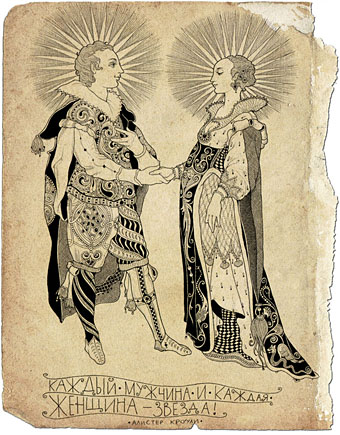
Every man and every woman is a star by Sveta Dorosheva.

• Matt Taylor (illustration) with Gregg Kulick and Paul Buckley (design) provide new Penguin covers for John Le Carré. I love the look which seems inspired by Daniel Kleinman’s title sequence for Casino Royale even if it doesn’t quite suit the shabby world of George Smiley and the Circus.

[Deborah Kass] told me that when she was going to art school in the ’70s, she tripped on LSD almost every week and she said she felt it was her “moral duty as an artist to take the trip.” […] I think psychedelic experience makes you think that there are multiple realities, that there isn’t just this one normal real world to which we’re supposed to conform, but that the reality changes depending on the state of consciousness that we’re in when we’re experiencing it. So, any different kind of art kind of posits a different reality. (more)

New York Times art critic Ken Johnson discussing his new book Are You Experienced?: How Psychedelic Consciousness Transformed Modern Art.

• “That got me thinking that evolution really isn’t survival of the fittest, when it comes to these things, it is more like survival of the interesting, survival of the beautiful, survival of the weird, cool stuff that managed to evolve.” Laurie Anderson and David Rothenberg discuss music and animals.

• Laura Cumming on the late Lucian Freud. And Stephen Heller on Alex Steinweiss, the originator in 1939 of the artistic record sleeve who also died last week.

• Alan Moore says “Think Locally: Fuck ‘Globally'”. He and Queen Calluz explain how Dodgem Logic magazine puts their ideas into practice.

• Adam Curtis gets interviewed while Alan Bennett returns to Armley Public Library in Leeds.

• Peacock’s Garden, a celebration of pavonine splendour.

• A visit to Seher Shah’s studio in Brooklyn, New York.

• Maximum androgyny at Epicenity, a Tumblr.

• Does your god have a penis?

• Chrysalide (1978) is an album of “cosmic” guitar instrumentals by Michel Moulinié which sounds at times like a French equivalent of Manuel Göttsching. It’s never been released on CD but a copy can be found here.

Mister Jarman, Mister Moore and Doctor Dee

tempest.jpg

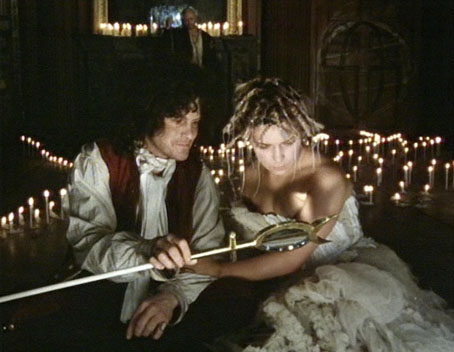
Prospero (Heathcote Williams) and Miranda (Toyah Willcox), The Tempest (1979).

The Shakespeare who spun The Tempest must have known John Dee; and perhaps through Philip Sidney he met Giordano Bruno in the year when he was writing the Cena di Ceneri—the Ash Wednesday supper in the French Ambassador’s house in the Strand. Prospero’s character and predicament certainly reflect these figures, each of whom in his own way fell victim to reaction. John Dee, with the greatest library in England, skrying for the angels Madimi and Uriel (so nearly Ariel)—all of which is recorded in the Angelic Conversations—ended up, in his old age, penniless in Manchester. Bruno was burnt for heresy.

Ten years of reading in these forgotten writers, together with a study of Jung and his disciples proved vital in my approach to both Jubilee and The Tempest. As for the black magic which David Bowie thought I dabbled in like Kenneth Anger, I’ve never been interested in it. I find Crowley’s work dull and rather tedious. Alchemy, the approach of Marcel Duchamp, interests me much more.

Derek Jarman, Dancing Ledge (1991).

Damon Albarn’s opera Doctor Dee has been all over the news this week following its premier as part of the Manchester International Festival. Last weekend one of the press ads was announcing this as an “untold story”, as though no one had given much thought to the Elizabethan magus prior to Mr Albarn’s arrival. Neither the ads nor anyone associated with the production will be in a hurry to tell you that the idea for the opera came from Alan Moore who’s had a fascination with John Dee’s life and work for many years. Albarn and fellow Gorillaz cohort Jamie Hewlett approached Alan about a collaboration a couple of years ago; Alan agreed to write something on the condition that Gorillaz provide a contribution to Alan’s magazine, Dodgem Logic. They agreed, Alan set to work, having suggested John Dee as a good subject then the whole thing fell apart: Gorillaz said they were too busy to accommodate themselves to the magazine’s generous deadlines so Alan told the pair that he was now too busy to have anything further to do with their opera. This is all old news (and being a Dodgem Logic contributor I have a partisan interest in the story) but it’s worth noting since the opera will be playing elsewhere once it’s finished its Manchester run so we’ll continue to hear about it. The point is that the subject matter was Alan Moore’s choice, not Damon Albarn’s; if Alan had decided to write something about Madame Blavatsky (say) we’d now be reading reviews of Blavatsky: The Opera. Albarn can at least be commended for staying with the subject. Despite John Dee’s exile in Manchester being part of the city’s history (among other things he helped organise the first survey of the streets) you can bet the apes from Oasis have never heard of him.
jubilee.jpg

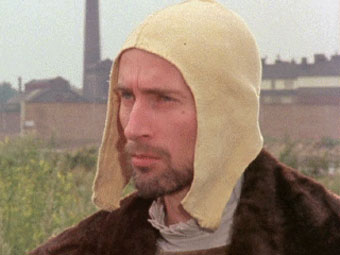
Richard O’Brien as John Dee in Jubilee (1978).

All of which had me thinking how John Dee, a maverick intelligence of the Elizabethan era, has a tendency to attract equally maverick intelligences in later eras. Derek Jarman’s work returns to John Dee often enough to make the magus a recurrent theme in his films, from the scenes in Jubilee (1978) (part of an earlier script) where he’s portrayed by Richard O’Brien showing Elizabeth I the future of her kingdom, to The Tempest (1979) where Prospero’s wand is modelled on Dee’s Monas Hieroglyphica, to The Angelic Conversation (1987) which borrows its title from Dee’s scrying experiments and finds via the sonnets another connection between John Dee and Shakespeare (Ariel being the contrary spirit whose magic allows a vision of the future in Jubilee). By one of those coincidences which make you think there must have been something in the air during the mid-70s, Michael Moorcock’s novel Gloriana, or The Unfulfill’d Queen was published the year Jubilee premiered, a fantasy in which the Elizabethan court is blended with its fictional counterpart from Spenser’s The Faerie Queen, and which features a Doctor John Dee as the queen’s Councillor of Philosophy. (If you want to stretch the connections further, Jenny Runacre who plays Elizabeth in Jubilee had earlier portrayed Miss Brunner in the film of Moorcock’s The Final Programme.)
mindscape_dee.jpg

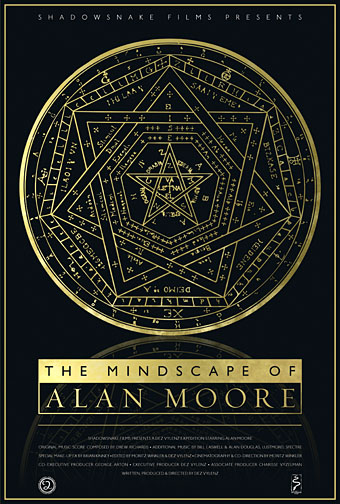
My 2009 poster design for The Mindscape of Alan Moore, a documentary by Dez Vylenz. John Dee’s Sigillum Dei Aemeth appears in the film so I used this as the principal motif for the packaging design and DVD interface.

Reading the reviews it’s impossible to tell how Alan’s libretto might have fared on stage compared to the work which is now showing, the content of which draws on Benjamin Woolley’s excellent biography, The Queen’s Conjuror. Alan and Benjamin Woolley can both be found among the interviewees in a Channel 4 documentary about John Dee broadcast in the Masters of Darkness (sic) series in 2001. For those keen to delve beyond the stage show, Derek Jarman’s films are all on DVD, of course, while fragments of Alan’s libretto can be found in the fourth edition of Strange Attractor along with his notes for the rest of the opera. Charlotte Fell Smith’s life of Dee from 1909, for many years the standard study of the man, can be found online here.

Previously on { feuilleton }
• The Tempest illustrated
• Robert Anning Bell’s Tempest
• In the Shadow of the Sun by Derek Jarman
• Designs on Doctor Dee
• Derek Jarman at the Serpentine
• The Angelic Conversation
• The life and work of Derek Jarman

Morlocks, airships and curious cabinets

morlock.jpg

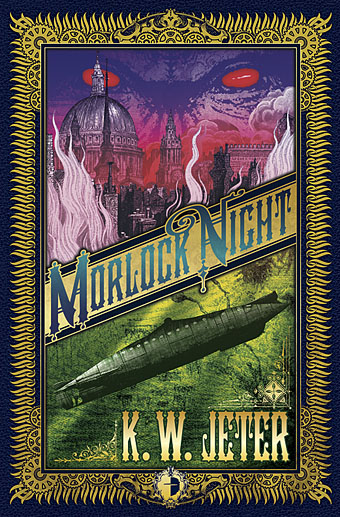
Things I was working on late last year continue to percolate or, if you prefer, build a head of steam. My cover for KW Jeter’s Morlock Night appears in a short piece by Rick Poynor in July’s Creative Review. That feature is prompted by the British Library’s Out of the World exhibition. Nice to see something of mine with Hannes Bok’s illustration for Who Goes There? by John W Campbell, the story which was filmed as The Thing from Another World, and later, John Carpenter’s The Thing.

Morlock Night is also one of my contributions to the lavish Steampunk Bible which editors SJ Chambers and Jeff VanderMeer have been promoting for the past couple of months. USA Today ran a feature on the book which included my piscine airship among the selected illustrations.

Next up will be the Thackery T Lambshead Cabinet of Curiosities for which I’ve provided a number of illustrations and decorative title pages. Jeff V has a preview shot of the cover. That will be out next month. More later.

Previously on { feuilleton }
• The Steampunk Bible
• Steampunk Reloaded
• Steampunk overloaded!
• Vickers Airship Catalogue
• The Air Ship
• Dirigibles
• More Steampunk and the Crawling Chaos
• The art of François Schuiten
• Steampunk Redux
• Steampunk framed
• Steampunk Horror Shortcuts
• The Airship Destroyer
• Zeppelin vs. Pterodactyls
• The Hetzel editions of Jules Verne

Art et Décoration

aed1.jpg

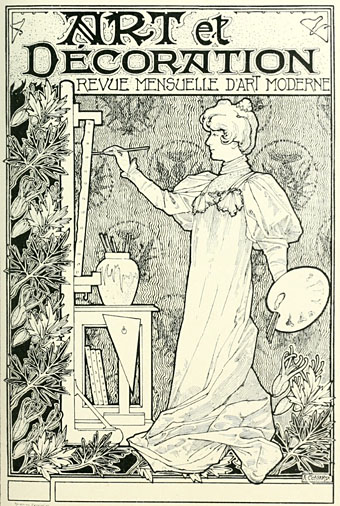
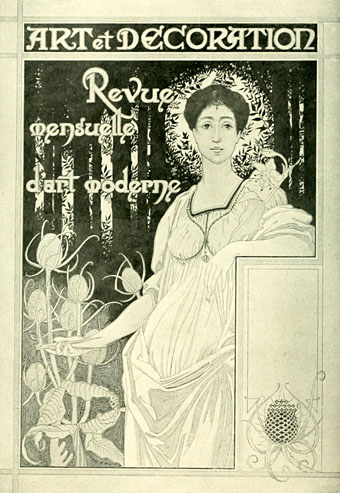
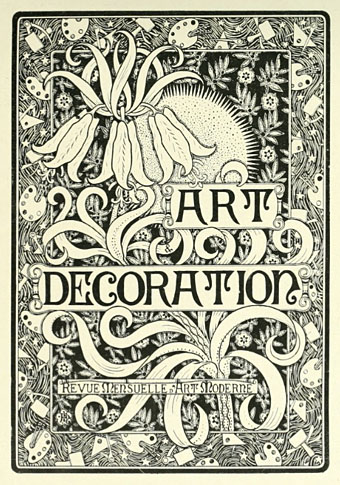
Another Art Nouveau journal partially emerged from the world’s libraries, Art et Décoration was a French equivalent of The Studio, launched a few years after its British counterpart in 1897. The examples here are from a cover design competition in the first issue which yielded the usual complement of decorous muses and florid borders; The Studio used to hold similar competitions. For now the Internet Archive only has the four issues of A&D, the first two then numbers 41 & 42. Here’s hoping that more become available, I’m naturally curious to see how they treated the Exposition Universelle of 1900.

aed2.jpg

aed3.jpg

Continue reading “Art et Décoration”