Dissent

pen.jpg

If you believe in freedom of speech, you believe in freedom of speech for views you don’t like. Goebbels was in favour of freedom of speech for views he liked. So was Stalin. If you’re in favour of freedom of speech, that means you’re in favour of freedom of speech precisely for views you despise.

Noam Chomsky in Manufacturing Consent: Noam Chomsky and the Media (1992)

Terrorists don’t care about rights or laws so any debate about freedom of speech isn’t directed at them. I’d be more encouraged by the show of solidarity for dead cartoonists if I didn’t believe that many of those currently declaring their support will continue burning up social media in the next few months with demands that something be banned or stopped. We live in censorious times. Censorship (or the urge to see it enforced) never disappears, it migrates along with whatever happens to be taboo to current generations. In the 1970s much of the heat was around sexual content; today it’s predominantly about identity politics. Whatever the provocation, the results are the same: angry people step forward with a demand that something be forbidden. Last September a showing at the Barbican in London of Brett Bailey’s Exhibit B was cancelled after a petition and a demonstration outside the venue. Bonnie Greer wanted to make up her own mind but she didn’t get the opportunity:

These people largely reacted from hearsay, ideology, photos and the reactions of others who had seen it—not their own experience. I’ve seen people like this before, self-appointed judges, roaming the internet in search of what displeases and offends them. One protester went so far as to issue an absurd analysis of the possible psychological damage Exhibit B could cause the actors involved. It was ignorant and insulting psychobabble.

I don’t want to be stopped from seeing a work because, in their opinion, it’s “inappropriate”, “incorrect” or “racist”—words which are, at best, moveable feasts. I want to think for myself.

You’ll be seeing more movable feasts in the next few days when Anglophone commenters begin to discover that Charlie Hebdo was a full-spectrum offender rather like my colleagues at Savoy Books. When David Britton’s novel Lord Horror was being subject to Crown Court disapproval in 1992 The Independent wrote a prissy editorial complaining that the novel and a death metal album by Dismember were hardly worth the trouble of defending. These things weren’t art, they were trash, something that one of the UK comics mags (I forget which one) also complained about when discussing the Meng & Ecker prosecution. You can defend the principle of freedom of speech (or art) without agreeing with anything that’s being said, but for some people this often seems to be a step too far. Lord Horror escaped the obscenity charge thanks to Geoffrey Robertson QC but Meng & Ecker didn’t (comics being deemed trashier than novels by the court); my artwork for Hard Core Horror #5 was deemed obscene three years later in a separate trial in which Savoy were also declared to be unworthy of trial by jury because they were “not a bona fide publisher”. We don’t have a freedom of speech defence in Britain which is why history continues to repeat itself.

In the end all discussion about censorship comes down to this: who decides what is art and what is trash, what should be defended and what should be thrown to the dogs (or the gunmen)? You? Me? The Pope? Some guy in a ski-mask? Is freedom of speech only for the responsible people, for you and your friends? Or does it also apply to the irresponsible, the contentious, the trashy and the downright offensive? If freedom isn’t for everyone then someone, somewhere is willing to decide it’s not for you.
Listen to the Colour of Your Dreams: Part One

mojo.jpg

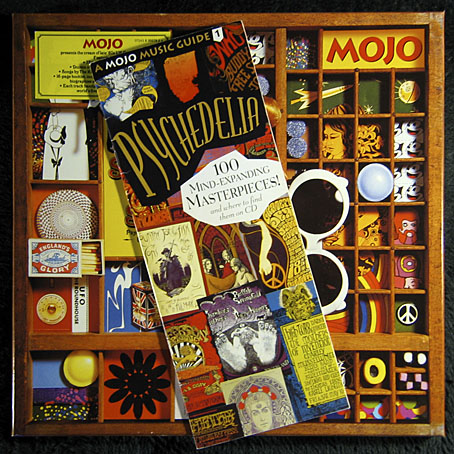
Blame these things: the Jon Savage booklet, and Mojo Presents Acid Drops, Spacedust & Flying Saucers (design by Phillip Savill).

One of the commissions for the New Year is psychedelia-related so to get in the mood I’ve been listening to the six CD compilations of psychedelic songs I made some years ago. I must have spent about five years gathering everything on these discs which comprise 132 selections in all, three for UK music and three for the USA, covering the years 1966–1969. The impetus was an annotated booklet listing “100 mind-expanding masterpieces” that Jon Savage had compiled for Mojo magazine in 1994; a revised list was published in 1997 along with some debatable contemporary additions. Things came to a head (so to speak) in 2001 when Savage and fellow Mojo journalists put together a four-CD collection of prime UK psychedelia for EMI, Acid Drops, Spacedust & Flying Saucers, which included many of the songs from Savage’s list. That collection and the Rhino Records Nuggets box began the mania to accumulate everything on Savage’s list. Once I’d started burning my own compilations the Savage 100 quickly expanded when I realised that I ought to include more favourites of my own.

To start the year, then, I’m uploading all six compilations to Mixcloud beginning with the UK selection. Despite all the effort and the number of songs this still isn’t a definitive collection. As Savage observes in his notes, the late 1960s was a time of massive over-production by record companies with hundreds of singles released, especially in the UK. Many one-off releases by obscure bands are as good as those that topped the charts which is why psychedelic compilations are so numerous, and why omissions are unavoidable.

With that proviso here’s the first part of the UK collection covering the years 1966 to 1967. The tracklist below indicates in bold the songs from the Savage 100 with notes about my additions. The listing is by order of release although this isn’t strictly accurate throughout. I’ll be uploading the rest of the compilations over the next few weeks.

UK Psychedelia, Part One by Feuilleton on Mixcloud

Dialogue — Alice In Wonderland (From Jonathan Miller’s BBC film, 1966.)
The Beatles — Tomorrow Never Knows
The Rolling Stones — Paint It Black
The Creation — Making Time
Craig — I Must Be Mad (A ferocious single by a band that only released one other 45 before splitting. Carl Palmer is on drums.)
Donovan — Season Of The Witch
The Yardbirds — Happenings Ten Years Time Ago
The Misunderstood — I Can Take You To The Sun (An American band who moved to London in 1966. This was their second and final single, and one of John Peel’s all-time favourites.)
Cream — I Feel Free
The Beatles — Strawberry Fields Forever
Pink Floyd — Interstellar Overdrive (Savage has the version from Tonite Let’s All Make Love In London which runs for almost 17 minutes. The version here is the shorter one from Piper At The Gates Of Dawn.)
The Smoke — My Friend Jack
The Poets — In Your Tower
The Move — I Can Hear The Grass Grow
The Troggs — Night Of The Long Grass
Traffic — Paper Sun
The Jimi Hendrix Experience — Are You Experienced?
Tomorrow — My White Bicycle (Savage has a later single, Revolution, but I much prefer this earlier 45.)
John’s Children — Midsummer Night’s Scene
Dialogue — Yellow Submarine
The Beatles — It’s All Too Much
The Attack — Colour Of My Mind
Small Faces — Green Circles

Previously on { feuilleton }
What Is A Happening?
My White Bicycle
Ogdens’ Nut Gone Flake
Tomorrow Never Knows
The Dukes declare it’s 25 O’Clock!
Yellow Submarine comic books
A splendid time is guaranteed for all

Weekend links 240

wiley.jpg

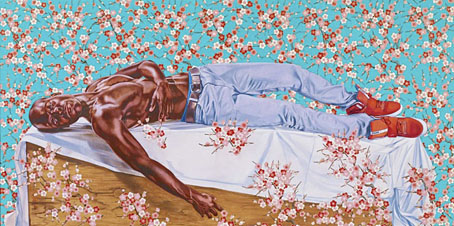
The Death of Chatterton (2014) by Kehinde Wiley.

• Mixes of the week (and the week before that): The Conjurer’s Hexmas: Second Rite by SeraphicManta; Secret Thirteen Mix 140 by Deaf Center; Best of 2014: A Highly Opinionated Mix by Robin The Fog.

• Never mind Music for Airports, how about Music for Neurosurgery? The Tegos Tapes Edits are extracts from “12 hours of unheard Vangelis music soundtracking films of various surgical operations”.

• “It was one of the first magazines that, with science-fiction and comics together, proposed comics for adults.” Aug Stone on 40 years of publisher Les Humanoïdes Associés and Métal Hurlant.

• Zinesters Do It on the Photocopier: Stephanie Schroeder on the Queer Zine Archive Project. Related: Holy Titclamps by Larry-bob Roberts.

A Year In The Country reached the end of its 365 posts. The archive is well worth a browse.

• “These people love to collect radioactive glass. Are they nuts?” asks Ben Marks.

• Think before you share: 86 viral images from 2014 that were totally fake.

• The Anti-Tolkien: Peter Bebergal on Michael Moorcock.

• Extracts from Alan Bennett‘s diary for 2014.

John Cage 4’33” Autotune

Alpha (1976) by Vangelis | Reve (1979) by Vangelis | L’Enfant (1979) by Vangelis

MMM in IT

mmm.jpg

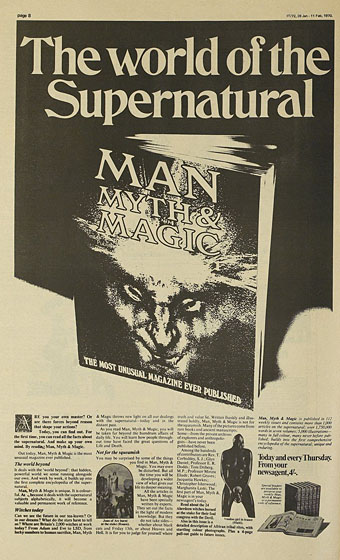
“Are you your own master? Or are there forces beyond reason that shape your actions?”

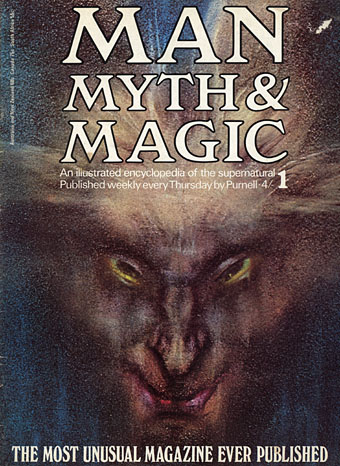
This full-page ad appeared in issue 72 of International Times, Jan 28, 1970. The part-work encyclopedia, Man, Myth & Magic, was launched at the best possible moment, capitalising on the late-60s’ resurgence of interest in the occult and unorthodox spirituality. That bold declaration—”The most unusual magazine ever published”—might have seemed unconvincing to readers of the undergrounds, many of which made “unusual” their starting point, but there certainly hadn’t been a magazine/encyclopedia like MMM before, and none of the titles that followed could match its scope and authority. The ad also promises “From Adam and Eve to LSD, from lucky numbers to human sacrifice…” which its 112 issues went on to deliver.

This is the first press ad I’ve seen for MMM. A TV ad for the later American reprinting turned up recently, 30 seconds of film that sent Austin Osman Spare’s sinister goat-faced elemental into millions of Christian households in 1974. I keep hoping we might get to see the UK equivalent one day.

MMM.jpg

Previously on { feuilleton }
Wilfried Sätty: Artist of the occult
Owen Wood’s Zodiac
Austin Osman Spare

Donald Cammell and Kenneth Anger, 1972

cinema.jpg

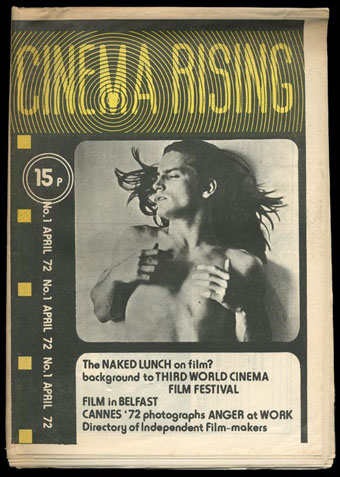
Another resurrected article. Cinema Rising was a short-lived newsprint film magazine that ran for three issues in the UK in 1972. I have a few pages from the rare first issue that was part of a batch of old underground newspapers I was given a few years ago. (The Frendz Hawkwind strip is from the same haul.) Cinema Rising was edited by Simon Hartog and Tony Rayns, the latter being a long-time Kenneth Anger aficionado which would explain both the magazine title and the presence of a photo feature about Anger’s Lucifer Rising. The bulk of this post is a short interview with Donald Cammell that’s of interest for his comments about the gender roles in Performance and his opinion of Jorge Luis Borges whose recurrence as both signifying text and presiding magus in Performance is never really explained.

Cammell’s next film after Performance would have been Ishtar (no relation to the notorious Warren Beatty flop), the themes of which Cammell discusses at the end of the piece. The Cammell biography describes a script concerning a film star and Hollywood producer who want to make a film in Morocco. While there they get involved with a woman who embodies various mystical/mythological feminine attributes; there’s also a sub-plot about the pair kidnapping an American judge. Mick Jagger was down for the role of the film star while William Burroughs was slated to play the judge. Given how wayward Cammell’s later films became it’s difficult to say whether this would have been good or not. Performance could very easily have been terrible but that film also had Nicolas Roeg on board.

After the Cammell piece there are photos from Cinema Rising‘s Kenneth Anger feature which show the director at work on the new version of Lucifer Rising. I’ve not seen any of these stills or the two black actors before—what happened to their parts? Note that some of the captions are misspelled: the photos should be credited to Diarmid Cammell—Donald’s brother—while the Adept (not “Lucifer”) is Haydn Couts.

dc1.jpg

DONALD CAMMELL: PERFORMANCE TO ISHTAR, Cinema Rising, no. 1, April 1972

Donald Cammell’s first movie was Performance, made in collaboration with Nicolas Roeg; the most unexpected British movie of recent years, and one of the very few products of the British industry capable of holding its own in an international context. Cammell’s new script is Ishtar, originally written with Mick Jagger in mind for the lead again, but possibly to be made without him; Cammell is currently in America to raise the backing for the film.

In the following extracts from a conversation with John du Cane (recorded last year), Cammell speaks of his background and interests…matters that inform his new script at least as much Performance.

Collaboration

“In the recent past, reverence for the director of a film as sole creator has been vastly exaggerated, through critical efforts. I’m thinking particularly of the Cahiers du Cinema ‘author’ concept—I’ve been living in Paris, and have been quite aware of it for a long time. The kind of theory of creativity that’s arisen there (and in related worlds in New York) is, succinctly, crap. It’s a way of trying to demonstrate the view that cinema is an artform, and that therefore there must be a single creative mind controlling the artefact, through to its ultimate form. It’s a way of justifying movie-making, socially and culturally.

“But leaving aside the reasons for the concept, I think it’s contradicted by the facts. I think that many of the greatest artefacts things that have moved people most throughout history—have been collectively produced. You don’t even have to look for examples: the whole of Egyptian culture, arcane cultures generally. Today in tribal cultures, the vast majority of the products are collectively produced. The hangup is the concept of one ego necessarily controlling the production in order for that ego to be expressed; the notion that the expression of an ego is the final goal of any artwork, that this is what it’s for. I think that an artwork expresses itself, that the creators involved will all see in it their own egos, each one individually satisfied when looking at the final work. My analogy is with contemporary music, where people go into it collectively, and their egos are satisfied collectively and individually. Look at Mick and Keith and their confreres: they see in their work as The Rolling Stones what they each wanted to say. Working in the film medium is ideally suited to interaction of different heads; it’s the ideal medium for all the good functions of collective work.”

Continue reading “Donald Cammell and Kenneth Anger, 1972”