Welles at 100

welles.jpg

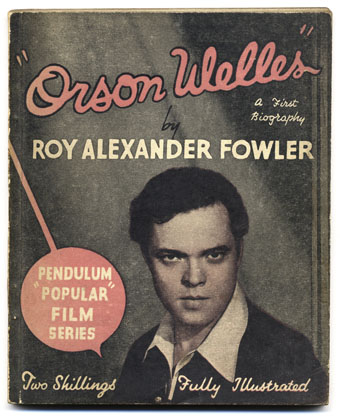
Orson Welles: A First Biography (1946) by Roy Alexander Fowler.

Happy birthday, Orson. The premature celebrity biography is nothing new, as this small volume from the Coulthart library demonstrates. Welles was only 31 in 1946 but was already the director of three feature films. If I’m less of a Welles obsessive today it’s because many of the films and radio plays that were once inaccessible can now be easily seen and heard, although a handful of unfinished projects still wait in the wings. The following is a selection of some favourite Wellesiana, old and new.

• The Mercury Theatre On The Air: Recordings of Welles’ theatre troupe at the Internet Archive and at the dedicated website. The Mercury production of The War of the Worlds is the essential one, of course, but I’m also partial to their production of Dracula which featured Agnes Moorehead playing Mina Harker, Welles as the Count, and a suitably spooky score by Bernard Herrmann. The production of Around the World in 80 Days was later expanded by Welles into an ambitious (and expensive) stage musical in collaboration with Cole Porter.

The Night America Trembled (1957) is a TV dramatisation of the alarmed reaction of some Americans to the War of the Worlds broadcast. Presented live by Ed Murrow, the drama features Warren Beatty, James Coburn, Warren Oates, and Ed Asner (who later presented the BBC’s RKO Story). Closer to Welles is The Night That Panicked America (1975) a TV movie recreation of the original broadcast with Paul Shenar as the director.

Newsreel footage of the final scenes of the so-called Voodoo Macbeth from 1936. As part of the WPA program to return Americans to work, Welles directed an all-black cast with the action of the play moved to Haiti. As usual, Welles wasn’t afraid of rearranging the Bard’s words, and this staging ends with the same lines as his 1948 film version: “Peace! The charm’s wound up.”

• My favourite Welles book is still This is Orson Welles (1992), a collection of Peter Bogdanovich’s interviews edited by Jonathan Rosenbaum. Bogdanovich’s interview tapes can be heard at the Internet Archive.

Orson Welles’ Horrorshow: Colin Fleming on Welles’ Macbeth, “the horror film no one likes to call a horror film”.

Peter Bradshaw on Citizen Kane and the meaning of “Rosebud”.

Six actors who have played Orson Welles onscreen

Previously on { feuilleton }
The Fountain of Youth
The Complete Citizen Kane
Return to Glennascaul, a film by Hilton Edwards
Screening Kafka
The Panic Broadcast

The Weird Questionnaire

peacock.jpg

A peacock. Photograph by Vidhya Narayanan.

Posted at the Weird Fiction Review in the past week, The Weird (or Étrange) Questionnaire is Éric Poindron’s Weird (or Étrange) riposte to the Proust Questionnaire. I’d read the post, and seen Jeff VanderMeer’s answers to the questions, but wasn’t planning on answering it myself until Neddal Ayad wrote asking whether I’d be willing to do so for a future WFR assembly of responses. So here we are. The rules are as follows:

…there are sixty questions (twice as many as most versions of the Proust Questionnaire). Spend no more than a minute on each, and an hour in total. However, don’t keep checking your watch: “let writing define time.”

In the end I took longer than an hour but the time limit is a good idea, otherwise I’d have spent far too long pondering, revising, qualifying remarks, unqualifying the qualifications, and so on. Deadlines have their uses.


The Weird Questionnaire

1: Write the first sentence of a novel, short story, or book of the weird yet to be written.

The first night of winter moonlight revealed a pattern of tiny runic figures etched inside the window glass.

2: Without looking at your watch: what time is it?

01:15

3: Look at your watch. What time is it?

01:20

4: How do you explain this—or these—discrepancy(ies) in time?

It’s always later than you think.

5: Do you believe in meteorological predictions?

“Believe” seems the wrong word in this context since the question concerns a conjecture based on scientific study. Short-range forecasts are fine, long-range ones seldom seem to be.

6: Do you believe in astrological predictions?

If this refers to newspaper columns, they’re always so vague they may as well be computer-generated. Maybe they are.

7: Do you gaze at the sky and stars by night?

Yes, when I’m out of the city.

8: What do you think of the sky and stars by night?

My bad eyesight (the stars are always a blur), the length of time the light has taken to reach us, how the familiarity of the few stars we do manage to see shields us from the true immensity of the stellar gulfs.

9: What were you looking at before starting this questionnaire?

A guest post by Clive Hicks-Jenkins on Kathe Koja’s blog.

10: What do cathedrals, churches, mosques, shrines, synagogues, and other religious monuments inspire in you?

Further appreciation of the values of art, architecture and related crafts. In the case of cathedrals: astonishment at the feats of labour required to build them in a pre-industrial age; their presence as sites of accumulated history.

Continue reading “The Weird Questionnaire”

Snowbound cinema

uk_snow.jpg

A satellite view of snow across Great Britain on January 7, 2010.

Walking the snow-laden streets this week felt like a considerable novelty when we rarely have snowfalls of any depth here and what there is never lasts much longer than a day. The current low temperatures which began just before Christmas may be inducing a national trauma but the genuinely wintery weather makes a change from the dreary weeks of rain and cold which usually prevail until April.

Whilst trudging through the crusted ice I found myself remembering favourite films which make the most of winter landscapes. Here’s a short list to follow the earlier winter-themed posts.

McCabe & Mrs Miller (1971)
Several Westerns before this one had featured winter scenes but I think Robert Altman’s was the first to be set at the height of winter in a snowbound town. Memorable for Vilmos Zsigmond’s photography, Leonard Cohen’s lugubrious songs, Warren Beatty’s doomed businessman stomping around wrapped in furs muttering “Pain, pain, pain!”, and the finale when he’s hunted down by a trio of assassins.

The Shining (1980)
Has anyone not seen this film? Despite the artificial snow, Kubrick’s direction and John Alcott’s photography communicate authentic chills, both meteorological and metaphysical.

timberline.jpg

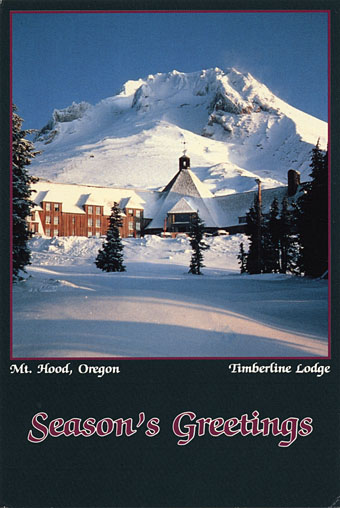
Yes, it’s a genuine Christmas postcard from Oregon’s Timberline Lodge which became the model for Kubrick’s Overlook Hotel. Writer Tom Veitch sent me this some years ago.

The Thing (1982)
John Carpenter’s grisly Antarctic horror is the film I still find to be his best. Like his earlier Assault on Precinct 13, this is another siege situation borrowed from Howard Hawks only this time the enemy is within. Until someone films At the Mountains of Madness, this is the closest you’ll get to Lovecraft’s polar nightmares.

Runaway Train (1985)
Few people know this: escaped convicts Jon Voight and Eric Roberts find themselves on the titular train with rail worker Rebecca De Mornay, and it’s a long ride through frozen landscapes as they try to escape the law and the train itself before it crashes. Andrei Konchalovsky directs a story by Akira Kurosawa rewritten by Edward Bunker (who has a cameo) and others. The result is a strange blend of hardboiled drama and existential symbolism with a great score by Trevor Jones.

Fargo (1996)
One of the Coen Brothers’ best. Watching this again over Christmas along with many of their other films, it was amusing to see Steve Buscemi transform from Fargo‘s vicious and splenetic kidnapper to the mild-mannered character he plays in The Big Lebowski. Despite the statement at the beginning of the film, Fargo isn’t a true story but its existence became tangled with some curious real-life events.?

Update: I was reminded on Twitter about Altman’s bizarre future Ice Age drama, Quintet, which I should have mentioned above. Not as successful as the earlier film but its setting certainly suits the weather.

Previously on { feuilleton }
Bruegel in winter
Winter panoramas
Winter music
Winter light
Kubrick shirts
At the Mountains of Madness
Images by Robert Altman