Kupka in Cocorico

kupka1.jpg

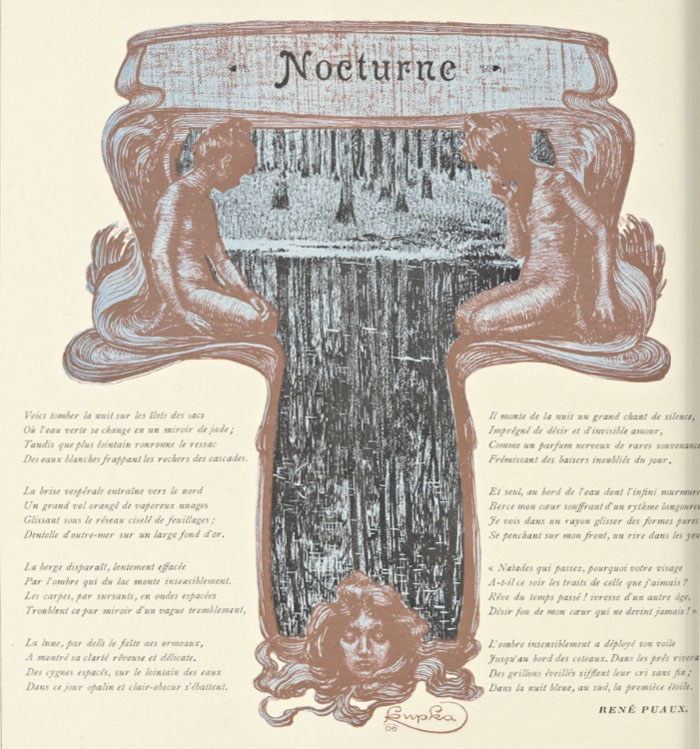
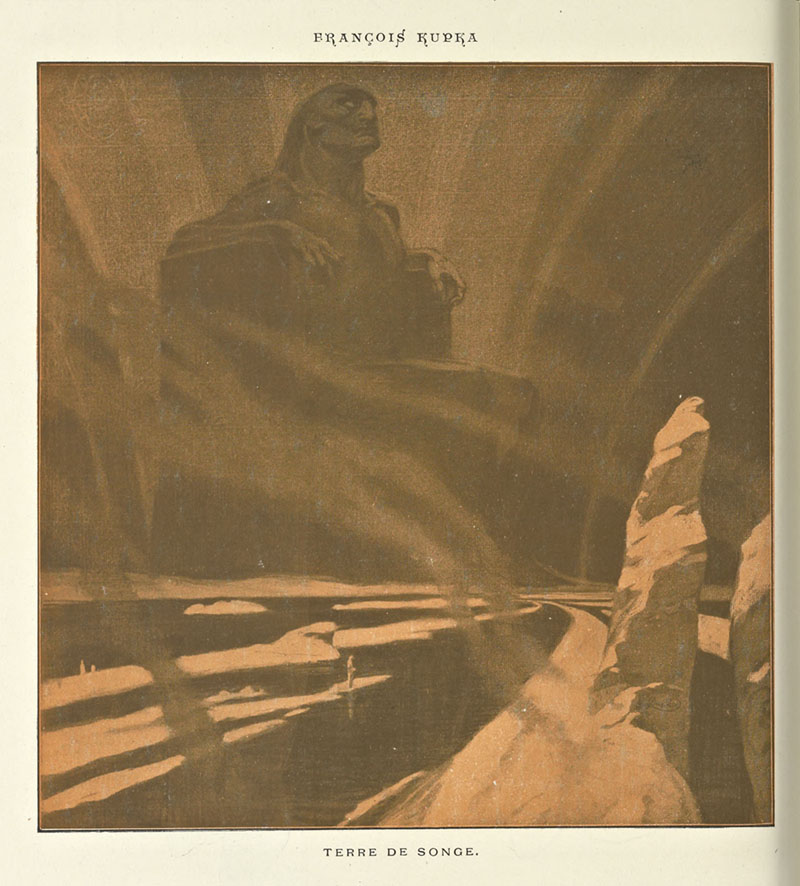
As noted yesterday, Czech artist František Kupka produced a cover for French magazine Cocorico together with this handful of interior illustrations, all of which date from around 1900. Kupka was living in Paris at the time, and several of these drawings reflect his connections to the Symbolist movement. I’ve posted his Poe illustration before but everything else here is new to me. The most striking piece is Terre de Songe (Land of Dreams) which illustrates a text piece with the same title. Kupka aficionados will recognise this as a variation on a print he made in 1903, Resistance, or The Black Idol, a drawing which today seems to be his most popular (or most visible) work. I’ve wondered a few times whether a tiny speck visible in The Black Idol was meant to be a human figure, something which Terre de Songe confirms. A fantastic drawing in all senses of the word.

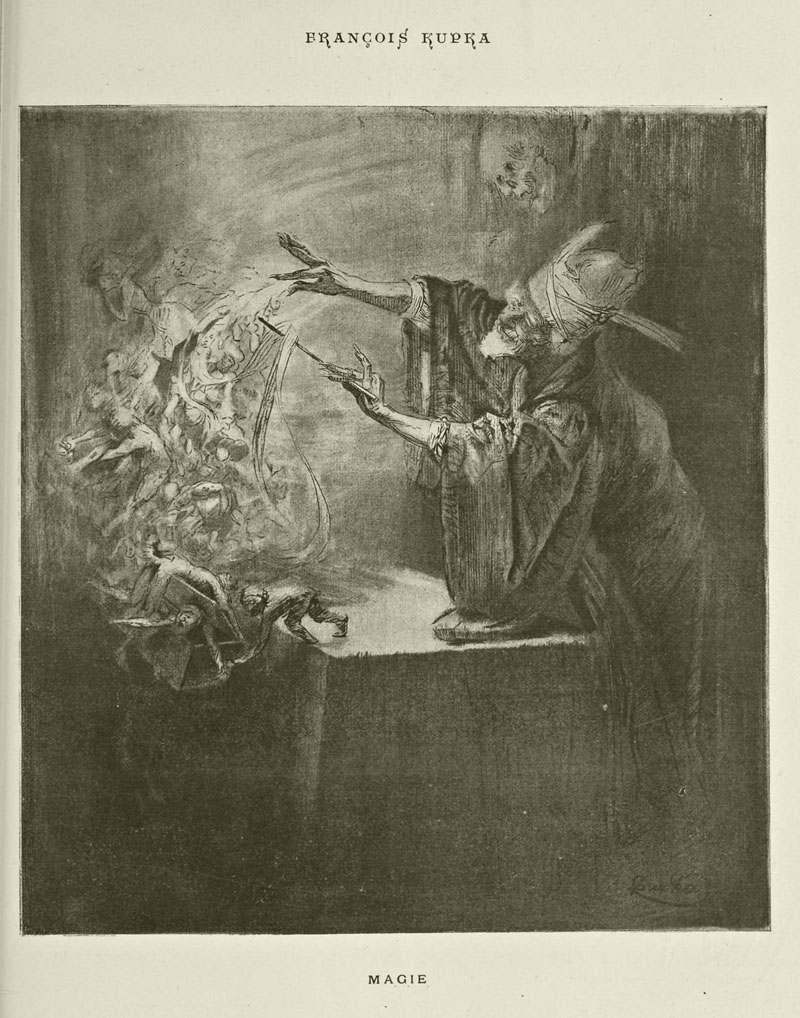
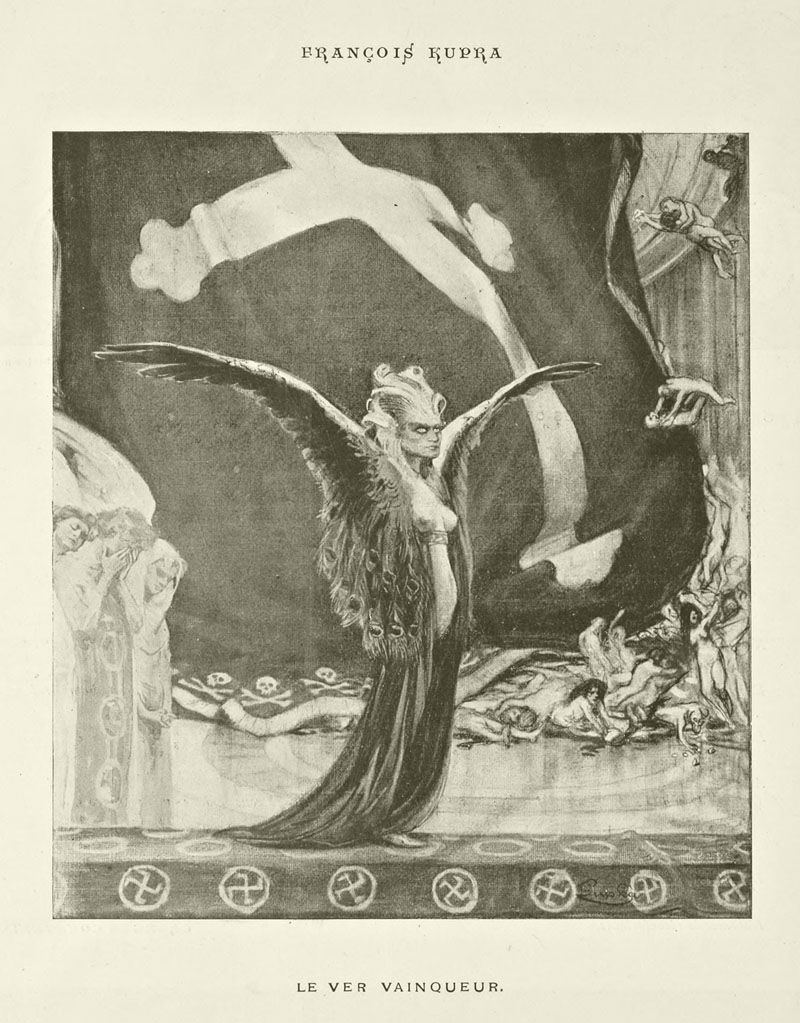
The four pictures which follow Terre de Songe are less impressive, a series of double-page satirical drawings whose obscure meaning isn’t helped by their being folded into the centre of the magazine. They’re included here for the sake of completeness.

kupka2.jpg

Magic.

kupka3.jpg

The Conqueror Worm (after Edgar Allan Poe).

kupka4.jpg

Land of Dreams.

Continue reading “Kupka in Cocorico”

Cocorico covers

cocorico01.jpg

Alphonse Mucha.

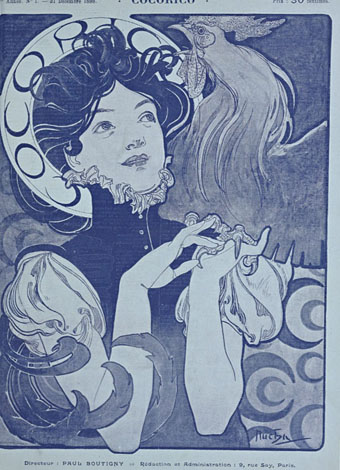
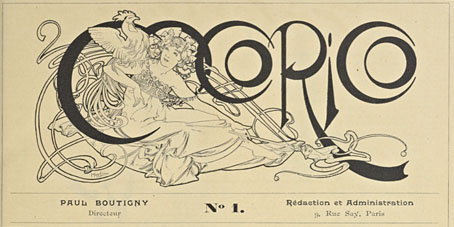
For a while now I’ve been waiting for several French journals of the fin de siècle to turn up online but humour magazine Cocorico has never been among them. I knew that Alphonse Mucha had contributed a handful of covers and some other graphics to Cocorico, notably the frontispiece (below) which ran in every issue. What I didn’t realise was that this title was effectively the French counterpart to Jugend magazine which had been running for two years when the first issue of Cocorico appeared in December 1898. Both magazines share the same mix of humorous articles, cartoons, serious art pieces and poetry, all connected by some very fine Art Nouveau graphics.

cocorico19.jpg

Alphonse Mucha.

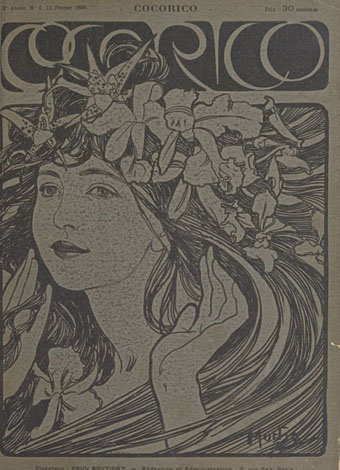
Jugend has the edge when it comes to the graphics, some of which are very strange, but Cocorico looks much more like a humour magazine to contemporary eyes, with many cartoons that resemble those drawn today. Cocorico is also mostly free of the Jugend brand of satire which is often little more than nationalist rabble-rousing. Cocorico ran for 63 issues to 1902 by which time its format had changed and the florid graphics had been abandoned for a more sober layout. What follows is a selection of cover designs, many of which are Mucha’s work, and all of which follow the Jugend template of varying the art style and title design. There’s also one by František Kupka (or François as he was credited here) who also contributed interior illustrations in the later issues. There’ll be more about him tomorrow.

cocorico02.jpg

Alphonse Mucha.

Continue reading “Cocorico covers”

Weekend links 255

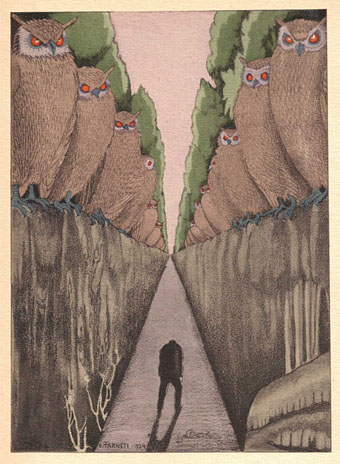
farneti.jpg

The Owls by Carlo Farneti for a 1935 edition of Les Fleurs du Mal. Via Beautiful Century although the scans probably came originally from 50 Watts.

• “…a project that seemed under a curse comprising greed, peculiar French copyright laws, jealousies and grudges, bad judgment, complicated ownership disagreements, a messy estate, and a list of individuals who believed they had some legal, financial, moral, or artistic right to the film itself.” Josh Karp on the tangled history of The Other Side of the Wind, always the most interesting of Orson Welles’ unfinished feature films.

• Producer Conny Plank is remembered for his work with a host of German artists but he also recorded a session with Duke Ellington and His Orchestra in 1970. Grönland Records is releasing the session in July, and they’ve posted Afrique (take 3 vocal) as a taster.

• “And that’s what a lot of social media by authors is starting to look like, to feel like: being smacked in the face, repeatedly, by hundreds of fish.” Delilah S. Dawson wants authors to leave off the incessant self-promotion.

“In everybody, there is an inner bestiary,” she claimed, and her pictures are overrun with animals and animal-headed creatures; sometimes sinister, sometimes acting as guides to the unconscious, as in The Pomps of the Subsoil (1947). As her interests grew more hermetic her paintings abandoned all trace of the world beyond. If the figures occupy any sort of space it’s rarely more than the planes of a room in muted browns or greys, and in many the surface is overlaid with geometric patterns that seem to imply some mystical framework.

Alice Spawls on the art and life of Leonora Carrington

• “How a pro-domme, a Russian diplomat, US intelligence and Mary Tyler Moore’s landscaper conspired to create a dance classic.” Dave Tompkins on The Dominatrix Sleeps Tonight.

• “Battersea, in fact, is a fairly simple climb, made ready by the builders who are destroying it.” Katherine Rundell on climbing Battersea Power Station at night.

• Mixes of the week: Secret Thirteen Mix 148 by Mlada Fronta, and The Ivy-Strangled Path, Volume V, by David Colohan.

Erté illustrates a gay romance in Lytton Strachey’s Ermyntrude and Esmeralda (1913 but not published until 1969).

• Dangerous Minds looks back at “The most unusual magazine ever published”, Man, Myth & Magic.

David Chase on the writing, directing and editing of the final scene of The Sopranos.

Magic Man (1969) by Caravan | The Myth (1982) by Giorgio Moroder | Magick Power (1987) by Opal

Weekend links 252

brizzi.jpg

Waiting by Liz Brizzi.

• “Music, politics, sex, and art were also widely represented by Evergreen. Gerald Ford famously maligned the magazine on the floor of Congress for printing the likeness of Richard Nixon next to a nude photo.” Jonathon Sturgeon on the return of an avant-garde institution.

• “The hallucinogenic properties of language are widely recognized by all repressive societies…which treat words like other tightly controlled substances.” Askold Melnyczuk reviews Where the Bird Sings Best, a novel by Alejandro Jodorowsky.

• Mixes of the week: A Mix For Thomas Carnacki by Jon Brooks whose Music for Thomas Carnacki has been reissued on vinyl; Solid Steel Radio Show 27/3/2015 by DJ Food.

One of the few vice-friendly cities left in the US, New Orleans remains his spiritual home, or whatever the atheist equivalent is. Waters’ supposed favourite bar in the world is here in the historic French Quarter. The Corner Pocket is a gay dive bar with tattooed strippers—filthy in exactly the way Waters likes.

“Trash and camp just don’t cut it any more,” he told a rapt audience at his interview panel on Friday. “Filth still has a punch to it. The right kind of people understand it and it frightens away the timid.”

John Waters growing older disgracefully

Songs of a Dead Dreamer and Grimscribe by Thomas Ligotti are being republished in a single edition by Penguin. Jeff VanderMeer wrote the foreword.

• “The film is brimming with Bacchanalian revelry, arcane mystery and mortal dread.” Robert Bright on The Saragossa Manuscript by Wojciech Has.

Alistair Livingston has posted page scans from When Darkness Dawns, volume two of his zine from the early 80s, The Encyclopedia of Ecstasy.

• “Without first understanding the flâneur we cannot understand the development of arcades,” says Aaron Coté.

• At A Journey Round My Skull: Jo Daemen cover designs; at 50 Watts: the art of Manuel Bujados.

• Vast spacecraft and megastructures: Jeff Love on the science-fiction art of Chris Foss.

• At Dangerous Minds: RE/Search’s Vale on JG Ballard and William Burroughs.

• RIP John Renbourn

Pentangling (1968) by Pentangle | Lyke-Wake Dirge (1969) by Pentangle | Lord Franklin (1970) by Pentangle

Weekend links 250

gebbie.jpg

Untitled artwork by Melinda Gebbie.

• “Johnny Rocket is like a Chaucerian epic retold by David Peace with music by Bruce Haack and The Focus Group for a music hall located in Hell.” John Doran talks to Maxine Peake and the Eccentronic Research Council about their “psychedelic ouija pop”.

Allison Meier looks at a new exhibition of Victor Moscoso’s psychedelic drawings. Related: Julia Bigham writing in Eye magazine in 2001 about London’s psychedelic poster scene.

• “Oh to eye the very enfilade through which that orchidaceous entity would make his stately progress…” Strange Flowers on the eccentric Count Stenbock.

Melinda Gebbie: What Is The Female Gaze? The artist is in conversation next month with Mark Pilkington and Tai Shani at the Horse Hospital, London.

Pamela Colman Smith: She Believes in Fairies. The Tarot artist and illustrator in a rare interview from 1912.

• Minimalist posters: “a lack of nuance disguised as insight,” says John Brownlee.

• Saturday night in the City of the Dead: Richard Metzger on the John Foxx-era Ultravox.

The Will Gregory Moog Ensemble plays the Brandenberg Concerto No. 3.

• “In a weird way”: a brief history of a phrase by Ivan Kreilkamp.

Die Hexe: An installation by Alex Da Corte.

• RIP Daevid Allen

Istaqsinaayok

You Can’t Kill Me (1971) by Gong | Master Builder (1974) by Gong | When (1982) by Daevid Allen