Weekend links 475

brooks.jpg

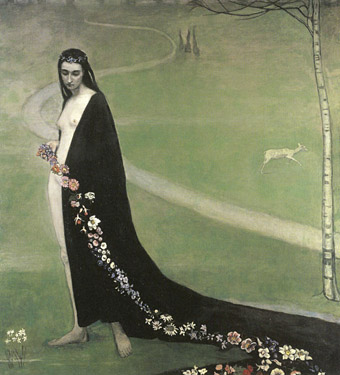
Femme avec des fleurs (c. 1912) by Romaine Brooks.

• “Boring people tend not to exile themselves to rocky islands, but even among the intriguing personalities we encounter in Capri, some individuals prove more extravagantly memorable than others.” Steve Susoyev reviews Pagan Light: Dreams of Freedom and Beauty in Capri by Jamie James.

• “The Mad “idiots” subverted the comic form into a mainstream ideological weapon, aimed at icons of the left and the right—attacking both McCarthyism and the Beat Generation, Nixon and Kennedy, Hollywood and Madison Avenue.” Jordan Orlando on a world without Mad Magazine.

• RIP Sam Gafford, Paul Krassner and Rutger Hauer. Related to the latter: Hauer’s first role as Floris, the hero of a Dutch TV series directed by Paul Verhoeven.

I cannot tell you what it does to me to hear pre-Stonewall. And even in our literature, even in the art, pre-Stonewall, post-Stonewall. I wrote three books pre-Stonewall and a dozen more post-Stonewall. There’s no demarcation. Gay history is centuries and centuries from the Romans to the Greeks to Oscar Wilde to all kinds of outrages. And those seem to be put back and pre-Stonewall is passive. Post-Stonewall is brave and dignified. I actually have heard things like that. I’ve talked, I’ve lectured and I’ve been invited all the way from Harvard to USC. And I talk about what it was like, what we had to survive.

Look, pre-Stonewall produced Allen Ginsberg, William Burroughs, Oscar Wilde, and I could go on. Post-Stonewall produced Bret Easton Ellis, who jumps out of the closet only now and then and then rushes back in, and Queer Eye for the Straight Guy, where we’re reduced to clowns for straight people. The husband of Mr. Buttigieg, he is so darling talking about the silver he’s going to be choosing for the White House. It embarrasses me, it embarrasses me very much because that’s what people expect a gay man to do, to be very precious, and that’s not what we are. A good solid queen I will protect forever, they are heroes.

A lot of people think that everything stopped, everything, all harassment stopped. Look, it’s still going on. It’s still going on, for god’s sake. The same tactics are often used in a different way.

John Rechy talking to Jason McGahan

• The genius of Barry Adamson: An exclusive interview by Paul Gallagher at Dangerous Minds.

• Three hours of the Prophecy Theme from Dune (by Brian Eno with Daniel Lanois & Roger Eno).

• Ed Sanders on why pop culture still can’t get enough of Charles Manson.

• Havelock Ellis takes a trip: Mike Jay on peyote among the Aesthetes.

• Darren Anderson on why little works of architecture deserve respect.

• Mix of the week: Stephen O’Malley presents / Java / Apr 27 2017.

• Phil Hine reviews Folk Horror Revival: Urban Wyrd 1 & 2.

• John Waters revisits “The Golden Age of Monkey Art”.

• I Must Be Mad (1966) by The Craig | The Day My Pad Went Mad (1982) by John Cooper Clarke | Yesterday, When I Was Mad (1993) by Pet Shop Boys
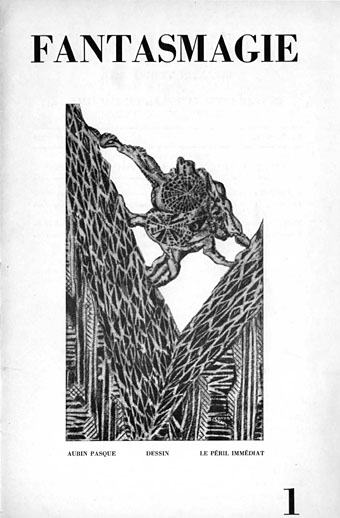
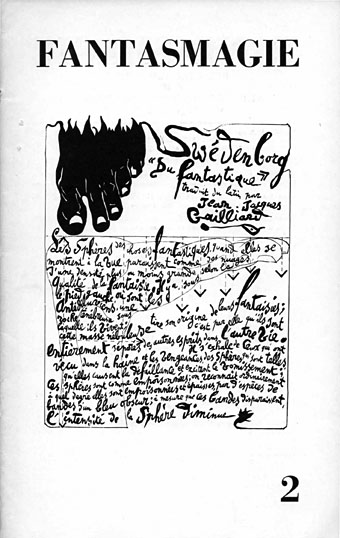
Fantasmagie

fantasmagie01.jpg

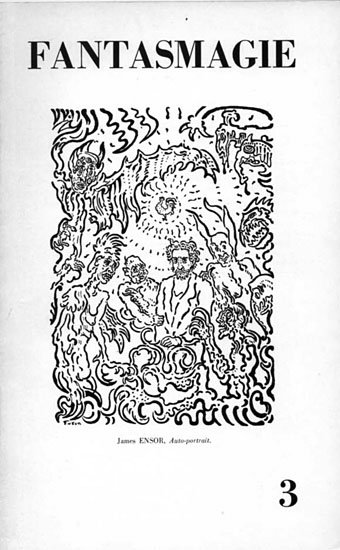
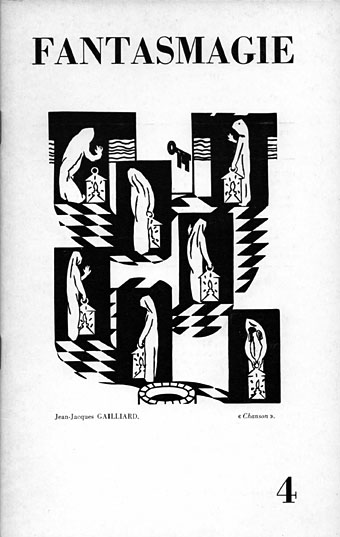
Another post with a Belgian theme (a coincidence despite my present preoccupation with Franco-Belgian culture), and another that has to be filed under “further research required”. The splendidly titled Fantasmagie was founded by author Serge Hutin and artist Aubin Pascale, and was the newsletter/review for the Centre International pour l’étude de l’Art Fantastique et Magique. 52 issues were published from 1959 to 1979 charting the Belgian continuation of the Surrealist project.

fantasmagie02.jpg

I’d been hoping there might be a collection of all the issues online somewhere but this isn’t the case to date. However, the first 11 issues may be browsed in full at Scribd or downloaded if you use one of the PDF scrapers (search for “Scribd free”). Each issue showcases art by contemporary Surrealists or practitioners of what Ernst Fuchs called Fantastic Realism, all of which was of little interest to the art establishment of the time so from our perspective the artists are fresh discoveries. Issue 8, which is a collage special, is especially good.

fantasmagie03.jpg

fantasmagie04.jpg

Continue reading “Fantasmagie”

Weekend links 463

eye.jpg

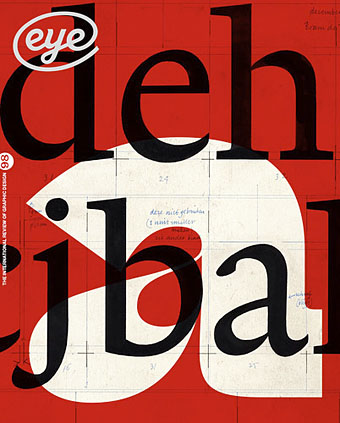
Eye 98: Beatrice Display Black, Sharp Type, 2018, and a detail from an original drawing for Lexicon by Bram de Does, 1989.

• Issue 98 of Eye, the international design journal, is out this month. The new issue is a typography special but also features my review of Mark Dery’s Born to be Posthumous: The Eccentric Life and Mysterious Genius of Edward Gorey. This is the second time I’ve written about Dery’s book, with the new piece focusing more on Gorey’s work as a designer/book creator, and his place in the history of illustration.

• Portal is a new release by Slovakian metal band Doomas, the artwork of which adapts one of my illustrations for Lovecraft’s Monsters. The band also have a suitably Lovecraftian video.

• Reading recommendations by M. John Harrison: the old (the excellent Rogue Moon by Algis Budrys) and the new (Underland et al).

I first started drawing in my Wake to count the number of rivers mentioned in an episode, one page alone counting 85. Gradually, I would be so moved by a line or a character I would colour them in, the most obvious being the 28 Rainbow girls to the more obscure nebulae, railroad tracks, hidden mythical islands and turn of the century lightships. Themes began to emerge which demanded documentation and always the sad, ecstatic relief of finishing a chapter merited some sort of coloured tribute. By the time I finished four years later, I simply drew a leaf to reflect Joyce’s metaphor on the last page: my leaves have drifted from me. All. But one clings still.

Susie Lopez on Finnegans Wake at 80

• Old ghosts at The Paris Review: a preview of The Spectacle of Illusion by Matthew L. Tompkins.

• At Dangerous Minds: Malcolm McDowell and the making of Lindsay Anderson’s O Lucky Man!

• Herbie Hancock: “I felt like I stood on the shoulders of giants and now it’s my turn”.

• Mix of the week: XLR8R Podcast 590 by Christian Löffler.

• The discography of Diamanda Galás is now at Bandcamp.

• RIP Quentin Fiore, graphic designer and book creator.

• At Dennis Cooper’s: Haunted dolls.

• Antique Doll (1967) by The Electric Prunes | The Doll’s House (1980) by Landscape | Voodoo Dolly (1981) by Siouxsie And The Banshees

Synapse: The Electronic Music Magazine, 1976–1979

synapse01.jpg

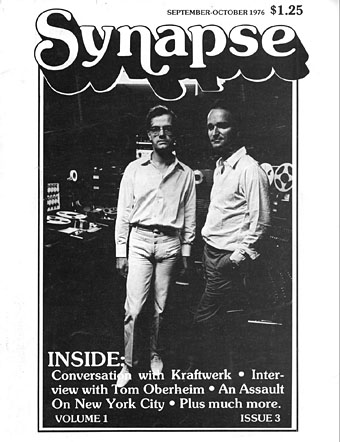
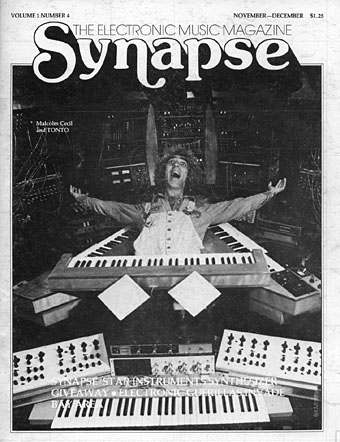
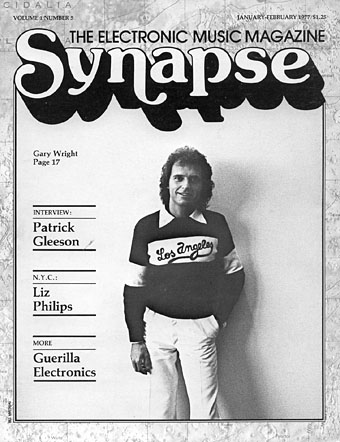
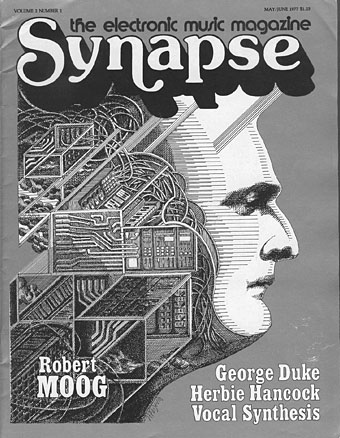
Synapse magazine has been mentioned here before, but only briefly in a weekend post. Looking last week for one of the back issues revealed that the scans of the magazine placed online by the publishers in 2012 have now vanished so this post links to an archive of PDFs at Monoskop. The publishers didn’t have copies of the first two issues so the run begins with issue 3.

synapse02.jpg

Synapse wasn’t around for very long but it’s of great interest for people like myself who have an enthusiasm for the analogue synthesizer music of the 1970s. The magazine was small but managed to secure interviews with major synthesists of the period (and Stockhausen!), as well as lesser-known figures who you wouldn’t expect to see in the general music press. Tangerine Dream and Brian Eno have never been starved of attention but the interviews with Isao Tomita and Michael Hoenig are valuable ones; the latter discusses his earlier career in the Kosmische band Agitation Free as well as his new album, the very Tangerine Dream-like Departure From The Northern Wasteland.

synapse03.jpg

Elsewhere in the magazine there are the usual technical articles that were common in journals of this type (the border between art and engineering in the early synthesizer world used to be as permeable as it was in the first decades of science fiction); and the latest synth-related albums receive reviews, many of which are more equivocal than you might expect. It’s a surprise seeing an album such as Ricochet by Tangerine Dream being treated with scepticism but then the reviewer evidently preferred the recordings of the group’s pre-Virgin period. Likewise, Kraftwerk were featured in the third issue but their Man-Machine album is given the same “Is this the future we really want?” appraisal they used to receive from the rock press.

synapse04.jpg

As always with old magazines, the ads are often as interesting as the editorial, and Synapse is filled with promotional material for a wide range of synth gear, from the major keyboard manufacturers to tiny electronic companies. It’s not every magazine where you can see a full-page command to “Trade in your Mellotron”.

• Synapse contents list at Wikipedia

synapse05.jpg

Continue reading “Synapse: The Electronic Music Magazine, 1976–1979”

The Dial

dial01.jpg

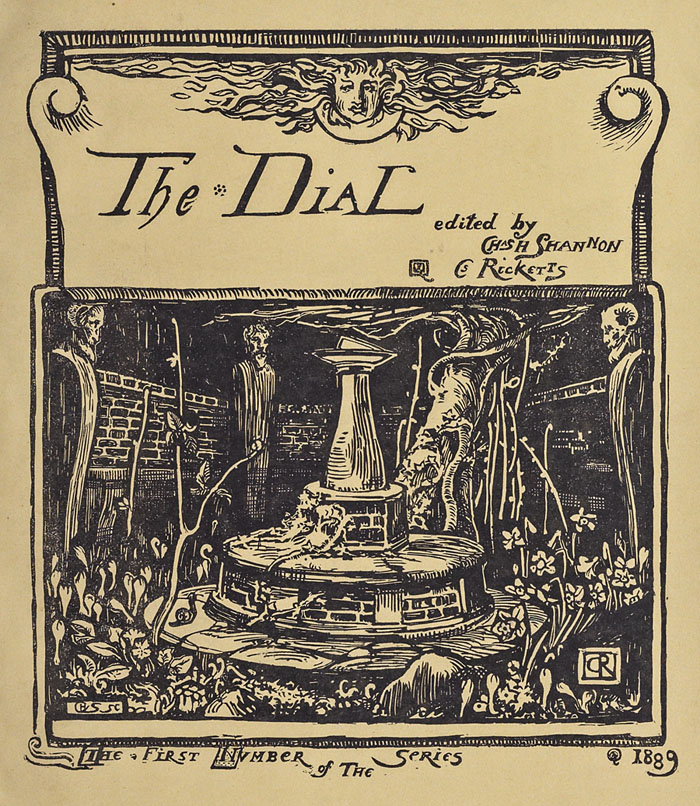
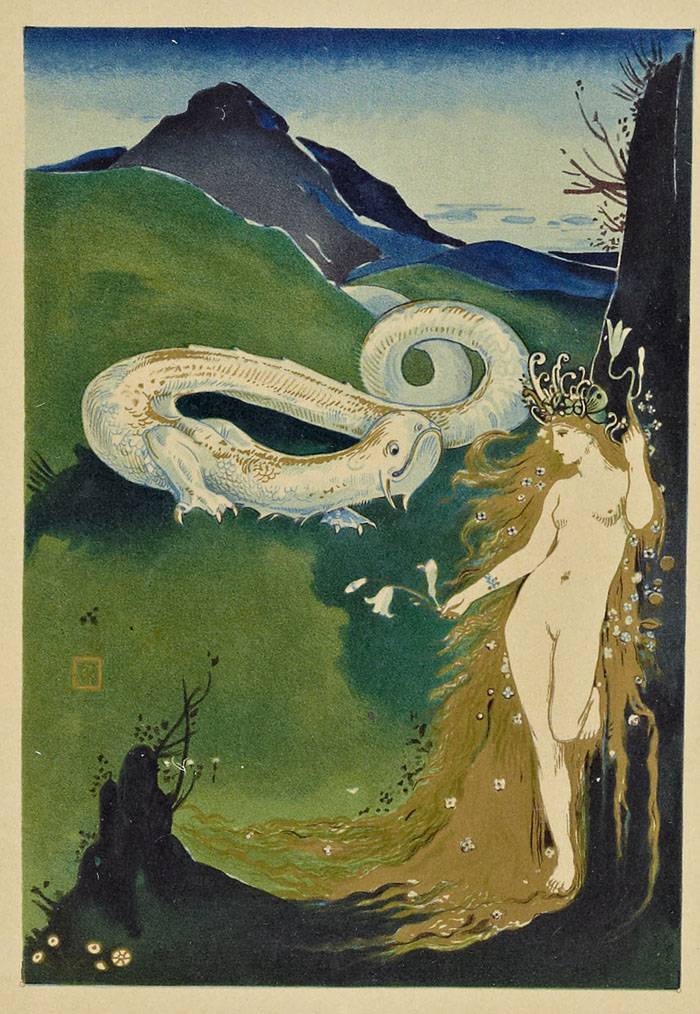
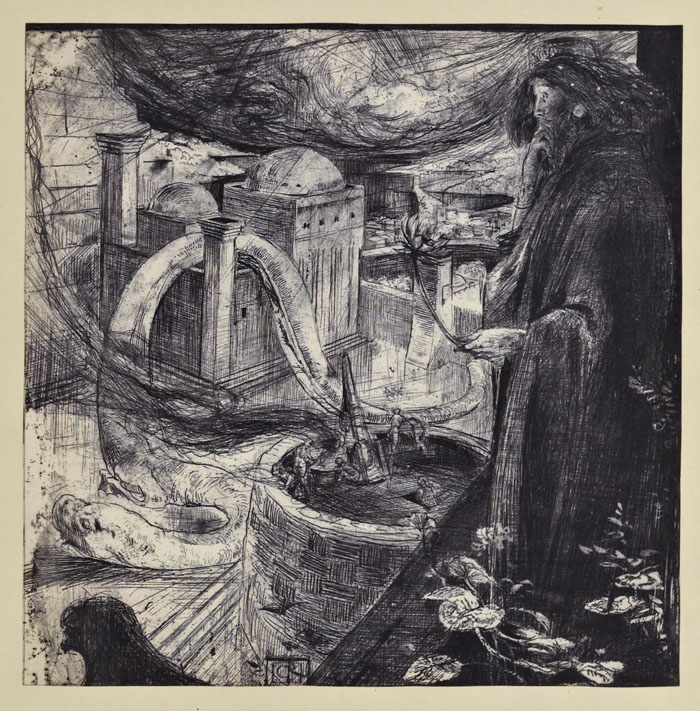
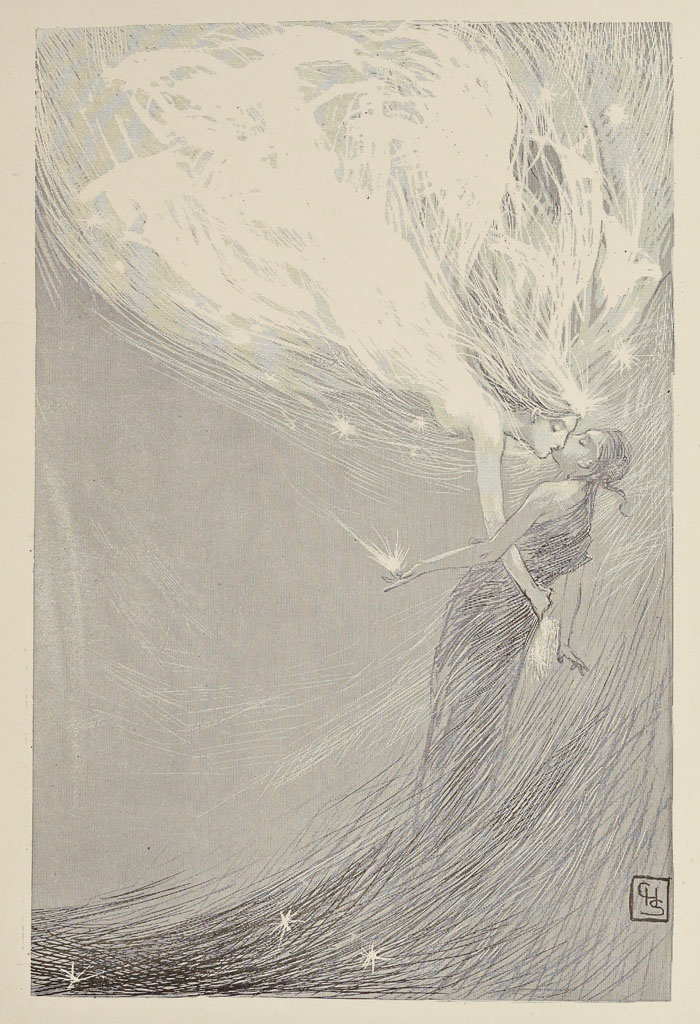
Yet another fin de siècle journal which we can now see in its entirety, The Dial was a short-lived British publication which expired at a time when more prominent titles were being launched. The publishers were Charles Ricketts and Charles Shannon, a couple who were partners in life as well as art and publishing, and members of Oscar Wilde’s small circle of circumspect gay and lesbian friends. Ricketts and Shannon published some of Wilde’s poetry—notably a beautiful edition of The Sphinx—and followed the William Morris ideal of using traditional techniques for art and printing rather than relying on the line block. Most of the illustrations in The Dial are woodcuts although Ricketts and Shannon also produced etchings and the occasional painting, as with Ricketts’ Moreau-like piece below. Many of the Dial pieces have been reprinted in books about the pair but these never show you everything so the journals contain a number of smaller works I hadn’t seen before. The Dial ran for five issues from 1889 to 1897. The Internet Archive has a couple of sets of which these are the better copies:

• Issue 1 | Issue 2 | Issue 3 |Issue 4 | Issue 5

dial02.jpg

dial03.jpg

dial04.jpg

Continue reading “The Dial”