MCMLXX

data70.jpg

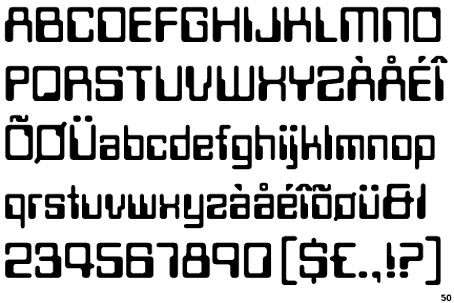
Data 70, a typeface by Bob Newman.

The presence of electronic artists Data 70 in the Spatial mix at the weekend had me thinking about the preponderance of cultural items that were given “70” as a suffix in the 1960s or in the year 1970. The air of futuristic optimism in the 60s drew attention to the birth of a new decade in a manner that hadn’t really happened before, and certainly didn’t happen for 1980 by which time the optimism had been sunk by a decade of political and fuel crises, and the end of the space race.

Data 70 take their name from the “futuristic” computer-like typeface designed by Bob Newman in 1970. Newman’s typeface wasn’t the first of the Space Age designs—Colin Brignall’s Countdown appeared in 1965—but Data 70 was everywhere in the 1970s. Data 70 (the group) dedicated a piece of music to Newman.

A few more 70s follow. These are only the ones I’ve been able to remember or stumble across so I’m sure there are more. And note: to qualify for this micro-category something has to be named “70” only where the suffix signifies modernity or the future, no Expo 70 (the world’s fair in Osaka) or anything annual that happened to be labelled 70 as part of a series.

boccaccio.jpg

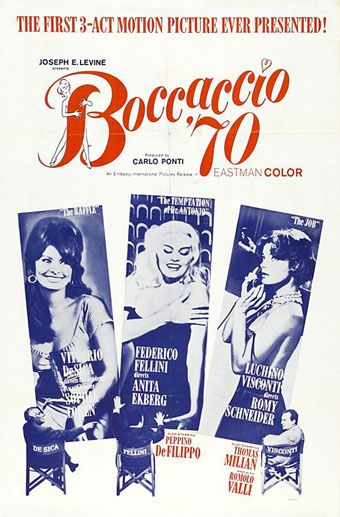
Boccaccio 70 (1962).

The label might imply the future but the predominant tone of these entries is sex. Boccaccio 70 set things in motion by updating the Decameron to modern Italy. Despite the claims of the poster, anthology films are nothing new, and this one has four stories directed by Vittorio De Sica, Federico Fellini, Mario Monicelli and Luchino Visconti. Italo Calvino was one of the writers.

Continue reading “MCMLXX”

Weekend links 233

casas.jpg

Alchemical Stone (2014) by Daniel Lasso Casas. Via full fathom five.

• “I am unsure if this reality is an everyday one. We don’t know if the universe belongs to a realist genre or a fantastic one, because if, as idealists believe, everything is a dream, then what we call reality is essentially oneiric.” Jorge Luis Borges in 1984 in conversation with Argentinian poet and essayist Osvaldo Ferrari.

• “I am transgender, so ‘he’ is not appropriate and ‘she’ is problematic. I’m what I think of as pure transgender.” Antony Hegarty talks to Cian Traynor about Turning, a new DVD and album project.

Unearthing Forgotten Horrors 2014 is a weekend festival of rural weirdness at the Star and Shadow Cinema, Newcastle-upon-Tyne.

Henry Darger, one of the most celebrated examples of an outsider artist (see: Vivian Girls), has been uniformly ignored by the literary firmament. Despite the success of his artwork, none of his fiction manuscripts have seen print. The language of literature is the language of privilege, in which even the stories of the working class are regularly clad in a bourgeois prose. The language of literature cannot be extricated from its white, genteel roots. Those of us without access to education are welcome to practice, but we must come in from the cold, adopt the house language. We must be civilized, scrubbed clean. Naiveté has no place in the colosseum of words.

Ravi Mangla on Coming in from the Cold: Outsider Art in Literature

Carel de Nerée tot Babberich en Henri van Booven, a collection of Beardsley-like drawings by a neglected Dutch artist.

Forever Butt is a new collection of the best of recent issues of BUTT magazine, still the best print mag for gay men.

Anne Billson’s guide to Brussels, another European city I’d like to visit some day.

• At BibliOdyssey: Schönschreibmeister, a calligraphy master’s album.

Third Ear Band live (and in colour!) on French TV in 1970.

• Mix of the week: Secret Thirteen mix 132 by Spatial.

• The Internet Archive now has an Internet Arcade.

Crazy Cat Lady Clothing

The Pattern Library

Stone Circle (1969) by Third Ear Band | Sacred Stones (1992) by Sheila Chandra | Stoned Circular I (1996) by Coil

Weekend links 231

advisory.jpg

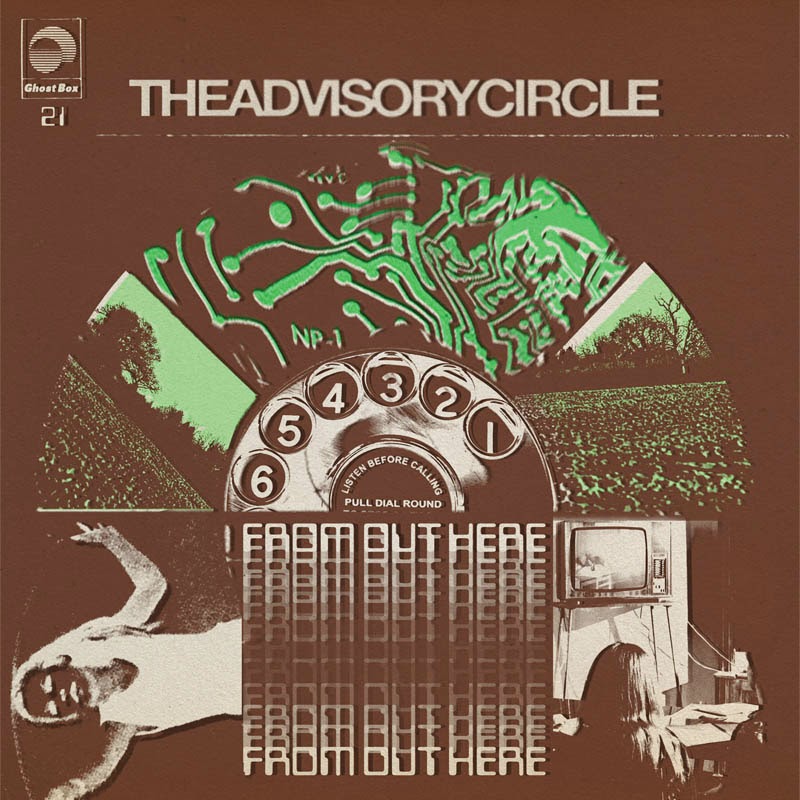
Design by Julian House.

Always good to hear of a new release on the Ghost Box label, and a new album by The Advisory Circle (due on 5th December) is especially welcome. From Out Here is described thus: “Exploring darker territory than 2012’s more pastoral As The Crow Flies, The Advisory Circle hint at a Wyndham-esque science fiction story, where bucolic English scenery is being manipulated and maybe even artificially generated by bizarre multi-dimensional computer technology.” The Belbury Parish Magazine has extracts.

• Jon Hassell’s Fourth World Music Vol. I: Possible Musics receives a long-overdue reissue next month. Possible Musics was a collaboration with Brian Eno, and Eno has some of his own albums reissued again in expanded editions. Most notable is the first official release of My Squelchy Life, an album that was withdrawn in 1991 to be replaced by Nerve Net.

• Some Halloween theatre on Friday (the 31st) at the Museum of Bath at Work with a dramatisation of Ringing the Changes by Robert Aickman. There’s a repeat performance the following week (8th November) with added spectral atmospherics from the Electric Pentangle. Free admission.

The value of these books wasn’t anything wholesome they contained, or any moral instruction they offered. Rather, it was the process of finding them, the thrill of reading them, the way the books themselves, like the men they depicted, detached you from the familiar moral landscape. They gave a name to the palpable, physical loneliness of sexual solitude, but they also greatly increased your intellectual and emotional solitude. Until very recently, the canon of literature for a gay kid was discovered entirely alone, by threads of connection that linked authors from intertwined demimondes. It was smuggling, but also scavenging. There was no internet, no “customers who bought this item also bought,” no helpful librarians steeped in the discourse of tolerance and diversity, and certainly no one in the adult world who could be trusted to give advice and advance the project of limning this still mostly forbidden body of work.

Smuggler: A Memoir of Gay Male Literature by Philip Kennicott

• Getting in before the Mixcloud Halloween rush, mix of the week is Samhain Seance 3: Better Dead Than Never by The Ephemeral Man. My Halloween mix for this year is almost finished; watch the skies.

• For those who can’t wait until December for From Out Here, there’s a new Howlround album, Torridon Gate, out this week from A Year In The Country.

• Last week, Yello’s Boris Blank was choosing favourite electronic albums, this week he runs through a list of thirteen favourite albums.

Altered Balance: A Tribute to Coil by Jeremy Reed & Karolina Urbaniak. Richard Fontenoy reviewed the book for The Quietus.

Cut-Ups: William S. Burroughs 1914–2014, an exhibition of Burroughs’ typescripts at Boo-Hooray, NYC, from 7th November.

Brando, a film by Gisèle Vienne for the song by Scott Walker & Sunn O))).

NASA has a Soundcloud page

The art of leaves

Cobra Moon (1979) by Jon Hassell | Moon On Ice (1987) by Yello feat. Billy MacKenzie | Moon’s Milk Or Under An Unquiet Skull Pt. I (1998) by Coil

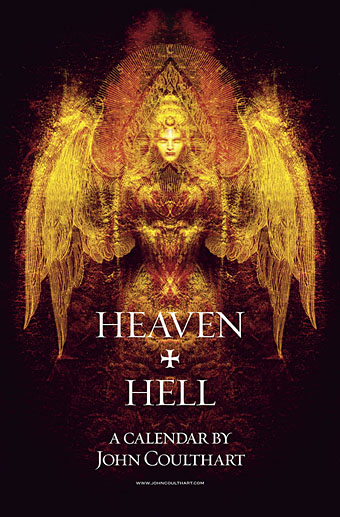
Heaven and Hell calendar

heavenhell00.jpg

Painting from the poster art for The Highbury Working (2000) by Alan Moore & Tim Perkins.

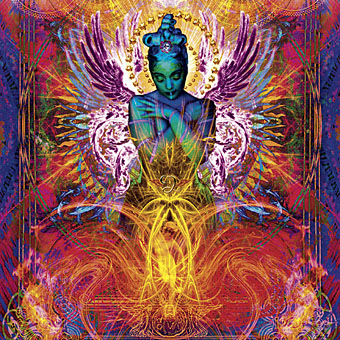
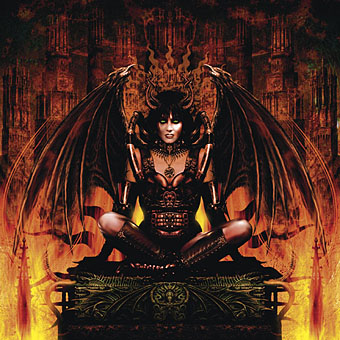
Unlike last year, this year’s CafePress calendar arrives on time, its creation being eased by the fact that it’s a reworking on an earlier version. The idea with the previous Heaven & Hell calendar had been to alternate various pieces of infernal Cradle of Filth artwork with contrasting imagery; as things turned out I had more offerings for Hell than for Heaven—no surprise there—so the reality wasn’t very satisfying.

This year I’ve managed to fill out the Heaven sequence with more recent works, all of which have been slightly adjusted to fit the square page ratio required by CafePress. So even though these are old pieces many of them are unique to this printing. Larger copies of the pages may be seen here while the CafePress purchase page is here. As always, my thanks to everyone who buys these things.

And as before, the calendars for previous years are now available all year round; see the full range here. Note that this means you need to select January as the starting month if you want the months to run for a single year only.

heavenhell01.jpg

JANUARY: Variation of the poster art for Angel Passage (2001) by Alan Moore & Tim Perkins.

Angel Passage was Alan and Tim’s album about the life and work of William Blake. I designed the CD, a poster, and also produced a video for the multi-media performance of the piece at the Purcell Room, London, in February 2001.

heavenhell02.jpg

FEBRUARY: Cover for Bitter Suites To Succubi by Cradle of Filth (2001).

My first piece of Cradle of Filth art. I was a little surprised when working on this that they really did want the wings and horns; Dani loved that kind of imagery. I was even more surprised when this cover was subsequently showcased in an entire window in Tower Records’ main London shop in Piccadilly.

Continue reading “Heaven and Hell calendar”

Weekend links 230

bebergal.jpg

Cover art by Arik Roper.

Peter Bebergal’s Season of the Witch: How the Occult Saved Rock and Roll was published this week. Articles about rock music’s occult preoccupations have been a recurrent feature of music magazines, especially around Halloween, but Bebergal’s book is the first attempt at a wide-ranging, full-length study. Despite the subtitle, the scope goes beyond the familiar—David Bowie’s Golden Dawn references, Jimmy Page’s Aleister Crowley obsession—to take in the pagan nature of the blues, pre-Beatles rock’n’roll, and the byways of electronic music. My old employers, Hawkwind, provide a title (Space Ritual) for one section, and I was pleased to see the Krautrock scene receiving some attention: years ago you couldn’t have counted on this from an American music study. As Bebergal notes, Can’s Aumgn on Tago Mago (1971) isn’t the hippy Aum/Om but originates in a mantra defined in Crowley’s Magick in Theory and Practice.

• “We don’t just have skeletons in our cupboard, we have an ossuary.” Another week, another Alan Moore interview, but Tim Martin‘s piece is as much a portrait of the man as a conversation about the usual subjects: art, science, magic, etc.

• “Europe’s history of penis worship was cast aside when the Catholic Church realized Jesus’s foreskin was too potent to control.” Stassa Edwards on venerated members.

Gays and horror actually have  somewhat of a lost history. FW Murnau, the director of Nosferatu, was openly gay. Frankenstein’s real creator, James Whale, was also out. Given the talent involved, and the illicit nature of the genre, amateur and professional critics have been divining queer themes from horror films for decades.

Patrick Rosenquist on Gory, Gay & Loving It: Why Homosexuals Heart Horror

• “I thought that fine art was fairly dishonest as an industry. It pretends to be about culture but it’s really about money.” Andy Butler interviews designer Neville Brody.

• Snapping, Humming, Buzzing, Banging: Richard B. Woodward on the creative partnership between David Lynch and sound-design genius Alan Splet.

• Also published this week: Discovering Scarfolk, Richard Littler’s guide to the occult-obsessed, rabies-infested English town.

• More rock music: When Art Rocked: San Francisco Music Posters, 1966–1971 by Ben Marks.

• The trailer for 808, a documentary about Roland’s celebrated drum machine.

• At The Millions: Devin Kelly on the collaborative art of words and images.

• More Crowley: Strange Flowers goes looking for Aleister Crowley’s Berlin.

• Mix of the week: Secret Thirteen Mix 130 by Gábor Lázár.

• Yello’s Boris Blank on his 10 favourite electronic records.

Richard Hirst‘s Top 5 Robert Aickman Stories.

I Put A Spell On You (1968) by Arthur Brown | I Put A Spell On You (1992) by Diamanda Galás | I Put A Spell On You (2004) by Queen Latifah