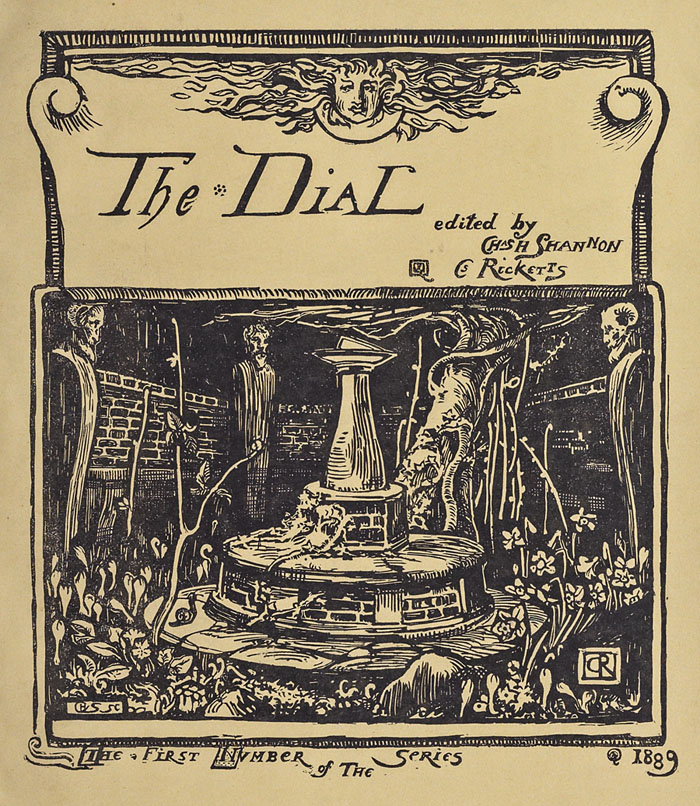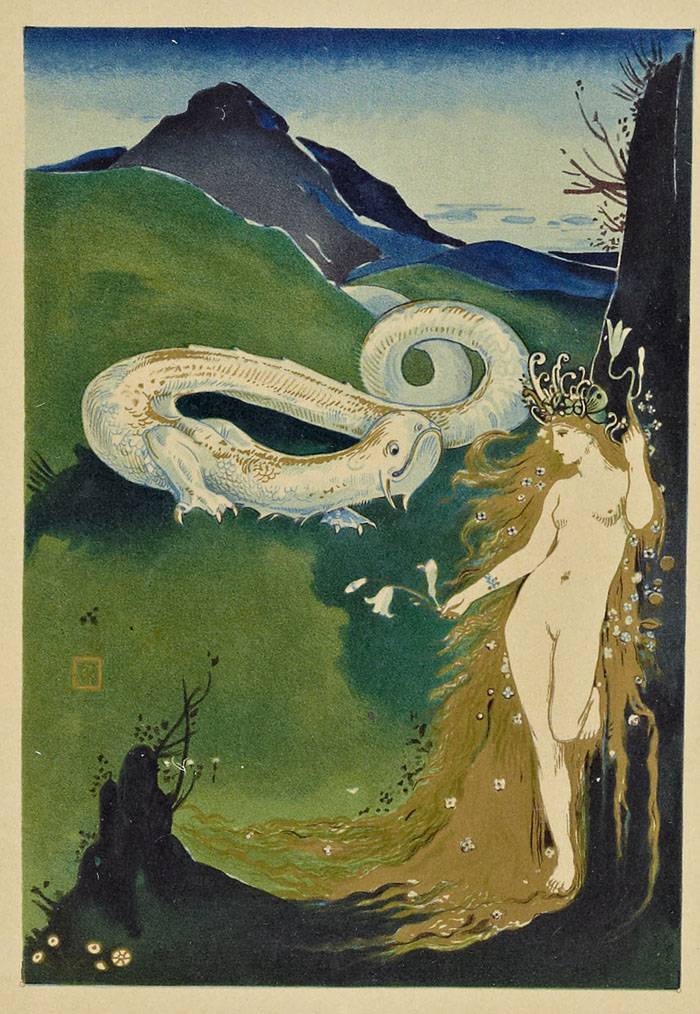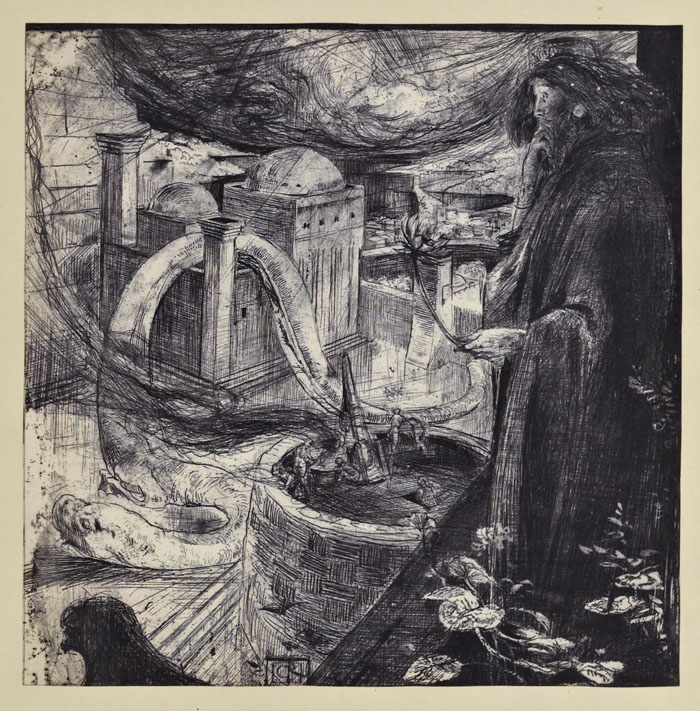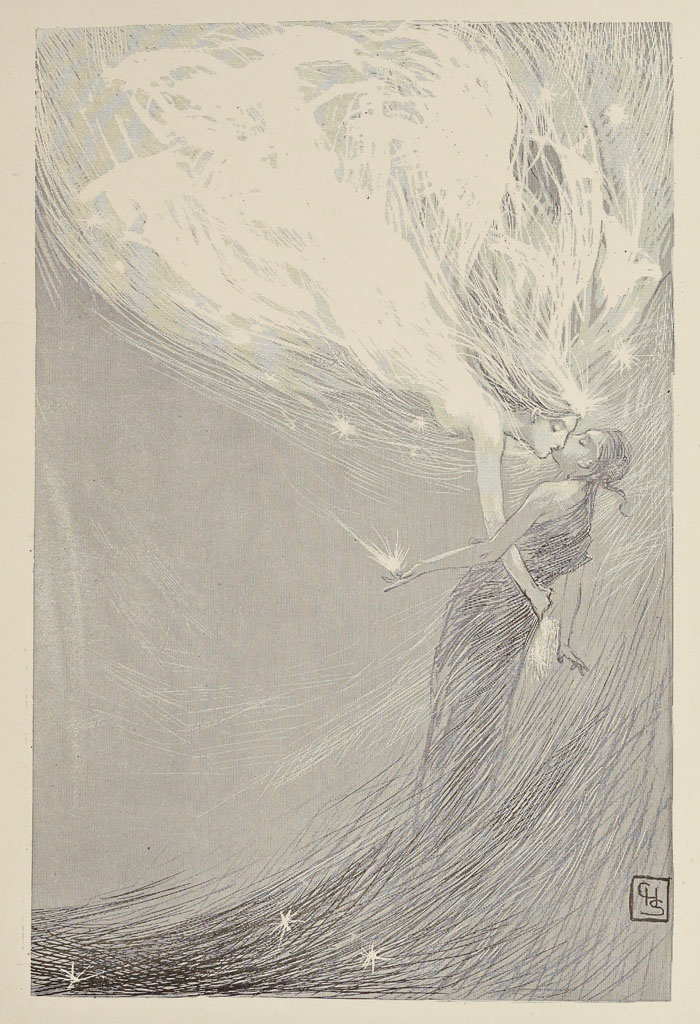
Yet another fin de siècle journal which we can now see in its entirety, The Dial was a short-lived British publication which expired at a time when more prominent titles were being launched. The publishers were Charles Ricketts and Charles Shannon, a couple who were partners in life as well as art and publishing, and members of Oscar Wilde’s small circle of circumspect gay and lesbian friends. Ricketts and Shannon published some of Wilde’s poetry—notably a beautiful edition of The Sphinx—and followed the William Morris ideal of using traditional techniques for art and printing rather than relying on the line block. Most of the illustrations in The Dial are woodcuts although Ricketts and Shannon also produced etchings and the occasional painting, as with Ricketts’ Moreau-like piece below. Many of the Dial pieces have been reprinted in books about the pair but these never show you everything so the journals contain a number of smaller works I hadn’t seen before. The Dial ran for five issues from 1889 to 1897. The Internet Archive has a couple of sets of which these are the better copies:
Category: {gay}
Gay
Weekend links 452

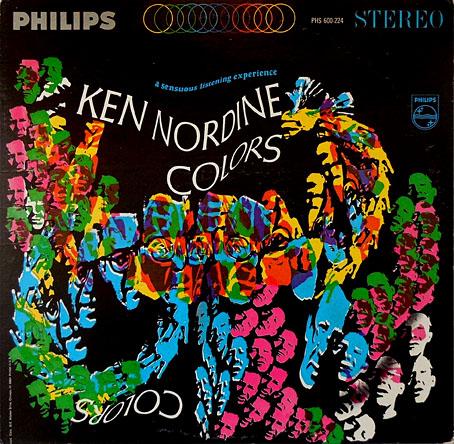
Colors (1967) by Ken Nordine.
• “The Do was the thing”: a lengthy chat with Chuck Gould of the San Francisco Diggers. The second interview from Jay Babcock’s oral history of the Diggers.
• Sticking it to the Man: Revolution and Counterculture in Pulp and Popular Fiction, 1950–1980 edited by Andrew Nette and Iain McIntyre.
• Adrian Shaughnessy‘s Krautrock Top Ten. (People who know me well won’t be surprised to hear that I own everything on this list.)
See “queer” as a term has become an umbrella that accommodates not only the type of sex you have and with whom, but also how you identify the sex you have, how you identify your personality, your aura, the ineffable je ne sais queer that may or may not be related in any way to your sexuality, or even the way you present yourself to the world, but simply some deeply held, internal feeling. You don’t actually need to share a common oppression or a common romantic or sexual behavior.
[…]
The reason I mind is because queer, in functioning as a catchall, serves to obscure what it is about my life, my community, my partners, that I needed to learn to be proud of in the first place. Because for me and all the other lesbians I know, figuring out your sexuality is hard enough, but the real work is in accepting yourself, demanding acceptance from others, being willing to walk away when that acceptance is denied.
Lesbians are women, and women are taught that we’re supposed to be sexually available objects of public consumption. So we spend a lot of time saying “No.” No, we won’t fuck or partner with men; no, we won’t change our minds about this; no, this body is a no-man’s land. Lesbian, straight or bi, women are punished whenever we try to assert a boundary. Queer as a catchall term makes it really hard for lesbians to assert and maintain this boundary, because it makes it impossible to name this boundary.
Jocelyn Macdonald on how the increasing dilution and commodification of “queer” as a label does little to serve the interests of the people to whom it was applied in the first place
• Two sets of live electronica from last year: Pye Corner Audio at The State51 Factory, and Tangerine Dream at Dekmantel.
• “LSD can get deep down and reset the brain—like shaking up a snow globe,” says Amanda Fielding.
• Ewan Wilson on the impossible architecture of video games.
• Mix of the week: Secret Thirteen Mix 279 by Marcos Cabral.
• RIP Betty Ballantine, Bruno Ganz and Ken Nordine.
• At Dennis Cooper’s: They will never exist.
• Cosi Fanni Tutti‘s favourite records.
• She Comes In Colors (1967) by Love | Colors (1969) by Pharoah Sanders | Balthus Bemused By Color (Mix II) (1988) by Harold Budd

Weekend links 451
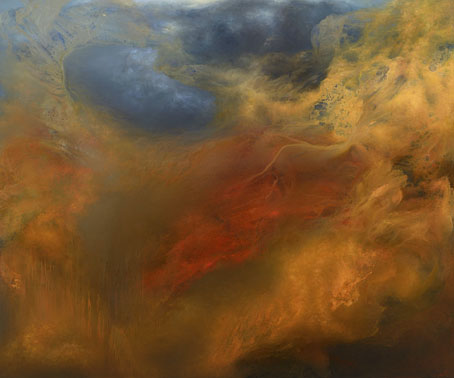
Manifold (2015), a painting by Samantha Keely Smith which will appear in April on the cover of Life Metal, a new album by Sunn O))).
• At Expanding Mind: Professor and queer historian Heather Lukes talks with Erik Davis about Silver Lake riots, gay bikers, house ball scenes, the nostalgia for repression, and the joys and challenges of working on the online archive The Grit and Glamour of Queer LA Subculture.
• A Stroke of Ingenious: Chatting Fear and Fantasy with Darius Hinks. Also this week, Darius Hinks’ The Ingenious (for which I created the cover art) was featured in a Barnes & Noble list of seven attractive (if hazardous) fantastic cities.
• “From the late ’60s and through the ’70s broadcasters invested in home-grown kids’ television, and much of it was decidedly weird.” Paul Walsh on the vanished, thought-provoking strangeness of British TV.
That late surrealism still needs rescuing by curators and critics is perhaps not a sign of its defeat but of the breadth and pervasiveness of its triumph. Could we have Pablo Picasso or Jackson Pollock without surrealism? What about David Lynch, JG Ballard or Angela Carter? As an influence, it’s easy to give [Dorothy Tanning] a crucial place in the canon of feminist art. Louise Bourgeois was born just a year later than Tanning but only started to sew after Tanning had exhibited her first sculptures.
Lara Fiegel on the weird, wild world of Dorothea Tanning
• After its own death / Walking in a spiral towards the house by Nivhek, a new album from Liz Harris (Grouper) “recorded using Mellotron, guitar, field recordings, tapes, and broken FX pedals”.
• At Dangerous Minds: Michael Rother (Neu!/Harmonia) on the forthcoming reissue of his solo albums from the 1970s.
• Clesse by Clesse, another pseudonymous musical project by Jon Brooks (The Advisory Council et al).
• After Dark: The art of life at night—and in new lights by Francine Prose.
• Elena Lazic on where to begin with Gaspar Noé.
• Mix of the week: Headlands by David Colohan.
• Steven Heller‘s confessions of a letterhead.
• RIP Albert Finney.
• Void (2009) by Monolake | Void (2013) by Emptyset | Void (2014) by The Bug feat. Liz Harris
Weekend links 449
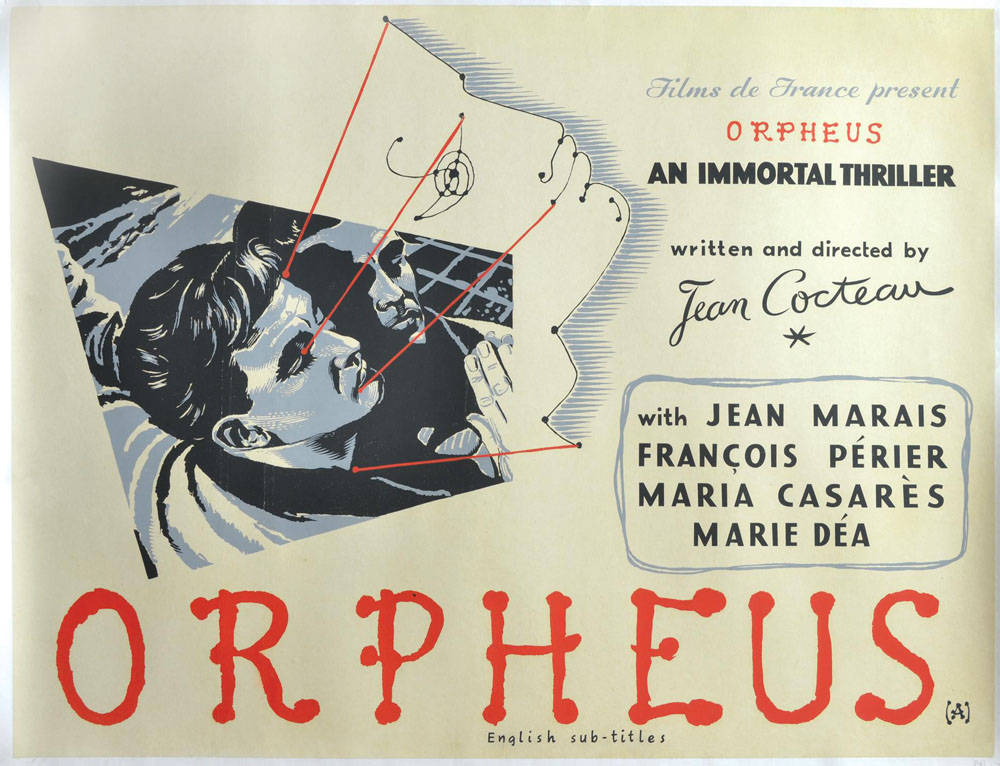
UK poster, 1950. Cocteau’s film receives a UK blu-ray release this week.
• Into the Zone: 4 days inside Chernobyl’s secretive “stalker” subculture by Aram Balakjian. (Again. There’s an implication in Balakjian’s piece that illicit Chernobyl tourism is a new thing even though people have been doing this for a while now.) Related: Jonathan’s visit to the Chernobyl reactor control room, and photos of Soviet-era control rooms (plus a couple of stray American examples).
• “He’s a very interesting author: a disabled, gay writer during the Third Reich…who somehow survived only to be shot by a Red Army patrol days before the end of the war.” At the Edge of the Night (1933) by Friedo Lampe will receive its first English-language publication via Hesperus Press next month.
• “The tradition of the painted still life has been reinvented by contemporary photographers with pictures that pose a puzzle and slow the viewer down,” says Rick Poynor.
• Comic artist Matt Howarth has been writing short reviews of electronic music for many years. Sonic Curiosity is his archive site.
• Bauhaus at 100: what it means to me by Norman Foster, Margaret Howell and others.
• RIP Jonas Mekas. Related: a conversation between Jonas Mekas and Jim Jarmusch.
• Beyond the Buzzcocks: Geeta Dayal remembers Pete Shelley‘s electronic side.
• Where to begin with Jean Cocteau: Alex Barrett goes through the mirror.
• Mix of the week: Secret Thirteen Mix 278 by Sarah Louise.
• At Dennis Cooper’s: Jud Yalkut Day.
• Undulating Terrain (1995) by Robert Rich & B. Lustmord | Darkstalker (2000) by Bohren & Der Club Of Gore | Stalker Dub (2012) by John Zorn
Weekend links 448

Gas Tanks 1965–2009 by Bernd Becher and Hilla Becher.
• At Dangerous Minds: the drawings produced by Moebius for Maxwell House in 1989 are better than the coffee whose sales they were intended to assist.
• Jarman Volume 2: 1987–1994, the BFI’s second collection of Derek Jarman films, is now available for pre-order.
• More Gorey: Cara Giaimo on Edward Gorey’s hoards and collections.
That movie [Susan Slade]—and I even have the paperback novelization of it—is a moment. That’s a perfect example. They would never release that image as a still of the movie. Come see a baby catch on fire! To me, I’m kind of rewriting the films as these scenes. That was a real shock to me as a teenager when I saw that. And I thought, Did that just happen? Her baby caught on fire? I remember in Serial Mom I had a big fight with a film executive who said that you can’t have her set her kid’s friend on fire. You can’t do that. And I said, “Why, it’s been in movies forever.” And I’m thinking of Susan Slade, but I’m thinking there’s no point using that in the argument.
John Waters talking to Gina Telaroli about his films but mostly about his works for the art gallery
• Georgina Guthrie on how green became cinema’s loneliest colour.
• Tom Crewe reviews Edward Burne-Jones at Tate Britain.
• Mix of the week: FACT Mix 688 by Steve Hauschildt.
• At Strange Flowers: 19 books for 2019.
• Jenzeits Cosmic Worlds by Jenzeits.
• Green Onions (1962) by Booker T. & The MGs | Green (1966) by Ken Nordine | Green Fuz (1969) by Randy Alvey And The Green Fuz