Weekend links: Ghosts, Spooks and Spectres edition

spectres.jpg

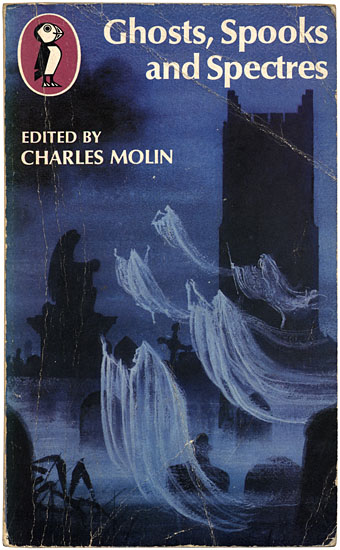
Cover design by Philip Gough.

Ghosts, Spooks and Spectres (1972 reprint). Editor Charles Molin collected nineteen ghost stories by writers including Oscar Wilde (The Canterville Ghost), Charles Dickens (The Signal-Man), J. Sheridan Le Fanu (Madame Crowl’s Ghost) and HG Wells (The Inexperienced Ghost). This was one of my favourite books when I was ten-years old. There’s nuffin like a Puffin. Puffin Books’ parent company, Penguin, is 75 this year.

• The good people at the Outer Alliance have posted an interview with me here in which I talk about the subversive sexualities of sf in the 1970s and also admit to writing fiction.

• There’s just time to mention It Came From Pebble Mill, an event which includes another screening of David Rudkin’s Penda’s Fen.

• “In our society, there has tended to be a very strong compartmentalization of different experiences, different cultural forms, different genres. We can talk in a very broad sense and say art is separate from science, for example, or body is separate from mind, or we can talk in a specific sense and say one certain form of dance music is separate from one form of, say, heavy metal. I don’t really buy those compartmentalizations. I understand why they exist, how they’ve come into being and why they’re convenient, but it’s not the way I think, it’s not the way I experience the world, it’s not the way I believe things should be.” From an interview by Colin Marshall with David Toop at 3QD. Toop’s latest book is Sinister Resonance: The Mediumship of the Listener.

The Kingdom of the Pearl by Léonard Rosenthal, illustrated by Edmund Dulac.

Ghost Stations by Dollboy, a CD package. And then there’s the Ghostly Bento.

7 Inch Cinema are Birmingham-based cultural historians.

• Mark Pilkington’s Mirage Men now has its own site.

Borges on Pleasure Island: JLB and his love of RLS.

• RIP Arne Nordheim, Norwegian composer.

• Charlie Visnic’s Modular Ghost Synth.

On the trail of Tutankhamen’s penis.

Photos by Thom Ayres.

Ghosts by Japan | Spooky Rhodes by Laika | Purple Dusk by Spectre.
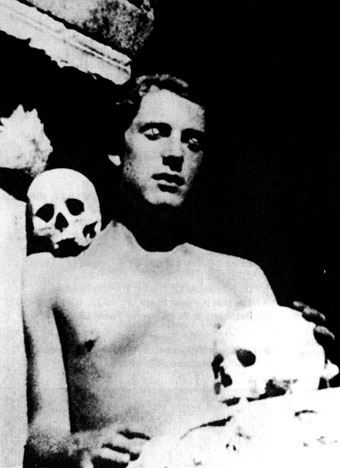
Brion Gysin let the mice in

gysin.jpg

Brion Gysin—autoportrait (1935).

“A shaman to me is always a pansexual being,” says the gay Canadian filmmaker. “These guys all came out of that period where queer was really hardcore, it was part of their radical art — and of course it was illegal.” (more)

The filmmaker in question is Nik Sheehan discussing FLicKeR, his 2007 documentary about artist and writer Brion Gysin. Sheehan’s film is available for viewing at Ubuweb although I haven’t got round to watching it yet so I can’t say much about it. (Reality Studio has a review.) Gysin’s life and work is certainly worthy of study, however, his art and writing—which encompassed novels and experimental poetry—often having been overshadowed by his close association with William Burroughs. He gets a raw deal in Ted Morgan’s curiously bad-tempered biography of Burroughs, for example, despite having given his co-conspirator the cut-up technique, collaborated with him on The Third Mind, and so on. FLicKeR‘s title refers to Gysin’s Dreamachine, the first sculpture which needs to be experienced with the eyes closed, being a homemade hallucination engine which works by flickering light and shadow at a rapid rate on the closed eyelids. I made some Dreamachines of my own in the mid-1980s by carefully studying photos in RE/Search #4/5, and they certainly do work. It’s a shame that 78rpm record players are more difficult to find than they used to be since the original template devised by Gysin and Ian Sommerville needs a high speed in order to create the optimum flicker rate. As you might expect, various psychonauts have since created their own variations such as this one for a 45rpm player.

I mentioned a few weeks ago that the New Museum in NYC is staging the first US retrospective of Gysin’s work, an exhibition which they happen to call Dream Machine, and which opens on July 7th. The New York Times ran a piece about Gysin in advance of that. Ubuweb has further Gysin materials, such as this Burroughs piece about Gysin’s invention of the cut-up method, and some recordings of the permutated poems. Finally, if you’re wondering about the title of the post, it’s a reference to this.

Previously on { feuilleton }
Burroughs: The Movie
William S Burroughs: A Man Within
Emil Cadoo
The Great God Pan
The Final Academy
William Burroughs book covers
Towers Open Fire

Weekend links 20

wulfing.jpg

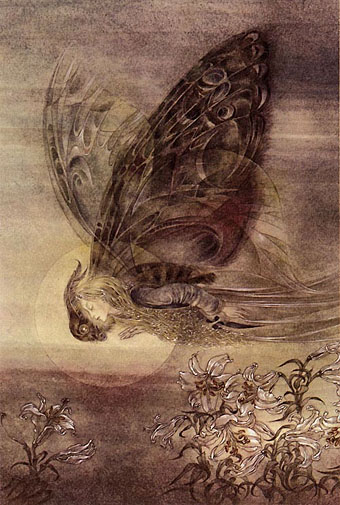
Transfiguration (1952) by Sulamith Wülfing.

• Observatory posted photos of its Lovecraft art exhibition; see if you can spot my pics. Related: Write Club has more photos. Also, A Word From Our Sponsor.

Taking the broooooaaaaad view of things: A Conversation with James Grauerholz on William S. Burroughs and Magick. Related: Beat Memories—The Photographs of Allen Ginsberg.

• Adam Curtis on BP and the Axis of Evil; how the the Anglo-Iranian Oil Company became British Petroleum and helped give Iran over to the Ayatollahs.

• The Quietus interviews Peter Christopherson (TG, Coil, etc) and Dr John.

The Strange World of Adolf Hoffmeister at A Journey Round My Skull.

An Artists’ Dialogue On CocoRosie’s Grey Oceans at Stereogum.

Werner Herzog and David Lynch combine their talents.

Jon Savage on The Residents versus The Beatles.

• BUTT magazine interviews James Bidgood.

• The Daily Drop Cap.

The Gay Rub.

Can on German TV in 1971.

The recurrent pose 36

gaetano.jpg

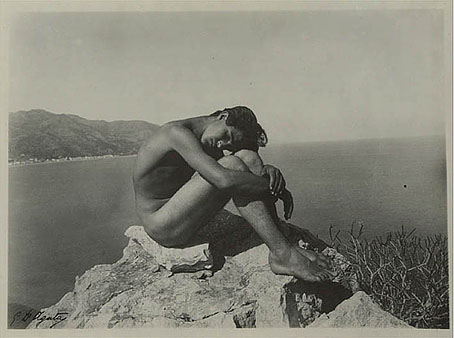
Another antique example of the Flandrin pose. Are you bored yet? Gaetano D’Agata (1883–1949) was one of the photographers who continued a tradition begun by Wilhelm von Gloeden for capturing the youth of Taormina, Sicily, in order to create tasteful prints for those who preferred their erotica to arrive with the vague excuse of Classical allusion. I’ve noted before that von Gloeden was possibly the first photographer to copy Flandrin’s painting, and his example led later photographers to copy him in turn, even borrowing his title, Cain, which reads into the painter’s work a Biblical meaning that seems misplaced. This picture comes from a Flickr selection which includes a similar rendering in postcard form, and also this rather cramped variation.

Elsewhere on { feuilleton }
The recurrent pose archive

Dodgem Logic again

dodgem.jpg

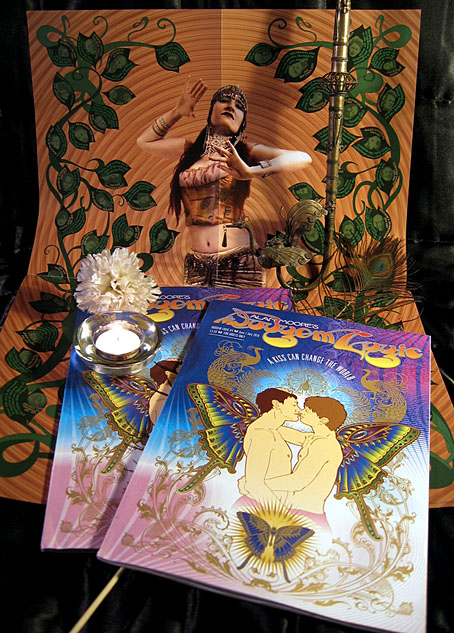
Look what the postman delivered. Well, not the peacock feather and candle, obviously… Dodgem Logic #4 is now in print and my cover design looks as splendid as I hoped, gold ink included. The bonus item for this delirious issue is the rather wonderful poster you see in the background, a Joe Brown & Alan Moore collaboration entitled Bohemia which features a burgeoning growth of Bohemians through the ages, from Sappho through to more contemporary cultural icons. Inside there’s Dick Foreman discussing psychedelia, comics from Steve Aylett, Barney Farmer, Lee Healey, Kevin O’Neill and Savage Pencil, Melinda Gebbie’s gorgeous paintings, Debbie Delano on how to be an openly gay school teacher, Steve Moore asking for no more war, and Mister Alan Moore giving us his personal history of science fiction. You can order it online here.

Previously on { feuilleton }
Dodgem Logic #4
Dodgem Logic