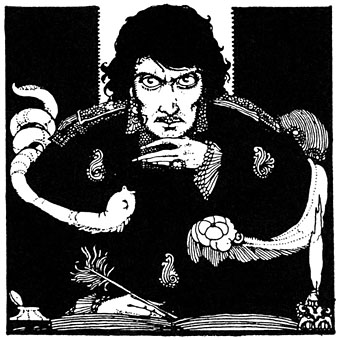
Poe by Harry Clarke.
Happy birthday Edgar Allan Poe, born two hundred years ago today. I nearly missed this anniversary after a busy weekend. Rather than add to the mountain of praise for the writer, I thought I’d list some favourites among the numerous Poe-derived works in different media.
Illustrated books
For me the Harry Clarke edition of 1919 (later reworked with colour plates) has always been definitive. Many first-class artists have tried their hand at depicting Poe’s stories and poems, among them Aubrey Beardsley, Gustave Doré, Arthur Rackham, W. Heath Robinson and Edmund Dulac; none complements the morbid atmosphere and florid prose as well as Clarke does. And if it’s horror you need, Clarke’s depiction of The Premature Burial could scarcely be improved upon.
Honourable mention should be made of two less well-known works, Wilfried Sätty’s The Illustrated Edgar Allan Poe (1976) and Visions of Poe (1988) by Simon Marsden. I wrote about Sätty’s collage engravings in Strange Attractor 2, and Sätty’s style was eminently suited to Poe’s work. Marsden’s photographs of old castles and decaying mansions are justly celebrated but in book form often seem in search of a subject beyond a general Gothic spookiness or a recounting of spectral anecdotes. His selection of Poe stories and poems is a great match for the photos, one of which, a view of Monument Valley for The Colloquy of Monos and Una, was also used on a Picador cover for Blood Meridian by Cormac McCarthy.
Recordings
These are legion but among the outstanding one-off tracks I’d note two poems set to music, Dream Within a Dream from Propaganda‘s 1985 album, A Secret Wish, and The Lake by Antony & The Johnsons. The latter appeared on the landmark Golden Apples of the Sun compilation and also on Antony’s own The Lake EP.
Among the full-length works, Hal Willner’s 1997 2-CD collection Closed on Account of Rabies features lengthy readings set to music from a typically eclectic Willner line-up: Marianne Faithfull, Christopher Walken, Iggy Pop, Diamanda Galás, Gavin Friday, Dr John, Deborah Harry, Jeff Buckley (one of the last recordings before his untimely death) and Gabriel Byrne. Byrne’s reading of The Masque of the Red Death is tremendous and the whole package is decked out in Ralph Steadman graphics.
Antony Hegarty appears again on another double-disc set, Lou Reed’s The Raven (2003), a very eccentric approach to Poe which I suspect I’m in the minority in enjoying as much as I do. An uneven mix of songs and reading/performances, Reed updates some Poe poems while others are presented straight and to often stunning effect by (among others) Willem Defoe, Steve Buscemi, Laurie Anderson, David Bowie, Amanda Plummer and Elizabeth Ashley.
Films
Once again, there’s too many films but The Masque of the Red Death (1964) has always been my favourite of the Roger Corman adaptations, not least for the presence of Jane Asher, Patrick Magee and (behind the camera) Nicolas Roeg. I wrote last May about the animated version of The Tell-Tale Heart from UPA. That adaptation, with narration by James Mason, is still on YouTube so if you haven’t seen it yet you can celebrate Poe’s anniversary by watching it right now.
Elsewhere on { feuilleton }
• The illustrators archive
Previously on { feuilleton }
• The Tell-Tale Heart from UPA
• William Heath Robinson’s illustrated Poe
• The art of Harry Clarke, 1889–1931