Leonora Carrington, 1917–2011

carrington.jpg

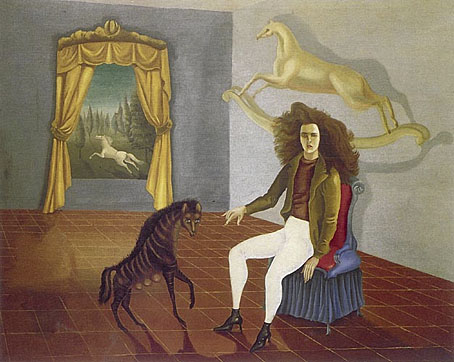
Self-portrait (1937–38) by Leonora Carrington.

Imagination and fantasy were two of the tools women artists used in the early decades of the 20th century to force their way into a male-dominated art world. The proliferation of illustrated books provided a creative platform in the Edwardian era for women shut out of art movements whose aesthetics might be avant garde but whose attitudes to sexual politics were either ignorant or reactionary. It was only with the advent of Surrealism that a notable body of women artists emerged in the field of painting and sculpture, not only Leonora Carrington but her almost namesake Leonor Fini, Dorothea Tanning, Remedios Varo, Meret Oppenheim, Kay Sage, Valentine Hugo and others. Part of this was the tenor of the time, of course, but Surrealism had no choice but to be open to anyone who came calling; if you’re going to let dreams and irrationality dictate the debate then everything that was previously fixed is up for grabs including gender dominance and sexuality. Leonora Carrington had a longer career than her contemporaries, and also distinguished herself as a writer of fantastic novels and short stories. Dalí aside, it could be argued that among the original Surrealists it was the women who stayed true to the project in subsequent decades. Max Ernst was a lover of Leonora and later married Dorothea Tanning but he left Surrealism after the Second World War for other styles of painting.

In Carrington’s work, mystical forces and surging instincts overpower the reign of reason. This is rebellion and liberation in the true surrealist sense. It is not the angry, testosterone-driven smack in the face typical of the high-profile showmen of surrealism. Rather, it is a low-key mystic subversion powered by the intrigues of seductive sibyls, sorceresses, and priestesses. (More.)

Among the obituary notices surfacing there’s a piece by Leonora’s cousin, Joanna Moorhead, who wrote a couple of years ago about her search for her celebrated relative, and a notice in the Telegraph. Ten Dreams has a small gallery of her paintings.

For Leonora Carrington by Peter Lamborn Wilson
• Coilhouse: Leonora Carrington – 6 April 1917 – 25 May 2011

Previously on { feuilleton }
Marsi Paribatra: the Royal Surrealist
Angels of Anarchy: Women Artists and Surrealism
Return to Las Pozas
The art of Leonor Fini, 1907–1996
Surrealist women
Las Pozas and Edward James

Lovecraft’s favourite artists revisited

hpl.jpg

HP Lovecraft (1937) by Virgil Finlay.

I was asked recently to join the bloggers at Tor.com writing about art as it relates to fantasy and science fiction, so for today’s post your attention is directed to this piece, an expanded version of a rather half-hearted list I put together a few years back concerning HP Lovecraft’s favourite artists. Half-hearted or not, people kept linking to that list so it seemed a good idea to make more of it. I’ll be writing these posts a couple of times a month, provided I have the time to do something worthwhile. Watch this space.

Previously on { feuilleton }
The monstrous tome

Weekend links: Apocalypse not now

apocalypse.jpg

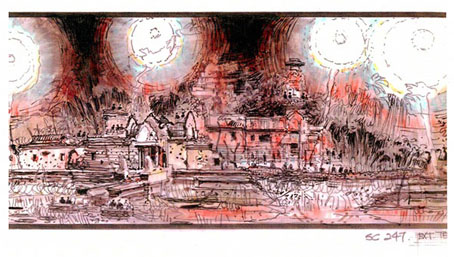
The Kurtz compound prior to destruction. An Apocalypse Now storyboard, one of a number which will be included among the extras on the Blu-Ray release of Francis Coppola’s film when it appears in the UK next month. The film is given a new cinema release on May 27th.

Radio broadcaster Harold Camping, a man denounced by fellow Christians as a false prophet, achieved one thing at least this week by making himself and his followers a global laughing-stock after the Rapture failed to materialise. I would have put money on him blaming those terrible gays somewhere along the way, such complaints being so common among a certain brand of American fundamentalist that you could write their sermons for them. Sure enough, here’s the old fool blathering about “lespianism” and describing the beautiful city of San Francisco as a cesspool. Shall we chalk this up as another victory for the gays, Harold? Related: No dogs go to heaven.

The internet has always been a home for ridicule but occasions like this bring out the wags in droves. The Oatmeal showed us how God is managing the Rapture using a Windows Install Wizard, and also pointed to a selection of sarcastic tweets. Meanwhile, this page has a comprehensive catalogue of previous apocalypse dates; the biggy is next year, of course.

Burroughs himself was no stranger to prosecution. In 1962 he was indicted on grounds of obscenity. Naked Lunch was not available in the US until 1962 and in the UK until 1964. The writer Norman Mailer and the poet Allen Ginsberg had to defend the book in court before the ruling could be reversed. In Turkey, it is now our turn to stand up for the novel.

Turkish writer Elif Shafak criticising the paternalism of the Turkish state in trying to protect its people from troubling novels. Related: William Burroughs publisher faces obscenity charges in Turkey.

An A–Z of the Fantastic City by Hal Duncan. “This guidebook leads readers and explorers through twenty-six cities of yore (Yore, while included, is one of the shorter entries).” Illustrated by Eric Schaller.

• The creepiest Alice in Wonderland of all, Jan Švankmajer’s semi-animated Alice (1988), receives a very welcome re-issue on DVD this month. With Brothers Quay extras and other good things.

smith.jpg

Robert E Howard’s sinister magus from the Conan stories, Thoth-Amon, as depicted by Barry Windsor-Smith. From a portfolio of five Robert E Howard characters, 1975.

What is computer music (or does it matter)? Related: A History of Electronic/Electroacoustic Music (1937–2001), 511 (!) downloadable pieces.

Unearthly Powers: Surrealism and SF: Rick Poynor explores the Tanguy-like strangeness of Richard Powers.

Magic Trip: Ken Kesey’s search for a kool place.

The Library of Congress National Jukebox.

Vladimir Nabokov’s butterflies.

Amy Ross’s Wunderkammer.

Rapture (1981) by Blondie | Apocalypse (1990) by William Burroughs | Rapture (2000) by Antony and the Johnsons.

The Steampunk Bible

steampunk1.jpg

Cover and interior designs by Galen Smith.

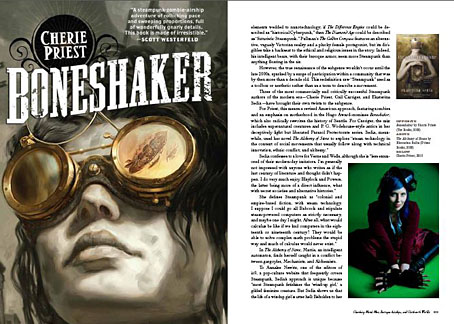
Arriving in your book emporia this week is The Steampunk Bible by Jeff VanderMeer & SJ Chambers, a comprehensive guide to the sub-genre which is now a thriving sub-culture. I contributed some bits of graphic design as well as a bespoke dirigible illustration (see below). The book also features a few other steampunk-related pieces of mine among its wealth of photos and illustrations. This is a typically lavish production from Abrams, beautifully designed by Galen Smith with a cover based on the celebrated Hetzel editions of Jules Verne’s novels. Inside there are essay contributions from Bruce Sterling, Catherynne M Valente, Jess Nevins and others. If you’re a steampunk enthusiast (or know one) this is an essential purchase. Some links and page samples follow below.

The official Steampunk Bible site
The Steampunk Bible: Mecha-Elephants, Raygun Rocketships, and Great Stories, a feature by Jeff V.
Amazon US | Amazon UK | Book Depository | Barnes & Noble | Indiebound

steampunk2.jpg

steampunk3.jpg

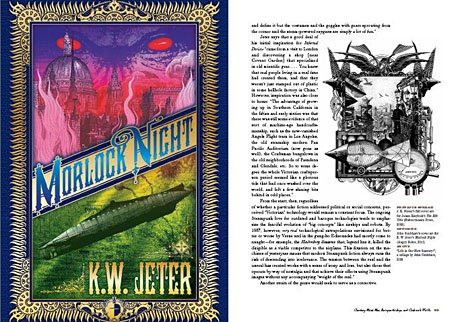
My cover for KW Jeter’s Morlock Night which has just been republished by Angry Robot.

steampunk4.jpg

steampunk5.jpg

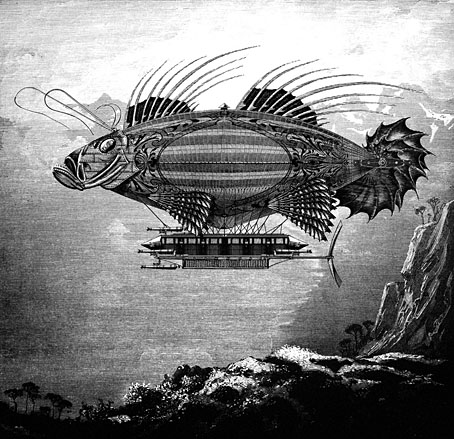
My brief was to create a cannon-bedecked piscine dirigible so this is what I came up with. See it in all its belligerent glory here.

Previously on { feuilleton }
Steampunk Reloaded
Steampunk overloaded!
Vickers Airship Catalogue
The Air Ship
Dirigibles
More Steampunk and the Crawling Chaos
The art of François Schuiten
Steampunk Redux
Steampunk framed
Steampunk Horror Shortcuts
The Airship Destroyer
Zeppelin vs. Pterodactyls
The Hetzel editions of Jules Verne

Gilles Rimbault revisited

rimbault1.jpg

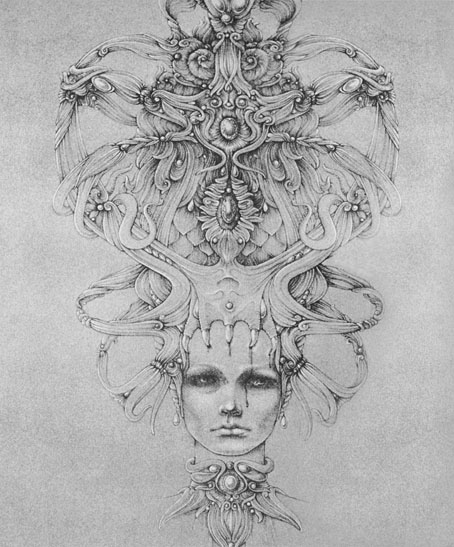
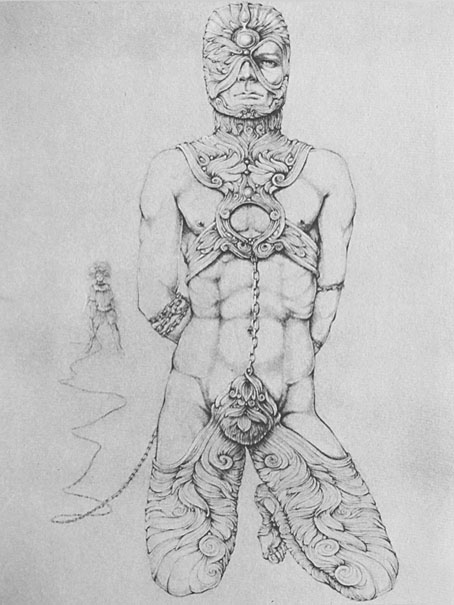
I posted a few examples of work by French artist Gilles Rimbault last year, and was hoping at the time that further drawings might come to light. We have D.R. Tenge to thank for posting these and other scans from Plexus magazine on the same LJ page where I found some of the earlier works, together with text that accompanied the pictures. “He pursues an endless search in the ‘erotisme fantastique'” Plexus tells us, and that’s a great description of this curious sub-genre which I’ve previously referred to (following Philip José Farmer) as “the pornography of the weird”. From what I know about Plexus it specialised in this typically late 60s/early 70s blend of science fiction, fantasy and erotic exploration, being a spin-off from Pauwels & Bergier’s magazine of “fantastic realism”, Planète; it also wasn’t the only magazine doing so which makes me wish that Taschen (or somebody) would delve into this sorely neglected area.

rimbault2.jpg

Elsewhere on { feuilleton }
The fantastic art archive

Previously on { feuilleton }
The art of Ran Akiyoshi, 1922–1982
The art of Gilles Rimbault
The art of Jim Leon, 1938–2002
The art of Sibylle Ruppert
The art of Bertrand