LSD-25 by The Gamblers

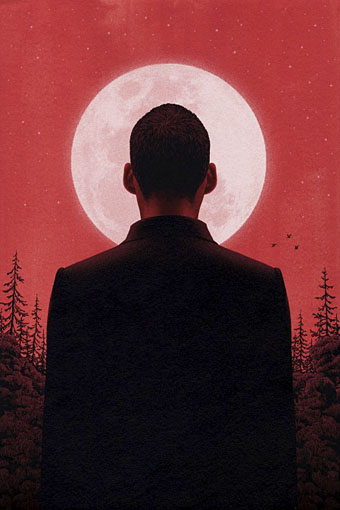
lsd25.jpg

A post last year concerned some of the songs that have flaunted their acid credentials by incorporating the letters L-S-D in their titles, the most famous being (of course) Lucy In The Sky With Diamonds. While it might be an idea to follow that post by tracking down songs with the word LSD in their title, a quick glance at Discogs shows an entire blotting pad of potential candidates. So I’ll let someone else do the leg-work on that one.

This post is less ambitious, prompted by a brief history of surf music in Rob Chapman’s Psychedelia and Other Colours. The Gamblers receive a mention for being the first group to record a piece of music with LSD in the title: LSD-25 was the B-side of their first single, Moon Dawg!, released in 1960. Moon Dawg! has the distinction of also being one of the first (if not the first) surf singles, and was later covered by The Beach Boys on their debut album, Surfin’ Safari (1962). With its hyperactive drums and twanging guitar Moon Dawg! certainly sounds like a surf number, whereas LSD-25 is more like one of Link Wray’s smouldering instrumentals. I’d heard the A-side on a Cramps-related singles compilation, Loose Lips Might Sink Ships, but hadn’t heard LSD-25 before so this is a welcome discovery. Someone had to be first with the LSD reference (chosen at random by a studio engineer according to Chapman), and we could have done much worse than this.

The Gamblers only recorded one more single before disbanding but guitarist Eliot Ingber had a distinguished career playing with Frank Zappa’s Mothers of Invention, Little Feat, Captain Beefheart (as Winged Eel Fingerling), and (I didn’t know this) as a member of The Peter Peter Ivers Band (sic) on Terminal Love (1974). You may not know Ivers’ name but you’ll probably know his voice when it appears in David Lynch’s Eraserhead in the guise of the Lady in the Radiator singing In Heaven.

Previously on { feuilleton }
More trip texts
Trip texts
Acid albums
Acid covers
Lyrical Substance Deliberated
The Art of Tripping, a documentary by Storm Thorgerson
Enter the Void
In the Land of Retinal Delights
Haschisch Hallucinations by HE Gowers
The art of LSD
Hep cats

Weekend links 275

wessi.jpg

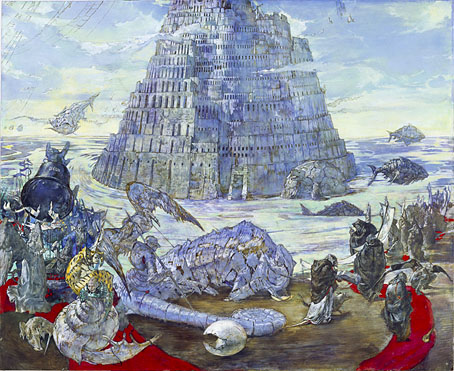
A painting from the Projekt Babelturm series by Wessi.

• “The first thing I would say is that I have no idea what authentic psych music is, and I have no wish to pursue that either. To me the idea of real psych is a paradox. I can’t see how you can have such a thing as real psychedelia when the whole thing is based on a psychedelic drug that gives you hallucinations and illusions and layers and layers of unreality.” Rob Chapman talking to Ben Graham about his new book, Psychedelia And Other Colours.

Elsewhere in a rather psychedelic week: Rob Young reviewed Chapman’s book for the New Statesman; Dangerous Minds posted “Hypnotic video of how a psychedelic masterpiece is made“; and in Germany a homeopathy conference “ended in chaos in Germany after dozens of delegates took a LSD-like drug and started suffering from hallucinations.”

• Coming soon from Dark Entries (so to speak), another collection of Patrick Cowley‘s music for gay porn films.

Jonathan Barnbrook works some quotes from JG Ballard into the British Road Sign Project.

• “Sorcery is more popular than football in Morocco,” says writer and filmmaker Abdellah Taïa.

• “If you’re going to make something, you should try and be wild,” says Mica Levi.

• Coca-Cola Milanese: Patrick Ellis considers the state of the world’s fair in 2015.

• Hear two pieces from Collapse, the forthcoming album by Drew McDowall.

• Mix of the week: Secret Thirteen Mix 162 by Ketev (Yair Elazar Glotman).

Emptyset’s Signal transforms Earth’s ionosphere into sound art.

Paul Laffoley: The Force Structure of the Mystical Experience.

• Fuck off, Star Wars, Ben Wheatley’s High Rise is on its way.

Ideologic Organ

Psychedelic Ride (1967) by The Ides | Psychedelic Warlords (Disappear In Smoke) (1974) by Hawkwind | Psychedelic Sewing Room (1989) by Bongwater

Weekend links 273

pelcer.jpg

Byronic I by Boris Pelcer. Via Full Fathom Five.

• “Music determines everything in terms of our narrative. Music demands, music suggests. Whereas traditional Hollywood animation is all based on character development—you know, there’s Toy Story and it’s Tom Hanks’s voice pushing the thrust of the action. For us, décor is all part of it. It’s the objects, a sense of atmosphere, the stimmung (mood) of what’s happening in this landscape where the puppet is just, invariably, a tiny element.” The Brothers Quay talking to JW McCormack about their films, and about Quay, a short documentary by Christopher Nolan.

• Croissants with Cthulhu: Stephanie Gorton Murphy reports on the Cthulhu Prayer Breakfast at last week’s NecronomiCon. I didn’t attend this: abject silliness is the last thing I want at 8 o’clock in the morning.

• “…a light daze for the rest of the afternoon, detrimental to studying but advantageous for daydreaming.” Italo Calvino on his cinema-going youth.

Only in that brief moment of absolute uncertainty – when both options seem equally plausible and implausible, when neither thought can be accepted or rejected, when everything can be explained and nothing can be explained – only in that moment do we really have this horror of philosophy, this questioning of the principle of sufficient reason. It is for this reason that Todorov qualifies his definition by stating that the “fantastic occupies the duration of this uncertainty.”

Eugene Thacker in an extract from Tentacles Longer Than Night (Horror of Philosophy, vol. 3), Zero Books, 2015

• It’s always good to hear some new rumblings by Emptyset. The Guardian has a stream of side 1 of the latest release, Signal.

• David Rudkin’s Penda’s Fen receives a film screening at the Whitechapel Gallery, London, on Saturday, 5th September.

Sea Calls Me Home, another song from the forthcoming Julia Holter album.

• Digital visualizations of imagined future landscapes by Mike Winkelmann.

• Mix of the week: The Ivy-Strangled Path Vol. IX by David Colohan.

• Cherchez la femme: Women and Surrealism at Sotheby’s, NYC.

• At It’s Nice That: 50 years of A Humument by Tom Phillips.

April 16, 1963: Housewife on LSD

Tentaclii: a Lovecraft blog

Signal (1981) by Phew | Signals (1983) by Brian Eno with Daniel Lanois and Roger Eno | Signals (2010) by The Soundcarriers

The Plutonian Drug

amazing.jpg

Cover art by Leo Morey.

To HP Lovecraft, Pluto was the planet Yuggoth, home to the fungoid, brain-harvesting Mi-go whose exploits are detailed in The Whisperer in Darkness (1931). Clark Ashton Smith wasn’t averse to imagining the planets of the Solar System as exotic worlds, but in The Plutonian Drug, a short story published in Amazing Stories for September 1934, he stayed closer to what was known of Pluto at the time, albeit with an exception or two:

“There are some other drugs, comparatively little known, whose effects, if possible, are even more curious than those of mnophka. I don’t suppose you have ever heard of plutonium?”

“No, I haven’t,” admitted Balcoth. “Tell me about it.”

“I can do even better than that — I can show you some of the stuff, though it isn’t much to look at — merely a fine white powder.”

Dr. Manners rose from the pneumatic-cushioned chair in which he sat facing his guest, and went to a large cabinet of synthetic ebony, whose shelves were crowded with flasks, bottles, tubes, and cartons of various sizes and forms. Returning, he handed to Balcoth a squat and tiny vial, two-thirds filled with a starchy substance.

“Plutonium,” explained Manners, “as its name would indicate, comes from forlorn, frozen Pluto, which only one terrestrial expedition has so far visited — the expedition led by the Cornell brothers, John and Augustine, which started in 1990 and did not return to earth till 1996, when nearly everyone had given it up as lost. John, as you may have heard, died during the returning voyage, together with half the personnel of the expedition: and the others reached earth with only one reserve oxygen-tank remaining.

This vial contains about a tenth of the existing supply of plutonium. Augustine Cornell, who is an old school friend of mine gave it to me three years ago, just before he embarked with the Allan Farquar crowd. I count myself pretty lucky to own anything so rare.

“The geologists of the party found the stuff when they began prying beneath the solidified gases that cover the surface of that dim, starlit planet, in an effort to learn a little about its composition and history. They couldn’t do much under the circumstances, with limited time and equipment; but they made some curious discoveries — of which plutonium was far from being the least.

“Like selenine, the stuff is a bi-product of vegetable fossilization. Doubtless it is many billion years old, and dates back to the time when Pluto possessed enough internal heat to make possible the development of certain rudimentary plant-forms on its blind surface. It must have had an atmosphere then; though no evidence of former animal-life was found by the Cornells.

“Plutonium, in addition to carbon, hydrogen, nitrogen, and oxygen, contains minute quantities of several unclassified elements. It was discovered in a crystalloid condition, but turned immediately to the fine powder that you see, as soon as it was exposed to air in the rocketship. It is readily soluble in water, forming a permanent colloid, without the least sign of deposit, no matter how long it remains in suspension.”

“You say it is a drug?” queried Balcoth. “What does it do to you?”

“I”ll come to that in a minute — though the effect is pretty hard to describe. The properties of the stuff were discovered by chance: on the return journey from Pluto, a member of the expedition, half delirious with space-fever, got hold of the unmarked jar containing it and took a small dose, imagining that it was bromide of potassium. It served to complicate his delirium for a while — since it gave him some brand-new ideas about space and time.

“Other people have experimented with it since then. The effects are quite brief (the influence never lasts more than half an hour) and they vary considerably with the individual. There is no bad aftermath, either neural, mental, or physical, as far as anyone has been able to determine. I”ve taken it myself, once or twice, and can testify to that.

“Just what it does to one, I am not sure. Perhaps it merely produces a derangement or metamorphosis of sensations, like hashish; or perhaps it serves to stimulate some rudimentary organ, some dormant sense of the human brain. At any rate there is, as clearly as I can put it, an altering of the perception of time — of actual duration — into a sort of space-perception. One sees the past, and also the future, in relation to one’s own physical self, like a landscape stretching away on either hand. You don’t see very far, it is true — merely the events of a few hours in each direction; but it’s a very curious experience; and it helps to give you a new slant on the mystery of time and space. It is altogether different from the delusions of mnophka.”

The most immediately notable detail here is the word “plutonium” which Smith was using as his own six years before the radioactive element was officially named. (By coincidence, transuranic plutonium was discovered the year Smith’s story was published.) Also of note is yet more discussion in a Smith story of real drugs such as opium and hashish. I’ve never seen any evidence that Smith was a drug user but he was happy to exploit the visionary potential of these substances. The time-viewing effects of Smith’s plutonium might have made for an effective weird tale but the piece runs out of steam fairly quickly; this is one of those stories with a promising idea that needs someone like HG Wells to do it justice. Many of Smith’s stories were written in haste so this isn’t too surprising but The Plutonian Drug lacks the imaginative scope of a piece of psychedelic science fiction like The City of the Singing Flame. Nevertheless, it was druggy enough to open Michel Parry’s Strange Ecstasies which is how I came to revisit it recently.

I was hoping the story might have been illustrated for its early printings but it seems not. The best I can find is this card design; there’s also a metal song by a band named Innsmouth that was released as a double-bill single in 2012. Smith’s story may be read in full at Eldritch Dark.


Previously on { feuilleton }
More trip texts
Yuggoth details
The Garden of Adompha
The City of the Singing Flame
Haschisch Hallucinations by HE Gowers
Odes and Sonnets by Clark Ashton Smith
Clark Ashton Smith book covers

Weekend links 266

dune.jpg

Spine and cover art by John Schoenherr for the first American edition of Dune, 1965.

• “[Herbert] had also taken peyote and read Jung. In 1960, a sailing buddy introduced him to the Zen thinker Alan Watts, who was living on a houseboat in Sausalito. Long conversations with Watts, the main conduit by which Zen was permeating the west-coast counterculture, helped turn Herbert’s pacy adventure story into an exploration of temporality, the limits of personal identity and the mind’s relationship to the body.” Hari Kunzru on Frank Herbert and Dune, 50 years on. Related: “To save California, read Dune,” says Andrew Leonard. There’s a lot more Dune cover art at ISFDB.

• “Embedded in Adam’s footage were several dark forms, human-ish in outline, unidentifiable but unmistakable, visible within the leaves or the shadows.” Holloway is a short film by Adam Scovell based on the book by Robert Macfarlane, Dan Richards and Stanley Donwood.

The Library of the Lost: In Search of Forgotten Authors by Roger Dobson; edited and with an introduction by Mark Valentine. Roger and Mark were my first publishers in 1988 when their Caermaen Books imprint produced the large-format edition of The Haunter of the Dark.

• “…over the years he created a series of ‘Pharmacies’: rows of glass bottles filled not with medicines to cure the body…but objects to stimulate the mind.” Clare Walters reviews Joseph Cornell: Wanderlust, an exhibition at the Royal Academy, London.

• “The sound machines we build today are invariably one-offs, made from salvaged parts, with all the precariousness of a prototype.” Sarah Angliss on the art of making music machines.

Mission Desire is a new single by Jane Weaver whose video is “set to scenes from Marie Mathématique – the French 1960s mini-series about Barbarella’s younger sister”.

• Ghost signs, ginnels and hidden details: an alternative guide to Manchester by Hayley Flynn aka Skyliner.

• “I want to be despised,” says John Waters who has a new art exhibition at Sprüth Magers, London.

Sonic Praise, an album of “Krautprogbikermetal” by Ecstatic Vision.

• The Evolution of the Great Gay Novel: an overview by Rebecca Brill.

• At Bibliothèque Gay: more homoerotic drawings by Jean Cocteau.

Wyrd Daze Lvl2 Issue 3 is a free download.

Nicolas Winding Refn: vinyl collector.

Art With Naked Guys In It

Caladan (2011) by Roly Porter | Giedi Prime (2011) by Roly Porter | Arrakis (2011) by Roly Porter