Weekend links 577

preisler.jpg

Black Lake (1904) by Jan Preisler.

• Upcoming releases on the Ghost Box label will include a new album by {feuilleton} faves Pye Corner Audio, plus the surprising appearance of figures from Bruegel on a Ghost Box cover design.

• Tilda Swinton and Olivier Saillard pay tribute to the films of Pier Paolo Pasolini. (Or to Pasolini’s costume designer, Danilo Donati.)

• New music: Spectral Corridor by The House In The Woods, and Re:Moving (Music for Choreographies by Yin Yue) by Machinefabriek.

• At Spoon & Tamago, Technopolis gets all the good things: “Giant kitty now greets commuters at Shinjuku Station.”

• Anil Ananthaswamy on the ways in which psychedelics open a new window on the mechanisms of perception.

• Mixes of the week: Isolated Mix 112 by Suna, and GGHQ Mix #56, “An Unfortunate Kink”, by Abigail Ward.

• In this week’s impossible task, Alexis Petridis attempts to rank The Velvet Underground’s greatest songs.

• DJ Food unearths more flyers for London’s Middle Earth club, plus covers for the East Village Other.

• Global signals: Aki Onda on Holger Czukay and radio’s power to connect.

• At The Paris Review: Paintings and collages by Eileen Agar (1899–1991).

• Will Sergeant’s favourite albums.

• The Babel Tower Notice Board

• Shaking Down The Tower Of Babel (1983) by Richard H. Kirk | Pärt: An Den Wassern Zu Babel (1991) by Estonian Philharmonic Chamber Choir conducted by Paul Hillier | The Black Meat (Deconstruction Of The Babel-Tower of Reason) (1994) by Automaton

Going beyond the zero

gr1.jpg

“But it is a curve each of them feels, unmistakably. It is the parabola. They must have guessed, once or twice—guessed and refused to believe—that everything, always, collectively, had been moving toward that purified shape latent in the sky, that shape of no surprise, no second chances, no return. Yet they do move forever under it, reserved for its own black-and-white bad news certainly as if it were the Rainbow, and they its children….”

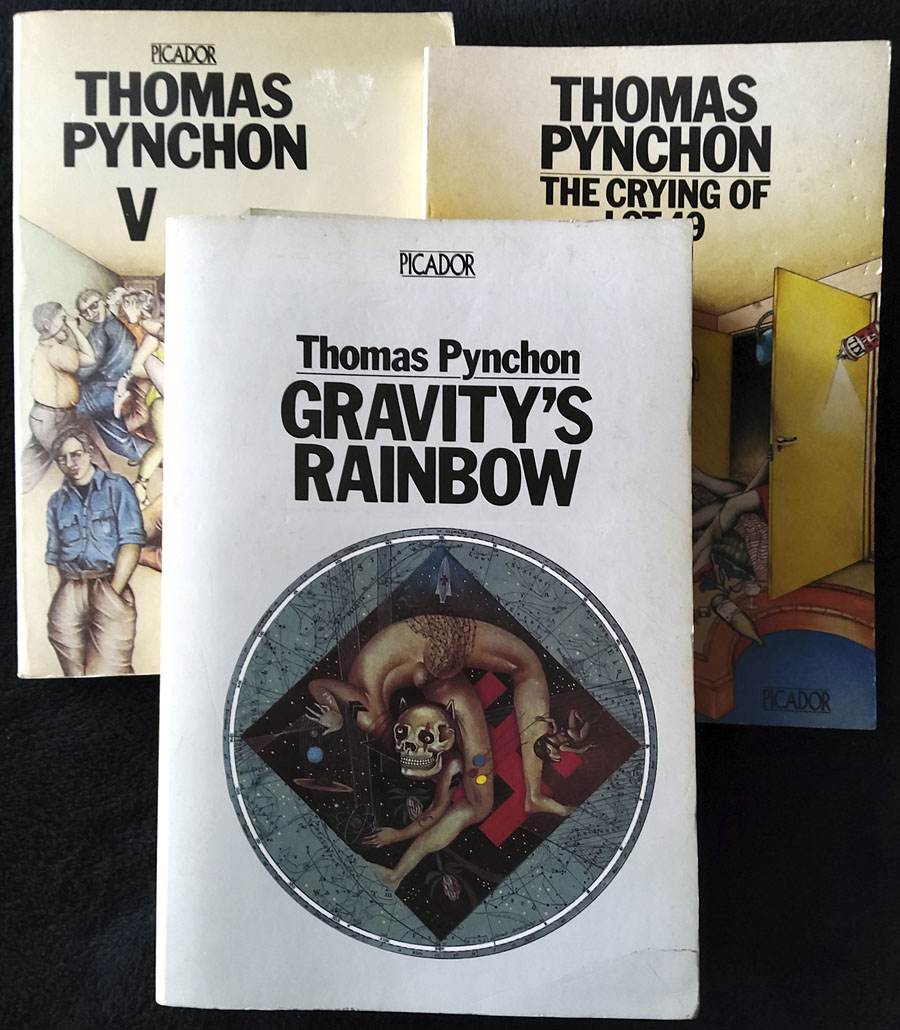
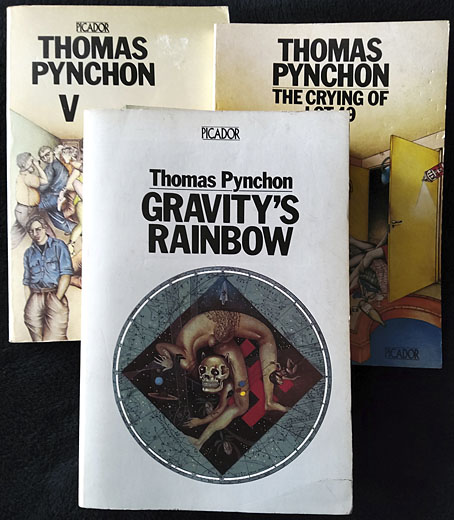
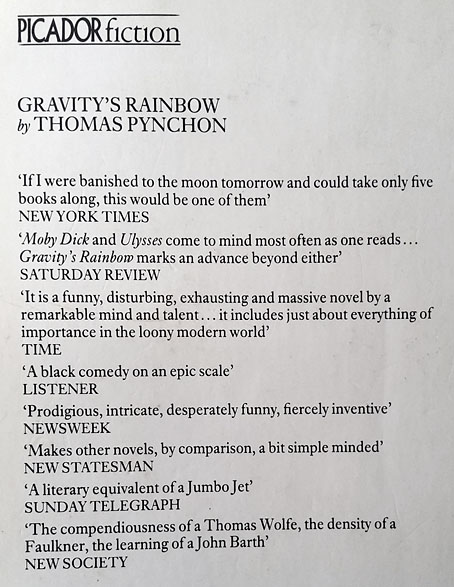
Reader, I read it. It isn’t an admission of great achievement to announce that you’ve reached the last page of a novel after a handful of stalled attempts, but when it’s taken me 36 years to reach this point it feels worthy of note; and besides which, Gravity’s Rainbow isn’t an ordinary novel. Umberto Eco is partly responsible for my return to Pynchon. I’d just finished The Name of the Rose, a book I’d avoided for years even while reading (and enjoying) a couple of Eco’s other novels, and was wondering what to read next. Maybe it was time to try the Rocket book again? The thick white spine of the Picador edition—760 pages in 10pt type—would accuse me every time I spotted it on the shelf: “Still haven’t made it to page 100, have you?” For many people this happens with novels because a book is “difficult” (which I didn’t think it was), or boring (which it isn’t at all), or simply too long (page count doesn’t put me off). Back in 1985 I was looking for more heavyweight fare after reading Ulysses, something I’ve now done several times, so I wasn’t going to be intimidated by a novel which is misleadingly compared to Ulysses on its back cover. If anything the comparison was an enticing one. Pynchon at the time exerted a gravitational pull (so to speak) for being very mysterious, although this was a decade when most living authors, especially foreign ones, were mysterious to a greater degree than they are today, when so many have their own websites and social media profiles. Pynchon’s works were also referred to in interesting places, unlike his less mysterious contemporaries. I may be misremembering but I seem to recall a mention of the W.A.S.T.E. enigma from The Crying of Lot 49 in Robert Shea & Robert Anton Wilson’s Illuminatus!; if it is there then it’s no surprise that a writer so preoccupied with conspiracy and paranoia would find favour with the authors of the ultimate conspiracy novel. (And that’s not all. I’m surprised now by the amount of coincidental correspondence between Illuminatus! and Gravity’s Rainbow. Both novels were being written at the same time, the late 1960s, yet both refer to the Illuminati, the eye in the pyramid on the dollar bill, Nazi occultism, and the death of John Dillinger. Both novels also acknowledge the precedent of Ishmael Reed’s Mumbo Jumbo, another remarkable conflation of conspiracy, secret history, and wild invention.)
gr2.jpg

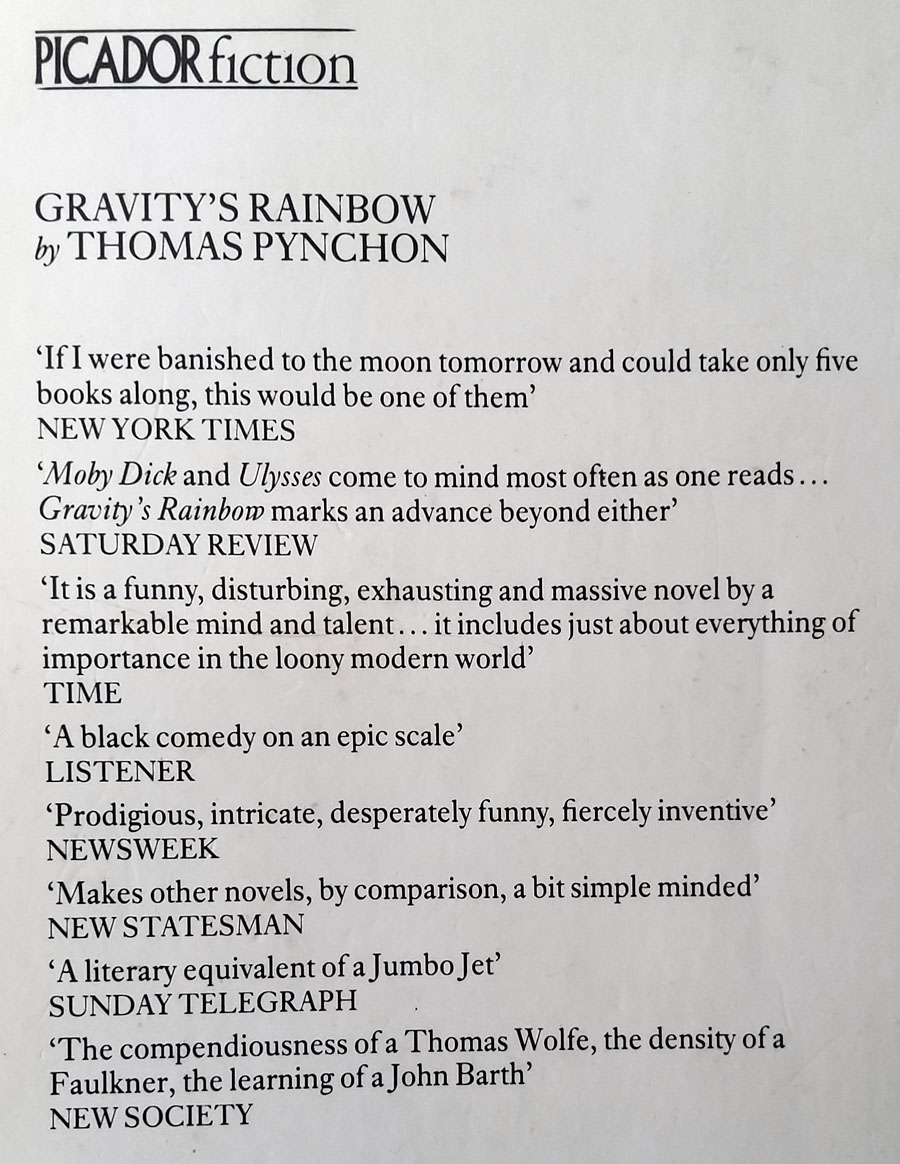
Pynchon had other connections to the kind of fiction I was already interested in. One of his early short stories, Entropy, had been published in New Worlds magazine in 1969, although editor Michael Moorcock later claimed to have avoided reading any of the novels until much later. And, Pynchon, like Shea & Wilson (and Moorcock…), made pop-culture waves. I think it was Laurie Anderson who put Gravity’s Rainbow in the centre of my radar when she released Mister Heartbreak, an album whose third song, Gravity’s Angel, refers to the novel and is dedicated to its author. As for the novel itself, in the mid-1980s this was still Pynchon’s major work, the one that fully established his reputation. Nothing new had appeared since its publication in 1973; Vineland, and the subsequent acceleration of the authorial production line, was six years away. The final lure was the refusal of the Picador edition to communicate very much of its contents: what was this thick volume actually about? The back cover is filled with praise but doesn’t tell you anything about the novel at all, while the cover illustration by Anita Kunz suggests a scenario connected with the Second World War but little else. (“This was one of the most complicated books I ever read,” says the artist, “and really hard to get the germ of the idea. Pynchon kept going off in tangents. I mixed up the art the same way the writer did and made an image that can be read in all directions.”) It’s only when you start reading the book that you find the connection between the novel’s dominant concerns—the development of the V-2 rockets used by the Nazis to bomb London, and the erotic compulsions of Tyrone Slothrop, an American lieutenant at large in war-ravaged Europe—subtly reflected in the illustration, much more subtly than the cover art on the edition that preceded this one.

Continue reading “Going beyond the zero”

The Gate to the Mind’s Eye

tgttme1.jpg

Turn a 6 on its head and you’ll see a number 9. Do the same with the psychedelic culture of the 1960s and you get the 1990s when psychedelia emerged again, after a fashion, in a profusion of new drugs (plus the same old ones), “ambient” music (a lot of which was never very ambient at all), and, of course, computer graphics. The resemblance of the overlit, weightless world of early computer graphics to the vivid inner landscapes of psychedelic hallucination prompted people like Timothy Leary to declare computers to be their new drug of choice, while also inspiring the resurrection of the kind of visual tripping aid that would have been considered dead and buried in the very un-psychedelic 1980s. (There were a few musical exceptions in that decade—the Paisley Underground, the Dukes of Stratosphear albums, Around The World In A Day by Prince & The Revolution—but all these were counter to the dominant trends of the time.)

tgttme2.jpg

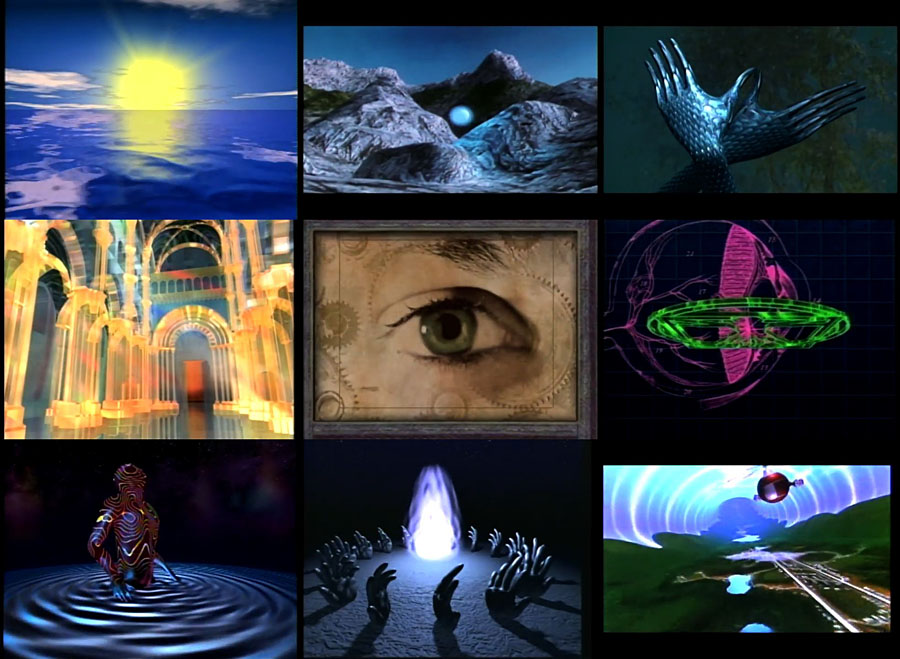
CD-ROMS were the hippest vehicle for far-out visuals in the mid-90s. Brian Eno was vocal in his criticism of the limitations of the point-and-click CD-ROM format but he still provided music for a thing called Headcandy in 1994, one of a series of “video kaleidoscopes” with 3-D visuals created by Chris Juul and Doug Jipson. Not so overtly druggy was a series of VHS tapes and laserdiscs released throughout the 1990s by Odyssey Productions, all of which had the words “Mind’s Eye” in their titles: The Mind’s Eye: A Computer Animation Odyssey (1990), Beyond the Mind’s Eye (1992), The Gate to the Mind’s Eye (1994) and Odyssey Into The Mind’s Eye (1996). Where Headcandy and its relations created far-out visuals using original data encoded on a CD-ROM, the Mind’s Eye laserdiscs wowed the viewer by stitching together the latest examples of CGI from a variety of sources—showreels, TV ads, music videos and so on—giving you an hour of coloured balls bouncing across crystal mountains, pulsating blobs of mercury, shiny objects zooming through corridors and vortices, together with the clumsy figure animation that’s a consistent feature of early computer graphics. Each instalment was provided with a soundtrack by a different musician, so each release is really a long music video in itself, rather like The Orb’s Adventures Beyond The Ultraworld (Patterns & Textures) (1992), a 50-minute collage of rave footage, dolphins, spacewalking astronauts and cheap video effects soundtracked by live music from The Orb.

tgttme3.jpg

The Gate to the Mind’s Eye is highlighted here mainly for its having a soundtrack by Thomas Dolby that I hadn’t heard before. Other instalments feature original music by Jan Hammer (which may be okay), and Kerry Livgren from Kansas (which promises to be as unpalatable as Giorgio Moroder’s misconceived mauling of Fritz Lang’s Metropolis). The Gate to the Mind’s Eye doesn’t feature the best of Dolby’s music, it should be said, which may explain why the soundtrack CD has only been reissued once since 1994, while the visual material looks like a combination of music video and computer game. But there’s a lot of this stuff around today, especially at the Internet Archive which now has a laserdisc section containing several uploads from Odyssey Productions and its affiliate, Miramar Productions. Closer to the psychedelic ideal is a series of discs from Japan with the uninventive name of Video Drug. The Internet Archive has five discs from this series. I might have been happy to watch these in the 1990s when late-night TV in the UK was either dull or non-existent but today I’m more taken with outmoded things like Electric Light Voyage aka Ascent 1, a video release from 1979 which featured analogue video effects of a type you don’t find at all in the digital world.

Elsewhere on { feuilleton }
• The abstract cinema archive

Previously on { feuilleton }
• Kusama’s Self-Obliteration, a film by Jud Yalkut
• Science Friction by Stan VanDerBeek

Trip texts revisited

trip1.jpg

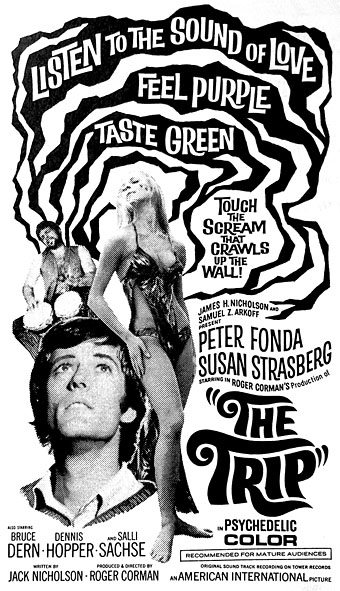
An update to a post from several years ago about the handful of significant books that appear in Roger Corman’s The Trip (1967). The earlier post was prompted by a DVD viewing; this update has been prompted by a re-viewing via blu-ray which yielded screen-grabs showing more detail. As I’ve no doubt said before, one of the pleasures of home viewing is being able to scrutinise film frames in this manner, something that was previously only possible if you were a writer with access to a cinema print.

trip2.jpg

Corman’s film is probably the only feature from American International Pictures that contains any kind of extraneous intellectual reference. The AIP ethic was always “shoot it fast and cheap”, a production rule that had no time for winking to the hip contingent of the audience with books, of all things. Leave that stuff to the French. The Trip was still shot fast and cheap but Corman had been stretching himself increasingly while making his cycle of Poe films, especially with The Masque of the Red Death which had a longer production schedule, a British cast and crew, and a symbolic finale that sets it apart from its rivals at Hammer and other studios. The Trip is as far-out as Corman gets, the cut-up shots of Peter Fonda stumbling in delirium around Sunset Boulevard wouldn’t be out of place in any underground film of the period.

trip3.jpg

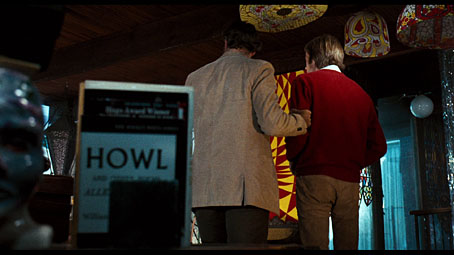
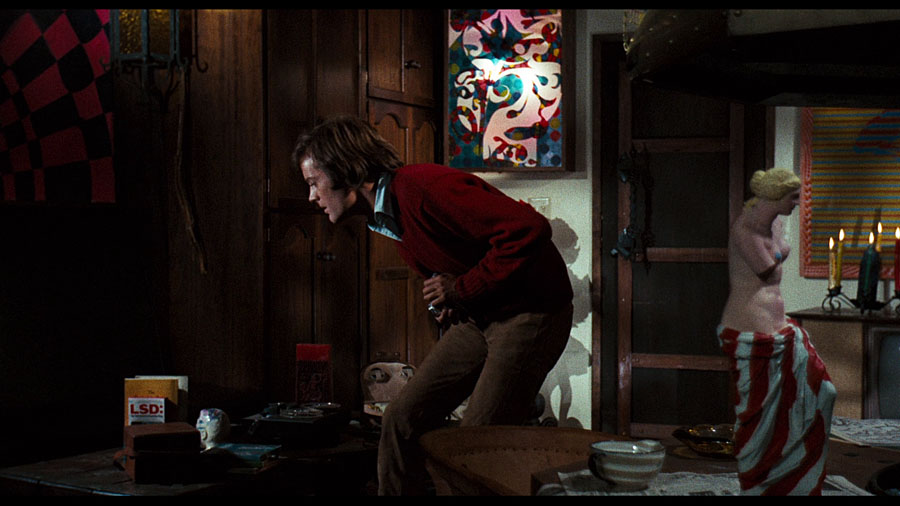
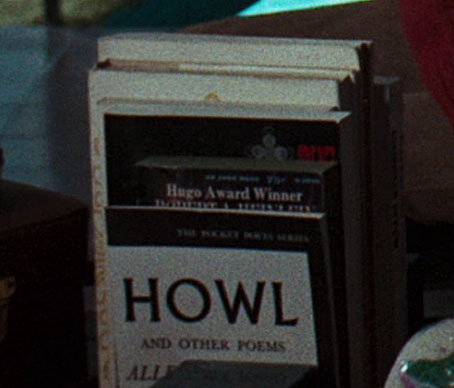
The surprising thing about the books that appear in the scene where Fonda’s character, Paul, drops his acid is that they’re perfectly appropriate items of set decoration but only two of them—the unmissable copy of Allen Ginsberg’s Howl, and David Solomon’s LSD: The Consciousness-Expanding Drug—would have been discernible to an audience. The latter inclusion is probably more to do with the three magic letters being so prominent on its cover than anything else, although it is the kind of book you’d find in a house owned by lysergic voyagers. The blu-ray detail now reveals more of the book hiding behind it although this one has eluded my attempts to search for a match: “The [something]….”? I thought it might be The Prophet by Kahlil Gibran but none of the editions prior to 1967 resemble the cover.

trip4.jpg

trip5.jpg

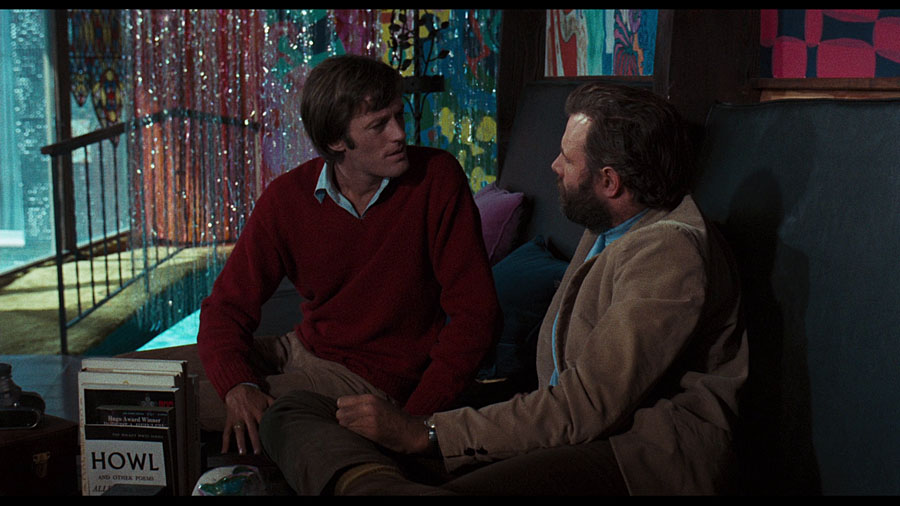
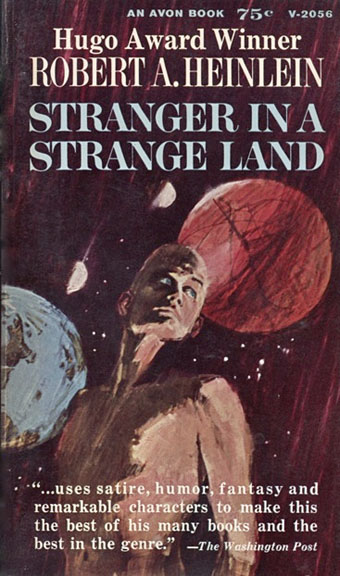
The main discovery this time round was finding a match for the book hidden by Howl, a title that I now confidently declare to be the 1962 Avon edition of Stranger in a Strange Land by Robert A. Heinlein. (The reds and blues of the cover art are more discernible in a full-frame shot.) When watching the DVD I thought those words might be “Hugo Award Winner” but couldn’t make out an author’s name, and “Award Winner” was a guess. The book might also have been written by someone named Hugo… Heinlein’s novel was a hippy favourite in the 1960s, one of several books together with The Prophet, Richard Brautigan’s novels and poetry, Herman Hesse’s Steppenwolf, etc, that were popular with turned-on readers. The irony of the author of Starship Troopers being mooned over by the love ‘n’ peace crowd wasn’t lost on the younger generation of SF authors but their criticisms didn’t travel outside genre circles. Heinlein could evade opprobrium for being one of the signatories of an ad in Galaxy for June, 1968, supporting the war in Vietnam because hippies en masse weren’t reading SF magazines.

heinlein.jpg

As noted in the earlier post, the book behind the Heinlein is a 1960 edition of The Tibetan Book of the Dead, which I was only able to identify because I own a copy of the same edition. Behind this there lurks another title whose identity is now going to nag at me. The cover decoration means it will be easy to find if it ever turns up somewhere. But will I remember it when it does? We’ll see.

Previously on { feuilleton }
• Alice’s Adventures in the Horse Hospital
• LSD-25 by The Gamblers
• More trip texts
• Trip texts
• Acid albums
• Acid covers
• Lyrical Substance Deliberated
• The Art of Tripping, a documentary by Storm Thorgerson
• Enter the Void
• In the Land of Retinal Delights
• Haschisch Hallucinations by HE Gowers
• The art of LSD
• Hep cats

Weekend links 552

keen.jpg

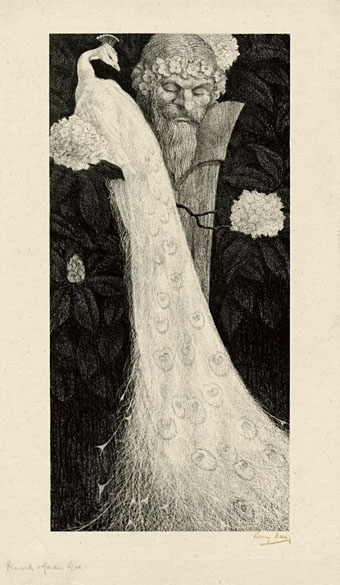
White Peacock and Garden God (c. 1922) by Henry Keen.

• “Though both writers confront some of the most unsavory and unjust dimensions of human life, Genet revels in moral ambiguity and coarse language, while Erpenbeck satisfies her audience’s desire for tidy ethical responses by using careful, equally tidy sentences. Genet’s world is dirty; Erpenbeck’s is clean.” Christy Wampole compares two newly-translated collections of non-fiction writing by Jean Genet and Jenny Erpenbeck.

• Gaspar Noé’s notorious, controversial (etc, etc) Irreversible receives the prestige blu-ray treatment from Indicator in April. Still no UK blu-ray of Enter the Void is there? I had to order a German release.

• Stereolab release Electrically Possessed: Switched On Vol. 4 next month, the latest in their series of albums which collect singles, compilation tracks and other rarities.

• At Nautilus: Antonio Zadra and Robert Stickgold on how dreaming is like taking LSD.

• At Dennis Cooper’s: Bollo presents…Éliane Radigue (& The Lappetites).

• Playwriting & Pornography: Adam Baran remembers Jerry Douglas.

• At Spine: Vyki Hendy on the joy of monochrome book covers.

• Mix of the week: Subterraneans 2 by The Ephemeral Man.

• John Boardley’s favourite typefaces of 2020.

• New music: Spirit Box by Blanc Sceol.

• Life In Reverse (1981) by Marine | Reverse World (1995) by David Toop | Reverse Bubble (2014) by Air