Weekend links 847

magritte.jpg

La voix des airs (1931) by René Magritte.

• “Gangsters is to the 1970s what The Prisoner was to the 1960s—a playful, knowing and mildly crazed production but today it bears an important warning from the past to us.” John Quin on the extraordinary vitality of Philip Martin’s Play For Today and the BBC drama serial spun-off from it.

• New music: Juxtapositions by Boddy | Scanner; Embodied Shadow Of Thy Secret Mind by Philippe Blache; Light on Water by Modern Apartments.

• At Public Domain Review: Metamorphosis: Transformations in the Early Modern Flap Book (early 19th century).

Maeterlinck would write of [The Great God Pan], “it is, I believe, the attempt had been made to combine the traditional, or diabolical Fantasy with the new scientific kind, and that such a mixture has produced the most disturbing work I have ever come across”. Maeterlinck’s description of Machen serves as a tidy introduction to the crux of Ray’s writings too. A writer equally perplexed, intrigued, and possessed by the “the terrifying, hypergeometric, fourth dimension”. Ray’s works span the thin fabric of reality, piercing through into other eternal worlds and abducted by its eternal horror. Ray’s worlds are numerous realities battling one another, overlapping, mimicking, and distorting; it is an evocation of time and space as a battle-field of alternativities, governed by strange supernatural forces, notably angels or the occult.

The London of the Imagination, an examination of the fictional metropolis as it manifests in the stories of Belgian writer, Jean Ray

• Mixes of the week: A Slomo mix for The Invisible College, and DreamScenes – September 2026 at Ambientblog.

• At Colossal: “Spanning 200+ works, a new book celebrates the world of fungi“.

• The Electric Music Machine: Five Days at the BBC Radiophonic Workshop (1988).

• Steven Heller’s font of the month is Ege Basalt.

• Matt Cargill’s favourite albums.

• RIP Jeremy Thomas.

• Metamorphosis (1970) by Ananda Shankar | Metamorphosis (1995) by Pet Shop Boys | Metamorphosis (2012) by Demdike Stare


Weekend links 846

borges.jpg

Design by Randoll Coate for the Labirinto Borges, a hedge maze at the Giorgio Cini Foundation, Venice, which was renovated earlier this year.

• “Code was probably our most overtly political record, which is interesting, touring and playing it in these very different but scary political times.”​ Stephen Mallinder of Cabaret Voltaire talking about the experience of touring America again.

• At The Daily Heller: A look at the work of designer/illustrator George Hardie whose five-decade career is to be celebrated in a retrospective exhibition in London. There’s more George Hardie here.

• “Almost as soon as weird began circulating outside of Macbeth, its meaning broadened too, from ‘eerie’ and ‘uncanny’ to ‘odd’ or ‘unusual’.” Colin Gorrie on the weird history of the word “weird”.

• At The Quietus: Toby Manning on 40 years of Gone To Earth by David Sylvian. A minor nitpick: the album’s art and design was by Russell Mills, not Vaughan Oliver.

• New music: Burning Song by Kali Malone; Obsessive Surrealism by Parallel Worlds.

• At Door Of Perception: The radical architectural designs of Eugene Tssui.

• DJ Food’s latest accumulation of psychedelic graphics from the desktop.

• Old music: When The Music’s Over (Live, 1970) by The Doors.

• Arthur Brown‘s favourite songs.

• Weird Dream (1976) by Harmonia | It’s So Weird (1983) by Bush Tetras | Ballad Of The Weird Sisters (2013) by Blood Ceremony

Weekend links 845

belbury.jpg

Cover design by Jim Jupp, art by Arik Roper.

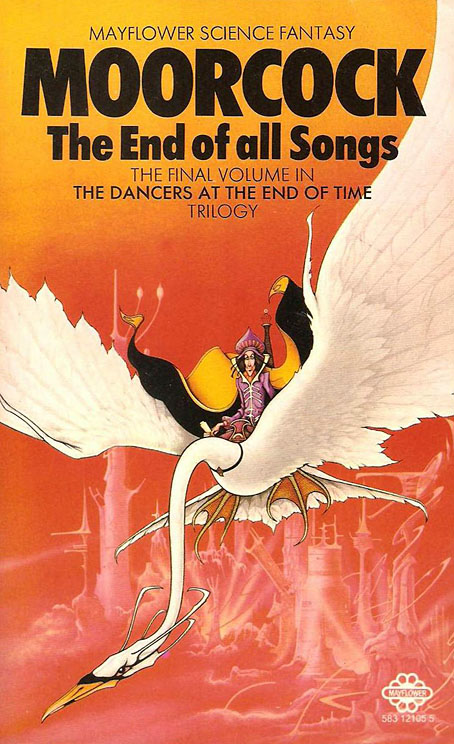
• New music: Sorcery by Belbury Poly, or “The Belbury Poly” as the credit on the cover art has it. The description of the forthcoming release says “it grew from [Jim] Jupp’s love of early to mid-80s electronic music and a rediscovery of how that music had soundtracked his childhood love of all things sci-fi and fantasy. It’s moody and melodramatic electronica rendered in bright and evocative 80s sounds.” And concerning the cover art there’s this: “Some may notice the typographical nod to Mayflower Books’ Michael Moorcock novels.” Indeed.

matthews.jpg

Cover art by Rodney Matthews, 1977.

• Among the new titles at Standard Ebooks, the home of free, high-quality, public-domain texts: The Mummy! A Tale of the Twenty-Second Century (1827) by Jane C. Loudon, and The Place Called Dagon (1927) by Herbert S. Gorman.

• More new music: Materia by Julia Holter; Avaeken by Stephen O’Malley; Witchcraft & Black Magic In The United Kingdom by Various Artists.

• The Natural History Museum presents competition photos from Wildlife Photographer of the Year.

• This week I drew a new header design for the Endless Bookshelf website.

• At the BFI: Brogan Morris chooses 10 great films about screenwriters.

• At Dennis Cooper’s it’s Palimpsest Day.

• RIP Tim Curry and Yayoi Kusama.

• Sorcery #1 (1974) by Jack DeJohnette | Sorcerer (1977) by Tangerine Dream | Return Of The Sorcerer (2011) by The Wounded Kings

Mug-wump Specific

mugwump1.jpg

Mugwump (mŭg´ wŭmp). An Algonquin word meaning a chief; in Eliot’s Indian Bible the word “centurion” in the Acts is rendered mugwump. It is now applied in the United States to independent members of the Republican party, those who refuse to follow the dictum of a caucus, and all political Pharisees whose party vote cannot be relied on. —Brewer’s Dictionary of Phrase and Fable, 1954

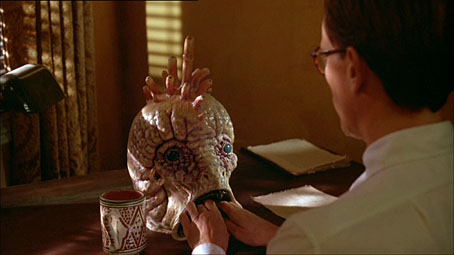
Such is the usual explanation given for the origin of the word “mugwump”, a term better known today, of course, for its use in Naked Lunch, and that mainly via David Cronenberg’s feature film. Why William Burroughs came to name his sinister creatures mugwumps is something I’ve never seen an explanation for although one may well exist somewhere.

mugwump2.jpg

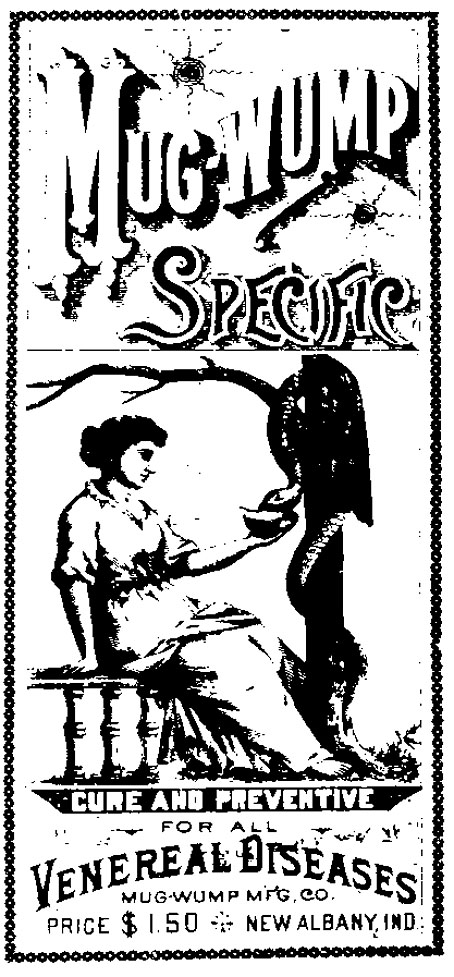
A few years ago I wrote a short post showing how the first description of the mugwumps in Naked Lunch was a kind of science-fictional rewrite of a similar passage from Junkie, a description a predatory character that a drug-user might encounter in the narcotic underworld of the 1940s. As an addendum to the post I added a crude image of a label for a 19th-century patent medicine, “Mug-wump Specific”, which had turned up at Wikipedia without any attendant information. At first sight the label seemed too good to be true in its Burroughsian combination of the mugwump name, sexual disease and—since it claims to be a cure—Dr Benway-style crank medicine. These associations were further compounded by the Freudian illustration of a woman offering a bowl to a very large snake. (The latter detail shouldn’t necessarily be taken as a reference to snake oil, however. The snake twined around a staff is a common medical symbol, derived from Asclepius, the Greek god of medicine.) Why a medicine manufacturer in Indiana should choose mugwump as the name for its alleged cure is yet another mystery, and one unlikely to be resolved. I’d guess it’s a result of the impulse that still prevails today when new products have to be named in a distinctive manner that’s both memorable and copyrightable.

mugwump3.jpg

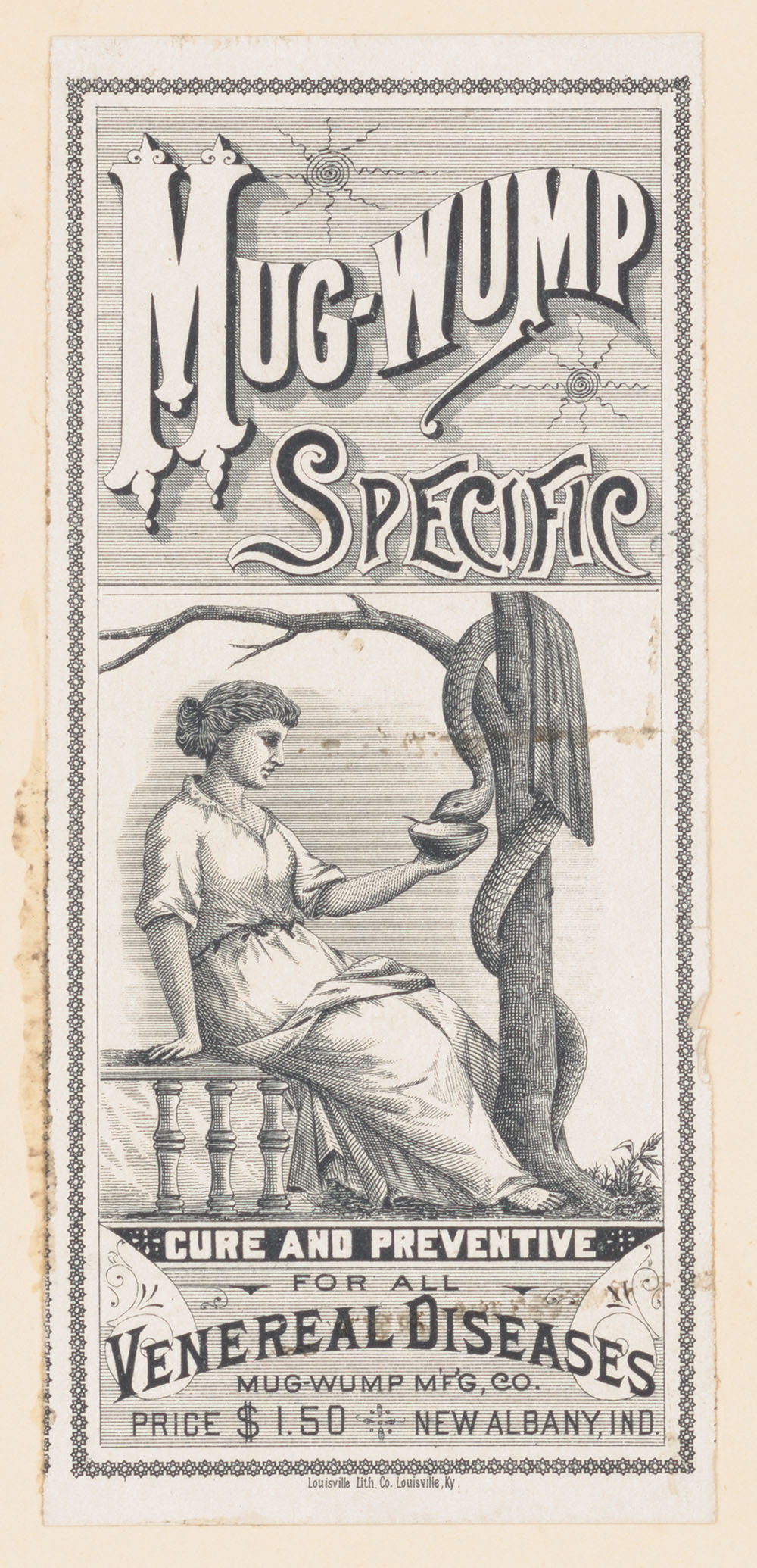
This mass of conundrums was percolating through my mind last week as a result of which I embarked on a fairly determined search to find the image above, a first-generation printing of the medicine label affixed to a US trademark application. Ever since the cruder image had turned up at Wikipedia I’d been wondering why there wasn’t a better copy to be found anywhere. Surely something with so many cultural connections should be flying around the Tumblr labyrinth by now? I’d previously tried all the obvious sources like the image section of the Wellcome collection, where you’ll find a variety of medicine labels, as well as the product catalogues at the Internet Archive. Since Google has taken to ruining its search engine it’s become increasingly difficult to find uncommon images but I was lucky on this occasion when I found one of the trademark applications for sale at eBay. Knowing that the Library of Congress has an online archive of such things I zipped over there and immediately found the sample above. I’ve since seen the same image plastered with proprietorial watermarks at Etsy where someone is selling reproductions. This happens a lot in print-on-demand circles and at image-resellers like Alamy where ownership is claimed over material which is demonstrably in the public domain. Well, if you’re desperate to own a “Mug-wump Specific” T-shirt or poster you can save yourself some money by downloading a high-resolution tiff of the label here.

Elsewhere on { feuilleton }
• The William Burroughs archive

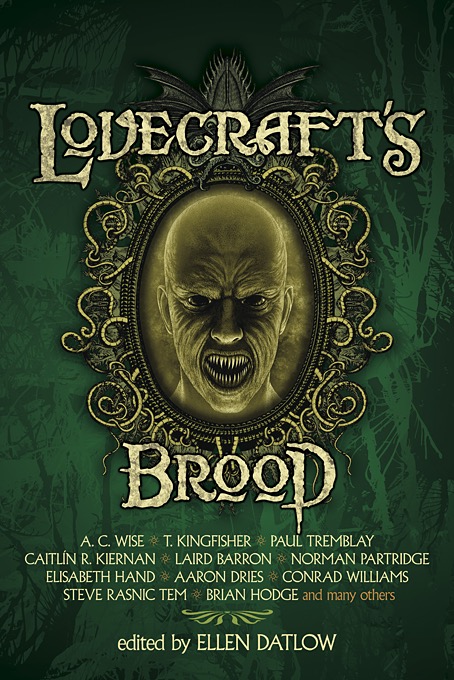
Lovecraft’s Brood

brood01.jpg

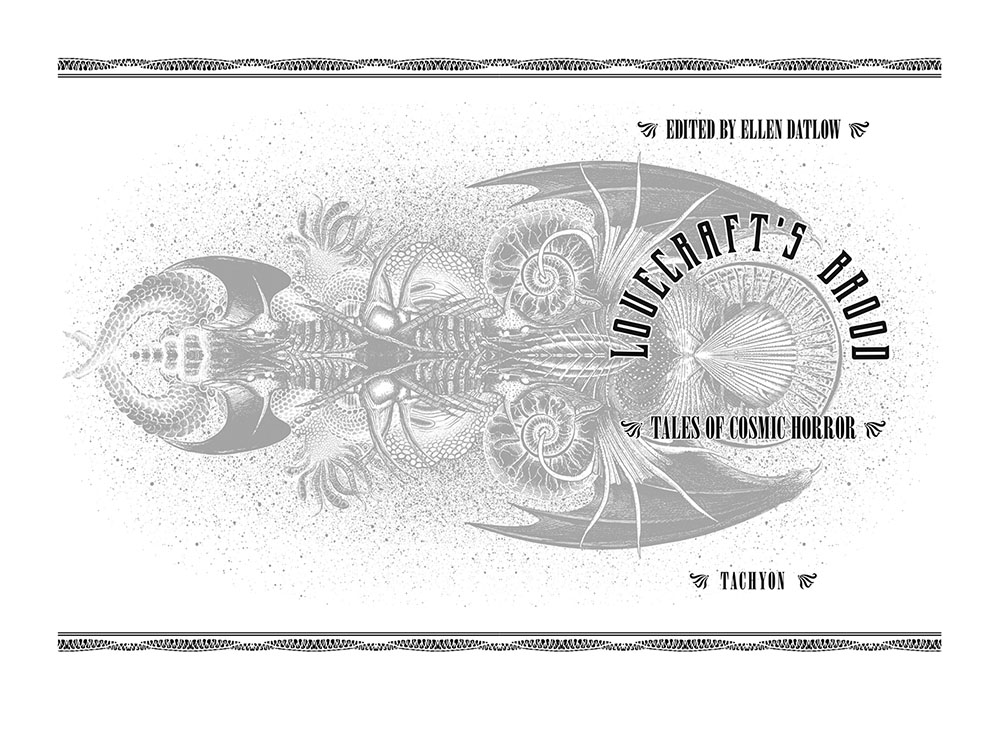
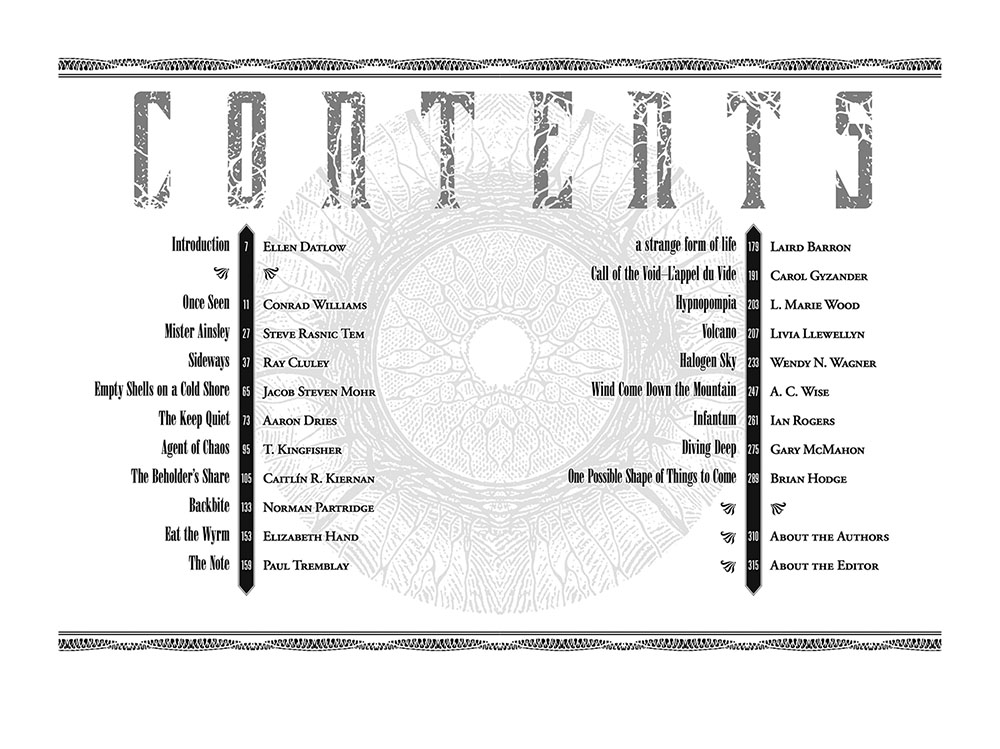
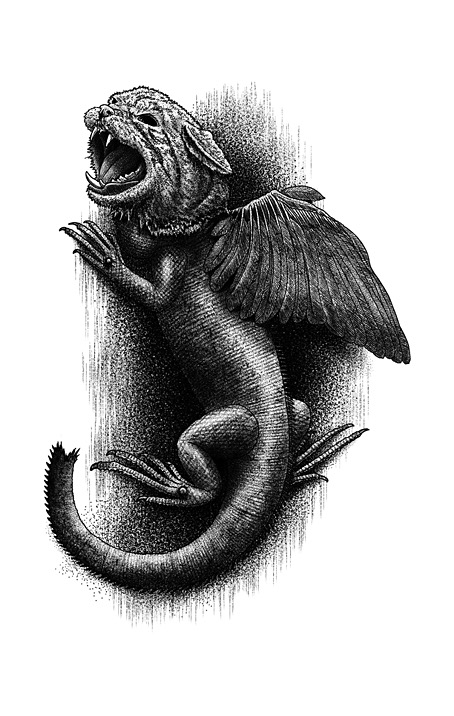
It’s that man again, or some of his progeny, infecting the world with their nightmares. Lovecraft’s Brood is a story collection edited by Ellen Datlow, a kind of follow-up to Lovecraft’s Monsters, although the new book is a more expansive take on the Lovecraftian weird tale. As with the earlier collection, I designed and illustrated this one throughout. The illustrations were more of a challenge this time since the stories weren’t always focused on explicitly physical threats; or if they were, the threats remained either unseen or inexplicable. That can be good sometimes—there’s a tendency in horror illustration to always go for monster portraits or spoilerish scenes from the end of the story—but it doesn’t make the artist’s task an easy one. For a few of the pictures I used a minor detail; in the case of Mister Ainsley, for example, there’s a mention of taxidermy experiments which is what I chose to focus on. What “Mister Ainsley” looks like (or actually is) is never described as such, the reader’s imagination is left to fill the gaps in the story.

brood21.jpg

Among the other pictures there’s my first ever drawing of the real church that gave Lovecraft his model for the home of The Starry Wisdom cult in The Haunter of the Dark. This church, or its fictional counterpart, has haunted my imagination for a long time, being the subject of my first Lovecraft illustration in 1979 and (of course) the subject of my first Lovecraft comic strip in 1986. In Lovecraft’s Brood the church appears in The Beholder’s Share, another fine riff on Lovecraft’s fiction by Caitlín R. Kiernan in which the Starry Wisdom cult actually existed, with the old Catholic church on Federal Hill being the centre of their operations. The real church was demolished in 1992 but the location is still easy to find since the grounds have been turned into a small recreational area which retains the walls that surrounded the building. When I was in Providence in 2015 I walked over to Federal Hill to see a concert performance in a converted cinema but I didn’t manage to visit the site of the church, something I now regret.

brood22.jpg

On the technical side, this set of illustrations is the first where I’ve used Glitch Lab in the creation of some of the artwork. Glitch Lab is one of several tablet-based image-processing apps made by Ilixa that function like Photoshop’s filters but with many more options. Photoshop hasn’t done much with its basic suite of filters since the 1990s, something that doesn’t bother me most of the time but every so often you find yourself wanting to imitate a technical effect that can’t easily be achieved without a lot of work. For two of these illustrations I wanted views seen through different kinds of monitors, the first a low-quality TV screen of a type you’d see in a supermarket, then a distorted image from a malfunctioning camera whose output is being viewed on a computer monitor. Glitch Lab specialises in this kind of technical distortion, and can imitate a wide range of visual glitches of a type generated by old TV sets. The Note is the story with the security camera for which I painted a relatively minimal greyscale scene. This wouldn’t have worked on its own but running it through the filters gave it the required appearance. Wind Come Down the Mountain is much more heavily processed, and could have been pushed a lot further but I’d already destroyed a lot of the detail I’d put into the picture.

Lovecraft’s Brood is out now in print and digital from Tachyon and all the usual outlets.

brood23.jpg

brood02.jpg

Once Seen by Conrad Williams.

brood03.jpg

Mister Ainsley by Steve Rasnic Tem.

Continue reading “Lovecraft’s Brood”