Lovecraft’s Brood

brood01.jpg

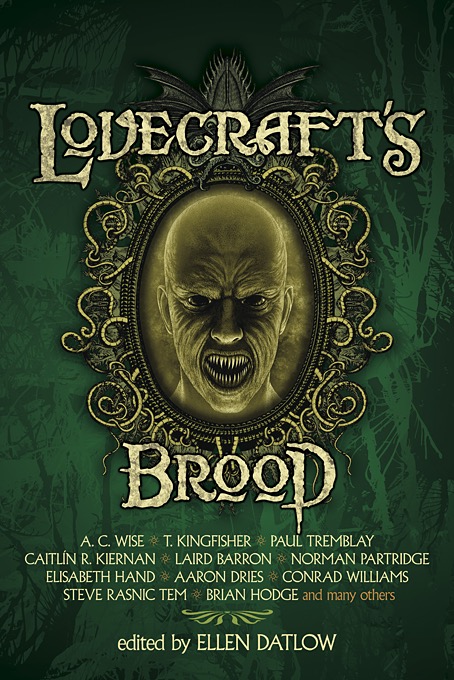
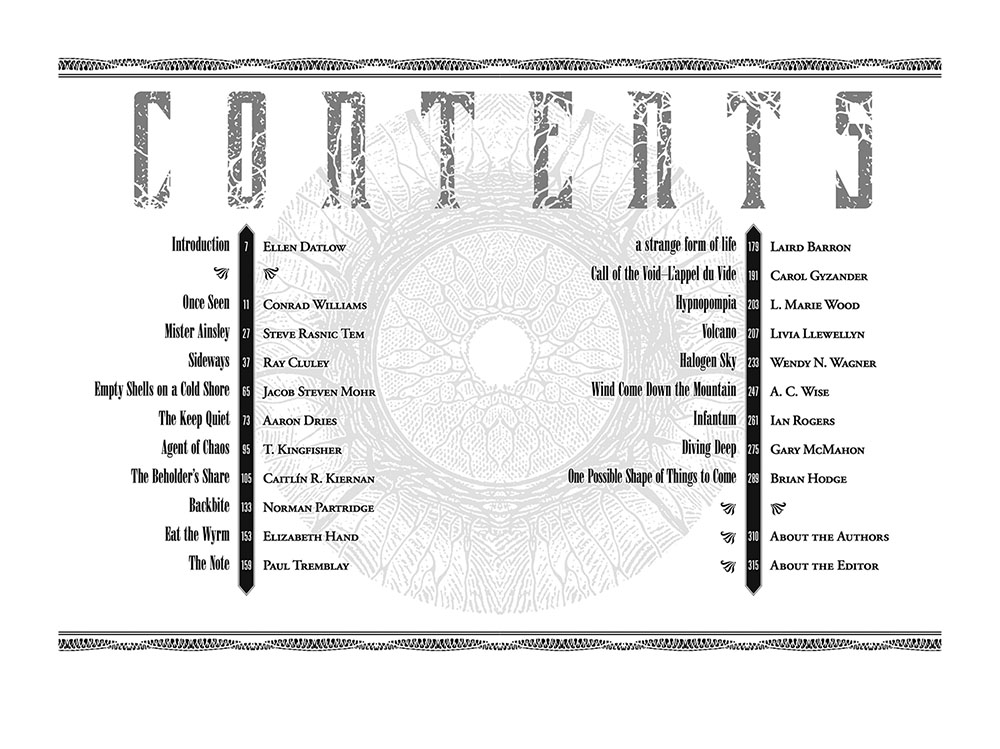
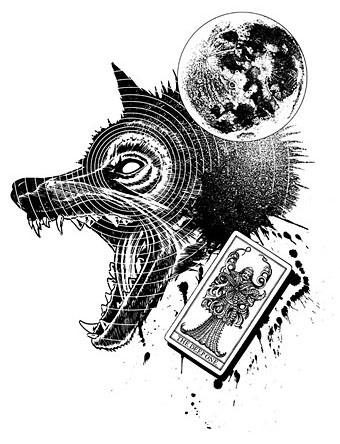
It’s that man again, or some of his progeny, infecting the world with their nightmares. Lovecraft’s Brood is a story collection edited by Ellen Datlow, a kind of follow-up to Lovecraft’s Monsters, although the new book is a more expansive take on the Lovecraftian weird tale. As with the earlier collection, I designed and illustrated this one throughout. The illustrations were more of a challenge this time since the stories weren’t always focused on explicitly physical threats; or if they were, the threats remained either unseen or inexplicable. That can be good sometimes—there’s a tendency in horror illustration to always go for monster portraits or spoilerish scenes from the end of the story—but it doesn’t make the artist’s task an easy one. For a few of the pictures I used a minor detail; in the case of Mister Ainsley, for example, there’s a mention of taxidermy experiments which is what I chose to focus on. What “Mister Ainsley” looks like (or actually is) is never described as such, the reader’s imagination is left to fill the gaps in the story.
brood21.jpg

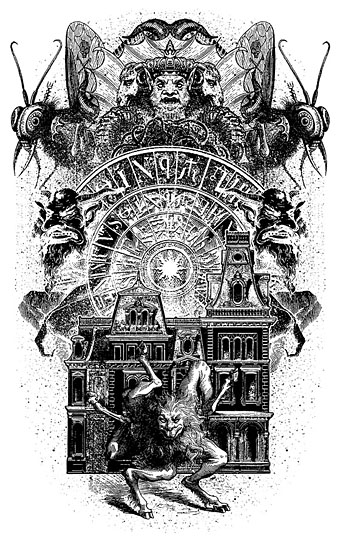
Among the other pictures there’s my first ever drawing of the real church that gave Lovecraft his model for the home of The Starry Wisdom cult in The Haunter of the Dark. This church, or its fictional counterpart, has haunted my imagination for a long time, being the subject of my first Lovecraft illustration in 1979 and (of course) the subject of my first Lovecraft comic strip in 1986. In Lovecraft’s Brood the church appears in The Beholder’s Share, another fine riff on Lovecraft’s fiction by Caitlín R. Kiernan in which the Starry Wisdom cult actually existed, with the old Catholic church on Federal Hill being the centre of their operations. The real church was demolished in 1992 but the location is still easy to find since the grounds have been turned into a small recreational area which retains the walls that surrounded the building. When I was in Providence in 2015 I walked over to Federal Hill to see a concert performance in a converted cinema but I didn’t manage to visit the site of the church, something I now regret.
brood22.jpg

On the technical side, this set of illustrations is the first where I’ve used Glitch Lab in the creation of some of the artwork. Glitch Lab is one of several tablet-based image-processing apps made by Ilixa that function like Photoshop’s filters but with many more options. Photoshop hasn’t done much with its basic suite of filters since the 1990s, something that doesn’t bother me most of the time but every so often you find yourself wanting to imitate a technical effect that can’t easily be achieved without a lot of work. For two of these illustrations I wanted views seen through different kinds of monitors, the first a low-quality TV screen of a type you’d see in a supermarket, then a distorted image from a malfunctioning camera whose output is being viewed on a computer monitor. Glitch Lab specialises in this kind of technical distortion, and can imitate a wide range of visual glitches of a type generated by old TV sets. The Note is the story with the security camera for which I painted a relatively minimal greyscale scene. This wouldn’t have worked on its own but running it through the filters gave it the required appearance. Wind Come Down the Mountain is much more heavily processed, and could have been pushed a lot further but I’d already destroyed a lot of the detail I’d put into the picture.

Lovecraft’s Brood is out now in print and digital from Tachyon and all the usual outlets.
brood23.jpg

brood02.jpg

Once Seen by Conrad Williams.

brood03.jpg

Mister Ainsley by Steve Rasnic Tem.
Continue reading “Lovecraft’s Brood”

Lovecraft’s Monsters

Lovecraft's Monsters

Graphic for the title page and ends of chapters.

I don’t usually post things so far away from publication, but editor Ellen Datlow put these pictures on her Facebook page a few hours ago so I may as well do the same here.

Back in February I bought a Wacom Intuos drawing tablet, something I’ve been using with regularity for the past few months. The Alas Vegas Tarot cards I designed in the summer were the first major attempt at getting used to working with it; Lovecraft’s Monsters, a forthcoming fiction anthology for Tachyon is the second, and I now feel very comfortable working with it. More than that, I’m increasingly pleased with the way it’s possible to combine the drawing techniques I’ve been using for years with the additional possibilities provided by working in Photoshop. As always, it’s the end result that counts but arriving at an end result can be easy or difficult. Some of these illustrations look no different than they would have done had I used ink on paper but they took half the time to create, a considerable benefit when a deadline is looming.

The stories Ellen Datlow has chosen for this collection all present different aspects of monstrosity seen through the lens of Lovecraft’s fiction and his cosmic menagerie. Some are full-on extensions of the Mythos, others are more allusive; all the pieces bar one have been published before but I’d not read any of them so for me this was fresh material. Having spent the past few years saying I was finished with Lovecraft’s fiction I was excited to be working on this book. The stories are good, and I welcomed the challenge of having to illustrate such a variety of material.

Larger copies of all the pictures can be seen here.

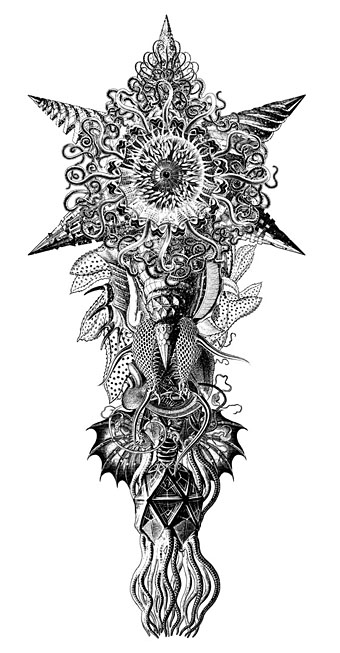
The star-headed thing at the top of this page is another amalgam of elements plundered from Haeckel’s Kunstformen der Natur and other sources. I’ve leaned rather heavily on Haeckel in the past, something I wanted to avoid here; this serves as a kind of visual punctuation separating the stories.

Lovecraft's Monsters

Cthulhu.

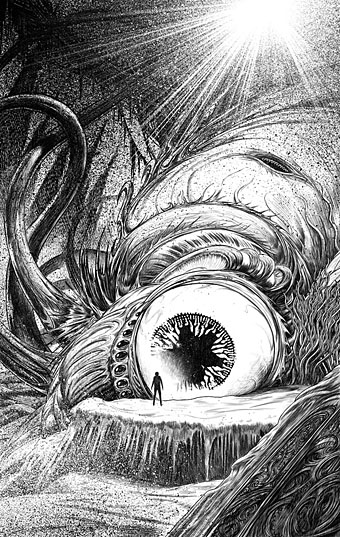
The drawing I’ve called Cthulhu is a piece for the introductory pages. Having already produced a lot of Cthulhoid art I didn’t want to repeat myself. The initial idea was of a tiny human figure faced with something enormous and nightmarish; that could be a vast eyeball or it could be a mouth or some other organ/aperture, the vagueness was intentional. Lovecraft continually impresses upon his readers how difficult things are to describe or apprehend but you seldom find this quality in art based upon his stories. Cthulhu especially has devolved into little more than an outsize man-in-a-rubber-suit à la the Creature from the Black Lagoon. In The Call of Cthulhu the figure on the mysterious statuette is described as having a humanoid shape but Lovecraft doesn’t describe the appalling reality in any detail at all. When Cthulhu is struck by a ship at the end of the story it breaks apart and is then seen recombining, the implication being that the creature is corporeally amorphous.

Lovecraft's Monsters

Only the End of the World Again by Neil Gaiman.

Neil Gaiman’s entry concerns a werewolf private detective in Innsmouth. Lovecraft’s decaying fishing village and its inhabitants turn up in several of the stories so care was taken to avoid repetition.

Lovecraft's Monsters

Bulldozer by Laird Barron.

A great story about another detective, a Pinkerton agent this time, hunting his quarry through the Old West. Collin de Plancy’s Dictionnaire Infernal is mentioned so I used some of Louis Breton’s illustrations from the third edition.

Continue reading “Lovecraft’s Monsters”