Weekend links 311

vasconcelos.jpg

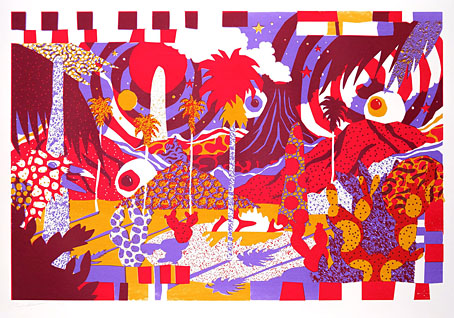
Sphinx (2015) by Lupe Vasconcelos.

• I’ve been reading my way through Patricia Highsmith’s Ripley novels for the past couple of weeks, and may well progress to some of her other books once I’m finished. Highsmith had a long career so there’s a lot to read on the web. Catching my eye this week were 10 Best Patricia Highsmith Books recommended by her biographer, Joan Schenkar; The Patricia Highsmith Recommendation Engine; Highsmith on Desert Island Discs in 1979 (the book she said she’d take, Moby-Dick, is the same one chosen by JG Ballard, albeit for different reasons); and a prickly interview late in her life with Naim Attalah.

Discovering 20th-century literature: books, manuscripts and other documents in the collection of the British Library.

• Signed copies of Paul Gorman’s Barney Bubbles monograph, Reasons To Be Cheerful, may be ordered from the author.

• How a mysterious ghost ship brought cosmic disco to Cape Verde. Related: Quirino Do Canto by Mino Di Mama.

• Zombi drummer AE Paterra and composer Paul Lawler make prog-synth epics as Contact.

• Mix of the week: Secret Thirteen Mix 185, a locked-groove mix by Massimo Carozzi.

• In London next weekend: Alchemy and Magic at Brompton Cemetery.

Die or DIY?: scarcities from the post-punk outer limits.

• More Penda’s Fen: a lengthy appraisal by Jerry Whyte.

Dennis Cooper salutes James Coburn

Bandcamp is good for musicians.

Vladimir Nabokov’s butterfly art.

• This Heat: Rimp Ramp Romp (1977) | 24 Track Loop (1979) | Health And Efficiency (1980) | Makeshift Swahili (1981)

Weekend links 309

witch.jpg

From What is a Witch, “an illuminated manifesto on witchcraft” by Pam Grossman and Tin Can Forest.

• “The other strand of influence for me from dance music was a production house called Savoy in Manchester, England. They were a super underground publishing house that printed cartoons and comic books, and they also released a series of underground dance records. And they were always being shut down by the police and all their stuff was being confiscated, because it was considered ‘anti-society’ in England.” Anohni giving a shout to my colleagues at Savoy Books in a new interview.

Belladonna of Sadness (1973), a feature-length animated film by Eiichi Yamamoto, has been restored, and is being given a premier release in the US. There’s a review here and a trailer here. No news as yet of a UK release but Finders Keepers has the soundtrack album.

Alejandro Jodorowsky talks to Daniel Kalder about his new novel, Albina and the Dog-Men, while Jodorowsky’s comic-book collaborator, Ladrönn, talks to Smoky Man about their new graphic novel, The Sons of El Topo.

Pretty little watercolours these are not. Made by bulldozers and dynamite instead of a paintbrush and easel, the works—often sited on baking sandscapes—fuse minimalism and modern industrial aesthetics to evoke the otherworldly structures of ancient civilisations, from Stonehenge to Mayan temples and the Egyptian pyramids.

Alex Needham on America’s land artists. A few years ago I tracked down some of the structures he describes using Google Maps.

• In every dream home a heartache: High Rise director Ben Wheatley on adapting Ballard, practical special effects and ’70s parenting.

Tom Phillips: From Prequel To Sequel, an exhibition of pages from A Humument at Shandy Hall Gallery.

• From fresh food to magic mushrooms: Michael Pollan probes the medicinal uses of psychedelic drugs.

• “Let’s not forget graphic design is an artistic discipline,” says Jonathan Barnbrook.

Supervert discusses censorship and related matters at SomethingDark.

• “I’ve sung gospel music when in great despair,” says Diamanda Galás.

• Mix of the week: FACT Mix 550 by James K.

Boy Club is a new gay magazine.

Gospel Trane (1968) by Alice Coltrane | The Gospel Comes To New Guinea (1981) by 23 Skidoo | Gospel Train (1990) by African Head Charge

Tomita album covers

tomita01.jpg

Snowflakes Are Dancing (1974); art direction; Joseph J. Stelmach; artwork: David B. Hecht.

The Japanese composer Isao Tomita died last week so I’ve been listening to some of his early recordings, and thinking—as usual—about their cover designs. Tomita was by far the best of the many electronic musicians in the 1970s who took advantage of the huge success of Wendy Carlos’s Switched-On Bach (1968) to create their own versions of classical music with Moog and other synthesisers. If this makes Tomita sound like an opportunist (and his 1972 collection of electronic pop covers was titled Switched On Hit & Rock), he quickly developed his own approach to electronic composition which ranged from quirky humour to his own brand of cosmic pictorialism. The latter was very different from the equally cosmic meanderings of Tangerine Dream which seldom strayed too far from the rock world. Tomita had a genius for taking very familiar pieces of classical music which he fashioned into synthesizer soundtracks for imaginary science-fiction films. (He also produced actual scores for a number of Japanese films but few, if any, of these were released outside Japan.) This approach is shown to great effect on The Bermuda Triangle (1979), an album that was subtitled “A Musical Fantasy Of Science Fiction”, and which filters Prokofiev and Sibelius through a library of crank paperbacks, with references to UFOs, undersea pyramids, Agharta, the Hollow Earth, Close Encounters of the Third Kind, and the Tunguska Event.

tomita02.jpg

Pictures At An Exhibition (1975); artwork: bas-relief by Gene Szafran. The first appearance of the logo that became a fixture of Tomita’s albums. No designer is credited but I’d guess it was the work of Joseph J. Stelmach. The logo typeface is Sinaloa.

As for the covers, Tomita’s recordings may have been classical music but RCA targeted the albums at a rock audience so there’s no sign of the venerable composers heads that appear continually on the sleeves of orchestral recordings. The examples here are almost all the Western releases which, surprisingly, tended to have better covers than the Japanese originals. This is also a partial selection, favouring Tomita’s own releases (no soundtracks), and mostly the early albums. The later albums aren’t as impressive, and many of them were only released in Japan.

tomita03.jpg

Firebird (1975). No design or art credit. I’d not noticed before that the logo evolves by degrees, here gaining some extensions.

Lastly, I’ll dedicate this post to my old friend Nik Green who died in March. Nik was a session musician of some note, and the first person I knew who owned a synthesizer (an ARP Odyssey). He was also a great Tomita enthusiast who shared Tomita’s sense of humour and relished the quirkier moments on many of these albums. I can’t listen to the opening of the Mars section of Tomita’s The Planets without remembering Nik shouting “That’s a Moog!” when a synthetic fanfare interrupts the sounds of a spacecraft lift-off.

Continue reading “Tomita album covers”

Weekend links 308

trochut.jpg

Frank Herbert’s Dune receives a new cover design by Alex Trochut together with other notable works of science fiction and fantasy for a new series from Penguin.

• “…poet, scholar and biographer Sandeep Parmar…has raised the possibility that a long poem by Hope Mirrlees, titled Paris and published by the Hogarth Press in 1919, was a strong influence on The Waste Land.” Alfred Corn on new TS Eliot scholarship.

• “[Evolution‘s] strain of body horror brings to mind an ethereal HP Lovecraft mixed with David Cronenberg.” Rachel Bowles talks to the film’s director, Lucile Hadžihalilović.

• Library music “is a sonic world of ‘weird beats, odd instrumentations, albums full of dark jazzy interludes or bizarre garage rock.'” Adrian Shaughnessy on innovation in banality.

Italy, which EM Forster called “the beautiful country where they say ‘yes’”, became another resort, especially the island of Capri, where a French poet staged a ceremonial flogging of his teenage Italian lover before the boy departed to do his military service and became the subject of a novel by his compatriot Roger Peyrefitte. In the Egyptian city of Alexandria, Forster observed the Greek poet Constantine Cavafy “standing absolutely motionless at a slight angle to the universe”, and the Australian novelist Patrick White met a local man who became his lifelong companion. For decades, the novelists Paul and Jane Bowles presided in Tangier, which Jack Kerouac was to call a “sinister international hive of queens”. William Burroughs arrived in 1954 with a teenage Spaniard named Kiki who, Woods writes, “was, famously, the boy who would blow smoke into his pubic hair and say ‘Abracadabra’ as his hardening cock emerged from the cloud”. Tangier was to figure in Burroughs’s novel Naked Lunch as a phantasmagoric, rubbery walled sex market called the Interzone.

Caleb Crain reviewing Homintern by Gregory Woods

• Beardsley biographer Matthew Sturgis reviews Aubrey Beardsley: A Catalogue Raisonné, a two-volume collection edited by Linda Gertner Zatlin.

• “He was the Bresson of Birkenhead.” Andrew Collins reviews the forthcoming collection of BBC dramas directed by Alan Clarke.

• “The postwar Hollywood western was more content to let strangeness be strange,” says Michael Newton.

• “Bosch’s work has always caused trouble for interpreters and critics,” says Morgan Meis.

Misplaced New York: a project by Anton Repponen and Jon Earle.

Wyrd Daze, Lvl2 Issue 6, is out, and as before is a free download.

Lessons we can learn from Robert Altman’s 3 Women.

• Mix of the week: FACT Mix 548 by Peder Mannerfelt.

Paris 1971 (1971) by Suzanne Ciani | Paris II (1987) by Jon Hassell | Dreaming Of Paris (2013) by Van Dyke Parks

Essex House book covers

essex01.jpg

I’ve known the name of American publisher Essex House for many years but the books they published, all of which appeared in a frenzy of activity from 1968 to 1969, have never been easy to find in the UK. The company is chiefly of note today for having three original Philip José Farmer novels on their list, all works of fantasy with the erotic side more dominant than in Farmer’s previous work. Erotic fiction with a generic slant was the Essex House speciality, and while the Farmer covers have appeared here before, I’d not seen any other Essex House covers until the discovery of this page which collects 38 of the 42 published titles.

essex13.jpg

It’s immediately evident looking down the list that the (uncredited) designer managed to forge a distinctive identity for the books at a time when any cover would suffice if the written material was sufficiently pornographic. Many of the covers borrow (or mutate) pre-existing artworks, while others emulate the watered-down psychedelic style that by the late 60s was visible everywhere in the US and much of Europe. These aren’t all great pieces of design but the graphics on erotic titles in the 60s either played safe by favouring text-only covers or sported technically crude emulations of paperback illustration. (For an example of just how technically crude, see this post about some of the many gay pulps on sale in the US.)

essex33.jpg

Essex House may not have been around for long but they seemed to be attempting something different, at least where the covers were concerned. I’ve only read the Farmer books so I can’t vouch for the other titles but the Encyclopedia of Science Fiction writes that

…about half the 42 titles published by Essex House were sf/fantasy; they included novels by Philip José Farmer, Richard E Geis, David Meltzer (perhaps the most distinguished), Michael Perkins and Hank Stine…of which a number were ambitious, some literary, and most somewhat joyless—even emetic—and redolent of 1960s radicalism.

Pornography as a tool of radical politics had a brief vogue in the late 60s and early 70s, something that’s particularly evident in the underground magazines of the period. The results may be “joyless” to some but then I find a lot of the alleged classics of science fiction joyless so it’s all a matter of taste. There was no equivalent of Essex House in the UK but in the 1970s France had the Chute Libre imprint which not only published all of the Essex House Farmer titles but did so with a collection of equally striking (or “joyless”) cover designs.

essex23.jpg

Artwork is a solarised version of Le Bout du monde (1949) by Leonor Fini.

Continue reading “Essex House book covers”