Wildeana 3

teleny.jpg

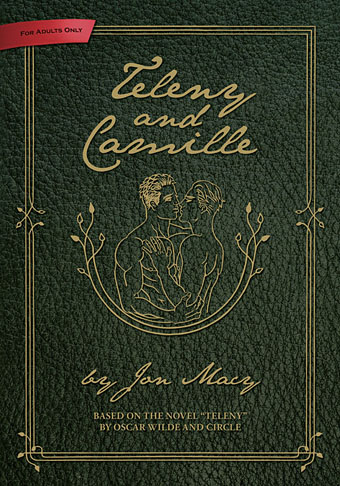
Some recent pieces of Wilde news. The cover above is for a new edition of Teleny and Camille, Jon Macy‘s comic strip adaptation of the erotic novel attributed to Oscar Wilde and members of his Uranian circle:

Teleny is the haunted musical genius that everyone desires but no one has truly touched… until the fateful night that he senses Camille’s presence in the audience. The wealthy young man is instantly seduced by Teleny’s dark beauty and smoldering melancholy. This groundbreaking and powerful early gay novel, written in secret by Oscar Wilde and his anonymous circle of writers, is now re-interpreted as a graphic novel, in all its lush, pansexual excess.

I wrote something about the novel last year. I’m not convinced that Wilde penned the whole thing but I can see places where he may have contributed. There’s a marvellous scene in an all-white room, for example, which seems inspired by the obsessive decor in Des Esseintes’ house from À rebours, the novel which had a great influence on Dorian Gray (both book and character). I’d been intending on writing something substantial about Macy’s adaptation all summer but failed dismally due to a deluge of deadlines. Suffice to say it’s a very accomplished and (most important) erotic work, doing full justice to a story that makes many later erotic novels seem timid and evasive. The drawings are black-and-white throughout which gives a Beardsley-like quality in places, and Macy conveys a period feel without fretting over details as I’m afraid I’d be tempted to do. Northwest Press have published the new edition and have a selection of reviews here.

For the other Wildeana, Lambda Literary had a review of a new book by Matthew Hofer and Gary Scharnhorst, Oscar Wilde in America: The Interviews which sounds like another essential purchase. And the Independent had this story about a sale of Wilde letters which included one to a magazine editor that may be read as a proposition. Readers of Neil McKenna’s The Secret Life of Oscar Wilde will be familiar with the form and know that there’s no “maybe” about it; Priapus was calling.

Elsewhere on { feuilleton }
The gay artists archive
The Oscar Wilde archive

Weekend links 30

woody.jpg

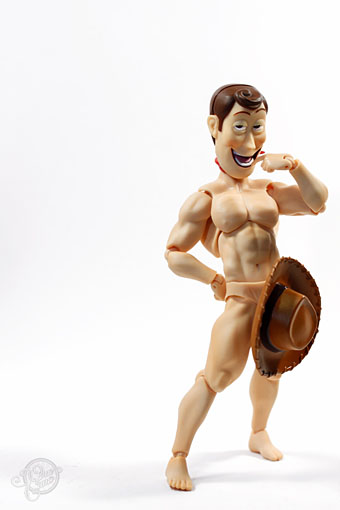
Did someone say “woody”? Plenty more toy antics at TheOneCam.

• And yet more Haeckelisms: Praying in Haeckel’s Garden, recent works by artist Mary O’Malley.

Seasons of the Peacock, the perennial showoff as depicted by a handful of Art Nouveau artists. A couple of examples there I hadn’t seen before.

• Dorian Cope presents On This Deity, “Commemorating culture heroes and excavating world events.”

• At long last, Fantagraphics will be publishing Ah Pook is Here, the comic strip collaboration between William Burroughs and artist Malcolm McNeill. Something to look forward to for next year. Related: Malcolm McNeill’s website.

David Lynch Dark Splendor: “Der große Filmemacher David Lynch als Fotograf, Maler, Zeichner und Grafiker.”

More on the forthcoming album from Brian Eno, Leo Abrahams and Jon Hopkins. With this degree of hype the end result is going to be a disappointment.

Book design by Richard Hollis, including John Berger’s essential Ways of Seeing.

A fistful of Vignellis: the work of Lella and Massimo Vignelli celebrated.

• Berni Wrightson’s Frankenstein at Golden Age Comic Book Stories.

Jimi Hendrix, Philip José Farmer reader.

Imagerie du Chemin de Fer.

El UFO Cayó (2005) by Ry Cooder.

Druillet’s vampires

vampire3.jpg

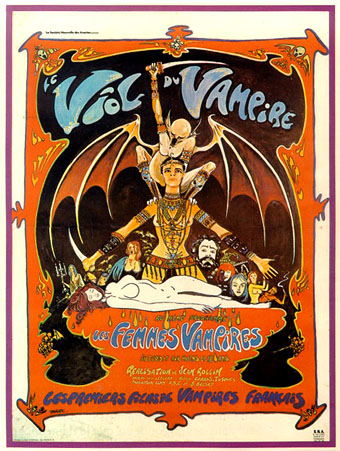
Le Viol du Vampire (1968) or Rape of the Vampire (stay classy, Jean!); re-titled Queen of the Vampires for the Anglophone world.

We’re so inundated these days with vampires and—worse—fucking zombies, that I’ll be perfectly happy if I never see another bloodsucker or shambling corpse again. But let’s overlook the degrading of horror staples for a moment to consider Philippe Druillet‘s excursions into the art of the cinema poster.

vampire1.jpg

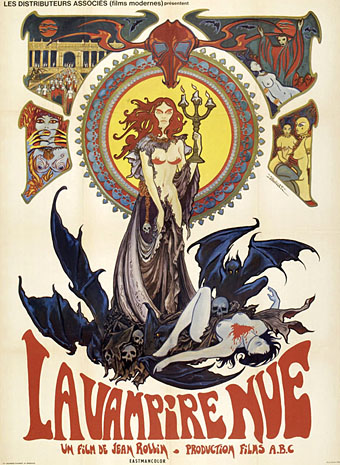
La Vampire Nue (1969).

These pieces are for Jean Rollin‘s first three films, additions to the groovy-lesbian-vampire-with-false-eyelashes-and-bare-boobs sub-genre made at a time—the late 60s—when all the European film studios, Hammer included, were pushing the erotic content of their films more than had previously been dared. Rollin’s erotic comic strip from 1967, Saga de Xam, featured art contributions from Druillet, among others, which no doubt explains the choice of artist. As with David Palladini’s fantastic design for Werner Herzog’s Nosferatu the Vampyre (1979), these are further examples of how unique and distinctive film posters once were in a way they rarely are today. (Druillet, incidentally, produced his own adaptation of Nosferatu in 1989.)

vampire2.jpg

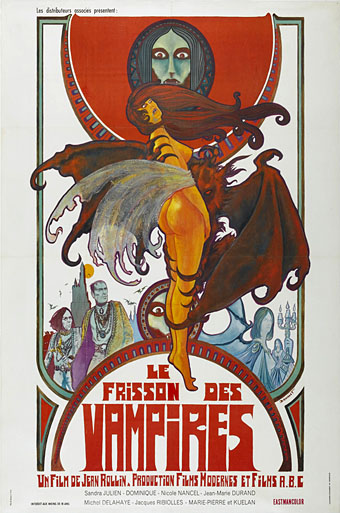
Le Frisson des Vampires (1970).

Pages from the fabulously rare Saga de Xam feature in the Art Nouveau catalogue that was the subject of yesterday’s post. So too does Druillet’s poster for Le Frisson des Vampires although any of these pieces would have made suitable inclusions. Even more than in his comic strips Druillet’s work here shows the overt influence of Alphonse Mucha.

Most of Rollin’s films seem to be available on DVD should you be desperate for some fangs and boobs. I’d much rather see Saga de Xam be reissued; it’s been out of print since 1967 and the copies available go for upwards of £200. This site has samples of the pages and there’s a post about the book (in French) here. For more about Jean Rollin, see Fascination: the Jean Rollin Experience.

Elsewhere on { feuilleton }
The illustrators archive

Previously on { feuilleton }
The Art Nouveau dance goes on forever
Salammbô illustrated
Druillet meets Hodgson
The music of Igor Wakhévitch
Nosferatu

The Art Nouveau dance goes on forever

nouveau1.jpg

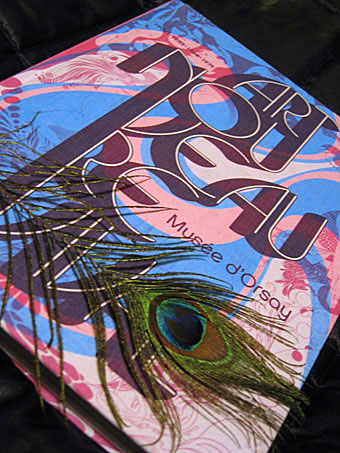
Catalogue for Art Nouveau Revival 1900 . 1933 . 1966 . 1974. Peacock feather not included.

Regular readers may recall my mention of the Musée d’Orsay exhibition Art Nouveau Revival which was launched late last year. I didn’t get to see the exhibition, unfortunately, but this week I finally ordered a copy of the catalogue, an expensive cloth-bound volume with essays (in French) by Philippe Thiébaut, Stephen Calloway, Irene de Guttry, Thierry Taittinger and Philippe Thieryre. Despite the ruinous postal charges incurred by the book’s weight this was worth every euro, it being the kind of polymorphous production which in solipsistic moments one can choose to believe was created solely for your own benefit.

nouveau3.jpg

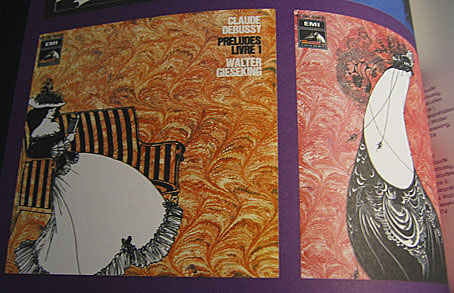
Aubrey again, album covers from 1974.

Much of the subject matter has been explored here in various small ways, with the curators following the influence of Art Nouveau through Surrealism (mainly Dalí) to the psychedelic art of the 1960s and on into the Pop Nouveau (for want of a better term) which flourished in the first half of the 1970s. Among the familiar Aubrey Beardsley graphics and psychedelic posters there are also some pleasantly surprising inclusions, including illustrations by Philippe Jullian (yes, I’m still intending on writing about him at some point), yet more Beardsley album covers, film posters, and even some of the sillier films of the late-60s such as Casino Royale. Being a French exhibition there’s a section devoted to comic strips which includes work by Moebius, Philippe Druillet and Guido Crepax.

nouveau2.jpg

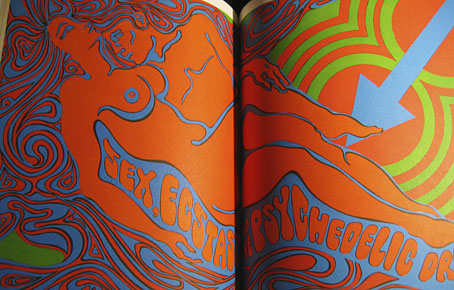
Sex and LSD, a spread from Playboy, 1967.

It’s common to see parallels drawn between the 1890s and the 1960s but the strange blooms of vulgarised fin de siècle style which burgeoned in the wake of psychedelia are seldom given much attention. One of the great things about this catalogue is the amount of ephemera the curators chose to include such as magazine ads and trend-chasing album sleeves. It was precisely this blend of 1890s + 1960s + 1970s I sought to capture in my recent cover for Dodgem Logic. As I said, it’s an expensive book but for anyone drawn to this aesthetic hothouse it’s also an essential purchase. Art Nouveau Revival can be ordered direct from the museum shop. Further samples follow.

Continue reading “The Art Nouveau dance goes on forever”

Weekend links 24

early.jpg

Delta-Wing (2009) by Chloe Early.

• “Feted British authors are limited, arrogant and self-satisfied, says leading academic”. Stating the bleeding obvious but it still needs to be said, apparently, especially when the announcement of the Booker list this year caused the usual confusion when Amis Jr. and McEwan weren’t included, as though the mere existence of their novels makes them prize-worthy. And as someone pointed out, the word “male” is missing from that headline.

Hero of Comic-Book World Gets Real: Alan Moore again, in the NYT this time. Related: a review of Unearthing live.

• Announcing The Hanky Code by Brian Borland & Stephen S Mills, a 40-poem book to be published next year by Lethe Press. For an explanation of the Hanky Code there’s this, and there’s also an iPhone app.

Folk—the ‘music of the people’—is now hip again, says (who else?) Rob Young who can also be heard on the archived podcast here. Related: the folk roots of Bagpuss. Related to the latter: The Mouse Mill.

zvorykin.jpg

An endpiece from The Firebird and other Russian Fairy Tales by Boris Zvorykin.

‘Yes’ to Catastrophe: Roger Dean, Prog and SF. A lengthy and thoughtful analysis of Roger Dean’s early work.

Into the Media Web, the enormous Michael Moorcock book which I designed, is officially published this week.

Cassette playa: in praise of tapes. I’ve complained about tapes in the past but people continue to find them useful. Some technologies die harder than others.

Boy BANG Boy: “Quiet moments made suddenly very loud with the attitude and opinion of what it means to be a young male in an impossibly diverse world.” An exhibition opening at Eastgallery, London, on August 5th.

Empty your heart of its mortal dream: Alfred Kubin’s extraordinary novel, The Other Side.

Ghostly and Boym Partners devise a new way to deliver digital music.

Besti-mix #27: a great selection by producer Adrian Sherwood.

Agnostics are troublemakers. Amen to that.

• RIP Harry Beckett.

Acousmata.

Let Us Go In To The House Of The Lord by Pharoah Sanders (live, 1971): Part 1 | Part 2