Exposition Universelle films

expo2.jpg

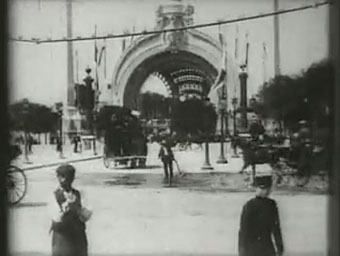
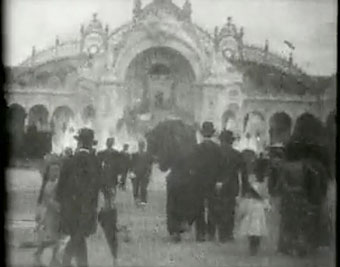
The Exposition entrance at the Place de la Concorde.

Yes, films of the Paris Exposition Universelle of 1900. This week I’ve been reading Philippe Jullian’s book about the Exposition (more about the admirable Monsieur Jullian later) and it was only when he mentioned early cinema screenings as one of the entertainments that I realised I hadn’t looked for films of the Exposition itself. YouTube has the goods, of course, and those goods are unavoidably primitive given the age of the prints and the infancy of the medium. Quality isn’t the point, however, what matters is the thrill of looking back 110 years to see these fleeting structures and their visitors. Most of the footage seems to have been filmed by the Edison Company and the filmmakers conveniently let us know that it was the month of August. According to Jullian, Paris was suffering from a heatwave at the time but you wouldn’t know it from the way everyone is dressed although most of the women (and some of the men) are carrying parasols. In addition to the period footage, there’s also the channel of a 3D animator who’s been creating computer models of the buildings. I’ve thought for some time that these vanished expositions could be resurrected using 3D modelling so it’s encouraging to find someone doing exactly that.

The films:
Thomas Edison’s L’ Exposition Universelle de 1900 à Paris | A compilation of the shorts with intertitles.
Panoramic view of the Place de la Concorde
Esplanade des Invalides
Panorama from the Moving Boardwalk
Eiffel Tower lift
The Palace of Electricity

Update: The Edison shorts and some other Exposition clips not listed above can also be found in the Edison film archive at the Library of Congress. You need to go to this page and use the search term “paris” to receive a list. They’re still low-res, unfortunately, but at least the files haven’t been put through YouTube’s compression filters.
expo1.jpg

The Palace of Electricity.

Previously on { feuilleton }
Exposition jewellery
Exposition Universelle catalogue
Exposition Universelle publications
Exposition cornucopia
Return to the Exposition Universelle
The Palais Lumineux
Louis Bonnier’s exposition dreams
Exposition Universelle, 1900
The Palais du Trocadéro

Weekend links 11

orazi4.jpg

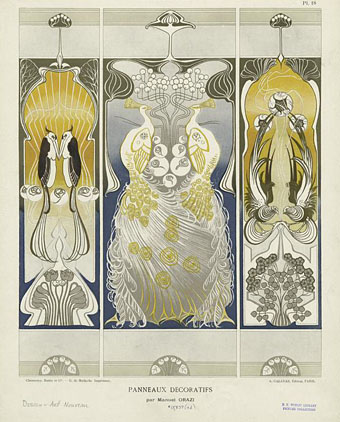
Panneaux decoratifs (1900) by Manuel Orazi at NYPL.

Ghostsigns: “a collaborative national effort to photograph, research and archive the remaining examples of hand painted wall advertising in the UK and Ireland.”

• Golden Age Comic Book Stories posts some Alphonse Mucha.

Voyage Fantastique – An illustrated guide to the body and mind at A Journey Round My Skull.

The gallery of the International Exhibition of Calligraphy.

Trevor Wayne Pin-Up Show, a new photo collection of the tattooed Mr Wayne which includes photos and a foreword by Clive Barker.

Phallophonies, a gallery exploring the penis in religious art. Related: “Churchgoers are outraged over a crucifix in a Catholic church that they say shows an image of genitalia on Jesus.”

Hollingsville: “Expect live and unscripted wanderings around voodoo science parks, examinations of cities as battle suits and thoughts on pods, capsules and world expos.”

Phantom Circuit #33 is a Ghost Box special featuring an interview with Jim Jupp (Belbury Poly) and Julian House (The Focus Group). Related: Ghost Box films at YouTube.

Eldritchtronica and Wyrd Bliss, a mixtape by Simon Reynolds.

• Avant garde music and cinema meet at The Sound of Eye.

• Make your own newspaper with Newspaper Club.

Drawdio: A pencil that lets you draw music.

Yoko Ono collects rare books.

KittehRoulette.

• Song of the week: The Four Horsemen (1972) by Aphrodite’s Child.

Manuel Orazi’s Salomé

orazi1.jpg

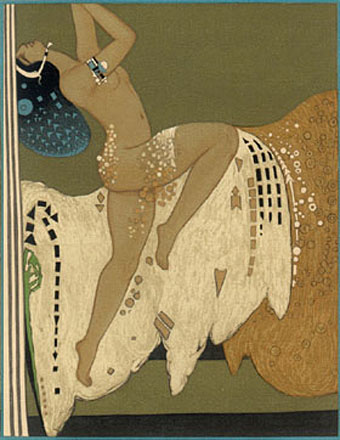
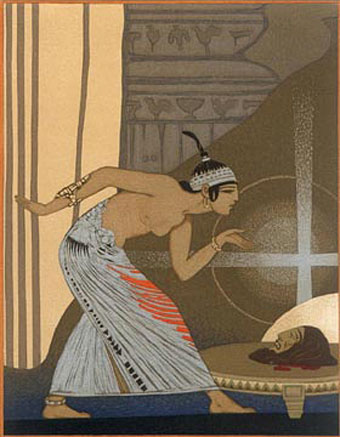
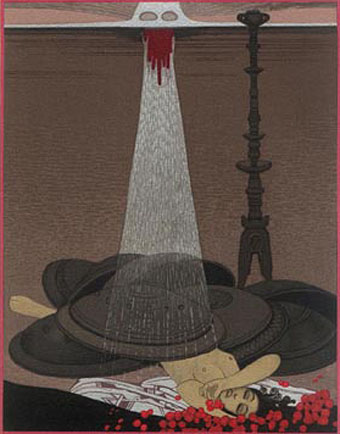
The Biblical bad girl returns in three pictures from an illustrated edition of Oscar Wilde’s play, published as a limited run in 1930. Manuel Orazi (1860–1934) was a French artist whose work has appeared here before, and no doubt will do again very soon since I’ve been finding further examples of his illustrations and designs. These drawings are closer to Gustav Klimt or George Barbier than his earlier illustrations which owed much to the stylisation of Mucha’s Art Nouveau.

orazi2.jpg

orazi3.jpg

Elsewhere on { feuilleton }
The illustrators archive
The Salomé archive

Weekend links 10

harlequin.jpg

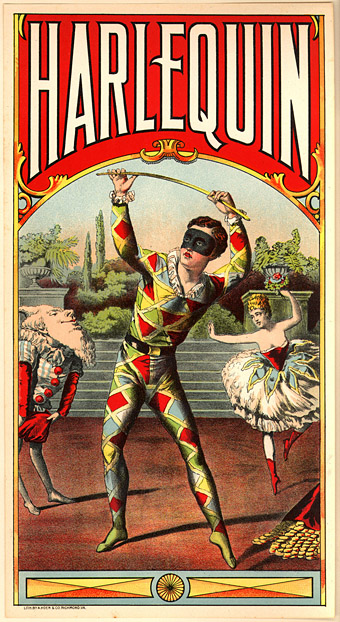
One of a number of vintage ads and ephemeral items at this Flickr set.

• From 1971: The Anthony Balch/William Burroughs/Jan Herman video experiment.

• The NYT reports on World on a Wire, a neglected science fiction drama by Rainer Werner Fassbinder.

• “While some of the technology industry’s brightest minds were inventing the first PCs and developing groundbreaking software, they were also feeding their heads with LSD.”

• The archive of author and illustrator Mervyn Peake has been acquired by the British Library for £410,000.

• Thames & Hudson are publishing I Wonder, a book by the wonderful Marian Bantjes, later in the year. Her site has a preview. I want.

• The gays: It’s election season in the UK so My Gay Vote looks at how the three main parties have supported LGB issues. (No data for the graphs, however.) Is theatre finally glad to be gay? Yet more Tumblrs: I heart skinny boys & Cute boys with cats.

• Trend-spotter, “svengali”, Situationist and the man who named the Sex Pistols: RIP Malcolm McLaren. The Guardian ran a number of memorial pages. Related: Anarchy in Gardenstown.

• Dublin’s One City, One Book choice for April 2010 is The Picture of Dorian Gray.

The Catastrophist: Christopher Hitchens on JG Ballard.

Steampunk Taxidermy by Lisa Black.

• LIFE looks back at Aleister Crowley.

• Groovy songs of the week: Julie Driscoll (with Brian Auger & The Trinity), a pair of songs by Bob Dylan—This Wheel’s On Fire—and Donovan—Season Of The Witch—and sets which look like a collaboration between Verner Panton and Marcel Duchamp. Amazing.

Salome’s Last Dance

salome1.jpg

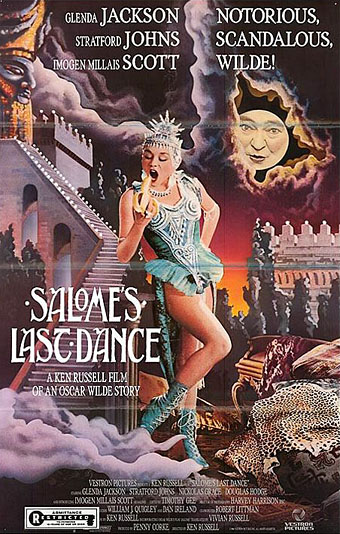
More Wildeana. It’s taken me over two decades to watch this film, and while I can’t really say it was worth the wait it was more entertaining than I expected. Salome’s Last Dance was directed in 1988 by Ken Russell and is his own typically mannered adaptation of the Wilde play. It appeared around the same time as his adaptation of another Victorian work, Bram Stoker’s The Lair of the White Worm, and it was the latter film which caused me to lose my patience with Russell’s excesses and so ignore this one. In Salome’s Last Dance we have Oscar Wilde and Lord Alfred Douglas visiting Alfred Taylor’s London brothel one night in 1892 where Taylor and company stage a performance of Wilde’s banned play.

salome2.jpg

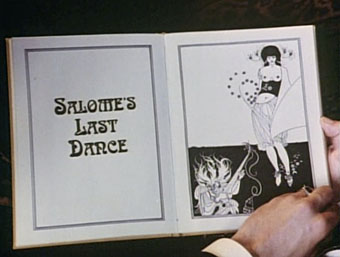
Aubrey Beardsley’s illustrations appear in the title sequence.

If you’re a Wilde enthusiast there are at least two ways you may take this; you can be appalled by Russell’s “translation” of Wilde’s words (Salomé was written in French then translated for English publication in 1894; there’s no reason to re-translate a version the author approved), a translation which is really more of an adaptation, with much of the poetic monologue removed and the tone lowered for a general audience—Wilde’s “Iokannen” is vulgarised to “John the Baptist” throughout. Or you can try and enjoy what is at least a complete performance of the play, even though it more often resembles Carry On Salomé than anything one might have expected Sarah Bernhardt to perform. Injecting a Symbolist drama with slapstick and grotesquery is probably inevitable given the director (Russell is also co-writer and he plays—badly—the role of the Cappadocian). I found it impossible to decide whether Russell was sending up the play because he found it too pompous or whether he felt that an audience wouldn’t sit still for it otherwise. Whatever his intention, the premise is intriguing enough to inspire speculation as to how it might have been treated by other hands.

Continue reading “Salome’s Last Dance”