Weird Fiction Review

weird.jpg

weird, a.

1. Having the power to control the fate or destiny of human beings, etc.; later, claiming the supernatural power of dealing with fate or destiny. Originally in the Weird Sisters = †(a) the Fates; (b) the witches in Macbeth.

2. a. Partaking of or suggestive of the supernatural; of a mysterious or unearthly character; unaccountably or uncomfortably strange; uncanny.

b. of sounds or voices.

3. Of strange or unusual appearance, odd-looking.

4. a. Out of the ordinary course, strange, unusual; hence, odd, fantastic. (Freq. in recent use.)

b. Colloq. phr. weird and wonderful, marvellous in a strange or eccentric way; both remarkable and peculiar or unfathomable; exotic, outlandish. Freq. ironical or derog.

5. Comb., as weird-looking adj.

Oxford English Dictionary

Weird: I’ve relished the word since I was at school for the way it managed to embody or describe so many of the things I was deeply attracted to, especially in the world of fiction. Weird Tales magazine when it was at its height in the 1930s was able to publish stories of fantasy, horror and science fiction, or hybrid stories of fantasy/horror or horror/sf, none of which needed to be alloted specific definitions when “weird” was there to cover everything. China Miéville noted the usefulness of the “weird” designation ten years or so ago, and I’ve been hoping ever since that other people might pick up the broader, more inclusive term instead of dividing the major genres into ever smaller sub-genres. “Weird” could accommodate generic work but also encompass those stories that were simply strange without possessing the usual genre trappings.

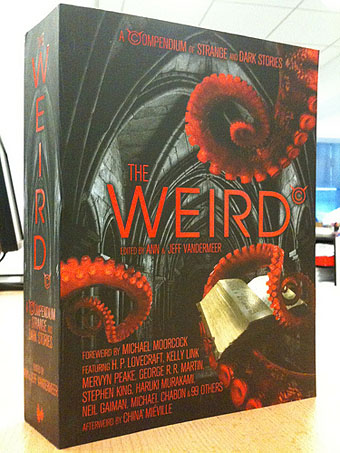
So far the term hasn’t found the widespread favour I’d been hoping for but that may change thanks to the Weird Fiction Review, a site launched this week by my friends and occasional collaborators Ann and Jeff VanderMeer whose enormous brick of an anthology, The Weird: A Compendium of Strange and Dark Stories, is published by Corvus this month. Weird Fiction Review states that:

its primary mission over time will be to serve as an ongo­ing explo­ration into all facets of the weird, in all of its many forms—a kind of “non-denominational” approach that appre­ci­ates Love­craft but also writers like Franz Kafka, Angela Carter, and Shirley Jack­son—along with the next gen­er­a­tion of weird writ­ers and inter­na­tional weird.

Already on the site is an interview with Neil Gaiman who says:

I think of Hor­ror as a sec­tion of a book­shop, gothic as a type of book that ended, truly, with North­hanger Abbey, and The Weird as an attempt to unify what­ever it was that Robert Aick­man did, that Edward Gorey did—using the tools of hor­ror to delight and trans­form.

I’m re-reading some of Aickman’s stories at the moment. He called them “strange” but I’d call them 100% weird. There’s one in Ann & Jeff’s anthology whose contents are an ideal introduction to this zone of literature.

Previously on { feuilleton }
The Vengeance of Nitocris
Die Andere Seite by Alfred Kubin
The King in Yellow
Hugo Steiner-Prag’s Golem

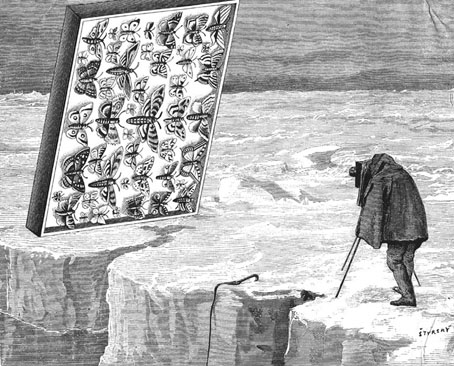
The art of Jindřich Štyrský, 1899–1942

styrsky1.jpg

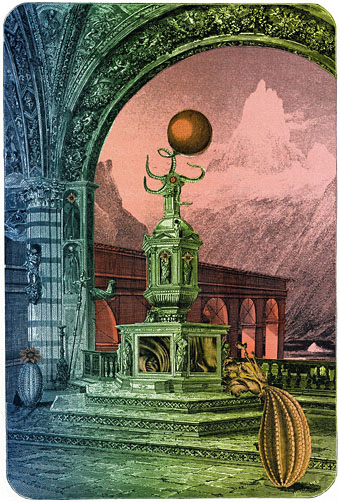
From a late Surrealist to an early one. Jindřich Štyrský is a Czech artist best remembered today for his collages but he was also a painter, a photographer and a publisher of erotic material. He illustrated and published a Czech edition of Lautréamont’s Maldoror, and helped found the Surrealismus review in Prague.

styrsky2.jpg

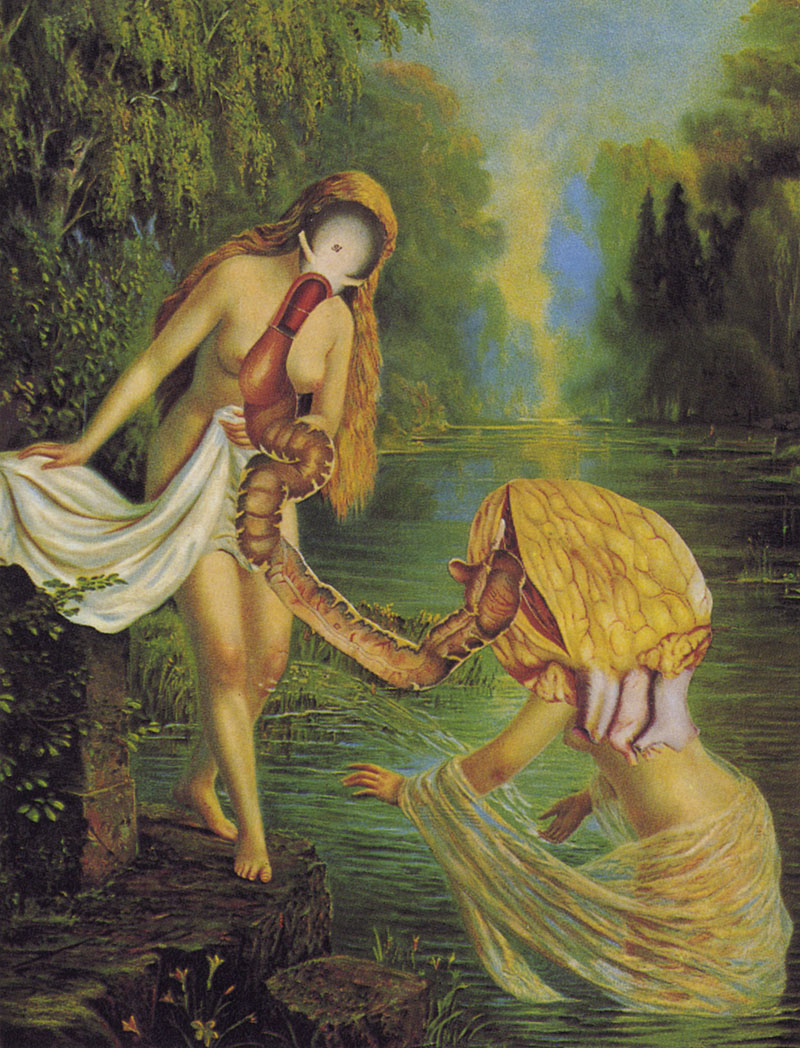
The Bathe (1934).

Regular readers won’t be surprised to hear that I’ve liked Štyrský’s collages for years, many of which subject sentimental Victorian illustration to processes of violent transmutation. Ever since seeing The Bathe I’ve found it impossible to look at one of Renoir’s fleshy nudes without wondering what happened to the exposed viscera. Weimar covered Štyrský’s career in some detail last year so that’s a good place to go for further information. There’s an extract from Štyrský’s dream diary here, and a substantial collection of the collage work and other material at this Flickr set.

styrsky3.jpg

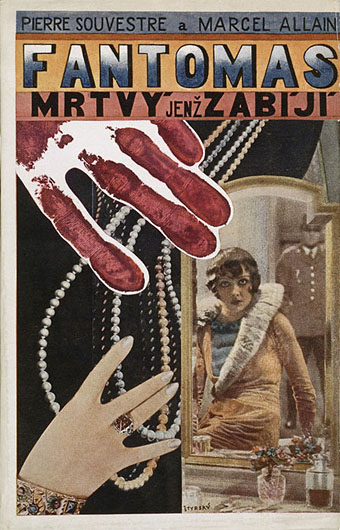
Cover for a Czech edition of Fantômas (1929).

Elsewhere on { feuilleton }
The fantastic art archive

Previously on { feuilleton }
Initiations in the Abyss: A Surrealist Apocalypse
Vultures Await
Wilfried Sätty: Artist of the occult
Illustrating Poe #4: Wilfried Sätty
Metamorphosis Victorianus
Max (The Birdman) Ernst
Gandharva by Beaver & Krause
The art of Stephen Aldrich

Klapheck versus Ballard

klaphek.jpg

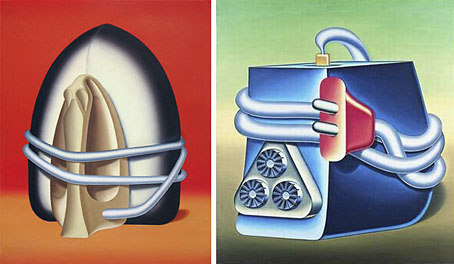
left: The Hostage (1966); right: The Female Terrorist (1971). Both by Konrad Klapheck.

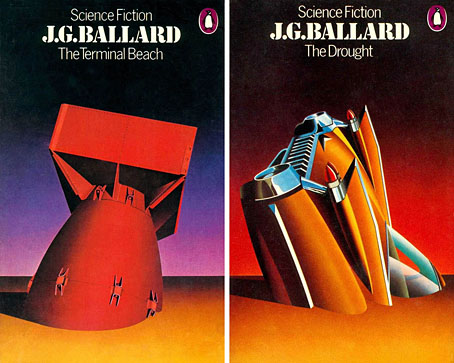
No, I’m not suggesting that David Pelham’s paintings for the Ballard covers he designed in the 1970s are inspired by the earlier work of German artist Konrad Klapheck. But it’s tempting to think of Klapheck’s isolated objects as being intended for Ballard collections that never saw the light of day. Klapheck has connections with late Surrealism, and some of his paintings prefigure the styles and concerns of Pop Art, so I’m sure Ballard would have approved.

pelham.jpg

Three of Pelham’s memorable Ballard paintings were made available as signed and numbered prints earlier this year, together with his design for A Clockwork Orange. For more about the covers see Landscapes From a Dream: How the Art of David Pelham Captured the Essence of JG Ballard’s Early Fiction, an essay at Ballardian. The designer discussed his career at some length in 2007. Then there’s the complete set of covers at the Penguin Science Fiction site, and let’s not forget Konrad Klapheck who’s still painting and who has a website here.

Elsewhere on { feuilleton }
The book covers archive

Alice in Liverpool

caterpillar.jpg

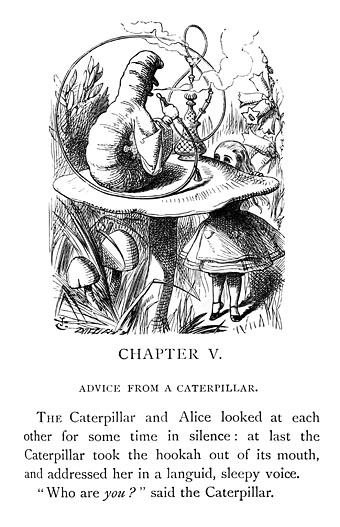
Alice and the Caterpillar (1865) by John Tenniel.

It’s perhaps surprising that an art gallery, rather than a library, is holding a huge survey exhibition about Alice, but then Carroll’s creation has been and still is the inspiration of artists, photographers, theatrical designers, animators, film-makers.

Thus Marina Warner writing about an exhibition of art based on Lewis Carroll’s Alice books opening at Tate Liverpool this Friday:

Alice in Wonderland will offer visitors a rare opportunity to view Carroll’s own drawings and photographs, alongside Victorian Alice memorabilia and John Tenniel’s preliminary drawings for the first edition of the novel.

Carroll’s stories were soon adopted by other artists. Surrealist artists from the 1930s onwards were drawn towards the fantastical world of Wonderland where natural laws were suspended. From the 1960s through the 1970s, Carroll’s Alice tales also prompted conceptual artists to explore language and its relationship to perception, and the stories inspired further responses in Pop and Psychedelic art. Expect to see works by artists ranging from Salvador Dalí and René Magritte, to Peter Blake and Yayoi Kusama. (more)

The exhibition runs to January 29th, 2012, and I suppose this gives me a convenient opportunity to point again to my psychedelic Alice calendars which have been updated for the forthcoming year.

Previously on { feuilleton }
Coulthart calendars for 2012
Scenes from a carriage
Through the Psychedelic Looking-Glass: the 2011 calendar
Jabberwocky
Alice in Acidland
Return to Wonderland
Dalí in Wonderland
Virtual Alice
Psychedelic Wonderland: the 2010 calendar
Charles Robinson’s Alice’s Adventures in Wonderland
Humpty Dumpty variations
Alice in Wonderland by Jonathan Miller
The Illustrators of Alice

Weekend links 82

morris.jpg

At the Mountains of Madness (1979) from Halloween in Arkham by Harry O. Morris.

• Golden Age Comic Book Stories always pulls out the stops in the run up to Halloween. In addition to a wonderful collection of Harry O. Morris collages, Mr Door Tree has also been posting Virgil Finlay’s illustrations for Edgar Allan Poe, Lynd Ward’s tremendous illustrations for a collection of weird tales entitled The Haunted Omnibus, Barry Moser’s woodcuts for an edition of Frankenstein, and Virgil Finlay’s illustrations for stories and poems by HP Lovecraft.

• “Eugene Thacker suggests that we look to the genre of horror as offering a way of thinking about the unthinkable world. To confront this idea is to confront the limit of our ability to understand the world in which we live – a central motif of the horror genre. In the Dust of This Planet explores these relationships between philosophy and horror.”

• “…the reader […] becomes a conscious participant in the process of imposing a linear sequence, while at the same time remaining aware that all narrative is an act of memory, and that memory is necessarily random.” Jonathan Coe reviews Marc Saporta’s book-in-a-box, Composition No.1, recently republished by Visual Editions.

• Nearly fifty years after its first performance, Peter Weiss’s Marat/Sade is still disturbing playgoers. And nearly ninety years after its release, Alla Nazimova’s silent film production of Oscar Wilde’s Salomé is touring the UK with live musical accompaniment.

Tom of Sinland at Homotography, in which illustrator Bendix Bauer portrays some of the fashion world’s notable male designers as Tom of Finland-style characters for Horst magazine.

Neil Gaiman Presents is a new audiobook imprint which launches with works by Jonathan Carroll, Alina Simone, Keith Roberts, M. John Harrison and Steven Sherrill.

• The Weird Wild West: Paul Kirchner has put all his Dope Rider comic strips online.

Leonora Carrington prints at Viktor Wynd Fine Art, London, from November 5th.

The Fall to Earth: David Bowie, Cocaine and the Occult.

Photos of New York City, 1978–1985.

Kathy Acker recordings at Ubuweb.

The Occupied Times of London.

The Golden Age of Dirty Talk.

Pushkin silhouettes.

• This week I’ve been lost in the Velvet Goldmine (again): John, I’m Only Dancing (1972) by David Bowie | The Jean Genie (1972) by David Bowie | Drive-In Saturday (1973) by David Bowie.