John Austen’s Hamlet

austen01.jpg

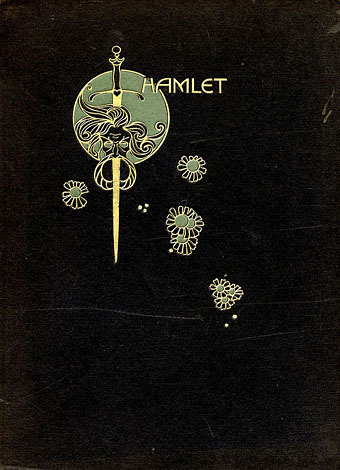
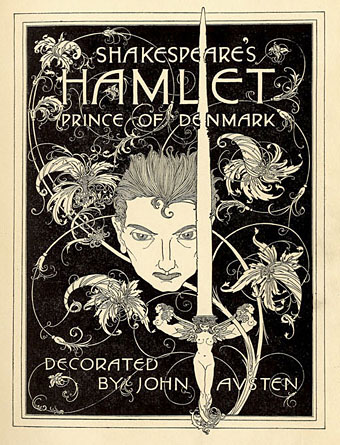
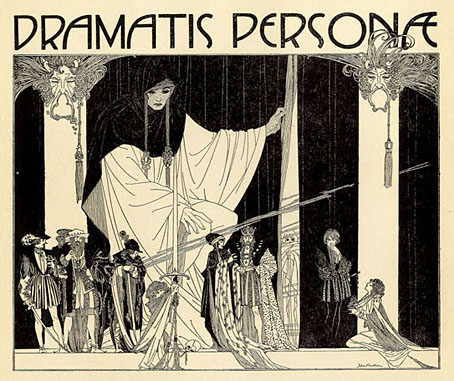
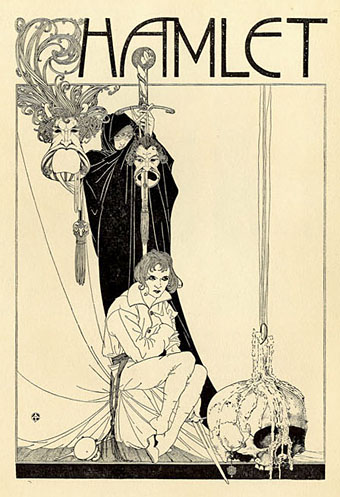
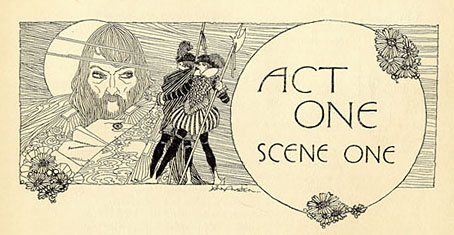
The 1922 edition of Hamlet “decorated” by British artist John Austen (1886–1948) is a lot more visible today than it was a few years ago, thanks to a reprint by Dover Publications in their Calla Editions series. The scans here are from an original printing at VTS. Austen’s Hamlet is often rated as his chef d’oeuvre, and with good reason, he manages to lend some visual splendour to a play whose concerns are a lot more introspective than the usual illustration standards of The Tempest and A Midsummer Night’s Dream. Masks, swords and skulls are recurrent symbols. Yes, the drawings owe a great deal to Harry Clarke’s example—all those manga faces, spiny fingers and swathes of black—but that’s no bad thing if you can pull it off. If you’re going to borrow a style then you may as well take from the best.

austen02.jpg

austen03.jpg

austen04.jpg

austen04-1.jpg

Continue reading “John Austen’s Hamlet”

Weekend links 164

panikanova.jpg

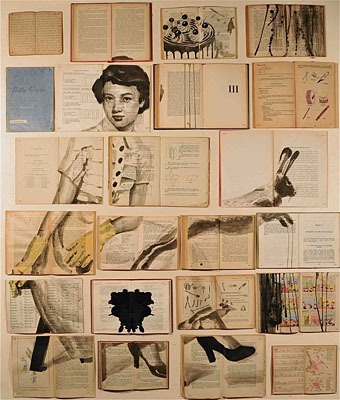
Ekaterina Panikanova paints on books.

Back in 2009 I bought a book of Art Nouveau illustration and design which contained an intriguing drawing by an Austrian artist, Franz Wacik (1883–1938). At the time there was little of Wacik’s other work online so I was delighted by the latest post at 50 Watts which showcases a selection of his illustrations. Wacik was a contemporary of British illustrator Sidney Sime, and both artists share a predilection for the comic and the grotesque.

• “The outlawing of drugs such as cannabis, MDMA and LSD amounts to the ‘the worst case of scientific censorship since the Catholic Church banned the works of Copernicus and Galileo’, the former Government drugs advisor Professor David Nutt has claimed.” Related: “At last, the edifice of drugs prohibition is starting to crumble,” says Amanda Feilding.

Alan Johnston on “A gay island community created by Italy’s Fascists”, and at Another Nickel In The Machine a report on The Gateways Club, one of the few meeting places for London’s lesbians in the 1960s. Alex Park wonders “Why Is Gay Porn So Popular In Pakistan?”

• If it’s June 16th then it must be Bloomsday: The Irish Times has a page of Joyce-related links to mark the anniversary. This year there’s a global reading of Ulysses taking place.

• “Now we can concentrate on album number nine,” says Kraftwerk’s Ralf Hutter. The rest of us will impatiently count the passing seconds.

• After a week in which George Orwell’s Nineteen Eighty-Four has seen an increase in sales, a look at its cover designs old and new.

Aleister Crowley: Wandering the Waste is a 144-page graphic biography of the Great Beast by Martin Hayes and RH Stewart.

Barnbrook Design‘s presentation of Taxidermy, a book by Alexis Turner, is rather splendid.

• FACT Mix 386 is a great collection of dubby grooves compiled by Young Echo.

• From 2001: Michael Wood in the LRB reviewing Apocalypse Now Redux.

• The first recording of Allen Ginsberg reading Howl.

Rejoyce (1967) by Jefferson Airplane | The Sensual World (1989) by Kate Bush | Molly Bloom (2013) by Alan Munde

Weekend links 163

michishita.jpg

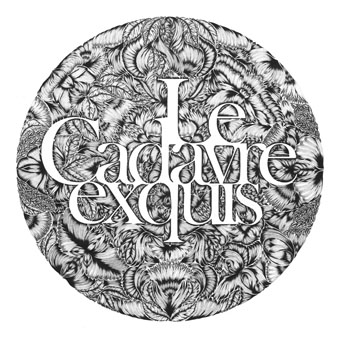
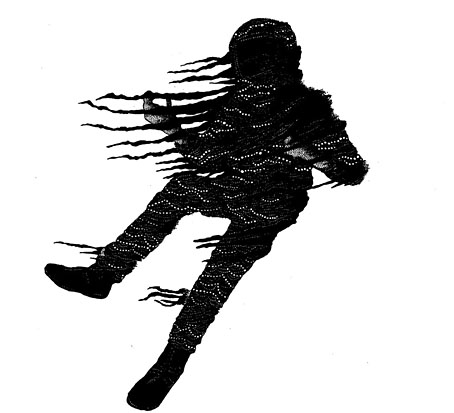
Le Cadavre Exquis by Yukio Michishita. As featured in The Purple Book: Sensuality & Symbolism in Contemporary Art & Illustration by Angus Hyland & Angharad Lewis.

• ” Like Polo’s magic cities, which in the end all turn out to be Venice, fantasy finally refers us back to reality and the challenge of everyday social engagement.” Jonathan Galassi on The Dreams of Italo Calvino. In the same edition of the NYRB, Anna Somers Cocks on The Coming Death of Venice?

• Mix of the week: Solid Steel Radio Show 7/6/2013 Part 3 + 4: Peter “Look Around You” Serafinowicz compiles 70 minutes of Boards of Canada-inflected ambience.

• “Magic and art tend to share a lot of the same language. They both talk about evocation, invocation, and conjuring.” Alan Moore talks to Peter Bebergal.

The gay rights movement around the world has promoted a basic idea: we want to show society that we are human beings like everyone else. The problem is that the train driver at the Kashirskaya train station doesn’t necessarily think that those few dozen passengers in whose face he closes the doors are a priori inferior and deserve such treatment. He feels that he becomes superior to them by means of using his power over them. This sense of superiority can be trumped only by some higher superiority.

On the Moscow Metro and Being Gay by Dmitry Kuzmin.

• “I went from being a very promising young writer to being completely ignored in two novels.” Madeleine Monson-Rosen on Angela Carter.

Sequence6, another excellent sampler from Future Sequence: 40 new pieces of music as a free download.

timlin.jpg

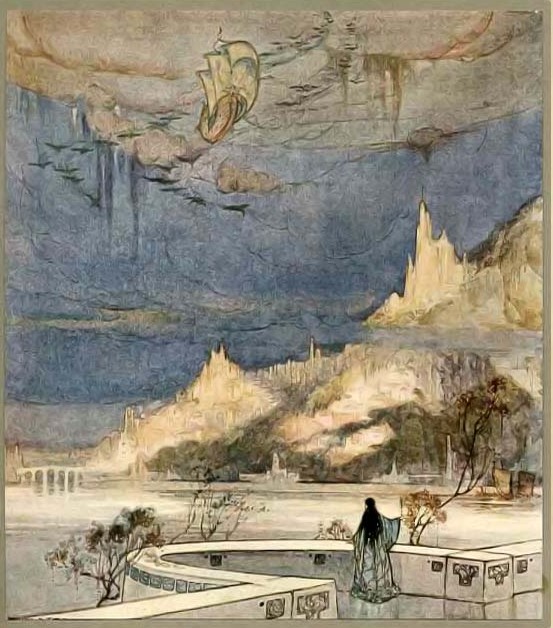
The Arrival on Mars, an illustration from The Ship That Sailed to Mars (1923) by William Timlin.

• At PingMag: An Icon for Everyone: Shoryu Hatoba, Japanese Crest Artist.

• More Japanese weirdness at Sardines Bizarres.

• Larry Nolen on Bruno Schulz.

Magic Ritual (1976) by Black Renaissance | Magic Fly (1977) by Space | Magic Vox (1981) by Ippu-Do

Meetings with Remarkable Men

meetings1.jpg

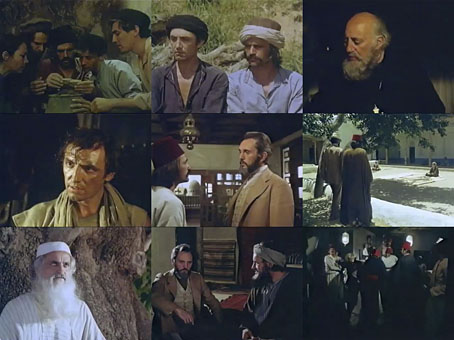
Another Peter Brook film, and a very strange one it is, not for its content but more for the way you wonder how the director managed to get anyone to pay for it, and what kind of audience it was supposed to be aimed at. Meetings with Remarkable Men is a book by GI Gurdjieff which is supposedly an account of the mystic’s early life and youthful questing for truth, although there’s always been debate about how much of it was intended as straight autobiography and how much as symbolic instruction. I’ve known about Brook’s film since it was first released in 1979 but its resolutely uncommercial nature means it never had a wide cinema release, and I’ve never seen it listed for TV screening either.

meetings2.jpg

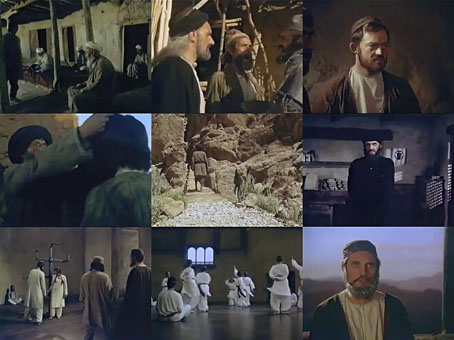
I’ve not read Gurdjieff’s book but know enough about the man’s life and general philosophies to at least appreciate Brook’s film. Many other viewers would have considerable problems when Brook and screenwriter Jeanne Salzmann make no attempt to elaborate on the details of Gurdjieff’s quest. From youthful worries about life and death, to a search for a secret brotherhood who may have preserved ancient philosophies, the film illustrates scenes in the sketchiest manner: old volumes are bought then discarded; a map is sought then forgotten; gurus are pursued only to be found unsatisfying. For a film about enlightenment it’s surprising to be left so unenlightened. Much of the film was shot on location in Afghanistan shortly before the Soviet invasion, and at times the film seems like a chase from one dusty location to another with little reason or purpose.

The most bizarre feature of all is the cast: Gurdjieff is portrayed by a Serbian actor, Dragan Maksimovic, but many of the other roles provide cameos for an array of British talent, not least Terence Stamp in between appearances as General Zod in the Superman films. Elsewhere there’s Warren Mitchell (!) playing Gurdjieff’s dad, Colin Blakely, Marius Goring, Ian Hogg (who was also in The Marat/Sade), and most surprising of all since I was watching him recently in Quatermass and the Pit, Andrew Keir as the head of the mysterious Sarmoung Monastery. The cast alone helps maintain some interest although at times it’s like one of those all-star features such as Around the World in Eighty Days where you’re wondering who’s going to turn up next. For those whose curiosity is piqued, the entire film is on YouTube.

Previously on { feuilleton }
The Marat/Sade

Weekend links 162

penrose.jpg

Untitled drawing by Sophie Penrose.

• “…many arts producers – much more so than the artists themselves – were over-fearful of the prospect of prosecution, when in nearly all incidents there were no reasonable grounds for bringing charges.” Julia Farrington of Index on Censorship on self-censorship by artists and art institutions in the UK.

• “Tons of tones – some dissolved in beats, some beatless treatments – in a continuous mix of current ambient and electronic goodies, pouring more than a score of ambi-valent shapes and etheric waves into an occluded reverb-trail echo-veil mood-stream.” Ambivalentine, a mix by Albient.

• “I was followed by a bee, a golden bee. For three years, every day, the golden bee followed us.” Forty years ago Penthouse magazine talked to Alejandro Jodorowsky. This month Dazed magazine asked the polymath twenty questions.

• “…investigators were stupefied to find the spymaster’s quarters full of pink leather whips, cosmetics, and pornographic photographs, framed in snakeskin.” Erik Sass on Colonel Redl and a gay spy scandal in the Vienna of 1913.

• “With no one to sponsor him, Marino Auriti’s dream museum became the stuff of legends.” Stefany Anne Golberg on Marino Auriti’s Enciclopedico Palazzo del Mondo.

• The Crime Epics of Louis Feuillade: YouTube links and more. Related: YouTube’s Vault of Horrors.

Werner Herzog: 50 years of potent, inspiring, disturbing films.

• The doors of perception: John Gray on Arthur Machen.

• Some Sort of Alchemy: Albert Mobilio on Sun Ra.

• British Pathé’s film of ghost hunters in 1953.

• “Escape your search engine Filter Bubble

• RIP Jack Vance

Bumble Bee Bolero (1957) by Harry Breuer | The L S Bumble Bee (1967) by Peter Cook & Dudley Moore | Ant Man Bee (1969) by Captain Beefheart and His Magic Band | Be A Bee (2009) by Air