Covering Maldoror

roy.jpg

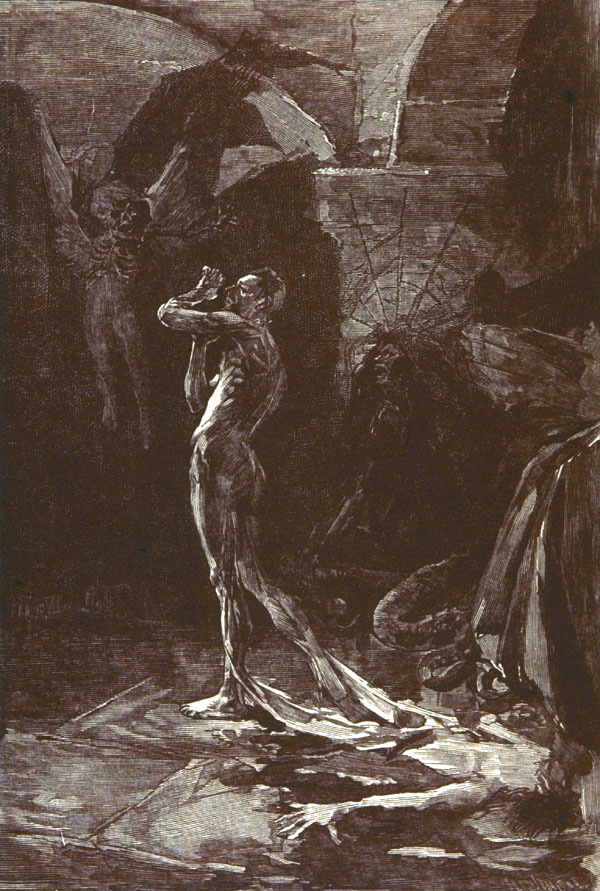
This illustration by José Roy is a frontispiece created for a rare edition of Les Chants de Maldoror published by Genonceaux in 1890. Roy (1860–1924) was a French artist whose work receives little attention today but his Maldoror illustration happens to be the first of its kind, and a picture that serves the text better than some of those being produced a few years later. The detail of a flayed man stepping out of his skin prefigures Clive Barker by almost a century, a further example of the ways in which Lautréamont’s baleful masterpiece was ahead of his time.

maldoror01.jpg

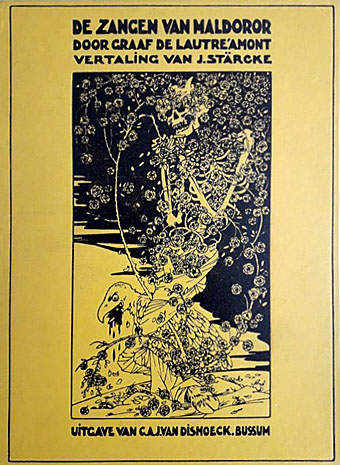
Netherlands, 1917. Cover art by WF Gouwe.

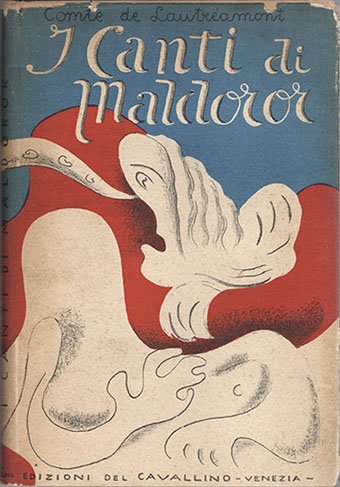
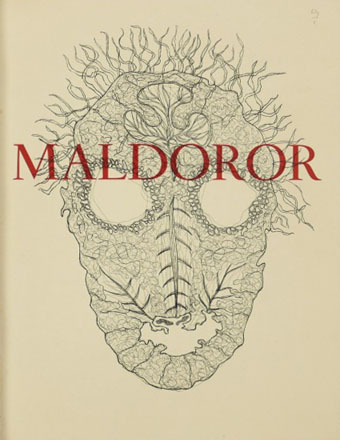
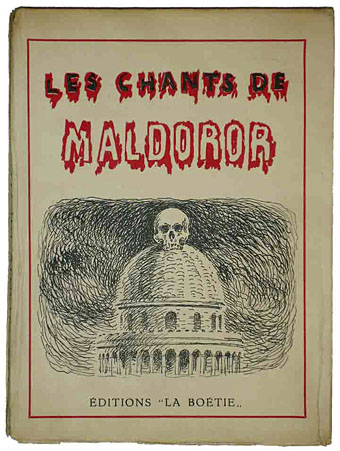
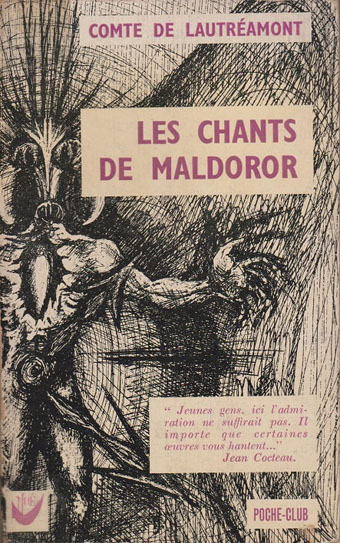
Previous posts here have concerned illustrated editions of Maldoror but this one is all about the covers. Literary classics aren’t always very rewarding in this respect but Maldoror’s textual and imaginative wildness has prompted an assortment of illustrative choices that range from the appropriate to the bewilderingly arbitrary. The following covers are a selection of the more notable examples, avoiding those without pictures or ones that use photographs of the book’s enigmatic author, Isidore Ducasse.

maldoror02.jpg

Italy, 1944. Cover art by Mario De Luigi.

maldoror26.jpg

France, 1947. Cover and interior illustrations by Jacques Houplain.

Salvador Dalí was the first well-known artist to illustrate Maldoror but his 1934 edition was published with plain black boards. Houplain’s illustrations follow the text more closely than do those by Dalí, Magritte or Bellmer, all of whom remain preoccupied with their own obsessions.

maldoror03.jpg

Belgium, 1948. Cover and interior illustrations by René Magritte.

maldoror04.jpg

France, 1963. Cover art by Paul Jamotte.

Continue reading “Covering Maldoror”

Weekend links 674

moon.jpg

The Far Side of the Moon, as photographed by NASA’s Lunar Reconnaissance Orbiter.

• “It goes against centuries of traditional belief to accept that the moon is barren, that it is indifferent, that it is innocent of any role in monthly spikes in the crime rate or in the cycles of menstrual unreason. When telescopic observation had found nothing on the near side (Roger Boscovich had established by 1753 that it lacks even an atmosphere), the far side still remained a site for the projection of fantasies of a different, neighbouring world.” Justin EH Smith working his way towards a history of the dark side of the moon.

• “It shocks me that movies still lean in so hard to all these outmoded gay narrative tropes: coming out, coming of age; very identity-oriented representations of gay characters. It’s much easier to represent a gay boy who’s repressed in high school and comes out and makes friends. It’s very mainstream, and kind of played out.” Bruce LaBruce on cinematic trends in relation to his new film, a gay-porn take on Pasolini’s Teorema.

• At Cartoon Brew: Pavel Sannikau explains how he developed his own techniques of digital animation in order to create the ever-expanding Floor796.

• There’s always more Poe: Mysterium, Incubus et Terror, Poe-inspired music by a variety of artists, plus illustrations by John D. Chadwick.

• At Smithsonian Magazine: The results of a themed contest in the Close-Up Photographer of the Year Challenge.

• Mixes of the week: In Praise of the Saddest Chord at Ambientblog, and The Funky Eno Pts 2 & 3 by DJ Food.

• Steven Heller talks to Hungarian artist István Orosz about his Escher-like drawings.

• At Unquiet Things: Caitlin McCormack’s ghostly chains of knotted memory.

• At Spoon & Tamago: Intricate and organic sculptures by ceramicist Eriko Inazaki.

• New music: Illumina by Call Super with Julia Holter.

Dark Side Of The Mushroom (1967) by The Chocolate Watchband | Dark Side Of The Star (1984) by Haruomi Hosono | On The Dark Side Of The Sun (live) (2003) by Helios Creed

Eco Del Universo

edu1.jpg

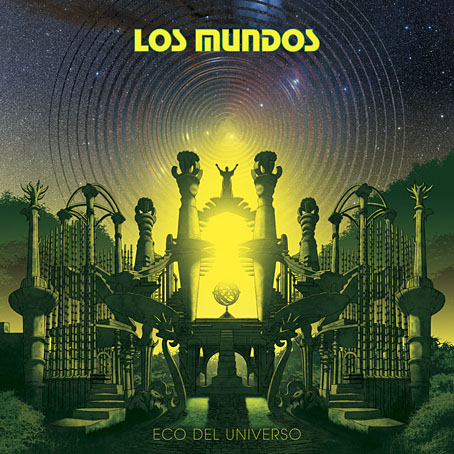
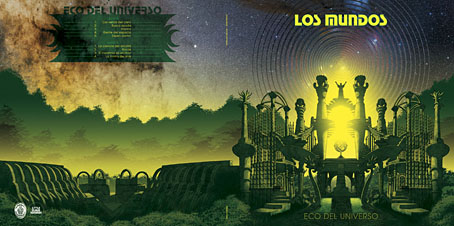
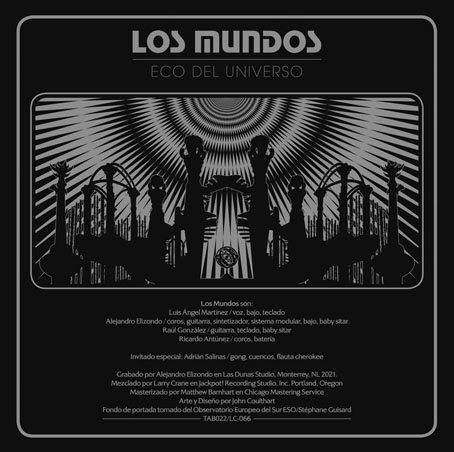
Eco Del Universo, the ninth album by Mexican band Los Mundos, was released last month on Acid Test Recordings. I designed and illustrated the outer and inner sleeves for an album whose music is described on the group’s Bandcamp page as psychedelic rock. I’ve not seen a physical copy yet but the vinyl disc is available in two pressings that complement the colours of the cover.

edu2.jpg

The brief for this one was for something based on the concrete fantasia known as Las Pozas, an overgrown park with accompanying hotel that Edward James spent many years and a great deal of money building in the Mexican jungle. James was a British aristocrat who fell for Surrealism in a big way in the 1930s, using his inherited wealth to support artists such as Salvador Dalí, René Magritte and Leonora Carrington, while creating Surrealist-styled homes for himself, first at Monkton House in West Sussex then at Xilitla in Mexico. James and his jungle resort have been recurrent subjects here so I didn’t need much encouragement to create something based on his constructions. In the past I’ve described Las Pozas as unfinished but this suggests a scheme with a final goal in mind. I don’t think this was ever James’s intention. His creations are more like very large concrete sculptures rather than architecture, even though some of them have a recognisable architectural form. Finished or not, the structures are a unique hybrid of the purposeless architectural folly—a popular indulgence for British landowners of the 18th and 19th centuries—and caprices like the Palais Idéal of Ferdinand Cheval.

edu3.jpg

My cover art is a fantasy on the fantasy which makes James’s improvisations look a little more planned than they are by mirroring their disposition. I also crowded together several of the constructions which at Las Pozas are in separate areas of the complex. Looking at the artwork again I’m reminded of some of Roger Dean’s views which wasn’t my intention originally. I think it’s the combination of unusual architecture, layered foliage and the treatment of light and shade. If the structures weren’t outlined and the sky was a Dean-like gradient there’d be even more of a similarity. The beautiful stellar photo is from the European Southern Observatory (ESO) whose images of the cosmos are free to use so long as you give them credit. This one was by Stéphane Guisard.

Previously on { feuilleton }
The Secret Life of Edward James
Palais Idéal panoramas
Las Pozas panoramas
Return to Las Pozas
Las Pozas and Edward James

Weekend links 669

claveloux.jpg

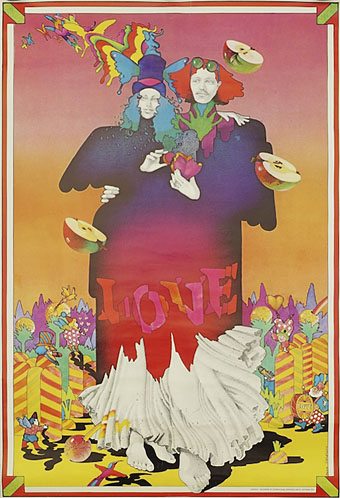
Love (1973), a poster by Nicole Claveloux.

• “Warner Brothers had been keen on a Rolling Stones movie. Jagger was keen on being a movie star. But Donald Cammell’s script was no Beatles’ jolly japes musical comedy…” Des Barry examines the ninth minute of Cammell & Roeg’s Performance.

• “…part of what made his 1970s work so original was the degree to which his band cross-pollinated guitar with synthesizer.” Aquarium Drunkard explores the esoteric jazz-rock of Steve Hillage.

• Magma, the cosmic jazz-rock group from France, have been around for 50 years without making a music video. Hakëhn Deïs is their first.

There was half-Tarkovsky embedded in async, “Solari” and “Stakra” and “Walker”, a hand outstretched to those great poems of living and light that we call films. “I had a strange dream last night,” Andrey Tarkovsky wrote in one of the diary entries collected in Instant Light, “I was looking up at the sky and it was very, very light and soft; and high, high above me it seemed to be slowly boiling, like light that had materialised like the fibres of a sunlit fabric, like silken living stitches in a piece of Japanese embroidery.”

David Toop remembers Ryuichi Sakamoto

• “Floor796 is an ever-expanding animation scene showing the life of the 796th floor of the huge space station…”

• The Electrifying Dreamworld of The Green Hand: Dan Clowes on the comic-art of Nicole Claveloux.

• At Bandcamp: Andy Thomas on the post-punk pop subversion of David Cunningham.

• At Unquiet Things: An enigmatic baroness and her collection of skulls.

• New music: River Of Dreams by Romance & Dean Hurley.

• Steven Heller’s font of the month is Ray Gun.

• Mix of the week: DreamScenes – April 2023.

• RIP Al Jaffee.

Skulls Of Broken Hill (1996) by Bill Laswell | The Bees Made Honey In The Lion’s Skull (2008) by Earth | Black Skulls (2018) by Jóhann Jóhannsson

Art on film: The Dark Corner

dark1.jpg

Continuing an occasional series about artworks in feature films with a post that suits a week where Surrealism has been a dominant theme.

I’ve been watching a lot of film noir recently, and I do mean a lot. Since August last year I’ve watched almost 100 films that warrant the label (I’ve been keeping a written record to avoid losing track), with more of them still to come. Many of these have been first-time viewings, an experience that’s been enlightening and mostly positive. I’ll have more to say on the subject in the future but for now here’s a discovery from The Dark Corner (1946), a detective drama directed by Henry Hathaway, and one I hadn’t seen before.

dark2.jpg

A Vermeer in a dark corner.

The story concerns a New York private eye, Bradford Galt (Mark Stevens), who’s being framed by parties unknown. When Galt investigates the mystery with his secretary, Kathleen (Lucille Ball in a straight role), their researches lead them to a Fifth Avenue art gallery run by Hardy Cathcart (Clifton Webb playing the same waspish aesthete as he did in Laura). Many of the art details can’t help but seem amusing or bizarre today, such as when someone brings home a genuine Vincent van Gogh painting and leaves it propped in a chair. There’s also a painting that we’re told is a rare Raphael but since this has to resemble Cathcart’s wife it looks nothing like a Renaissance picture. Elsewhere, a Donatello statue is priced at a mere $40,000, while Cathcart has Vermeer’s Girl with a Pearl Earring on sale despite the real painting having been in the collection of the Mauritshuis in The Hague since 1902.

dark3.jpg

As to the Surrealism, a scene inside the gallery features a blink-and-you-miss-it moment when a pair of would-be purchasers are seen peering at this Salvador Dalí painting, one of the few pieces of contemporary art on display. Before the camera pans away we see the man on the right shaking his head. I think this painting was also created for the film but unlike the alleged Raphael it looks genuine, and resembles several pictures that Dalí painted in the 1930s (eg: this one), all of which feature telephone receivers. The choice of imagery is apt. Two years earlier Dalí had created a seven-picture sequence illustrating “The Seven Lively Arts”. The Art of Cinema is represented by a figure whose head is a giant eyeball positioned between two huge ears, and with eyelashes that are cords leading to yet more telephone receivers.

Imitation or not, the painting in The Dark Corner did at least end up on the screen. In 1946 Dalí was working with Disney’s animators on the Destino project but the results of this wouldn’t be seen for another 50 years. I’ve been wondering what other Dalínean references might be hiding in American feature films from this time. (Don’t say Spellbound, everybody knows that one…)

Previously on { feuilleton }
Art on film: Je t’aime, Je t’aime
Art on film: Space is the Place
Art on film: Providence
Art on film: The Beast