The art of Simon Moulijn, 1866–1948

moulijn5.jpg

Landscape, Drenthe (1896). Collection Hein Klaver.

Sander Bink’s previous guest posts here concerned some of the forgotten artists of the Dutch fin de siècle, in particular the Beardsley-inspired work of René Gockinga. This new post from Sander is more Symbolist-oriented, with a look at the work of another Dutch artist.

* * *

Simon Moulijn was a Dutch painter and graphic artist whose work shows a striking affinity with European Symbolism, in particular his prints and paintings made in the 1890s which would appear to provide a link between Dutch Realism and mystical Symbolism. Beyond their historical context, these are simply beautiful pictures which is, of course, the most important thing.
moulijn6.jpg

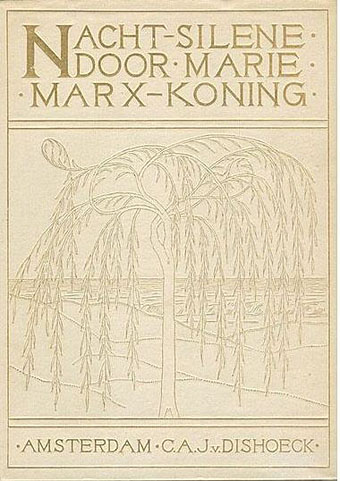
Cover design for Nachtsilene, 1902.

Landscapes were Moulijn’s main theme; some bring to mind the land- and cityscapes of Fernand Khnopff in which the world has become silent: a serene, quiet world, free from the noise and misery of modern life. “Anywhere out of this world”, but within the world we already know. Although not “Decadent” like Khnopff—there are no femmes fatales in his landscapes—Moulijn must certainly have been inspired by Khnopff and similar artists. Van Gogh and Jan Toorop were important for Moulijn as well. That Moulijn was well-versed in Symbolism and other new art forms at the time such as Art Nouveau is evidenced by his exhibition at Siegfried Bing’s Paris Gallery in 1895. Like many of the artists of his generation, he was greatly inspired by the mystical writing of Maeterlinck. No wonder, then, that he designed book covers and illustrations for Marie Marx-Koning, a Dutch writer unjustly neglected today, whose novels and stories also show a strong affinity with European mystical Symbolism.

moulijn1.jpg

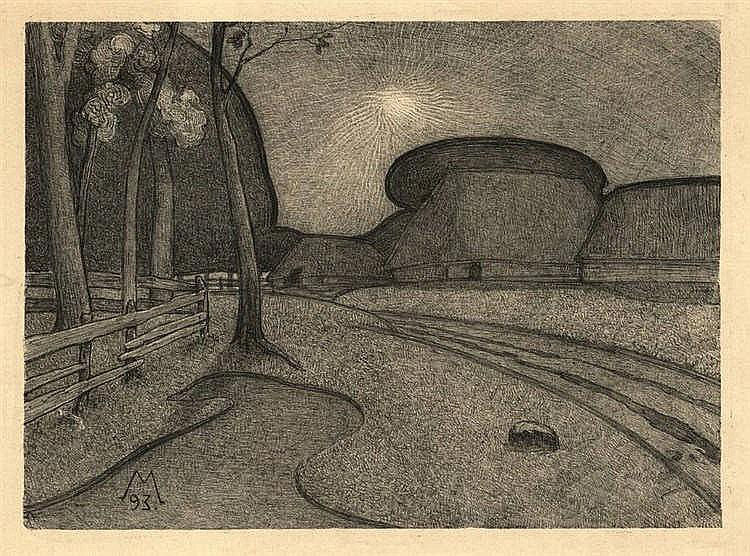
Night (1893). Lithograph.

These qualities are already exemplified by Moulijn’s first printed work, the lithograph Night from 1893 which depicts a traditional Dutch subject, a farm; but there are no peasants, and the nightly tones and silence make it look more like a farm from an Ingmar Bergman film than a landscape by his painter contemporaries from The Hague School.

moulijn2.jpg

Farm at Diphorn (1896). Gemeentemuseum Den Haag.

moulijn4.jpg

Spring (1896). Drents Museum.

moulijn3.jpg

Autumn (1895). Drents Museum.

An 1896 painting with the same subject, Farm at Diphorn, brings to mind the imaginary landscapes of Félix Vallotton, as do, more or less, two pastels which I personally feel to be his best: Spring and Autumn. Once again, the coloured areas in these Symbolist landscapes are reminiscent of a Vallotton or Franz Melchers. But where Vallotton’s landscapes might be characterised as psychological landscapes, these two by Moulijn are almost abstract experiments in colour.
moulijn7.jpg

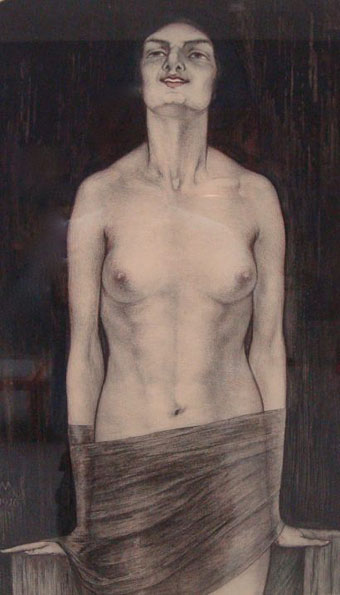
Vampire (1916). Collection Van Wezel.

Finally mention must be made, for curiosity’s sake and to satisfy the reader’s Decadent needs, of the 1916 coloured lithograph Vampire. This demonstrates Moulijn’s affinity with a more Decadent Symbolism, although by this time the style was increasingly outmoded.

Sander Bink

Previously on { feuilleton }
René Gockinga revisited
Gockinga’s Bacchanal and an unknown portrait of Fritz Klein
More from the Decadent Dutch
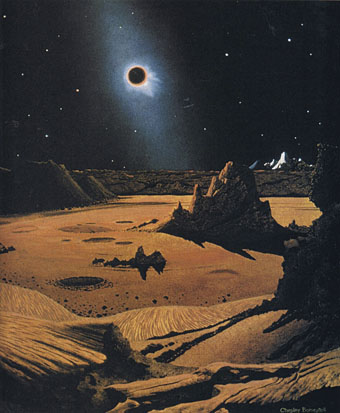
The artists of Future Life

future.jpg

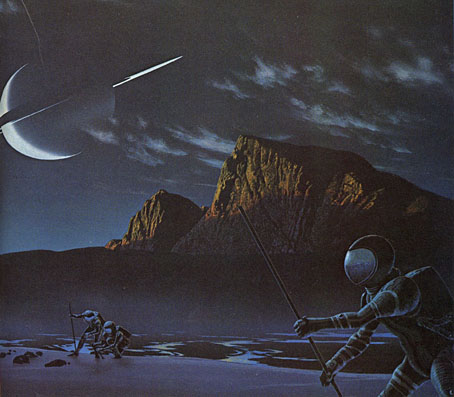
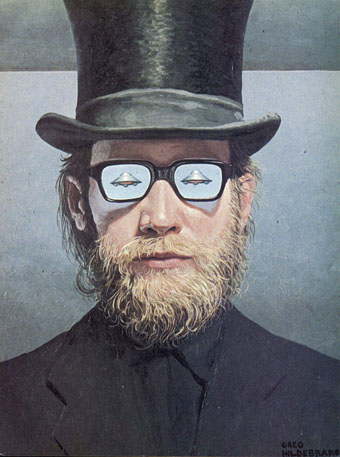
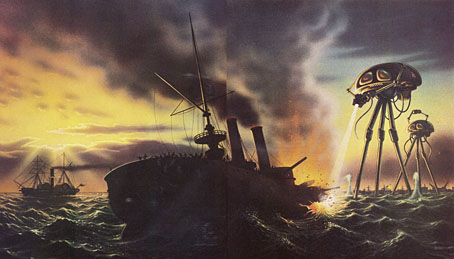
My earlier post about Future Life magazine mentioned the regular Portfolio series which featured interviews with illustrators and space artists, the latter group being the people who providing conceptual paintings for astronomy books and government entities such as NASA. Since the magazine files at the Internet Archive aren’t searchable I thought it worth making note of the interviews here, for my own benefit as much as anything else. (This blog has often served as a useful notebook.)

fl01-bonestell.jpg

Issue 1: Chesley Bonestell.

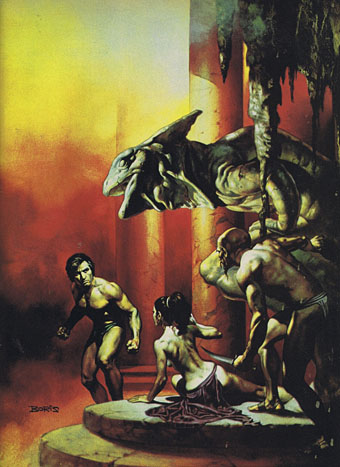
Many of the artists featured in Future Life were receiving their first (in some cases, only) high-profile feature at a time when little attention was given to the producers of this kind of work even in popular science-fiction magazines. The story magazines have always run interviews with writers but prior to Future Life, Science Fiction Monthly was the only magazine that I’d seen with a regular illustration feature, and that title didn’t last very long. Future Life covered some of the same people, Chris Foss, for example, while seeking out the prominent figures of the US illustration world. Not all the art is to my taste at all but the interviews are of interest even if you don’t like the pictures. One surprise was finding an interview in one of the issues that I’d missed with Ludek Pesek, a Czech artist whose views of the Solar System and depictions of the evolution of life on Earth I knew from the Puffin books he worked on with Peter Ryan. Those books were aimed at a young readership and were great favourites of mine before I’d seen anything by Foss and co. Another of the space artists interviewed is David Hardy, a British contemporary of Pesek’s whose view of an alien planet will be familiar to Hawkwind enthusiasts on the back cover of Hall Of The Mountain Grill. Another notable feature of the series is the lack of women artists, although this isn’t so surprising given that women creating pictures of space hardware are few even today. All the same, they might have featured Rowena Morrill, a popular cover artist for SF and fantasy novels at the time, and someone whose work I prefer to many of the people they did profile.

fl03-boris.jpg

Issue 3: Boris Vallejo.

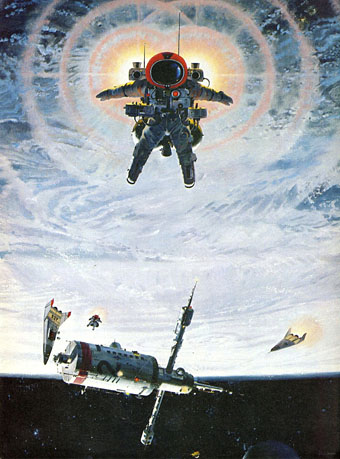
fl04-mccall.jpg

Issue 4: Robert McCall.

fl05-nagaoka.jpg

Issue 5: Shusei Nagaoka.

A Japanese artist best known in the West for his album-cover art for ELO, Earth, Wind and Fire, and many others.

fl06-miller.jpg

Issue 6: Ron Miller.

fl07-hildebrandt.jpg

Issue 7: The Brothers Hildebrandt.

fl08-hardy.jpg

Issue 8: David Hardy.

Continue reading “The artists of Future Life”

Weekend links 409

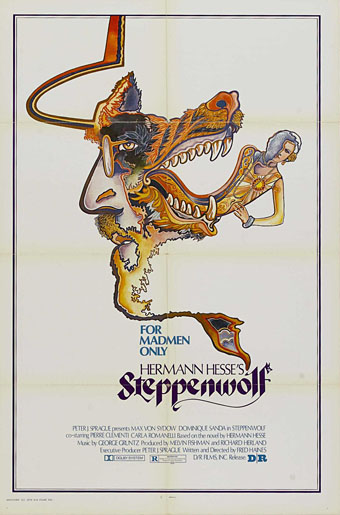
steppenwolf.jpg

Poster for Steppenwolf (1974), a film directed by Fred Haines (his only one) based on the novel by Herman Hesse, and starring Max von Sydow and Dominique Sanda. No artist or designer credited.

• “…in her 20s, she heard two elderly folk singers and was struck by their ‘gentle dignity’. It cemented her own philosophy: ‘No dramatising a song, no selling it to an audience, no overdecorating in a way that was alien to English songs, and most of all, singing to people, not at them.'” Laura Snapes on Shirley Collins and her memoir, All in the Downs.

• Many of the BBC’s sound effects were available for years in necessarily small collections on vinyl, tape and CD. Now you can download over 16,000 of them for free here. The interface is still primitive so try typing some words into the search box to see what shows up.

Carl Swanson on Natalie Frank’s paintings based on Pauline Réage’s Story of O, and the problems these caused when she tried to exhibit them.

• Pictures of the Jazz Age: Regina Marler reviews three books about photographer Berenice Abbott.

• “The late Juraj Herz was a one-man wave of Czechoslovak horror,” says Kat Ellinger.

Mark Dery on William S. Burroughs and the dead-end horror of the Centipede God.

• Mixes of the week: FACT mix 648 by Laraaji, and XLR8R Podcast 538 by Fluxion.

Kashmir by Forming The Void, and Kazakhstan by Brian Eno.

• At Dennis Cooper’s: Dominique Sanda Day.

PixaTool by Kronbits.

Born To Be Wild (1968) by Steppenwolf | Steppenwolf (1976) by Hawkwind | Der Steppenwolf (2015) by Selofan

Weekend links 408

sasada.jpg

Kujaku (2018) by Yasuto Sasada.

• “The Ernst picture [Of This Men Shall Know Nothing] has also been interpreted as depicting sexual alchemy, which also ties in with much of Peter Grey’s writing on Babalon and the goddess’ connection to sexual magic and the three ‘Fs’: f(e)asting, flagellation and fucking!” Hawthonn’s Phil & Layla Legard talk to Folk Horror Revival about their superb new album, Red Goddess (of this men shall know nothing).

• South London “Psychic Circuit”: A walk with London writer Iain Sinclair inspired by cult writer Steve Moore—from Shooter’s Hill and the Shrewsbury burial mound to Charlton House then Maryon Park and the locations used in Antonioni’s Blow Up.

• Czech filmmaker Juraj Herz, director of The Cremator (1969) and Morgiana (1972), died last week. One of his later films, The Ninth Heart (1978), featured an animated title sequence by Jan Švankmajer and Eva Švankmajerova.

• The week in psychedelic visuals: Ben Marks on Bill Ham’s San Francisco light shows (a piece from 2016), and Dangerous Minds on Astralvision’s Electric Light Voyage (1979), a light show on Betamax tape.

• “From glaciers to nuclear bunkers, photographer Chloe Dewe Mathews descends into the dark heart of the Swiss mountains that inspired Mary Shelley.”

• Mix of the week: Secret Thirteen Mix 250 by Sote, and XLR8R Podcast 537 by SNTS.

When The Horses Were Shorn Of Their Hooves, new music by Dylan Carlson.

Emily Temple on Edward Gorey’s illustrated covers for literary classics.

Hidden Hydrology: Coil’s Lost Rivers studio sessions.

Tube: Minimalist YouTube search

Sukhdev Sandhu is In Wild Air

• Lost Roads (1988) by Bill Laswell | Lost Sanctum (1994) by Lull | Lost Ways (2016) by Pye Corner Audio

HR Giger’s Passagen

giger1.jpg

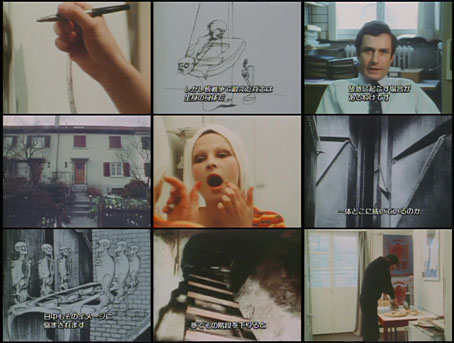
HR Giger’s art books were always very thorough in detailing all the media manifestations of the artist’s work, including film and television appearances. For years this presented tantalising questions, especially regarding the lengthy pre-Alien documentaries that were listed there: what were these films, and when would we get to see them? Giger’s Necronomicon (1976) did finally appear on YouTube a few years ago, and now here’s the second of the pair thanks to an upload of what appears to be a Japanese laserdisc.

giger2.jpg

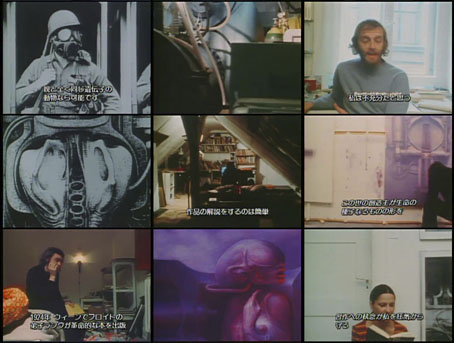
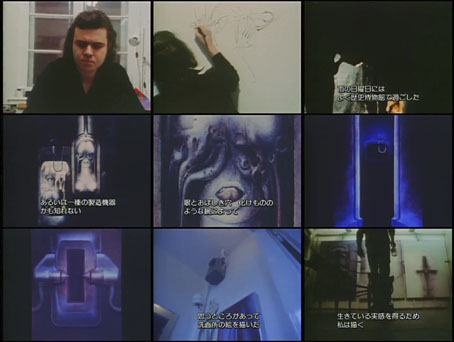
Passagen was made in 1972 by Giger’s friend Fredi M. Murer, their third film collaboration after Heimkiller and High (1967) and Swiss Made 2069 (1968). The latter (which Giger co-directed) is still frustratingly absent from the web, and similarly tantalising for being a 45-minute piece of underground science fiction which features Giger’s first production designs for cinema. Passagen was less ambitious, a 50-minute documentary about Giger’s work made for the German TV station, WDR. As a documentary it functions as a companion to Giger’s Necronomicon, while both films complement the subsequent art books, especially Giger’s Necronomicon (the book) which features many of the paintings seen in the films, together with anecdotes about their origins and inspiration. One of these anecdotes, about the nightmares induced in the young Hans Rudi by a stairway in the hotel next door to the Giger family home, is recounted in Passagen alongside the vertiginous drawings the nightmares inspired. It’s impossible to consider this piece of child psychology, and to watch the artist walking up and down stairs and stepladders, without recalling that Giger died after falling down a flight of stairs in 2014.

giger3.jpg

Giger’s Necronomicon is the more interesting of the two documentaries, especially now that the life and work is so well known; the art is taken more for granted, and we also get to see Giger at work on one of his big airbrush paintings. Passagen spends much of its time attempting to contextualise Giger’s drawings and paintings for an unwitting television audience, so a great deal of the running time is given over to newsreel footage of wars, riots, terrorism, atomic explosions and so on. A geneticist discusses the effects of atomic mutation while Giger’s earliest series of pictures, Atomkinder, is shown; psychoanalysts examine his paintings from a psychosexual angle.

Of more interest for Giger aficionados is the presence of his partner at the time, Li Tobler, the subject of several memorable portraits from this period. Among the working shots, the best shows Giger improvising a drawing with the same speed as Philippe Druillet in the Ô Sidarta film. Giger only started using an airbrush in 1972 so most of the works seen here are either early drawings or the paintings in the Passagen and Alptraum series, the style and colouring of which is much closer to the art world of 1972 than anything which would follow. For me the greatest revelation comes early on when Giger picks out a record to play while he’s working. The disc he chooses is just identifiable as Universal Consciousness by Alice Coltrane, an album which had been released the year before. (This isn’t the music heard on the soundtrack, however.) Alice Coltrane’s brand of ecstatic, pan-religious jazz would seem remote from Giger’s own universe but the choice isn’t so surprising if you know that he’d been a jazz enthusiast since the 1950s; in The Book of Alien (1979) his list of influences includes HP Lovecraft, John Coltrane and Miles Davis.

As is evident from the screen grabs, the film is hard-coded throughout with Japanese subtitles. Unlike Giger’s Necronomicon there’s no English overdub either, the soundtrack is in German throughout. I can’t complain when I’ve been waiting so long to be able to see this at all. For those who watched the later film divided into four YouTube clips there’s now a complete version (also Japanese but with English overdub) here.

Previously on { feuilleton }
Heimkiller and High
The Man Who Paints Monsters In The Night
Hans by Sibylle
HR Giger album covers
Giger’s Necronomicon
Dan O’Bannon, 1946–2009
Alejandro Jodorowsky’s Dune
The monstrous tome