Mark Twain

twaintesla.jpg

Nikola Tesla and Mark Twain, 1894.

Mark Twain died 100 years ago today, April 21st, 1910, and the anniversary is being marked in America by a variety of events throughout the year, some of which are listed on this dedicated site. I’ve always been grateful to Twain for cheering a portion of my dismal school days with The Adventures of Huckleberry Finn, one of two books we were forced to read that I actually enjoyed. (The other was Lord of the Flies; both stories, perhaps significantly, concern Wild Boys.) I’ve wanted to re-read Huckleberry Finn for years, perhaps now would be a good time to actually do so.

Unlike many writers of his generation, Twain’s work still seems vital today, and not only his fiction. His broadsides and polemics return continually to basic issues of tolerance and humanity and are often as relevant now as they were a century ago. Twain had little patience for the hypocrisies of his fellows when it came to matters of religion, warfare or the treatment of other human beings; like his contemporary, Oscar Wilde, he’s always been endlessly quotable. Consider these two extracts:

Citizenship? We have none! In place of it we teach patriotism which Samuel Johnson said a hundred and forty or a hundred and fifty years ago was the last refuge of the scoundrel—and I believe that he was right. I remember when I was a boy and I heard repeated time and time again the phrase, ‘My country, right or wrong, my country!’ How absolutely absurd is such an idea. How absolutely absurd to teach this idea to the youth of the country. True Citizenship at the Children’s Theater, 1907

But the truth is, that when a Library expels a book of mine and leaves an unexpurgated Bible lying around where unprotected youth and age can get hold of it, the deep unconscious irony of it delights me and doesn’t anger me. Letter to Mrs FG Whitmore, February 7, 1907

(more)

…then wonder what Twain would have to say about America’s current crop of blustering yahoos with their flags and crosses and misspelled signs.

A copy of the first edition of The Adventures of Huckleberry Finn, illustrated throughout by EW Kemble, can be downloaded at the Internet Archive. For Twain’s dim view of the Bible and its adherents, see his Letters from the Earth. The Tesla Memorial Society has another photograph of Twain in the great inventor’s laboratory.
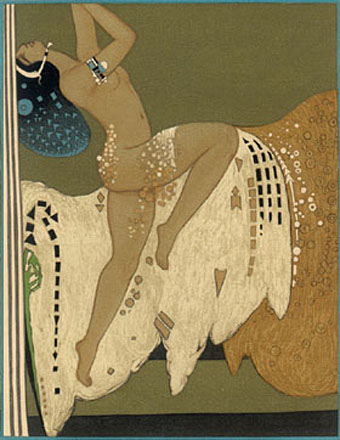
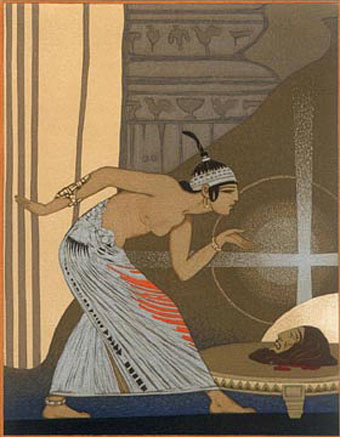
Manuel Orazi’s Salomé

orazi1.jpg

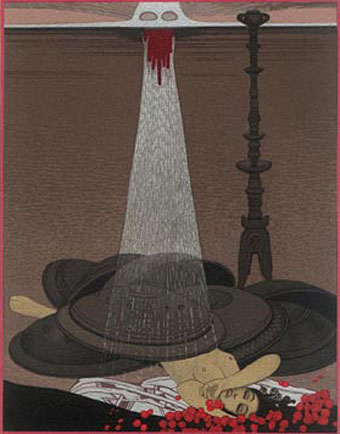
The Biblical bad girl returns in three pictures from an illustrated edition of Oscar Wilde’s play, published as a limited run in 1930. Manuel Orazi (1860–1934) was a French artist whose work has appeared here before, and no doubt will do again very soon since I’ve been finding further examples of his illustrations and designs. These drawings are closer to Gustav Klimt or George Barbier than his earlier illustrations which owed much to the stylisation of Mucha’s Art Nouveau.

orazi2.jpg

orazi3.jpg

Elsewhere on { feuilleton }
• The illustrators archive
• The Salomé archive

Jugend, 1899

jugend-99-01.jpg

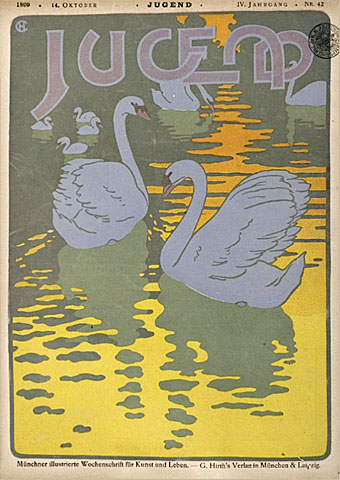
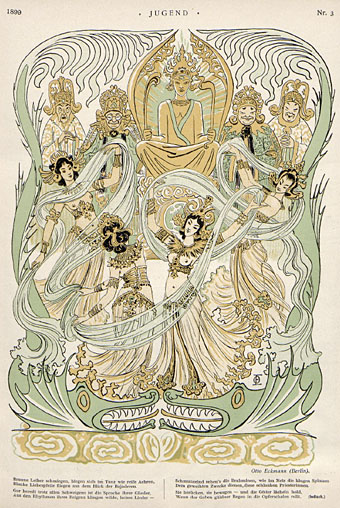
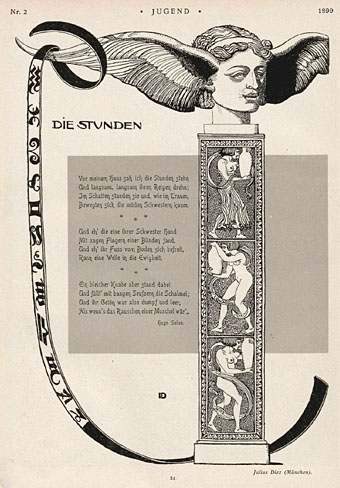
Continuing the delve into back issues of Jugend magazine, the German fin de siècle periodical of “art and life”, this post covers the year 1899. The earlier years of the magazine are replete with a variety of elegant and often bizarre graphics, as well as some classic examples of Art Nouveau graphic design. 1899 is the point in the magazine’s history that the variety (and, for me, the interest) begins to diminish. The covers lose their earlier inventiveness while the Art Nouveau stylings within are being replaced by drab illustrations of the German middle classes and patriotic depictions of country folk. There are still gems to be found, however, some of which follow below. As before, anyone wanting to see more of these graphics is advised to explore the bound volumes at the Heidelberg University archive. The two books for 1899 can be found here and here.

jugend-99-02.jpg

Otto Eckman (above) and Julius Diez (below) were heavily featured in the earlier years of the magazine and Diez in particular produces some of the best work in this year’s run.

jugend-99-03.jpg

Continue reading “Jugend, 1899”

Weekend links 10

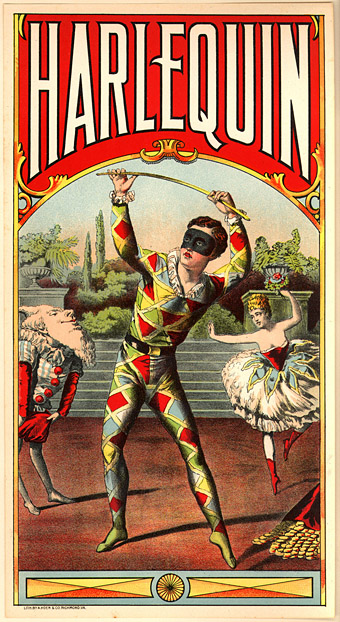
harlequin.jpg

One of a number of vintage ads and ephemeral items at this Flickr set.

• From 1971: The Anthony Balch/William Burroughs/Jan Herman video experiment.

• The NYT reports on World on a Wire, a neglected science fiction drama by Rainer Werner Fassbinder.

• “While some of the technology industry’s brightest minds were inventing the first PCs and developing groundbreaking software, they were also feeding their heads with LSD.”

• The archive of author and illustrator Mervyn Peake has been acquired by the British Library for £410,000.

• Thames & Hudson are publishing I Wonder, a book by the wonderful Marian Bantjes, later in the year. Her site has a preview. I want.

• The gays: It’s election season in the UK so My Gay Vote looks at how the three main parties have supported LGB issues. (No data for the graphs, however.) Is theatre finally glad to be gay? Yet more Tumblrs: I heart skinny boys & Cute boys with cats.

• Trend-spotter, “svengali”, Situationist and the man who named the Sex Pistols: RIP Malcolm McLaren. The Guardian ran a number of memorial pages. Related: Anarchy in Gardenstown.

• Dublin’s One City, One Book choice for April 2010 is The Picture of Dorian Gray.

• The Catastrophist: Christopher Hitchens on JG Ballard.

• Steampunk Taxidermy by Lisa Black.

• LIFE looks back at Aleister Crowley.

• Groovy songs of the week: Julie Driscoll (with Brian Auger & The Trinity), a pair of songs by Bob Dylan—This Wheel’s On Fire—and Donovan—Season Of The Witch—and sets which look like a collaboration between Verner Panton and Marcel Duchamp. Amazing.

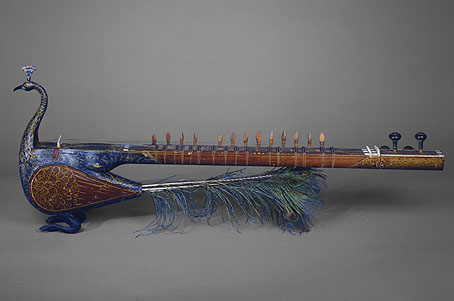
Mayuri lute

lute.jpg

Mayuri means “peacock” and although this splendid instrument doesn’t look like a European lute, a lute it is, albeit styled for Indian court performances. Via Wunderkammer.

Popular at nineteenth-century Indian courts, this bowed lute borrows features of other Indian stringed instruments, such as the body shape of the sarangi and the frets and neck of the sitar. There are four melody strings and fifteen sympathetic strings, which sound when the instrument is played to accompany popular religious song. The peacock is the vehicle of Sarasvati, the goddess of music, and it appears in Indian poetry as a metaphor for courtship. (More.)

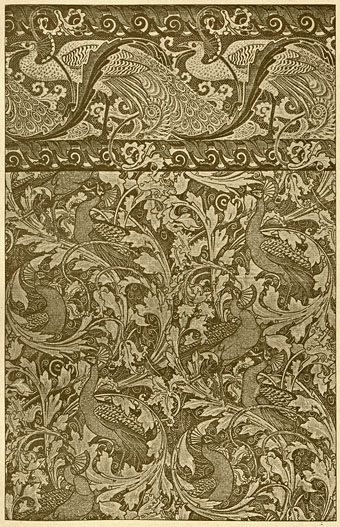
peacock-crane.jpg

As a complement, here’s something I’m still hoping to find in a good colour reproduction, all one usually sees are details. The Peacock Garden (1889) was one of a number of wallpaper designs created for William Morris by Walter Crane. This copy showing the full pattern is from an 1897 issue of the German arts periodical Pan, part of a section highlighting arts and crafts in England. Walter liked his peacocks, here’s Juno and her birds from The Baby’s Own Aesop (1887).

Previously on { feuilleton }
• Jaipur peacocks
• Maruyama Okyo’s peacocks
• Louis Rhead’s peacocks
• The White Peacock
• Peacocks
• Whistler’s Peacock Room
• Beardsley’s Salomé