Weekend links 126

dogo.jpg

Mala Reputación (1991) by Dogo Y Los Mercenarios. Cover art by Nazario Luque.

Artist Nazario Luque was Spain’s first gay comic artist who’s also known for the drawing which appeared (without permission) on the sleeve of Lou Reed Live – Take No Prisoners in 1978. On his website Nazario says he’s been described as “Exhibicionista, solidario, provocador, agitador moral, rompedor, arriesgado, polifacético, transgresor, canalla, pintiparado, morigerado o simplemente superviviente…” Via Música, maestros, a two-part post (second part is here) about album cover art by comic artists.

The BBC Radiophonic Workshop Returns. And quite conveniently, Ubuweb posts some original Radiophonic creations by electronic music genius Delia Derbyshire. Ms Derbyshire is profiled along with her other pioneering colleagues in an hour-long TV documentary, Alchemists of Sound.

• Tor.com celebrates the fiction of Shirley Jackson. Too Much Horror Fiction has a substantial collection of Shirley Jackson book covers.

Phantasmagorical and all but plotless, Nightwood flings itself madly upon the night, upon Wood, and upon the reader. Its sentences pomp along like palanquins and writhe like crucifixions. They puke, they sing. Their deliriums are frighteningly controlled. […] TS Eliot loved Nightwood so much that he shepherded its publication and wrote the introduction to the first edition. Dylan Thomas complimented it with his left hand by calling it “one of the three great prose books ever written by a woman” and with his right hand by stealing from it. […] Nightwood’s Dr. Matthew-Mighty-grain-of-salt-Dante O’Connor, florid monologist and transvestite, seems to have been a model (along with Captain Ahab) for Judge Holden in Blood Meridian. The difference is that Cormac McCarthy’s Judge is essentially Satan, whereas O’Connor is essentially Christ; they’re only just on opposite sides of the border of madness.

Austin Allen on The Life and Death of Djuna Barnes, Gonzo “Greta Garbo of American Letters”. There’s a lot more Djuna Barnes at Strange Flowers.

• Out at the end of the month, Extreme Metaphors, interviews with JG Ballard, 1967–2008, edited by Simon Sellars & Dan O’Hara.

• The favourite Polish posters of the Brothers Quay. Over at Cardboard Cutout Sundown there are more Quay book covers.

The Mancorialist: people on the streets of Manchester are given the Sartorialist treatment.

The Liverpool International Festival Of Psychedelia takes place on 29th September.

The Caves of Nottingham are explored in a detailed post at BLDGBLOG.

• In Remembrance: Bill Brent, Groundbreaking Queer Sex Publisher.

Confessions of a Bookplate Junkie

The Uranus Music Prize 2012

Fuck Yeah René Lalique

Dr Who: original theme (1963) by Ron Grainer with Delia Derbyshire | Falling (1964) by Delia Derbyshire | The Delian Mode (1968) by Delia Derbyshire | Blue Veils And Golden Sands (1968) by Delia Derbyshire.

Rue St. Augustin, then and now

augustin1.jpg

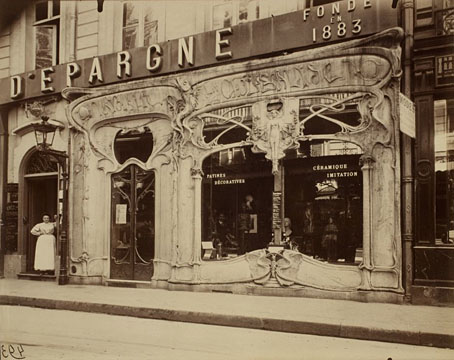
Boutique art nouveau, 45 rue st. Augustin (2e arr, 1904–05).

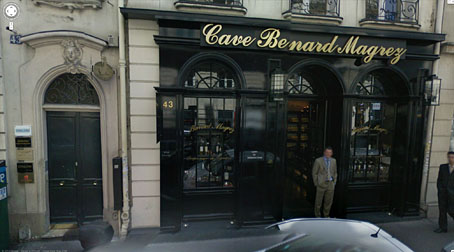
Despite being reasonably familiar with Eugène Atget’s celebrated photos of Paris, this picture of a very elaborate Art Nouveau façade is something I’d not seen until now. The photo is part of the George Eastman House collection of Atget prints, and is unusual for showing a very contemporary shopfront. Atget generally preferred premises redolent of an older, pre-Haussmann Paris, like the window full of barometers at Au Griffon, 39 Quai de l’Horloge. The Rue St. Augustin façade is an especially baroque example of Art Nouveau excess with a flying fish, a large butterfly (or moth) supporting the window, and the ubiquitous fin de siècle female floating above it. Naturally I had to know if the decor had survived but a quick look at Google Maps revealed the mundane scene below. The apartment entrance next door is pretty much unchanged but the wine shop that’s there now shows no traces of its delirious past.

augustin2.jpg

Previously on { feuilleton }
Hector Guimard elevations
Infernal entrances
Hector Guimard sketches
Temples for Future Religions by François Garas
Elizabetes Iela 10b, Riga
Atelier Elvira
Louis Bonnier’s exposition dreams
The Maison Lavirotte
The House with Chimaeras

Austrian arcades

austria1.jpg

The Passage of Palais Ferstel – Shopping Arcade, Vienna #1 by Gary Quigg.

Given their enclosed nature and multiple vistas, arcades are well-suited to panoramic photography, so it’s a surprise when more examples don’t turn up at 360Cities. The ones here are recent additions from Vienna and Steyr in Austria. The Palais Fertsel is a particularly lavish place with some suitably lavish shops which include a branch of the Xocolat chain of chocolatiers. The arcade in Steyr is an oddity since it seems to be filled with clock sellers and watchmakers, and has an elaborate mechanical clock poised above its crossing.

austria2.jpg

The Passage of Palais Ferstel – Shopping Arcade with Fountain, Vienna #3 by Gary Quigg.

austria3.jpg

Steyr, Upper Austria, A Clockwork Arcade by Roberto Scavino.

Elsewhere on { feuilleton }
The panoramas archive

Previously on { feuilleton }
Cours et passages à Paris
Arcades panoramas
Arcades
Passage des Panoramas
Passages 2
Passages

Hector Guimard elevations

guimard1.jpg

Design for the Facade of Societé Immobilière de la Rue Modern, No. 6 (1909).

Drawings by French architect and designer Hector Guimard (1867–1942), the man who gave Paris those plant-like entrances to the Metro stations. The examples here can be seen in greater detail at the Google Art Project where there’s a few more of his works including his typically organic smoking bench. One thing I like about the architectural drawings is seeing the way he stylised his lettering. Frank Lloyd Wright used to do the same on his plans but I doubt there are any architects today who do the same.

guimard2.jpg

Elevation of an Apartment Building, Société Immobilière, rue Moderne (now rue Agar) (1909–11).

guimard3.jpg

Rear Facade, Castel d’Orgeval, Parc Beauséjour, near Paris: Elevation (1904).

guimard4.jpg

Previously on { feuilleton }
Hector Guimard sketches
Temples for Future Religions by François Garas
Elizabetes Iela 10b, Riga
Atelier Elvira
Louis Bonnier’s exposition dreams
The Maison Lavirotte
The House with Chimaeras

Weekend links 121

lambshead.jpg

Title spread for The Thackery T. Lambshead Cabinet of Curiosities (2011) edited by Ann & Jeff VanderMeer.

I was surprised this week to find myself nominated as Best Artist in the World Fantasy Awards. The results will be announced at the World Fantasy Convention in November. Among the books nominated for Best Anthology is the Thackery T. Lambshead Cabinet of Curiosities for which I provided title page designs and some illustrations. Editors Ann & Jeff are well-represented (and ought to win for their landmark The Weird anthology), and I’m pleased to see Mark Valentine receive a nod for his excellent Wormwood magazine. Mark and Roger Dobson published my first Lovecraft adaptation, The Haunter of the Dark, in a large-format edition under their Caermaen imprint in 1988.

I remember having a conversation with my father about it. I told him what I’d really have liked to find, in my exhaustive search of the canon, was a gay superhero. You know: fucking dudes, saving the world. Never mind the fact that superheroes, with their notoriously contour-hugging apparel, are usually assumed gay by default. I wanted something that had existed, something from history. My father considered my criteria.

“I think what you want is Gore Vidal.”

Henry Giardina on Gore Vidal’s Bully Republic at the Paris Review.

• Appreciations and memorials for the late Gore Vidal continue to surface: “He was punk rock with a traditional, smooth exterior. But there was nothing traditional about him, not really. He defied singular category,” says Aaron Tilford at Lambda Literary. “Jokes course through Vidal’s entropy-heavy commentaries like a warm, reviving current. They, more than the barbs to which they form a counterpoint, are what make his essays a continuing pleasure to read,” says “J.C.” at the TLS.

• “Winterson’s opposition to strict realism is less an artistic critique than a cultural one. She uses the term ‘realism’ to describe an entrenched way of viewing the world, which it is the writer’s duty to challenge.” Hannah Tennant-Moore on Jeanette Winterson at n+1.

The Ghosts of Bush by Robin The Fog: “A final hauntological perambulation around the hidden corners of Bush House, Aldwych, London, June 2012”.

• “For everything that is not shown, the filmmaker counts on the power of imagination of his viewers.” Lebbeus Woods on Chris Marker and La Jetée.

Joseph Burnett on “Rainbow Ambiguity: Defying conservatism in mainstream LGBT culture”.

• Leigh Brackett book and magazine covers at Golden Age Comic Book Stories.

BLDGBLOG visited the Whitechapel Bell Foundry in London.

Stilled Life: A collection of photography by Thom Ayres.

• Underground subversion: Stickers on the Central Line.

Andrei Codrescu on five favourite Fantastical Tales.

Vangelis performs an analogue synth freakout for Spanish TV in 1982 | Oro Opus Alter, a track from the forthcoming album by Ufomammut | New World, a track from the forthcoming album by The Irrepressibles. Can’t wait.