Now It’s Dark

dark1.jpg

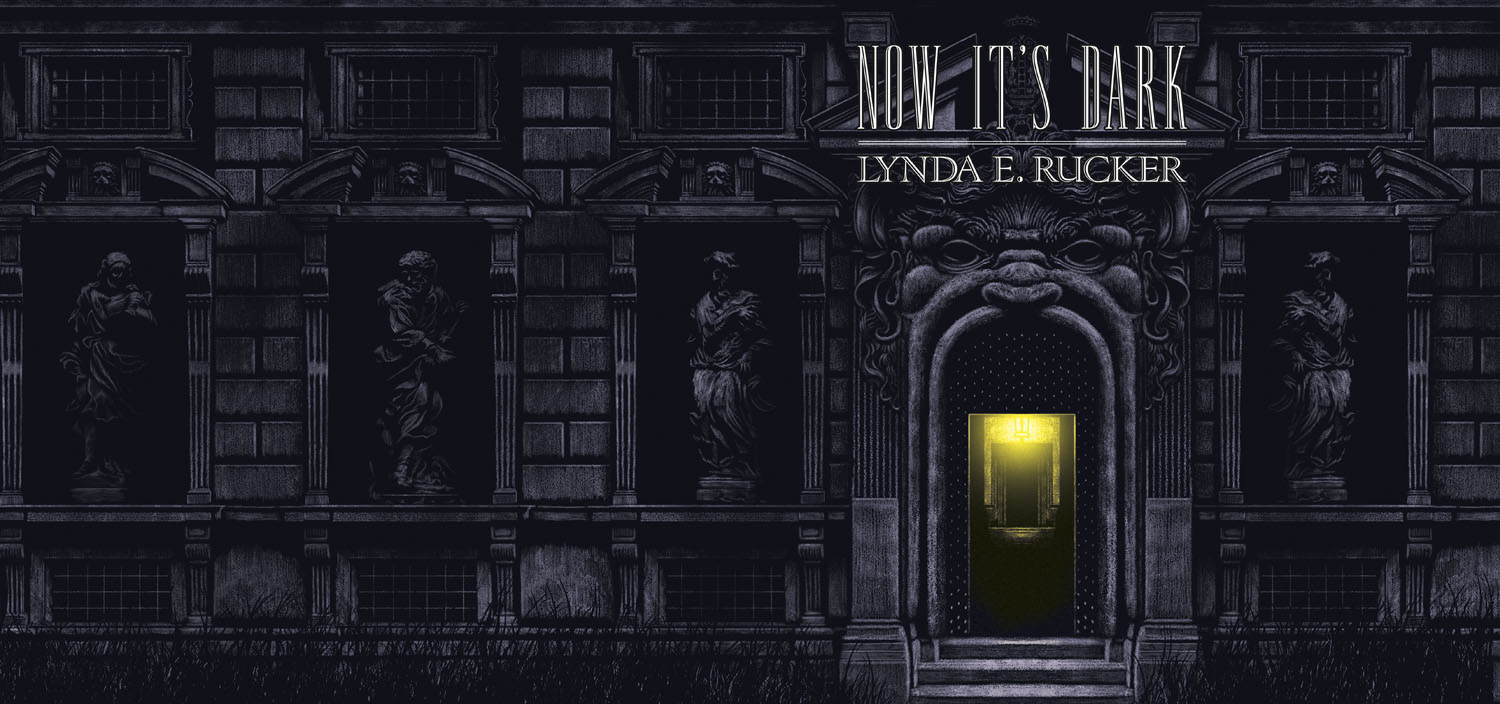
Now It’s Dark by Lynda E. Rucker; cover art by John Coulthart; jacket design by Meggan Kehrli; introduction by Rob Shearman; edited by Brian J. Showers and Timothy J. Jarvis; copyedited by Jim Rockhill; typeset by Steve J. Shaw; published by Swan River Press.

Hardback: Published on 27 January 2023; limited to 400 copies of which 100 were embossed and hand numbered; signed by Lynda E. Rucker, Rob Shearman, and John Coulthart; xii + 225 pages; lithographically printed on 90 gsm paper; dust jacketed; illustrated Wibalin boards; sewn binding; head- and tail-bands; ISBN: 978-1-78380-043-8.

dark2.jpg

Dust jacket.

dark3.jpg

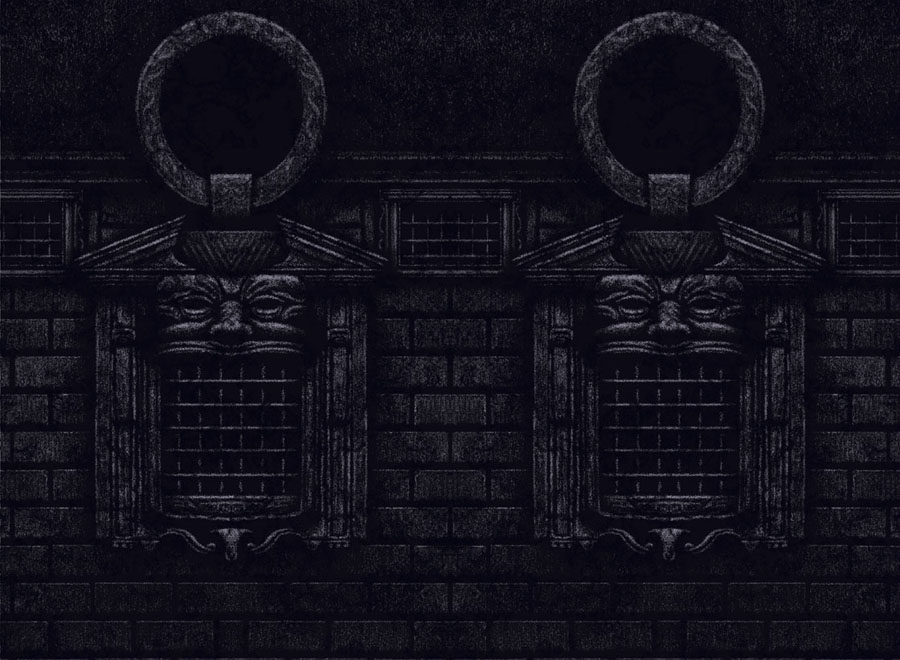
Printed boards.

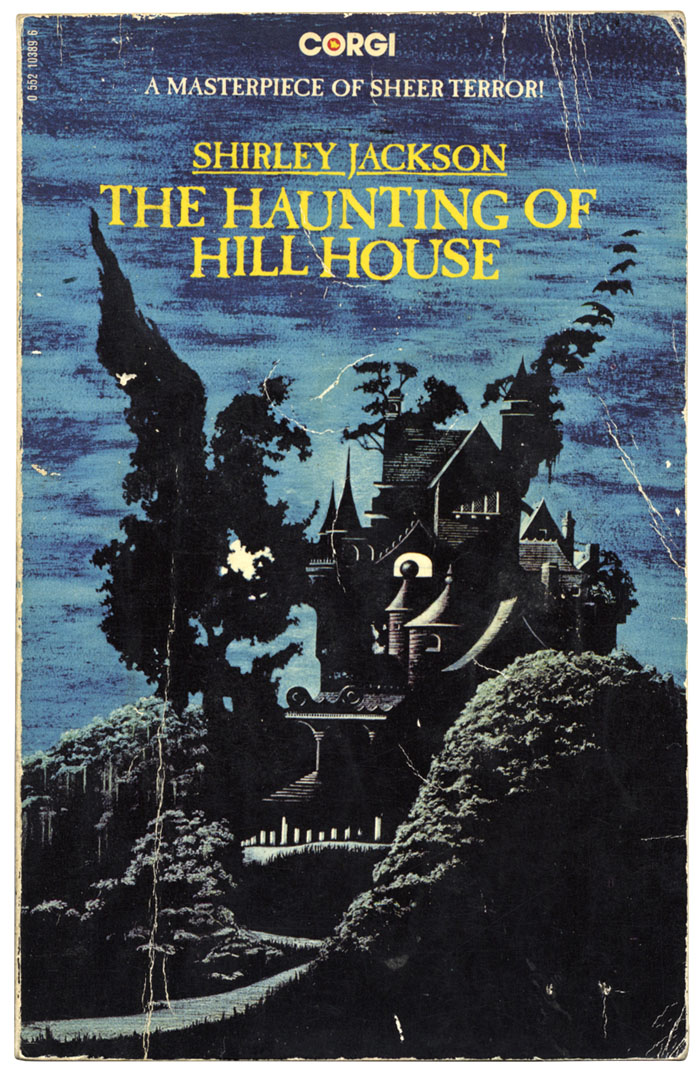
This is the last of the books I was working on last year, and being another design for Swan River Press means that once again the artwork is a wraparound cover with printed boards under the wrap. Now It’s Dark is a collection of horror stories (or possibly “strange stories” à la Robert Aickman), and a very fine collection it is. I was given carte blanche with this one so the cover is a mood piece rather than anything directly illustrational. One of the stories concerns the god Pan, which tempted me at first to do something with a satyr-like face, possibly as an architectural feature like a mascaron. But focusing on a single story in this way usually makes me worry about giving that story too much attention if it hasn’t also provided the title of the collection. Thinking about mascarons and their positioning above arched doorways led to the design you see here, a gesture towards a minor trend in horror illustration that makes use of the Arcimboldo effect, as with my battered Shirley Jackson paperback.

haunting.jpg

Corgi Books, 1977. No artist credited.

zuccari1.jpg

A Boy and His Dog on a Staircase in Rome (1886) by Niels Frederik Schiøttz-Jensen.

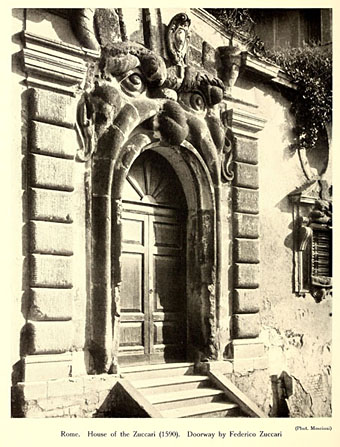
My cover is a variation on a real place, the “House of Monsters” entrance of the Palazzo Zuccari in Rome which today houses the Bibliotheca Hertziana. I placed the portal into an extended Baroque facade while moving the monstrous windows to the boards of the book. Given the way the grotteschi concept was a common feature of the Baroque you’d expect there to be more doorways like this but the palazzo street entrance seems to be unique. Equivalents such as the Ogre’s Head at Bomarzo are more like theme-park attractions than architectural features. I’ve never seen Umberto Eco mention the Palazzo Zuccari but I imagine he would have enjoyed seeing an infernal mouth as an entrance to a library.

zuccari2.jpg

Previously on { feuilleton }
Infernal entrances

Weekend links 656

escher.jpg

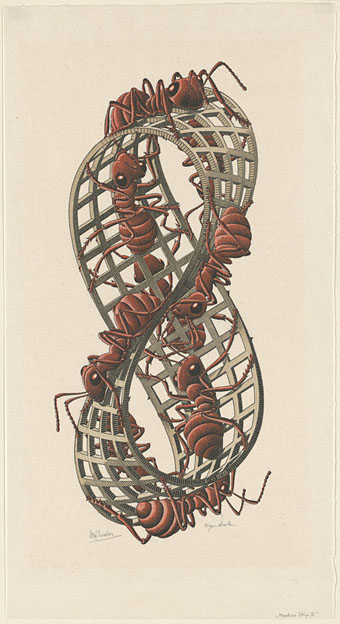
Mobius Strip II (1963) by MC Escher.

• Old music: Warp Records is reissuing two recent Jon Hassell discs later this year: The Living City (Hassell’s ensemble playing live in NYC, 1989) and Psychogeography (Zones Of Feeling) (remixes from City: Works Of Fiction), which will be available as standalone releases or bundled together as Further Fictions together with Hassell’s Atmospherics book.

• “His library is an immense and enviable wellspring, a demimonde of objects by murky creators who for decades have gnawed away at the inner organs of polite society.” Steven Heller talks to Glenn Bray about Library, an 800-page collection of scans from Bray’s trove of books, comics and print ephemera.

• New music: Tsathoggua, the latest in the Lovecraftian series of Cryo Chamber Collaborations which reminds me that I’m still missing the more recent entries. Also the non-Lovecraftian Coil by Ian Boddy.

• “Music is a way to express yourself beyond words,” says Hildur Guðnadóttir.

• See this year’s winners of the annual Close-up Photographer of the Year competition.

• At Dennis Cooper’s: Spotlight on…Ishmael Reed The Last Days of Louisiana Red (1974).

• A few new photos of Michael Heizer’s City in the Nevada desert.

City Of Night (1994) by David Toop & Max Eastley | City As Memory (1995) by John Foxx | City Appearing (2013) by Julia Holter


Weekend links 654

crm.jpg

Drawing for a New Year’s Card (c. 1900) by Charles Rennie Mackintosh.

• “Almanacs appealed to the perennial lust for wonder and weirdness in the world. They were the fantastic literature of the day.” Mark Valentine on English Almanacs 1500–1800. Reading this had me wondering whether Old Moore’s Almanac is still being published. Yes, it is.

• “Meet the designer of the fanciful subway entrances to the Paris Métro.” Susannah Gardiner on the architecture, design and anarchist philosophy of Hector Guimard.

• “Apocalypse is not alien to HR Giger,” says Steven Heller, reviewing Atomkinder, a book of the artist’s early cartoons for which he also provided an introduction.

• “Nabokov loved film, hopelessly.” Luke Parker on a short poem, The Cinema (1928), from Vladimir Nabokov’s Berlin years.

• From Loki to Behemoth: waves of the English coastline photographed by Rachael Talibart.

• Mix of the week: Winter Solstice 4: “In C” by ambientblog.

• At Dennis Cooper’s: Grace Zabriskie Day.

Atom Sounds (1978) by Jackie Mittoo | Atom Blaster (1985) by Vangelis | Atomic Buddha (1998) by Techno Animal

A.R.T. art

ARTflyer.jpg

Some Manuel Göttsching-related graphic ephemera. This 1971 flyer for Ash Ra Tempel seems to be a rare item, the only place I’ve seen it being inside one of the inserts for The Private Tapes, a series of six CDs limited to 1000 copies each that Manuel Göttsching released in 1996. I was lucky to buy these when they were first released. A double-disc selection from the series followed two years later but neither this nor the rest of the set have been reissued since, despite containing a wealth of previously unreleased recordings from Göttsching’s archives, including many live concert recordings of Ash Ra Tempel. The flyer was the work of Bernhard Bendig who also drew the sleeve art for the group’s first two albums.

ARTcosmic.jpg

Not as scarce, but not very visible either, is this painting of another somewhat wonky temple by P. Praquin for a 1975 reissue of two Ash Ra Tempel albums: Inventions For Electric Guitar (which isn’t really ART), and Seven Up, the ramshackle studio jam which is mostly spoiled by the bellowings of Timothy Leary and friends. Discover Cosmic was a short-lived series of double-disc reissues of albums originally released on Cosmic Music, an imprint of Barclay Records that repackaged releases from Ohr and Kosmische Musik for the French market. There were three volumes of Discover Cosmic, the other two showcasing Popol Vuh and “The Klaus Schulze Sessions”, this being the first Cosmic Jokers album plus Join Inn by Ash Ra Tempel. The mysterious P. Praquin was responsible for all three cover paintings of which this is the best, wonky or not, a variation on the church-as-spaceship idea that may have been borrowed from the Roger Dean cover for Space Hymns by Ramases. This is one of those graphic contrivances that I usually expect to find repeated elsewhere, although to date the only other example I’ve seen was a Viennese museum poster. But there are more than enough churches that resemble spaceships to give people ideas, especially recent constructions like the Hallgrímskirkja in Reykjavík. If you know of any other steeples blasting off then please leave a comment.

Previously on { feuilleton }
Manuel Göttsching, 1952–2022
The kosmische design of Peter Geitner
Raising the roof

The art of Franklin Booth, 1874–1948

booth01.jpg

One of the hazards of working for ephemeral media such as magazines is that your work disappears from view once the magazine has left the news-stand, exiled to libraries and other archives. This is a particular problem for illustrators, as I’ve noted in the past with regard to artists such as Virgil Finlay; stories by popular writers will be reprinted but their illustrations tend to remain marooned in the pulp pages where they first appeared. Franklin Booth worked at the opposite end of the scale to Finlay, providing editorial and advertising illustrations for very unpulpy titles such as Harper’s and Scribner’s. He was, and still is, highly-regarded, but his illustrations aren’t as easy to find today as those of his contemporaries who spent more of their time working for book publishers.

booth02.jpg

Franklin Booth: Sixty Reproductions from Original Drawings is a collection of the artist’s illustrations published in 1925, the most striking feature of which is the preponderance of fantastic scenes. Some of these are evidently story illustrations but the book lacks any notes about the origins of the drawings so we’re left to guess whether the same goes for the others, or whether these are examples of the artist indulging his imagination. Whatever the answer, Booth had a nice line in fantasy architecture, all soaring towers topped by cupolas and finials, which may explain the Booth influence in some of François Schuiten’s drawings. The building style is reminiscent of the Beaux-Arts confections that proliferated at international expositions in the years before the Deco idiom swept away superfluous decoration, something you also find in Winsor McCay’s Little Nemo in Slumberland where the dream palaces could easily have been built to showcase the latest engineering marvels.

Note: All these images have been processed to remove the sepia tone of the paper.

booth03.jpg

booth04.jpg

booth05.jpg

Continue reading “The art of Franklin Booth, 1874–1948”