Aguirre by Popol Vuh

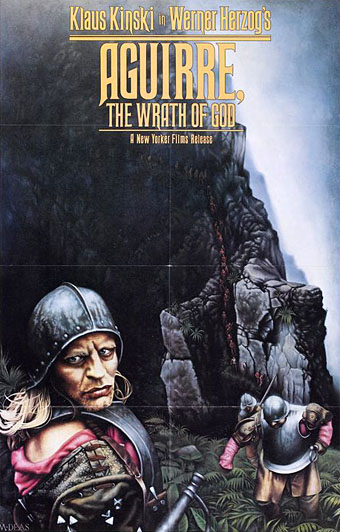
aguirre-poster.jpg

Design by Sawyer Studios, painting by Michael J Deas.

If you’re a music obsessive d’un certain âge it’s a common thing to get bees in your bonnet about the reissues of favourite albums. For Krautrock aficionados the reissues of Popol Vuh‘s releases have been more frustrating than most. Aguirre was the band’s seventh album released in 1976, four years after Werner Herzog’s film, Aguirre, The Wrath of God, for which the group provided a score and from which the album borrows its title.

The album isn’t quite a soundtrack—although it contains a snatch of ethnic music from the film and a recurrent theme—and it’s also less of a whole than the albums which preceded and followed it. The film’s ethereal title theme was played by Florian Fricke on a “choir-organ“, a mysterious Mellotron-like instrument which had previously been employed by Amon Düül II. The rest of the album was fleshed out with variations on tracks from earlier Popol Vuh releases, none of which are used in the film. Side 2 of the vinyl edition featured a single track entitled Vergegenwärtigung (Visualisation) which is also absent from the film and whose doomy ambience would have been more suited to Herzog’s later Nosferatu the Vampyre. This lengthy piece is a drifting slab of drone-werk which would have been recorded in the early 1970s when Florian still had his enormous Moog synth. It’s probably the most minimal thing in the whole Krautrock canon, sounding at times like a lost fifth track from Zeit, Tangerine Dream’s collection of drones which featured Florian as a guest performer. As such Vergegenwärtigung is an overlooked, if minor, piece of Kosmische electronica which has only ever been available on vinyl. And there, dear reader, is the rub.
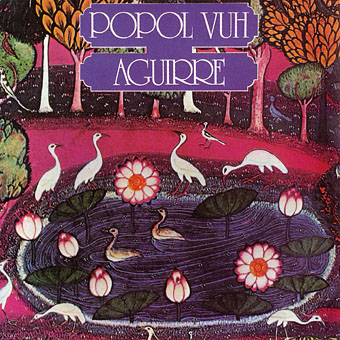
aguirre.jpg

No designer credited but it was probably Peter Geitner.

The various CD reissues of the album added and removed tracks from the band’s catalogue seemingly at random. I have the Spalax reissue which featured the film’s title theme then nothing else from the original album, the following tracks being the entirety of Popol Vuh’s second album, In Den Gärten Pharaos, and a beautiful solo piano suite, Spirit of Peace. Yes, it’s nice to have them there but, you know…it’s not Aguirre! When a Japanese edition appeared in 2006 the track they call Vergegenwärtigung turned out to be the errant electronic piece with additional pieces of music layered over it for no apparent reason. The Japanese are usually very good with CD reissues so this was a particular disappointment. After many years of living with a ruined vinyl copy of the album it was gratifying this weekend to find an mp3 of the original of Vergegenwärtigung which can be downloaded here. For the moment you’re unlikely to find it anywhere else.

YouTube has some choice Popol Vuh moments including a Florian Fricke Moog improvisation from 1971 and the band miming to Kyrie from the Hosianna Mantra album. Most fascinating for me has always been this scene from Herzog’s The Enigma of Kaspar Hauser with Florian playing a blind pianist. The music is a variation on his Agnus Dei theme which he obsessively reworked on several Popol Vuh albums and which is also one of the highlights of Aguirre.

Previously on { feuilleton }
A cluster of Cluster
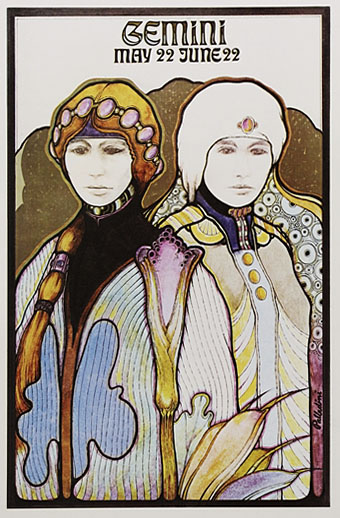
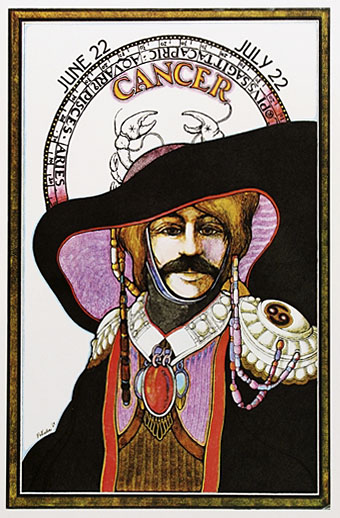
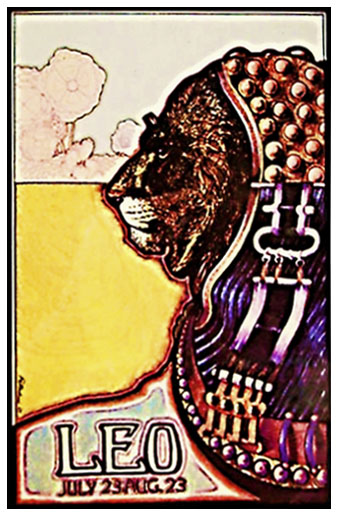
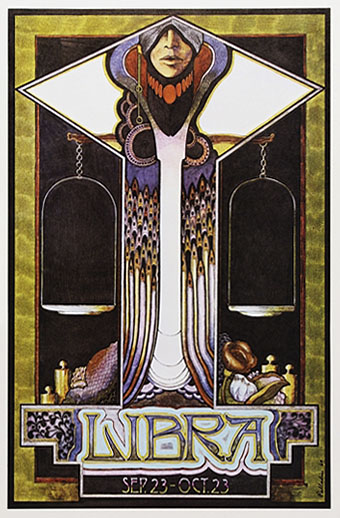
Palladini’s Zodiac

palladini06.jpg

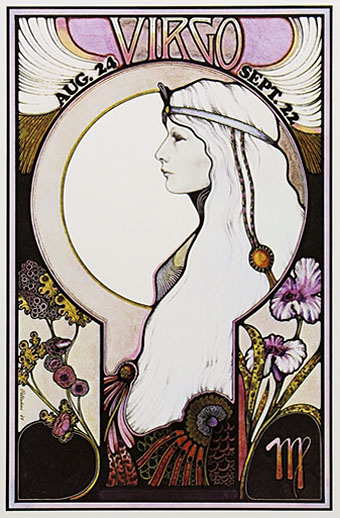
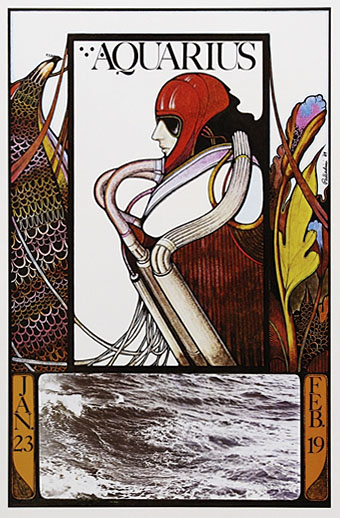
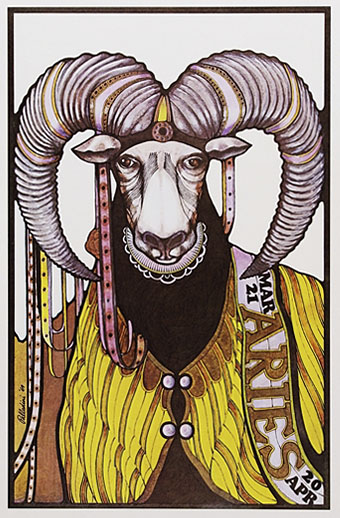
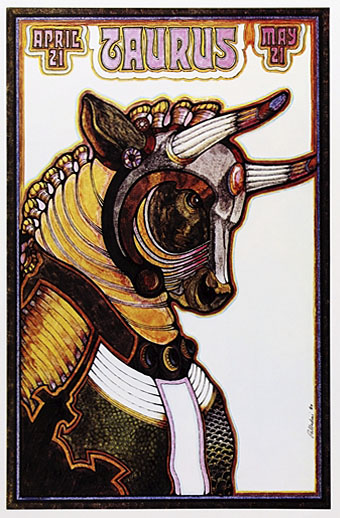
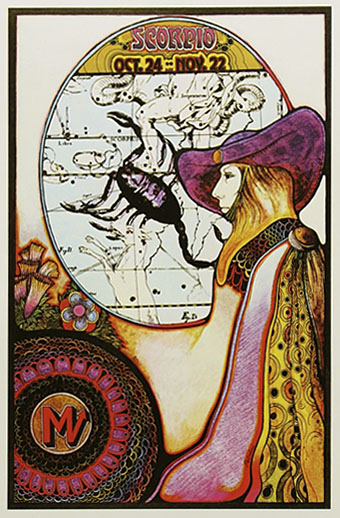
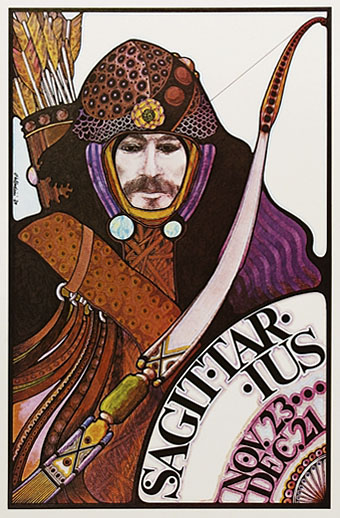
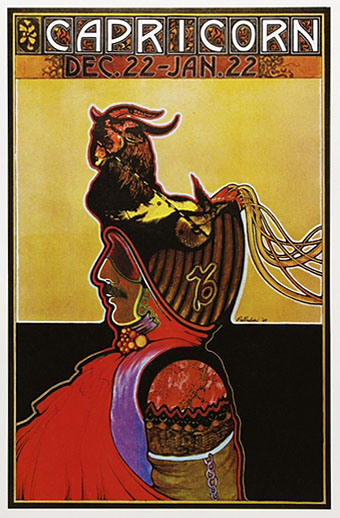
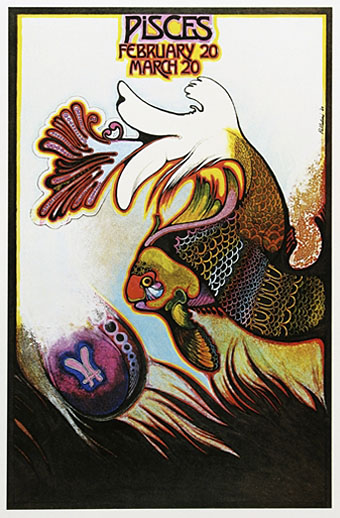
David Palladini’s poster for Werner Herzog’s Nosferatu the Vampyre has been mentioned here twice in the past week so it seemed only fair to see whether any of his other work matched that splendid piece. The artist has worked for years as a book illustrator but seems to receive most attention these days for his Aquarian Tarot deck, first produced in 1970 and still being sold today. Many of the card designs show something like the kind of stained-glass window approach he used for his film poster but with less decoration. Far closer to the Herzog piece is a series of posters he made in 1969 depicting his own interpretation of the signs of the zodiac. Every mention I’ve seen of these notes their scarcity which is a shame when many of them are such striking designs. Of particular interest to this Aubrey Beardsley obsessive is seeing that the scale shapes which Palladini put into the “N” of his Nosferatu lettering may, as I guessed, go back to the similar shapes which Aubrey borrowed from Whistler’s Peacock Room; see the peacock-like bird in Aquarius below.

This page has some examples of the Major Arcana designs from Palladini’s Tarot. More of his zodiac posters follow, all of which are courtesy Meibohm Fine Arts.

palladini11.jpg

palladini01.jpg

palladini02.jpg

palladini03.jpg

palladini04.jpg

palladini05.jpg

palladini07.jpg

palladini08.jpg

palladini09.jpg

palladini10.jpg

palladini12.jpg

Elsewhere on { feuilleton }
The illustrators archive

Previously on { feuilleton }
Druillet’s vampires
The Art Nouveau dance goes on forever
The Sapphire Museum of Magic and Occultism
The art of Pamela Colman Smith, 1878–1951
Layered Orders: Crowley’s Thoth Deck and the Tarot
Whistler’s Peacock Room
The Major Arcana

Druillet’s vampires

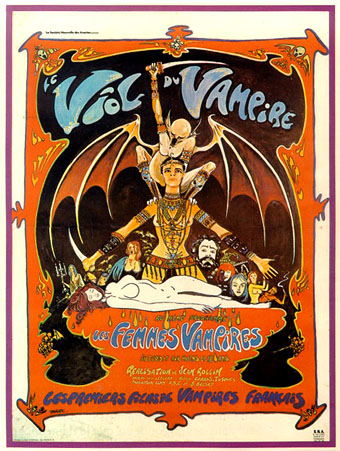
vampire3.jpg

Le Viol du Vampire (1968) or Rape of the Vampire (stay classy, Jean!); re-titled Queen of the Vampires for the Anglophone world.

We’re so inundated these days with vampires and—worse—fucking zombies, that I’ll be perfectly happy if I never see another bloodsucker or shambling corpse again. But let’s overlook the degrading of horror staples for a moment to consider Philippe Druillet‘s excursions into the art of the cinema poster.

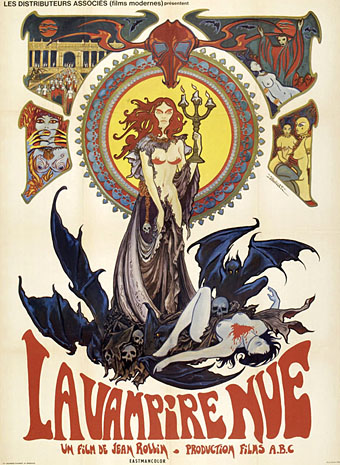
vampire1.jpg

La Vampire Nue (1969).

These pieces are for Jean Rollin‘s first three films, additions to the groovy-lesbian-vampire-with-false-eyelashes-and-bare-boobs sub-genre made at a time—the late 60s—when all the European film studios, Hammer included, were pushing the erotic content of their films more than had previously been dared. Rollin’s erotic comic strip from 1967, Saga de Xam, featured art contributions from Druillet, among others, which no doubt explains the choice of artist. As with David Palladini’s fantastic design for Werner Herzog’s Nosferatu the Vampyre (1979), these are further examples of how unique and distinctive film posters once were in a way they rarely are today. (Druillet, incidentally, produced his own adaptation of Nosferatu in 1989.)

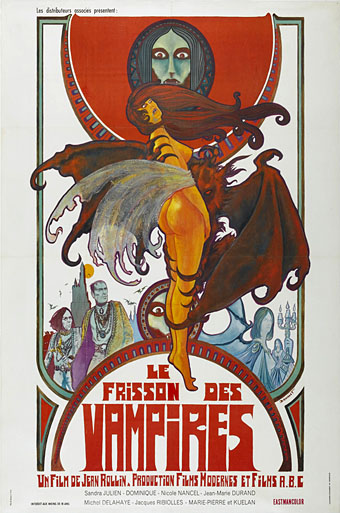
vampire2.jpg

Le Frisson des Vampires (1970).

Pages from the fabulously rare Saga de Xam feature in the Art Nouveau catalogue that was the subject of yesterday’s post. So too does Druillet’s poster for Le Frisson des Vampires although any of these pieces would have made suitable inclusions. Even more than in his comic strips Druillet’s work here shows the overt influence of Alphonse Mucha.

Most of Rollin’s films seem to be available on DVD should you be desperate for some fangs and boobs. I’d much rather see Saga de Xam be reissued; it’s been out of print since 1967 and the copies available go for upwards of £200. This site has samples of the pages and there’s a post about the book (in French) here. For more about Jean Rollin, see Fascination: the Jean Rollin Experience.

Elsewhere on { feuilleton }
The illustrators archive

Previously on { feuilleton }
The Art Nouveau dance goes on forever
Salammbô illustrated
Druillet meets Hodgson
The music of Igor Wakhévitch
Nosferatu

The Art Nouveau dance goes on forever

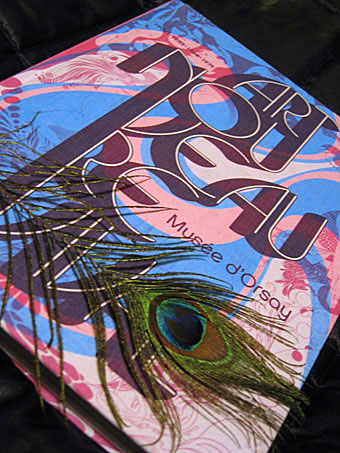
nouveau1.jpg

Catalogue for Art Nouveau Revival 1900 . 1933 . 1966 . 1974. Peacock feather not included.

Regular readers may recall my mention of the Musée d’Orsay exhibition Art Nouveau Revival which was launched late last year. I didn’t get to see the exhibition, unfortunately, but this week I finally ordered a copy of the catalogue, an expensive cloth-bound volume with essays (in French) by Philippe Thiébaut, Stephen Calloway, Irene de Guttry, Thierry Taittinger and Philippe Thieryre. Despite the ruinous postal charges incurred by the book’s weight this was worth every euro, it being the kind of polymorphous production which in solipsistic moments one can choose to believe was created solely for your own benefit.

nouveau3.jpg

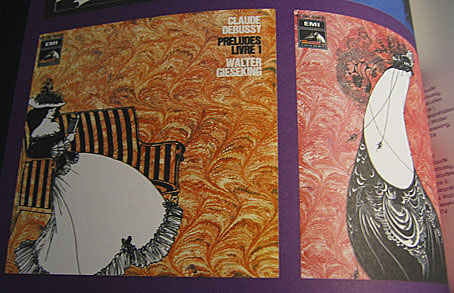
Aubrey again, album covers from 1974.

Much of the subject matter has been explored here in various small ways, with the curators following the influence of Art Nouveau through Surrealism (mainly Dalí) to the psychedelic art of the 1960s and on into the Pop Nouveau (for want of a better term) which flourished in the first half of the 1970s. Among the familiar Aubrey Beardsley graphics and psychedelic posters there are also some pleasantly surprising inclusions, including illustrations by Philippe Jullian (yes, I’m still intending on writing about him at some point), yet more Beardsley album covers, film posters, and even some of the sillier films of the late-60s such as Casino Royale. Being a French exhibition there’s a section devoted to comic strips which includes work by Moebius, Philippe Druillet and Guido Crepax.

nouveau2.jpg

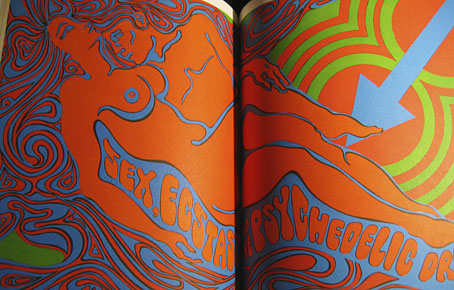
Sex and LSD, a spread from Playboy, 1967.

It’s common to see parallels drawn between the 1890s and the 1960s but the strange blooms of vulgarised fin de siècle style which burgeoned in the wake of psychedelia are seldom given much attention. One of the great things about this catalogue is the amount of ephemera the curators chose to include such as magazine ads and trend-chasing album sleeves. It was precisely this blend of 1890s + 1960s + 1970s I sought to capture in my recent cover for Dodgem Logic. As I said, it’s an expensive book but for anyone drawn to this aesthetic hothouse it’s also an essential purchase. Art Nouveau Revival can be ordered direct from the museum shop. Further samples follow.

Continue reading “The Art Nouveau dance goes on forever”

Weekend links 20

wulfing.jpg

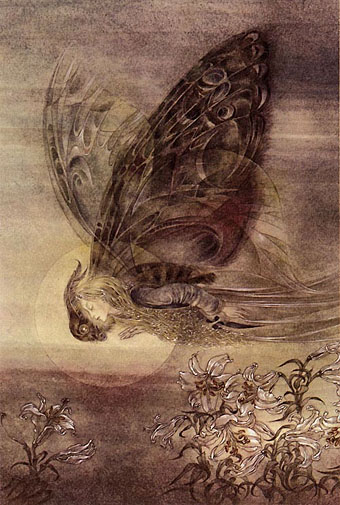
Transfiguration (1952) by Sulamith Wülfing.

• Observatory posted photos of its Lovecraft art exhibition; see if you can spot my pics. Related: Write Club has more photos. Also, A Word From Our Sponsor.

Taking the broooooaaaaad view of things: A Conversation with James Grauerholz on William S. Burroughs and Magick. Related: Beat Memories—The Photographs of Allen Ginsberg.

• Adam Curtis on BP and the Axis of Evil; how the the Anglo-Iranian Oil Company became British Petroleum and helped give Iran over to the Ayatollahs.

• The Quietus interviews Peter Christopherson (TG, Coil, etc) and Dr John.

The Strange World of Adolf Hoffmeister at A Journey Round My Skull.

An Artists’ Dialogue On CocoRosie’s Grey Oceans at Stereogum.

Werner Herzog and David Lynch combine their talents.

Jon Savage on The Residents versus The Beatles.

• BUTT magazine interviews James Bidgood.

• The Daily Drop Cap.

The Gay Rub.

Can on German TV in 1971.