The Vengeance of Nitocris

weirdtales.jpg

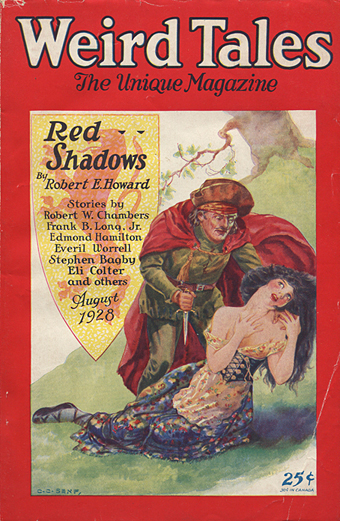
Cover illustration by CC Senf.

In her mind the queen Nitocris was seeing a ghastly picture. It was the picture of a room of orgy and feasting suddenly converted into a room of terror and horror, human beings one moment drunken and lustful, the next screaming in the seizure of sudden and awful death. If any of those present had been empowered to see also that picture of dire horror, they would have clambered wildly to make their escape. But none was so empowered.

Everyone today will be marking the Tennessee Williams centenary by noting his theatre work, of course, or his subversive celebration of outsiders and, yes, the gays. I’ll confine myself to reminding people that Williams’ first published work was a short story entitled The Vengeance of Nitocris in Weird Tales for August 1928, written when he was only 17. The story reads like the work of a teenager but editor Farnsworth Wright evidently enjoyed an atmosphere of lurid Egyptian melodrama which you can appraise for yourself here. Also in this issue was the debut appearance of Robert E Howard’s Solomon Kane, and The Demoiselle d’Ys by Robert Chambers. Seeing the name Nitocris I have to wonder whether Williams chose it after reading HP Lovecraft who used the name twice in earlier stories published in the same magazine, Imprisoned With the Pharaohs (1924) and The Outsider (1926). That last piece was one of Lovecraft’s most popular tales, and it’s easy to imagine its grotesque parable of alienation making an impression on a would-be writer who, as a gay youth, would have looked upon himself as another kind of outsider.

Previously on { feuilleton }
The King in Yellow

Weekend links 45

sa4.jpg

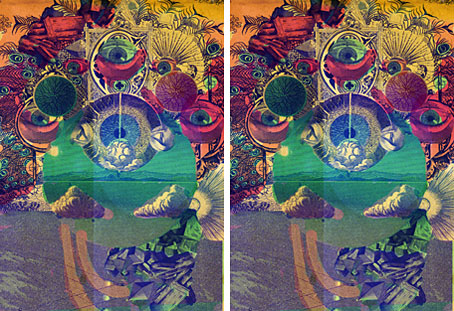
That essential journal of esoteric culture, Strange Attractor, announced a fourth number this week sporting a psychedelic cover which may be the work of Julian House (no credit is given on the SA site). As to the contents:

From Haiti and Hong Kong to the fourth dimension and beyond: discover the secrets of madness in animals; voodoo soul and dub music; ancient peacock deities; Chinese poisoning cults; the history of spider silk weaving; heathen mugwort magic; sentient lightning; Jesuit conspiracy theories; junkie explorers; Dali’s Atlantis; the resurgence of Pan (in London’s Crouch End); anarchist pirates on Madagascar; an ancient Greek Rip Van Winkle; French anatomical waxworks; Arthur Machen’s forgotten tales and Alan Moore’s unpublished John Dee opera.

Further details and the means to order a copy can be found here.

• Resonance FM’s Weird Tales For Winter has returned beginning with a presentation of The Gateway of the Monster, one of the better Carnaki tales by William Hope Hodgson. The story is read by Moon Wiring Club‘s Ian Hodgson (no relation) and the musical atmospheres are provided by The Advisory Circle. I ought to have posted this news yesterday since you’ll have missed the broadcasting of the first half but the second half will go out at midnight (UK time) on Monday. Details here, and the next release on the Café Kaput label in February will be the soundtrack, Music for Thomas Carnaki (Radiophonic Themes & Abstracts).
keepcalmcthulhu2.jpg

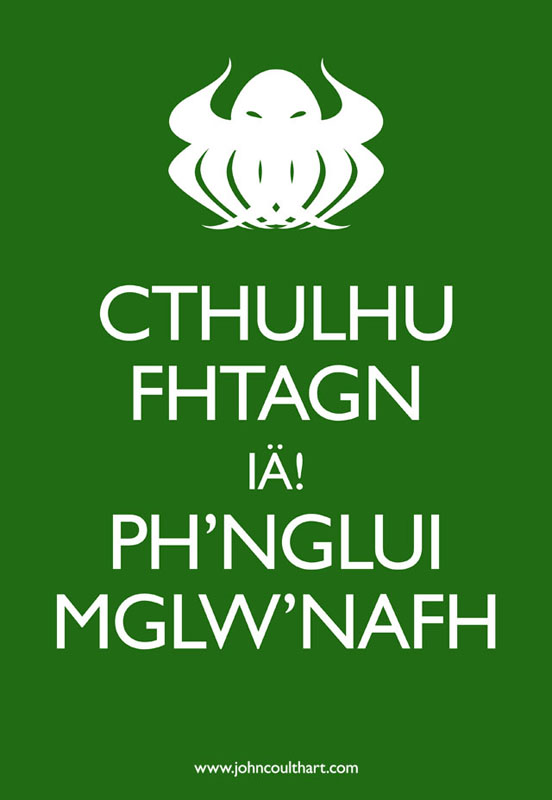
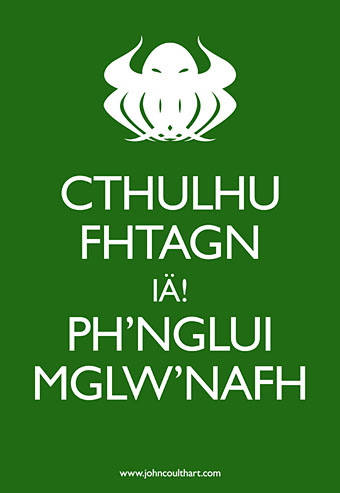
• The Keep Calm and Carry On Image Generator lets you work your own variations on the ubiquitous poster. It wouldn’t work for me, however, so I rolled up my sleeves and made my own. This may be good as a CafePress design, yes?

Interplay is an album by John Foxx and The Maths due to be released on March 21st. As with last year’s collection of Foxx instrumental pieces, DNA, the package design is by Jonathan Barnbrook. John Foxx first came to prominence as the lead singer in Ultravox (do I need to say “of course”? Okay…“of course”) and Ultravox’s debut album was part-produced by Brian Eno. It’s been painfully obvious recently (and it pains me to say it) that Foxx’s DNA was a far more accomplished and engaging work than Eno’s recent collection of over-hyped instrumentals. Related: Barnbrook Design’s albums of 2010.

Word Horde 2.0, “a substantial archive of manuscript material, correspondence, and books and printed matter, mostly signed” from the William Burroughs archives can be yours for $260,000. Related: William Burroughs’ Wild Boys photos. Also: Rudy Rucker on David Cronenberg’s Naked Lunch.

• “Nabokov described how ‘a modern taxonomist straddling a Wellsian time machine with the purpose of exploring the Cenozoic era’ would encounter the following series of events in the evolution of these butterflies…” The Royal Society confirms that a contentious theory of Vladimir Nabokov’s concerning the descent of butterfly populations was accurate.

• The work of Gérald Bertot aka Thomas Owen, a Belgian author of weird fiction, is explored at A Journey Round My Skull.

The Other Side of the Wind, Orson Welles’ unfinished film from 1972, may finally be given a release.

• Jon Savage celebrates Roy Harper and his extraordinary Stormcock album.

Philip Pullman wants the Tory philistines to leave our libraries alone.

• Rick Poynor takes a dérive through the arcades of Paris.

Space music new and old.

Young Savage (1977) by Ultravox | Clicktrack (2010) by John Foxx & Jonathan Barnbrook.

Odes and Sonnets by Clark Ashton Smith

cas.jpg

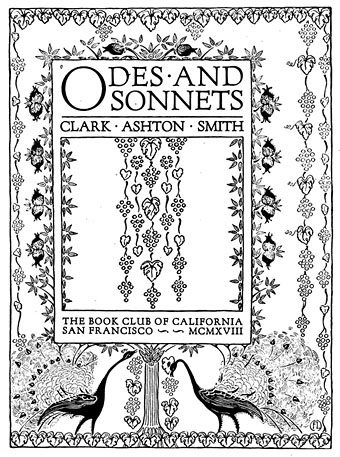
Clark Ashton Smith’s weird fiction is reprinted more often and more widely than his poetry so it’s convenient for those curious about his verse that the Internet Archive has two volumes of early work. Odes and Sonnets is from 1918 and features embellishments by illustrator Florence Lundborg whose grape-devouring peacocks nod towards the fin de siècle spirit Smith was trying to capture in his poems. The Star-Treader, and Other Poems is Smith’s first book from 1912, published when he was just 19, and is heavily indebted to the Decadents. That Decadent influence carried over into the stories he wrote for Weird Tales and augments their unique flavour and over-heated atmosphere, an atmosphere which raised his work above the often mediocre level of his contemporaries. On page 58 of The Star-Treader can be found The Eldritch Dark, the poem from which the leading Smith website takes its name.

Previously on { feuilleton }
Clark Ashton Smith book covers

Frank Frazetta, 1928–2010

frazetta1.jpg

Conan the Adventurer aka The Barbarian (1965).

How to appraise Frank Frazetta? In November last year I wrote about this Conan portrait for an SF Signal Mind Meld feature on favourite book covers:

The covers that launched a thousand imitators. Lancer’s series of Conan books in the 1960s were the first appearance of Howard’s barbarian in paperback and came sporting cover art by Frank Frazetta. A great example of artist and subject being perfectly matched, these are the standard by which all subsequent barbarian art must be judged. Frazetta’s painting of a brooding warrior lord (which he reworked slightly for its poster edition) is for me the definitive portrait of Howard’s hero, battle scarred and proudly malevolent, with a chauvinistic blur of trophy female clinging at his feet. Other artists can do the muscles and monsters but none capture the physical presence and brute animality of Howard’s characters the way Frazetta does.

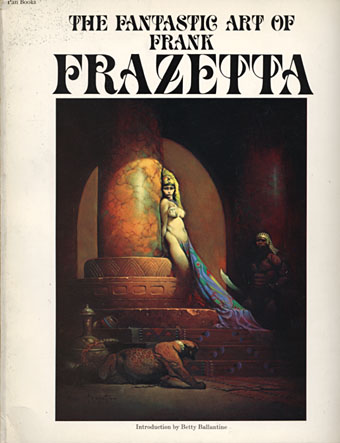
I found Frazetta’s work through the great series of fantasy art books which Pan/Ballantine published in the 1970s. I hadn’t read any Robert E Howard at the time, I only knew the diluted version of the Conan character in the Marvel comics series but Frazetta’s work was so powerful it was a spur to search out Howard, especially when I read that the writer had been a pen-pal of HP Lovecraft. I was never as interested in Frazetta’s other staple inspiration, Edgar Rice Burroughs, probably because Tarzan was too familiar from films and TV.

larkin_frazetta1.jpg

The Fantastic Art of Frank Frazetta (1975).

Both Howard and Frazetta defined a milieu which combined an intensity of vision with a projection of their own personalities into the worlds they created. (Many of Frazetta’s protagonists resemble their creator.) Both suffered from having that intensity of vision watered-down by ham-fisted imitators or the vulgarisations of films and comics. At their best, Howard’s Conan stories are a blend of heavyweight adventure story with supernatural horror; many of them were first published in Weird Tales magazine alongside other masters of the weird like Lovecraft and Clark Ashton Smith. What impressed me about Frazetta’s paintings was the way he managed to capture a sense of eldritch weirdness as well as the more obvious barbaric adventure in a manner which eluded so many of the sword and sorcery illustrators who followed. What’s even more remarkable when you read interviews is that he seemed to do all this instinctively. He’d learned from looking at earlier artists such as J Allen St John, Howard Pyle, Frank Schoonover and Roy Krenkel, and found the means to apply their painting style to his own internal aesthetics and sense of drama.

frazetta3.jpg

Swords of Mars (1974).

Aesthetics is one of the things I always come back to with Frazetta. I used to pore over these paintings wondering how it was that all the details of weapons and decor seemed absolutely right. Nothing was ever over-worked or too elaborate. Where did this invention come from? The other obvious feature is a raw sexiness which pervades everything. I’ve had people tell me that Frazetta must have been bisexual because of the equal care he lavished on his male and female figures. I’ve always disagreed with this. The point about Frazetta’s world is that everything is sexy: the people, the decor, the architecture, the animals, even the monsters; naturally the men are going to be as sexy as the women. In addition, he wasn’t afraid of giving his men real balls (so to speak) unlike the endless parade of costumed eunuchs filling the comic books. These figures may be dealing death but they’re filled with vigour and life when they’re doing it.

frazetta2.jpg

Bran Mak Morn (1969).

I said everything is sexy; I’ll make an exception for the extraordinary painting of Bran Mak Morn and his tribal horde, a picture of feral nightmarishness that goes beyond mere illustration and makes you feel the artist has shown you an atavistic glimpse of ages past. Robert E Howard would have been thrilled to see his characters brought to life with this kind of visceral intensity. For years Howard’s fiction was dismissed as pulp, now he’s a Penguin Modern Classic. And it’s as a modern classic that I’ll continue to think of Frank Frazetta.

Unofficial gallery site

Elsewhere on { feuilleton }
The illustrators archive

Previously on { feuilleton }
Frazetta: Painting with Fire
The monstrous tome
Men with snakes
My pastiches
Fantastic art from Pan Books

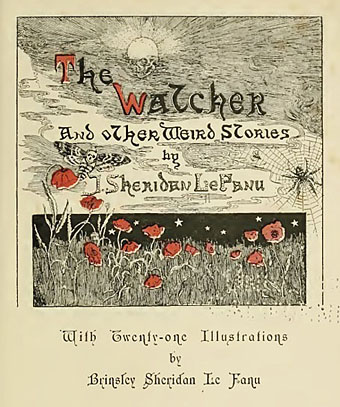
The Watcher and Other Weird Stories by J. Sheridan Le Fanu

lefanu.jpg

Irish writer J. Sheridan Le Fanu (1814–1873) has long been a favourite of mine since I first discovered his weird tales in ghost story collections, still the place you’re most likely to find his work. His ghost stories are frequently superior to the more celebrated MR James (who edited a Le Fanu collection), they’re less formulaic and often quite inexplicable. Green Tea, from In a Glass Darkly (1872) chills for its atmosphere of apparently random and unjustified malevolence; it’s also alarming for the directness of its central idea which I won’t spoil if you haven’t read it. Anyone wanting to know why Le Fanu is still read today should start there.

Unlike MR James, Le Fanu has lacked for illustrators so I was surprised to find this edition of his work at the Internet Archive with illustrations by his son, Brinsley. The artwork isn’t of the highest quality, and it’s debatable whether tales as nebulous and evocative as ghost stories should be illustrated at all, but their singularity makes them worth a look. The Watcher and Other Weird Stories is a small collection which includes A Strange Event in the Life of Schalken the Painter, a story memorably adapted for television by Leslie Megahey in 1979.

Previously on { feuilleton }
Chiaroscuro