Weekend links 817

paolozzi.jpg

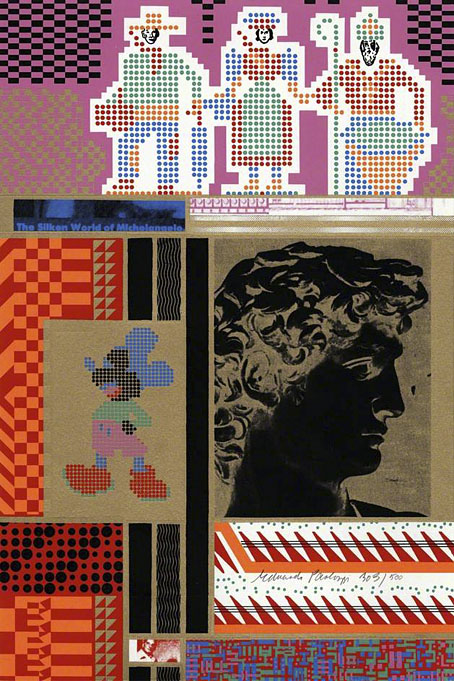
The Silken World of Michelangelo (1967) by Eduardo Paolozzi.

• “By the late 19th century, representing time as a line was not just widespread—it was natural. Like today, it would have been hard to imagine how else we could represent time. And this affected how people understood the world.” Emily Thomas on the evolution of our thinking about the nature of time.

• At Green Arrow Radio: Bill Laswell and the Cosmic Trip, in which the indefatigable performer/producer talks about his career and Cosmic Trip, a new album by saxophonist Sam Morrison.

• At Public Domain Review: Snail Homes, Bog Bodies, and Mechanical Flies: Robert Testard’s Illustrations for Les secretz de l’histoire naturelle (ca. 1485).

• Among the new titles at Standard Ebooks, the home of free, high-quality, public-domain texts: Continental Op Stories by Dashiell Hammett.

• The winter catalogue of lots for the After Dark: Gay Art and Culture online auction. Homoerotic art, photos, historic porn, etc.

• New music: The Third Mind. A Sonic Tribute to the Dreamachine by Various Artists.

• Mix of the week: DreamScenes – February 2026 at Ambientblog.

A Conversation with Tarotplane by AJ Kaufmann.

• RIP Bud Cort.

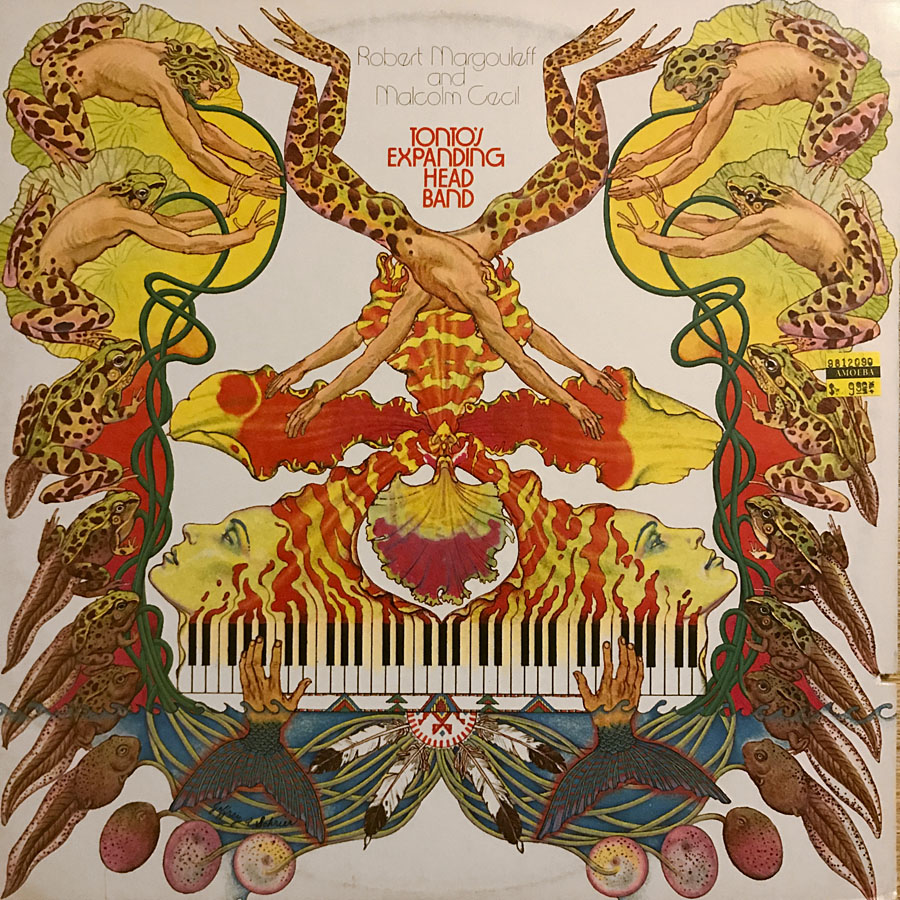
Timewhys (1971) by Tonto’s Expanding Head Band | Time Be Time (1990) by Ginger Baker | Time Scale (2009) by Belbury Poly

Weekend links 703

hallbeck.jpg

Njommelsaska i Lappland (1856) by Carl Svantje Hallbeck.

101 hidden gems: the greatest films you’ve never seen. Not another clickbait listicle of Hollywood fare that you really have seen, this is 101 films from Sight & Sound‘s annual poll of critics and directors, each of which only received a single vote. Cinema from the silent era to the present day, “from every continent but Antarctica”, all presented on a single page, and with accompanying notes from the voters. I’ve only seen four of these so it’s a list to mine for the future.

• 2024 will see the 100th anniversary of the publication of the first Surrealist manifestos, so the following new books are making their presences known before the celebratory rush. At Colossal: extracts from New Surrealism: The Uncanny in Contemporary Painting by Robert Zeller; at AnotherMag: photos by Coco Capítan of Salvador Dalí’s home at Port Lligat.

• “Cocteau was like one of those magicians who, having announced that they are going to reveal the secret of one trick, immediately perform another.” Pierre Caizergues introducing extracts from The Secrets of Beauty, a small book of aphorisms by Jean Cocteau, newly translated into English by Juliet Powys.

• More Michael Powell: “Scorsese says The Red Shoes is in his DNA”: Thelma Schoonmaker on her life and work with Michael Powell and his friend Marty.

Dennis Cooper’s favourite fiction, poetry, non-fiction, film, art, and internet of 2023. Thanks again for the link here!

• At The Daily Heller: Book covers by Iris Alba (1935–1993), art director, illustrator and graphic designer.

• At Smithsonian Magazine: See the newest underwater sculptures residing on the floor of the Caribbean.

• At Wormwoodiana: Douglas A. Anderson goes looking for the fantasy fiction of Raymond Chandler.

• At Public Domain Review: Paige Hirschey on Anna Atkins’ cyanotypes.

Entries for the Northern Lights Photographer of the Year 2023.

• At Bibliothèque Gay: Der Mann in der Photographie, 1954.

Aurora (1971) by Tonto’s Expanding Head Band | Aurora (2005) by Alva Noto + Ryuichi Sakamoto | Aurora Liminalis (2013) by William Basinski + Richard Chartier

Weekend links 563

tonto.jpg

Cover art by Jeffrey Schrier for the 1975 reissue of Zero Time by Tonto’s Expanding Head Band.

• RIP Malcolm Cecil, electronic musician, and producer of Stevie Wonder, among many others. The term pioneer is over-used when discussing electronic artists, but it’s an accurate one when applied to Cecil and his partner in Tonto’s Expanding Head Band, Robert Margouleff. The first Tonto album, Zero Time (1971), was a collection of fully-realised all-electronic compositions recorded in the days when “electronic music” in the rock sphere usually meant rock-band-plus-synth-burbles. As I said in a post about Tonto’s debut album a few years ago, “Jetsex sounds like an outtake from Kraftwerk’s Autobahn (albeit three years early) while Timewhys wouldn’t have been out of place on The Human League’s Travelogue album almost a decade later”. Cecil may be seen in this short film showing off the bespoke synth gear that comprised The Original New Timbral Orchestra (aka TONTO), while he talks at length about his career in issue 4 of Synapse magazine here. Cecil and Margouleff parted company in the mid-70s shortly after releasing a second album, It’s About Time (1974), a collection of jazzy instrumentals that’s overdue a proper reissue.

• “Every film production company they showed it to said it was ‘too weird’ to ever be made. ” Next month Strange Attractor publishes The Otherwise, a script by Mark E. Smith and Graham Duff for an unmade horror film.

• More horror: Predator’s Ball by Uni; music video as horror scenario in which you can play spot-the-reference: Alice in Wonderland, Rocky Horror, Leigh Bowery (?), Pasolini’s Salò (?)…

• At Bibliothèque Gay: Narkiss by Jean Lorrain, another homoerotic classic newly translated into Spanish, and with new illustrations.

• The week in Gary Panter: Nicole Rudick on Gary Panter’s Punk Everyman, and the man himself writing about his life and art.

• At Wormwoodiana: Mark Valentine investigates the connections between Charles Williams and Sax Rohmer.

• At Dangerous Minds: New Age Steppers, “the only ever post-punk supergroup”.

• Mix of the week: XLR8R Podcast 689, a feast of funk compiled by Steve Arrington.

• At Public Domain Review: Agostino Ramelli’s Theatre of Machines (1588).

• At Dennis Cooper’s: Pier Paolo Pasolini Day.

Valentina Magaletti’s favourite music.

Louvre site des collections

Narcissus Queen (1958) by Martin Denny | Narciso (1974) by Pierrot Lunaire | Narkissos (2006) by Sadistic Mikaela Band

Weekend links 548

aurora.jpg

The Aurora Borealis by Charles H. Whymper.

• “In 1829, when the celebrated Japanese artist Katsushika Hokusai was almost 70 years old, he created more than 100 drawings of a dazzling array of subjects: playful cats, serene landscapes, even severed heads. Hokusai’s fame continued to grow after his death in 1849, and the suite of small, elaborate drawings was last purchased a century later, at a Paris auction in 1948. Then it disappeared from the public eye.” The British Museum now has the drawings which may be seen here.

• The week in cover design: Emily Temple compares US and UK covers for the same books, while Vyki Hendy collects recent titles with objects as the main feature of the cover designs. One of my recent covers (which will appear here soon) is less minimal than these but also features an arrangement of objects.

• The compilation experts at Light In The Attic Records have put together another collection of obscure Japanese music. Somewhere Between: Mutant Pop, Electronic Minimalism & Shadow Sounds Of Japan 1980–1988 will be released in January.

“A Jamesian world is one of cursed artefacts, endlessly subsuming landscapes, forgotten manuscripts and tactile beings that punish the curious and intellectually arrogant.” Adam Scovell visits the grave of MR James.

• Dragons and Unicorns: John Boardley on the lost art of the Hieroglyphic Bible.

• I almost missed John Waters’ favourite films of the year.

• At Dennis Cooper’s: Sade’s Castle, Cardin’s House.

Northern lights photographer of the year.

Aurora Hominis (1970) by Beaver & Krause | Aurora (1971) by Tonto’s Expanding Head Band | Soft Aurora (1979) by Tod Dockstader

Weekend links 411

crowley.jpg

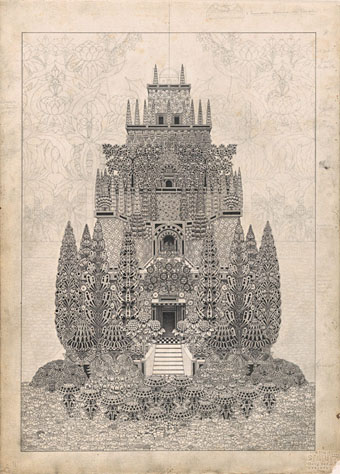
The Temple of Love (1911–24) by Herbert E. Crowley.

• My film viewing in the 1980s involved a considerable amount of backtracking: watching any film noir that turned up on the TV while chasing the early works of David Cronenberg, and various “New Hollywood” classics on television or at repertory cinemas (when such things were still plentiful). Contemporary fare by comparison was often a lot less attractive, although I’d be waiting for new work from David Lynch and Nicolas Roeg while pursuing obscurities (usually the banned or censored) on videotape. Popular films seldom generated actual loathing but throughout the decade I nurtured a persistent hatred for the works of John Hughes, an animus that can still return today when I read yet another nostalgic article about his oeuvre.

The monoculture of the 1980s was writ large on American cinema of the decade. From Arnold Schwarzenegger’s muscle-rippling actioners to John Hughes’s adolescent confections, bombastic, generally upbeat films characterised the decade of the yuppie.

Christina Newland offers a welcome riposte to the pastel-hued retrospectives in a piece entitled “Reagan’s bastard children: the lost teens of 1980s American indie films”. While not exclusively teen pictures, I’d have mentioned three low-budget films written by Eric Red: The Hitcher (1986), Near Dark (1987) and Cohen and Tate (1989).

The Temple of Silence: Forgotten Works & Worlds of Herbert Crowley is a lavish (and costly) study of the strange comic strips and incredibly detailed drawings of Herbert E. Crowley (1873–1937). Mark Newgarden interviewed Justin Duerr about rescuing Crowley’s art from undeserved neglect. I missed an earlier interview by Steven Heller with Temple of Silence publisher Josh O’Neill. There’s more: The Wiggle Much a Tumblr devoted to Crowley’s comic strips and other artwork. (Ta to Jay for the tip!)

Pandemic is an interactive film by John Bradburn for The Science Museum. “A pandemic is causing heart failure–how far will you go to create a pig/human hybrid to provide donor organs?” The multiple choice begins at YouTube; there’s also a behind the scenes feature at the Museum blog, and a trailer. Anyone who remembers a certain scene in Lindsay Anderson’s O Lucky Man! may hesitate before playing.

Given the plain palette of so much 1969–70 rock—jammed-out bluesy boogie in the Canned Heat and Allman Brothers mode, nasal pseudo-country harmony singing à la CSN&Y and their afterbirth—it is tempting to imagine an entirely alternative history for rock. It’s a parallel world where Fifty Foot Hose’s Cauldron, United States of America’s self-titled album and synthedelic oddities from Syrinx, Silver Apples, Beaver & Krause and Tonto’s Expanding Head Band were just the run-up to a giant leap into the electronic future.

Simon Reynolds in an excellent piece on one of my favourite musical sub-genres, electronic psychedelia

• The week in animated film: Emerald Rush, a video for an extract from Jon Hopkins’ new album, Singularity; Awaken Akira, a short homage to Katsuhiro Otomo’s graphic novel/film by Ash Thorp and Zaoeyo; Extra (1996), a video by one of the Akira animators, Koji Morimoto, for music by Ken Ishii.

Tenebrous Kate on The Powers of Darkness & The Powers of the Mind: The Legacy of Jacques Tourneur’s Night of the Demon. Related: a look at the film’s shooting script and pressbook.

• At Dangerous Minds: John Gray, the pre-Bosie lover of Oscar Wilde, and the man whose surname is memorialised in Wilde’s most famous creation, Dorian Gray.

• Skewing the Picture: China Miéville posts the full text of an essay from 2016 about the rural weird.

• Share a pastrami sandwich with TED Klein in Episode 65 of Eating the Fantastic.

• More Hodgsoniana: The Land of Lonesomeness, a short story by Sam Gafford.

• At The Quietus: Barry Miles on William Burroughs’ years in London.

• At Dennis Cooper’s: Curtis Harrington Day.

Night Of The Assassins (1977?) by Les Rallizes Dénudés | Night Of The Earth (1980) by Chrome | Night Of The Swallow (1982) by Kate Bush