Weekend links 476

kimura.jpg

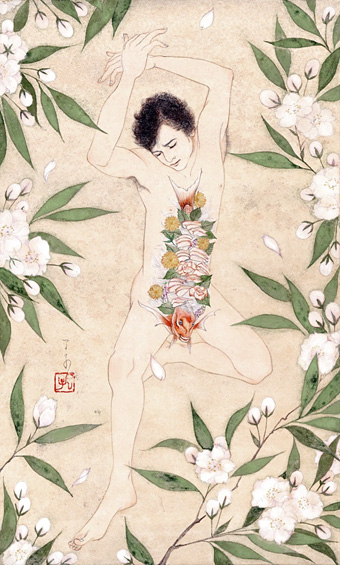
Man’s body dish for Sashimi under the cherry blossom (2005) by Ryoko Kimura.

• Godley & Creme’s Consequences (1977) is reissued this month on CD and vinyl. Originally a three-disc concept album with a theme of climate disaster and the natural world’s revenge on humanity, Consequences was released at a time when punk and prog rock were fighting for the attention of music listeners. 1977 wasn’t the end of prog by any means (many of the vilified bands had some of their greatest successes at this time) but Godley & Creme’s transition from the smart pop songs of 10cc to extended instrumental suites was abrupt, and their concept, such as it was, lacked the drama and accessibility of Jeff Wayne’s The War of the Worlds, even with the addition of Peter Cook providing a multi-voice comic narrative between the musical pieces. (Kevin Godley ruefully referred to the album in later years as Con Sequences.) The album flopped, and has been a cult item ever since.

• “A word of caution, though. Once you do read it, it’s hard to let it go.” Philip Hoare on Herman Melville and Moby-Dick. Related: William T. Vollmann on how a voyage to French Polynesia set Herman Melville on the course to write Moby-Dick.

Samm Deighan on The “Faraway Forest” in Peter Strickland’s Katalin Varga, The Duke of Burgundy, and The Cobbler’s Lot.

Brian Eno, Roger Eno, and Daniel Lanois discuss the recording of Apollo: Atmospheres & Soundtracks.

John Boardley on the first fashion books, Renaissance pixel fonts and the invention of graph paper.

Melanie Xulu looks back at a time where major labels were releasing witchcraft rituals.

• “Tom Phillips’ A Humument is a completely novel project,” says Rachel Hawley.

John Foster on the evolution of Stereolab’s analogue-inspired record sleeves.

• At Dennis Cooper’s: a history of le Grand Guignol by Agnes Peirron.

Casey Rae on William S. Burroughs and the cult of rock’n’roll.

• An Austin Osman Spare image archive.

Consequences (1965) by John Coltrane | Moby Dick (1969) by Led Zeppelin | Consequence (1995) by Paul Schütze
Weekend links 388

nakayama.jpg

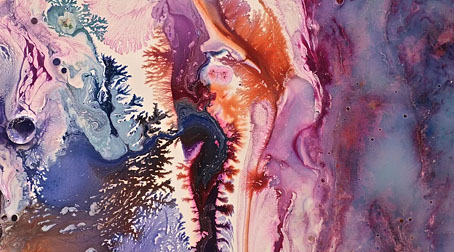
Still of an Alive Painting by Akiko Nakayama.

• “In what is a cross between performance art and installation, Nakayama uses a multitude of kitchen basters loaded with paint and water to add, mix, tilt, blow and add all sorts of extraneous effects to her paints, recording and projecting it all onto a large screen.” Continuously Changing “Alive Paintings” by Akiko Nakayama. There’s more performance video at the artist’s website.

• In January 2018 Song Cycle Records (UK) release Solaris, a “Collector’s Edition” of the Tarkovsky film and its soundtrack comprising vinyl/CD, blu-ray (no region details) and a book of photos, artwork and essays.

• Steve Davis may no longer be a snooker player but he’s still a Magma obsessive. This week he reviewed the new Retrospektiw collection for The Quietus.

What I was most thankful to TG for was leading me to Christopherson’s later band Coil with his partner, antagonist and lover John Balance (after they’d met in Genesis’ Psychic TV) whose music I fell for even harder. The arcane and homoerotic tragicomedy that underpinned their discography (and relationship) propelled me into new states, years before any first hand knowledge of the drug experiences they managed to intertwine so artfully with their music. Records like Scatology and Horse Rotorvator sexualised the male body for me for the first time—an awakening that’s hard not to find some amusement in when soundtracked by a romp called The Anal Staircase. From afar it seemed like their intense, exploration of electronic music as ritual was only possible as a result of the depth of the duo’s personal relationship and how it manifested spiritually, chemically and physically. The posture and machismo of the modern guitar music I listened to (and performed) with my friends could be tiring. The sound of Coil became a safe space in which to fantasise about manhood and Englishness and what it really meant, helping dismantle clichés I’d come to accept as reality. From medieval hymns to acid-house their music was unafraid and total. Though hard to define with any particular release I often play people their funereal takes on Tainted Love (of which all profits went to the Terrence Higgins Trust—a musical first in 1985 while AIDS was still very much taboo) and the Are You Being Served? theme tune, the basis of their transformative final track Going Up, completed by Christopherson after Balance’s death.

Fred Macpherson writing about Throbbing Gristle and Coil at new site The Queer Bible. This is the first appraisal of Coil I’ve seen on any site devoted to gay/queer issues, over ten years after the band expired following the death of John Balance. Better late than never, I suppose.

• Tom Phillips is helping support the National Campaign for the Arts by reworking a page of A Humument as a series of designs at CafePress.

• At Strange Flowers: The Secret Satan book list, a welcome alternative to the lists that fill the broadsheets at this time of year.

• Mixes of the week: Stephen O’Malley presents Acid Quarry Paris—A Hypnosis, and XLR8R podcast 517 by Davy.

• At the Internet Archive: 183 copies of Video Watchdog magazine (1990–2017).

• The TLS interview: Twenty Questions with M. John Harrison.

• At Unquiet Things: The solving of a family art mystery.

txt.fyi

The Hills Are Alive (1995) by Coil | Everyone Alive Wants Answers (2003) by Colleen | Only Lovers Left Alive (2014) by Jozef Van Wissem

John Aarts’ Lucifer

aarts01.jpg

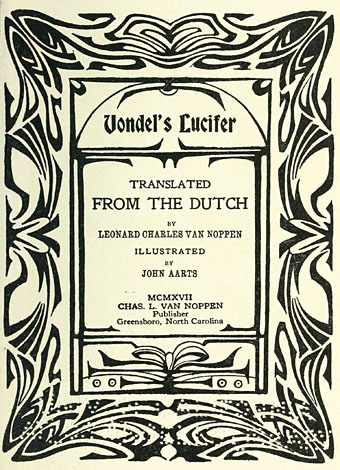
The Lucifer in question being the principal character in a play of the same name by Dutch poet and playwright Joost van den Vondel (1587–1679). I confess that I hadn’t heard of this work before even though it’s well-known in the Netherlands, and may also have influenced Paradise Lost. The version linked here is an American reprint of an earlier edition from 1898 that was the first English translation of the play. The graphics by John Aarts appear to be wood engravings but I’m not certain of that, matters not being helped by the present invisibility of Mr Aarts. In addition to a suite of full-page illustrations there are many embellishments in the nascent Dutch Art Nouveau style. And unlike many books that repeat the same two or three vignettes there’s a lot of variation throughout so it’s worth seeing the book as a whole.

aarts02.jpg

aarts03.jpg

aarts04.jpg

Continue reading “John Aarts’ Lucifer”

Weekend links 373

YDKMorimoe.jpg

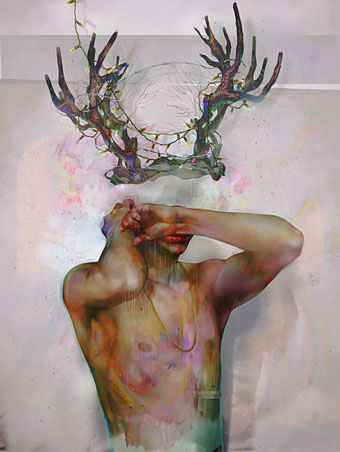
Untitled (2011) by YDK Morimoe. Via Jim Post at Dennis Cooper’s.

For The Climax Of The Night by Total Leatherette is almost certainly the only album you’ll see this year with autofellatio cover art. Faux Fox gives a taste of the new album, while an earlier piece, Squeeze Hunk, features a Tom of Finland-style video. And speaking of which, Dome Karukoski’s feature film, Tom of Finland, is released in the UK this week. Related: Tom of Finland coffee.

• The death of playwright Joe Orton in 1967 prompted yet more 50th anniversary articles this week. Mentioned here before, and better value than all the textual appraisal, is the BBC’s 70-minute TV documentary from 1982, A Genius Like Us: A Portrait of Joe Orton, which includes interviews with family, friends, colleagues and Orton’s biographer, John Lahr.

• Two skulls, 50,000 postcards and a book that took 50 years to finish: Stuart Jeffries visits artist Tom Phillips.

• New at the Internet Archive: 25,000 78RPM records. You can never go wrong with Duke Ellington.

Lock Your Door and The Reformation of St. Jules: Algernon Blackwood filmed in 1949.

Redemption, an exhibition of art by Fay Pomerance (1912–2001) at Ushaw College, Durham.

• At Dirge Magazine: Daniel Pietersen on the myth of the sunken city.

• Mix of the week: FACT Mix 613 by Aaron Dilloway.

Laetitia Sadier’s favourite albums.

• RIP Hywel Bennett

Sunken City (1961) by Les Baxter | Ys (1971) by Alan Stivell | Atlantis (1971) by Deuter

Weekend links 365

brunovsky.jpg

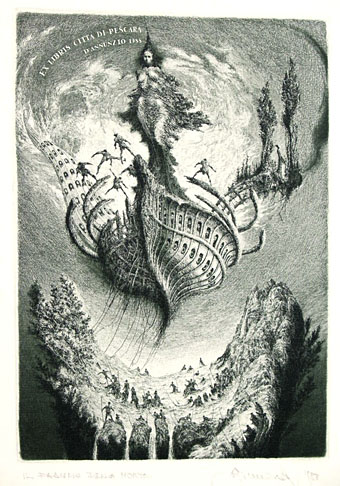
Il Fascino Della Morte (1988) by Albin Brunovsky.

• One of the forthcoming books featuring my cover art is Behold! Oddities, Curiosities, & Undefinable Wonders, a story collection due to be published next month by Crystal Lake Publishing. Bleeding Cool talked to editor Doug Murano about the collection and its contributors.

Six episodes of Tom Keating on Painters, a TV series from 1983 presented by Britain’s most well-known art forger. In six further episodes Keating examines the work of the Impressionists and Post-Impressionists.

• Opening at the Guggenheim, NYC, at the end of this month: Mystical Symbolism: The Salon de la Rose+Croix in Paris, 1892–1897.

The most potent form of gatekeeping is religion. When certain beliefs are deemed sacred, they are put beyond questioning. To challenge such beliefs is to commit blasphemy. The accusation of cultural appropriation is a secular version of the charge of blasphemy. It’s the insistence that certain beliefs and images are so important to particular cultures that they may not appropriated by others.

In Defence of Cultural Appropriation by Kenan Malik

• Mixes of the week: FACT Mix 605 by Anthony Parasole, and Secret Thirteen Mix 224 by Fanny Kaplan.

• Artist Tom Phillips at 80: “I’m still reading books. Nothing changes and everything changes.”

Negative Chambers is a new album by Yair Elazar Glotman and Mats Erlandsson.

• “Pornhub is the Kinsey Report of our time,” says Maureen O’Connor.

• “Postmodernism is dead. What comes next?” asks Alison Gibbons.

Cat Street View

Mystic Eyes (1965) by Them | Mystical Dream (1965) by The Roland Kirk Quartet | Mystic Green (1985) by Rain Parade