Weekend links 325

beeple.jpg

08-30-16 from the Everydays series by Beeple.

• “Monsieur de Bougrelon is a unique character: loquacious, proud, a leftover from an earlier age, wearing garish outfits and makeup that drips. To his speechless audience, he waxes nostalgic about his life as an exile in Holland, as well as what he calls “imaginary pleasures” – obsessions with incongruous people, animals, and objects. These obsessions are often sexual or border on the sexual, leading to shocking, surreal scenes. Monsieur de Bougrelon also enthuses over his beautiful friend Monsieur de Mortimer, making this novella one of the rare works of the nineteenth century to broach homosexuality in a meaningful way, years before Jean Cocteau and Jean Genet.” Monsieur de Bougrelon (1897) by Jean Lorrain will receive its first English publication by Spurl Editions in November.

• “…The Future seems in retrospect to have been no more than a spectacle, created by the optimistic few for the optimistic many, the readily gulled multitudes who had faith in technological seers just as an earlier generation had had faith in Great Men.” Jonathan Meades reviews Last Futures: Nature, Technology and the End of Architecture by Douglas Murphy.

In the Woods & On the Heath is a collection of 48 pieces of erotic prose and poetry by 24 writers, all of them illustrated by Van Rijn.

Borneman was widely read in European literature and, once settled in London, wasted no time bringing himself up to speed with developments in English-language writing, discovering a particular affinity with Hemingway and Joyce, not to mention American crime writers such as Carroll John Daly and Dashiell Hammett. This presumably explains the distinctive, sometimes highly eccentric style of The Face on the Cutting-Room Floor, which despite being set in an English film studio of the 1930s (which evokes images, perhaps, of genteel musical comedies performed in perfect RP accents), combines laconic, hardboiled dialogue with extended stream-of-consciousness passages, all filtered through the skewed phraseology of someone whose acquisition of English was still, to some extent, a work in progress.

Jonathan Coe on the mysteries of The Face on the Cutting-Room Floor, a novel by “Cameron McCabe” (Ernest Borneman)

• How Oscar Wilde paved the way for gay rights in the arts. Wilde will be honoured with a major exhibition in Paris later this month.

Noisy Rain is a free online publication dedicated to “artists working with the male figure and homo-eroticism”.

Dennis Cooper’s blog returns. The truth about Google’s deletion of the Blogspot account has finally emerged.

Peel Away The Ivy by The Pattern Forms will be release number 26 on the Ghost Box label in October.

• Glam Rock & Yorkshire Occult: Ben Myers on his novel Turning Blue.

• Mix of the week: Secret Thirteen Mix 195 by Jake Meginsky.

• At Phantasmaphile: Unarius: We Are Not Alone.

Blokdust is a browser-based musical instrument.

• Official trailer for David Lynch: The Art Life.

Future Dub (1994) by Mouse On Mars | Future Proof (2003) by Massive Attack | Future Past Perfect pt 01 by Carsten Nicolai

Weekend links 324

waliszewska.jpg

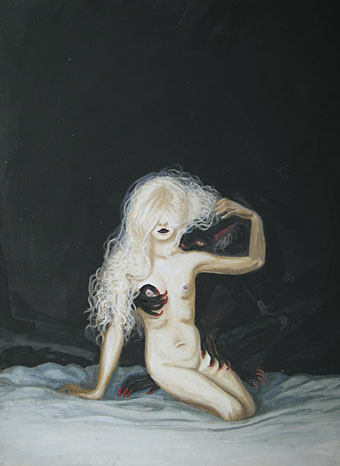
Untitled painting by Aleksandra Waliszewska. The artist is profiled by S. Elizabeth at Dirge Magazine.

• “…from my point of view, the only thing to do with any genre, any medium, is pretty much to break it, to transcend it, to find out what its limits are, and then go beyond them, and see what happens.” Alan Moore (again) talking to Heidi MacDonald about his novel, Jerusalem, which is out next month.

• A Monument to Outlast Humanity: Dana Goodyear gets the reclusive Michael Heizer to talk about his decade-spanning sculptural project, City, work on which is almost finished.

William Burroughs’ appearances in adult men’s magazines: a catalogue which includes some downloads of uncollected Burroughs essays and other writings.

• Mixes of the week: Homegirls & Handgrenades Mix by Moor Mother, Secret Thirteen Mix 194 by Kareem, and hieroglyphics #014 by Temples.

Remoteness of Light is a new album by The Stargazer’s Assistant inspired by the depths of the oceans and the vastness of space.

• RIP Gilli Smyth. “The silliness ran deep in Gong, but they could groove like mothers, too,” says Joe Muggs.

Guide to Computing: historic computers presented by James Ball as though they were new machines.

• “Oscar Wilde’s De Profundis is one of the greatest love letters ever written,” says Colm Tóibín.

• “Will You Dance With Me?” Derek Jarman films dancers in a gay club in 1984.

• Snapshots from an editor: Donald Weise on working with Edmund White.

Stupid by Wrangler (Stephen Mallinder, Phil Winter and Benge).

The Rutt-Etra-Izer

Dynamite/I Am Your Animal (1971) by Gong | Witch’s Song/I Am Your Pussy (1973) by Gong | Prostitute Poem (1973) by Gong

Weekend links 296

invisiblecreature.jpg

Mars (variant design): one of three new posters for NASA by Invisible Creature.

• “If the point of Sade’s work was to marry sexual frustration and release to the practice of interpersonal violence, he could confidently gaze out on the landscape of our popular culture and declare it a fait accompli.” Hussein Ibish on The United Sades of America.

• Gravitational Waves Exist: The Inside Story of How Scientists Finally Found Them by Nicola Twilley. Sean Carroll explains the importance of the discovery.

• Another This Heat interview: Bruce Tantum interrogates Charles Bullen and Charles Hayward about being a group ahead of their time.

The English word comes ultimately from Greek magike (in which the original Persian word is spliced with tekhne, “art”), while the Persian magos “one of the members of the learned and priestly class” ultimately derives from magush, “to be able, to have power”, from which we may also derive the word “machine”. So my social hierarchy is your magic, and my magic might be your craft—or even your machinery. My religion is your magic. Your religion is my fairy lore. Or your religions might be a mass of fakery and trickery and foolery. Hence in making magic into an intellectual discipline, I theorize based on my observations, which might not be mine but those of others, heritable observations. But because what I do looks very like empiricism, as I examine materials for the tricks or fooleries, or for the real alterations, checking my results against descriptions of previous experiments, what I do feels like science, feels like the template for Baconian empiricism and its great instauration.

Diane Purkiss reviewing The Book of Magic: From Antiquity to the Enlightenment, edited by Brian Copenhaver

• The Strange World Of…The Residents: Sean Kitching talks to The Residents’ resident artist, Homer Flynn.

• At Strange Flowers: film of Natalie Barney in 1962 reminiscing about Oscar Wilde and Marcel Proust.

• From Battleship Potemkin to Baker Street: Ian Christie on Sergei Eisenstein’s trip to London.

• Mixes of the week: Krautrock Mix by Tarotplane, and Mix #15 (Transversales) by Jon Brooks.

• From Rock en Stock (France, 1973): Can and Agitation Free in live performance.

• Twenty classic British folk-horror stories: a selection by Kai Roberts.

Immemory: a Flash version of Chris Marker’s CD-ROM.

Cronenberg Valentines

Static Gravity (1980) by Chrome | Zero Gravity (2001) by Monolake | Gravity (2013) by Roly Porter

Foreign appearances

steam1.jpg

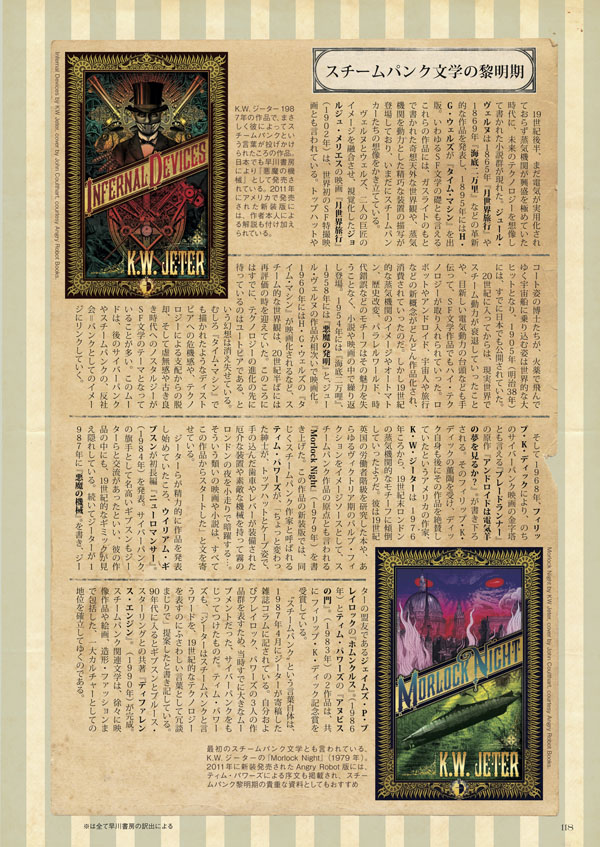
My work has appeared in a couple of foreign collections recently, each approaching popular culture from very different directions. The volume above is called Steampunk Japan Fashion Book according to a German bookseller although the title may read differently to Japanese speakers. This was published at the end of last year, and features my ever-popular covers for the Angry Robot editions of two steampunk novels by KW Jeter, Infernal Devices and Morlock Night. The book is the work of a collective who call themselves The Japanese Steampunkers.

steam2.jpg

popculture1.jpg

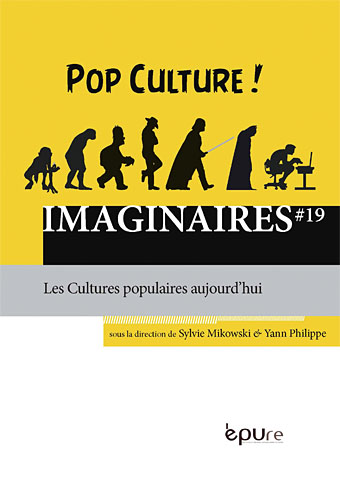
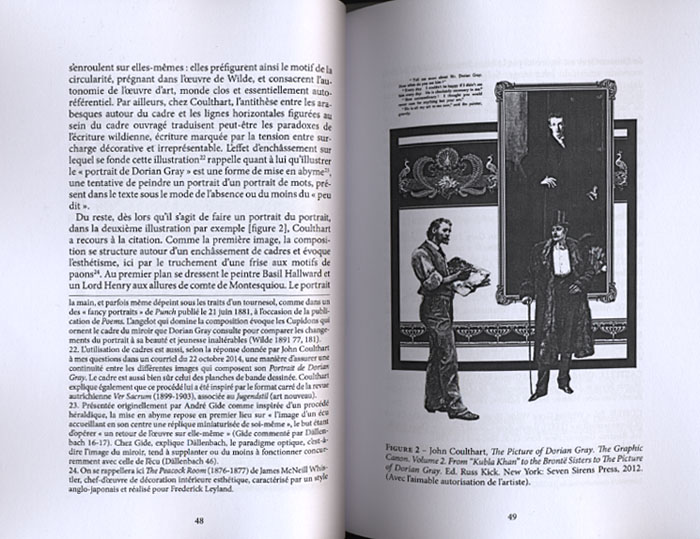
Meanwhile in France, Imaginaires #19: Les cultures populaires aujourd’hui is a collection of academic pieces about popular culture published by ÉPURE, Éditions et Presses universitaires de Reims. Inside there’s an essay by Xavier Giudicelli (University of Reims Chamapgne-Ardenne), The Picture of Dorian Gray et la culture populaire: du texte à la bande dessinée, which compares Wilde’s novel to various graphic adaptations. Xavier wrote to me some time ago about my Dorian Gray adaptation for the Russ Kick-edited Graphic Canon (2012) so the piece includes some of my remarks about my interpretation together with two of the pages.

popculture2.jpg

Previously on { feuilleton }
Picturing Dorian Gray

Weekend links 287

hugo.jpg

Cover by Valentine Hugo for Contes Bizarres (1933) by Achim d’Arnim. See Hugo’s interior illustrations here.

• “In spite of the blood-drinking pursuits of Rollin’s protagonists, there’s very little in the way of body horror to be found. His undead are sensual, romantic creatures that are frequently delicate of mind and body. These movies attempt to evoke nuanced emotional responses with their mixture of romance, loss, eroticism, and tragedy.” Tenebrous Kate on Sex, Death, and the Psychedelic Madness of Jean Rollin.

• “Late at night, [Melville] ‘turned flukes’ down Oxford Street as if he were being followed by a great whale, and thought he saw ‘blubber rooms’ in the butcheries of the Fleet Market.” Philip Hoare on Herman Melville’s time in London.

Haunted by Books, a new collection of writings by Mark Valentine, “explores the more curious byways of literature.” Full details at the home of the esoteric, Tartarus Press.

I am completely an elitist, in the cultural but emphatically not the social sense. I prefer the good to the bad, the articulate to the mumbling, the aesthetically developed to the merely primitive, and full to partial consciousness. I love the spectacle of skill, whether it’s an expert gardener at work, or a good carpenter chopping dovetails, or someone tying a Bimini hitch that won’t slip.

Art critic Robert Hughes quoted in a review by Siri Hustvedt of The Spectacle of Skill: Selected Writings of Robert Hughes

• “Art, art – I couldn’t give a crap about art.” Oscar Wilde’s nephew, Arthur Cravan, puts in another appearance at Strange Flowers.

• “The Tarot is utterly fascinating,” says Evan J. Peterson discussing his Tarot-inspired writing with Tarot Poetry.

Manuel Göttsching: “A lot of crazy music happened at the end of the ’60s, very strange, and very curious…”

• Mixes of the week: Secret Thirteen Mix 169 by Chra, and 28th November 2015 by The Séance.

Czech Artists’ Radical Book Designs of the Early 20th Century

• Ten things you might not know about Yayoi Kusama.

• More megaliths: Francis Pryor on ritual landscapes.

Peaches gets wild in the desert: Rub (uncensored).

Irmin Schmidt‘s favourite records (this week)

Mount Etna erupts

Rituals (1981) by Bush Tetras | Ballet For A Blue Whale (1983) by Adrian Belew | Etna (2006) by Boris & Sunn O)))