Reverbstorm: Bauhaus Horror

reverbstorm1.jpg

Lord Horror (after Klaus Barthelmess).

(No, not Pete Murphy and co.) Now that the Reverbstorm book is at the printers I have an excuse to discuss a few of the art and design appropriations that run through the narrative. I wanted to use some Bauhaus-style design back in the early 1990s when we were putting the first of the comic issues together but that idea got buried under conflicting demands and the need to actually finish all the drawing. It was only when I started designing the opening pages in 2008 that I was able to return to some of the original intentions. There were two reasons for this choice: one was that the minimalist graphics of the Bauhaus style worked well in black-and-white, and also provided an effective counterpoint to the very dense and detailed drawings that followed. The second was that the Bauhaus design school found itself in the early 1930s in opposition to the fascist forces which the figure of Lord Horror represents. (Many of the Bauhaus architects and designers eventually fled Germany for Britain and the United States.) This combination of antagonistic elements yielded another of Reverbstorm‘s collisions of counterposed philosophies and aesthetics.
reverbstorm2.jpg

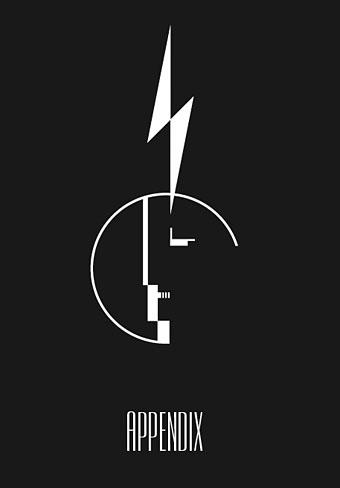
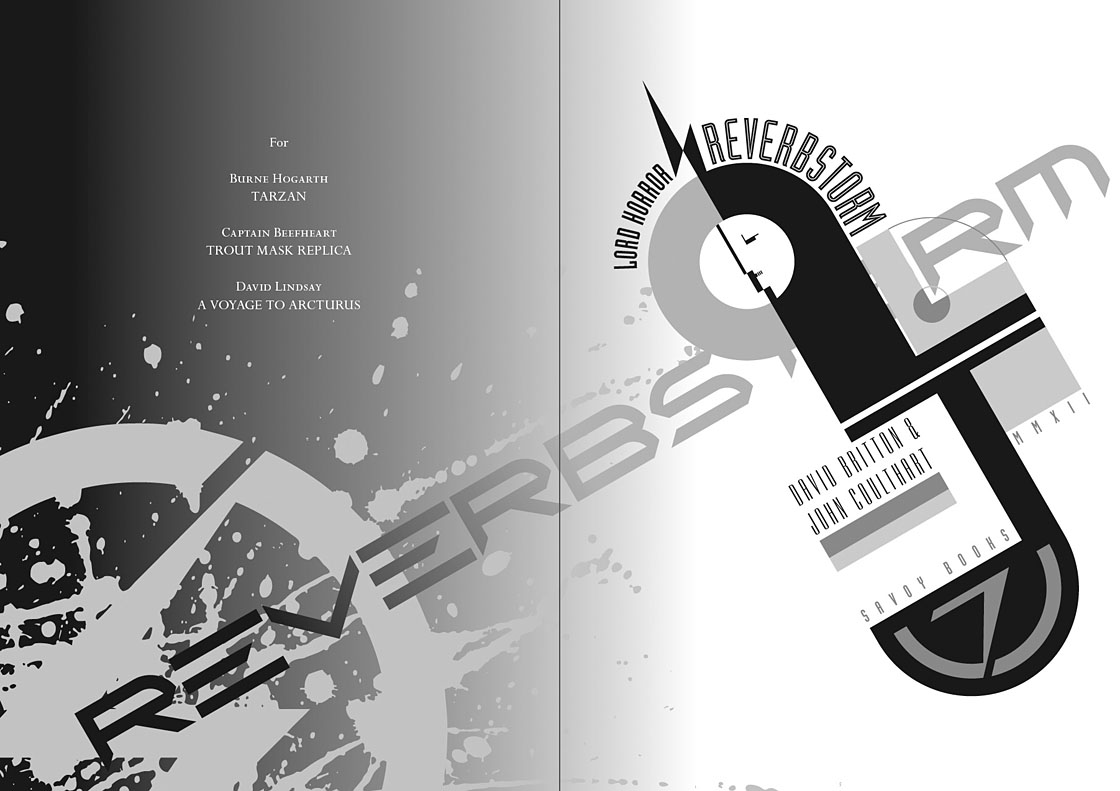
Reverbstorm title page.

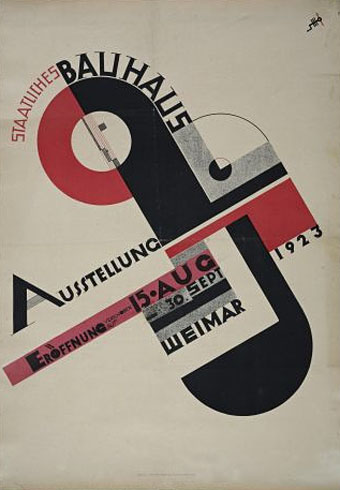
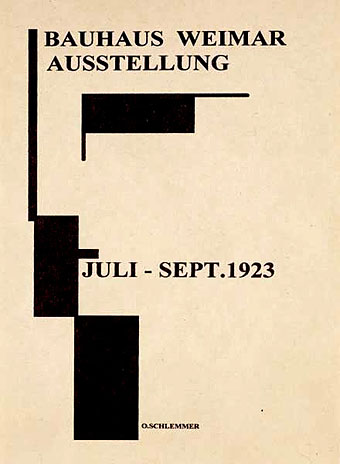
The title page is the most flagrant Bauhaus appropriation, a swipe worthy of Peter Saville at his plundering height. Joost Schmidt’s famous Bauhaus-Ausstellung poster is reworked with a Neville Brody typeface (Industria) and with Oskar Schlemmer’s face logo turned into a scowling profile.

On a typographic note, Industria was used right from the start with Reverbstorm since Brody designed it in the Thatcherite 1980s as a deliberate harking back to the authoritarian 1930s. It also has a very appropriate name. The other typefaces used in the book—Morris Fuller Benton’s Empire and Eric Gill’s Perpetua—date from 1937 and 1928 respectively.
reverbstorm3.jpg

Joost Schmidt (1923).

reverbstorm4.jpg

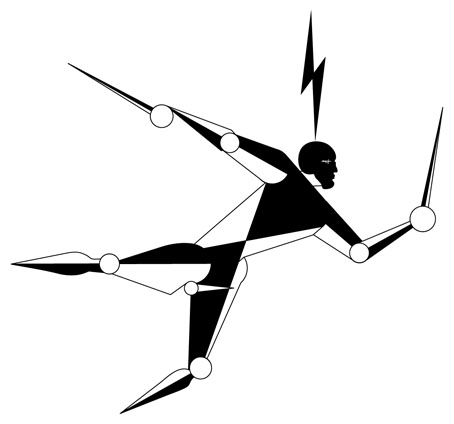
The reworked Oskar Schlemmer face/logo as it appears on the Appendix page. The lightning flash in Reverbstorm has multiple associations: adapted initially from the symbol used by Oswald Mosley’s British Union of Fascists (a symbol also appropriated at various times by David Bowie and Throbbing Gristle) it can also relate to storms, radio broadcasts and electricity in general. Here it becomes a minimal cipher representing Horror’s outrageous plume of hair.
reverbstorm5.jpg

Oskar Schlemmer (1923).

reverbstorm6.jpg

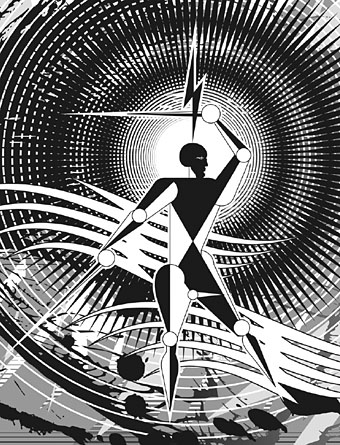
Reverbstorm, part 8.

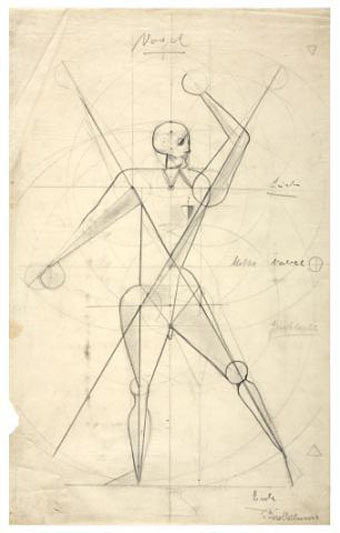
In part 8 of Reverbstorm Horror ends up naked inside “a Soul” (don’t ask), and we see his figure juxtaposed against a series of backgrounds that recapitulate earlier aspects of the narrative. It was always the intention to end the series with a change of style so I did this by creating a kind of digital maquette figure using vector shapes that could be posed in a variety of ways. The origin of the figure was a sketch by Klaus Barthelmess, one of the students in Oskar Schlemmer’s drawing class. The sketch below appeared in a slightly altered form in issue 5 of the original publications but I always felt more could have been done with it: a posable figure turned out to be the perfect solution. By coincidence, while I was working on the final pages, Clive Hicks-Jenkins had been running a maquette exhibition on his blog. I was tempted to offer my example but a combination of too much work and a reluctance to throw Lord Horror’s obscene and reprehensible presence into the mix put paid to that. Besides which, my figure is a digital creation, not a bona fide paper cut-out.
reverbstorm7.jpg

Drawing by Klaus Barthelmess (1922).

For those who want more Bauhaus design, the Barbican in London is currently staging a major exhibition, Bauhaus: Art as Life, that will run throughout the summer.

Previously on { feuilleton }
Reverbstorm: an introduction and preview
Weekend links 95

skidoo.jpg

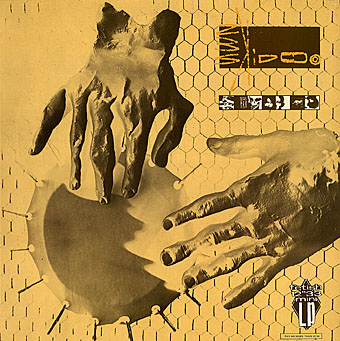
Seven Songs (1982) by 23 Skidoo. Sleeve by Neville Brody.

The first volume of The Graphic Canon will be published in May by Seven Stories Press, a collection of comic strip adaptations and illustrations edited by Russ Kick. The anthology has already picked up some attention at the GuardianWestern canon to be rewritten as three-volume graphic novel—and Publishers’ WeeklyGraphic Canon: Comics Meet the Classics. I know someone who’ll bristle at the lazy use of “graphic novel”. The Graphic Canon isn’t anything of the sort, it’s a three-volume voyage through world literature presented in graphic form with a list of contributors including Robert Crumb, Will Eisner, Molly Crabapple, Rick Geary, and Roberta Gregory. My contribution is a very condensed adaptation of The Picture of Dorian Gray that will appear in volume 2. More about that closer to the publication date.

• LTM Records announces a vinyl reissue for Seven Songs (1982) by 23 Skidoo, an album produced by Ken Thomas, Genesis P Orridge & Peter Christopherson that still sounds like nothing else. Related: an extract from Tranquilizer (1984) by Richard Heslop, cut-up Super-8 film/video with audio collage by 23 Skidoo.

• New exhibitions: Another Air: The Czech–Slovak Surrealist Group, 1991–2011 at the Old Town City Hall, Prague (details in English here), and Ed Sanders – Fuck You / A Magazine of the Arts 1962–1965 at Boo-Hooray, NYC.

• “…we have a situation where the banks seem to be an untouchable monarchy beyond the reach of governmental restraint…” Alan Moore writes for the BBC about V for Vendetta and the rise of Anonymous.

Announcing Arc: “a new magazine about the future from the makers of New Scientist“. Digital-only for the time being, as they explain here. Their Tumblr has tasters of the contents.

• From another world: Acid Mothers Temple interviewed. Also at The Quietus: Jajouka or Joujouka? The conflicted legacy of the Master Musicians.

• More from Susan Cain on introverts versus extroverts. Related: Groupthink: The brainstorming myth by Jonah Lehrer.

Ten Thousand Waves, an installation by Isaac Julien.

Afterlife: mouldscapes photographed by Heikki Leis.

• The book covers of Ralph Steadman. And more.

• “James Joyce children’s book sparks feud

Arkitypo: the final alphabet.

Book Aesthete

Kundalini (1982) by 23 Skidoo | Vegas El Bandito (1982) by 23 Skidoo | IY (1982) by 23 Skidoo

The Crackdown by Cabaret Voltaire

crackdown1.jpg

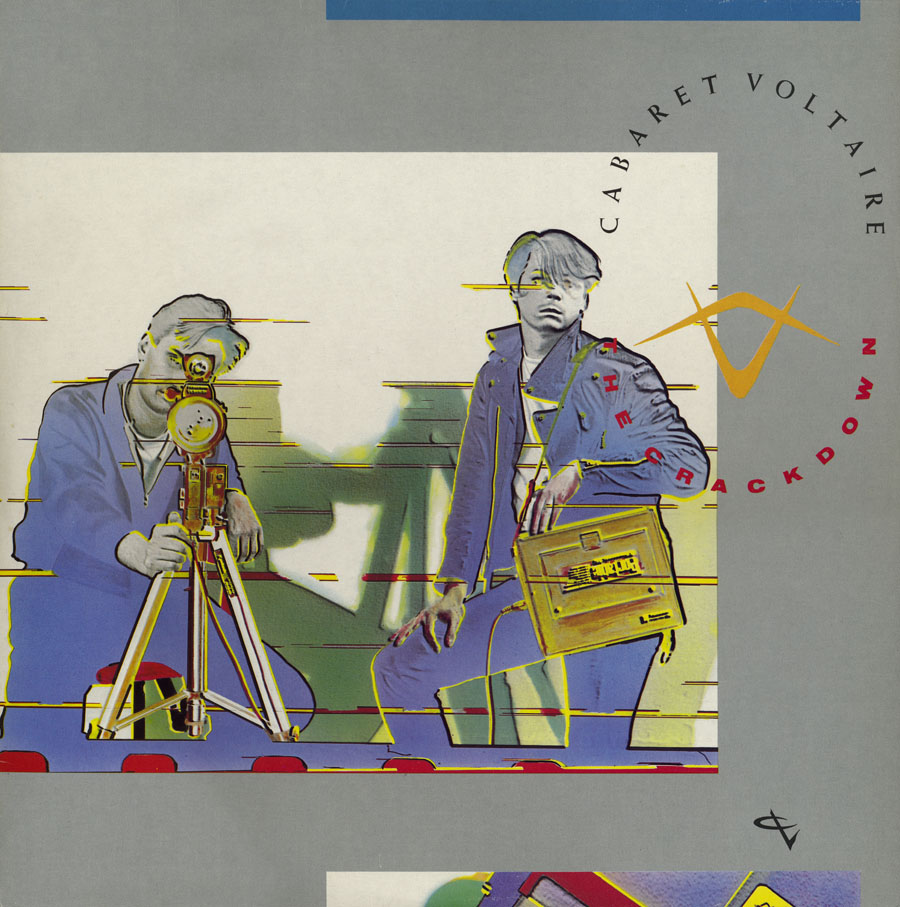
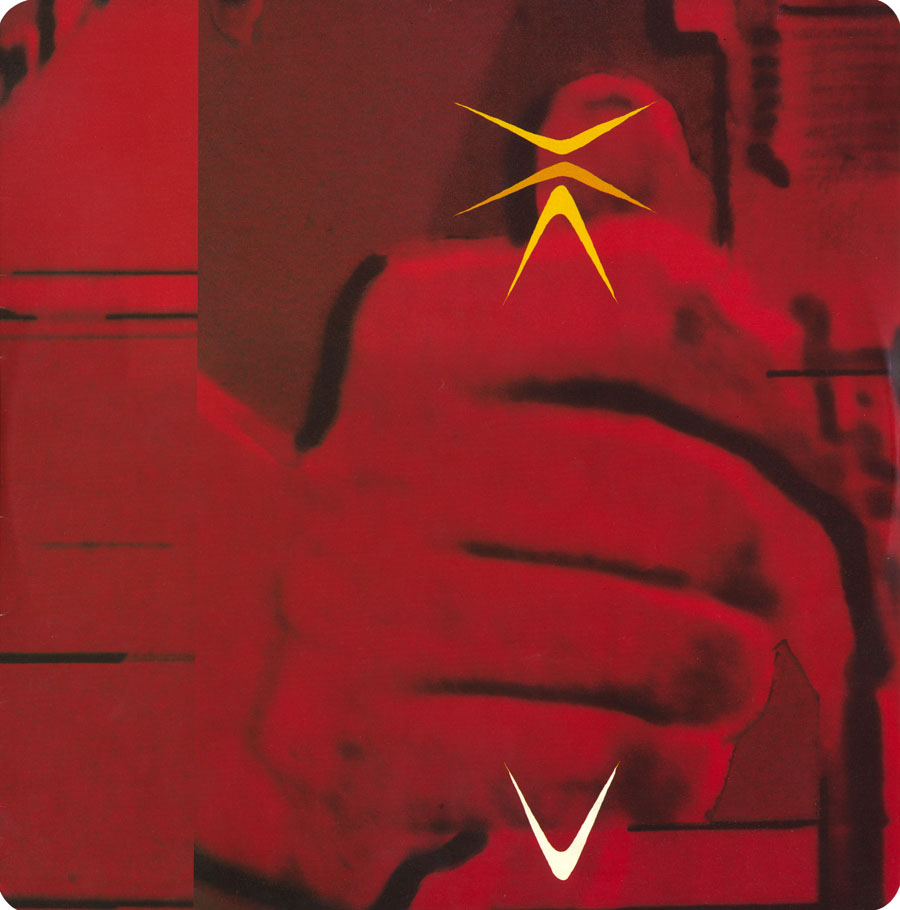
I mentioned yesterday Richard H. Kirk’s announcement that Cabaret Voltaire’s albums on the Virgin label are to be reissued next year by Mute Records. The news gives me a topical excuse to write something about the first album in that series, The Crackdown, which happens to be my favourite of all their releases. Cabaret Voltaire, like 23 Skidoo, benefited a great deal from their association with designer Neville Brody in the early 1980s, and this post mostly concerns Brody’s design for The Crackdown and its accompanying singles. The Crackdown was released in 1983 with the advance from Virgin having allowed them to buy new equipment and add a degree of polish to their recordings which earlier albums had lacked. Brody had been designing their covers for the past two years, and continued to do so for the next few releases before leaving the music business to concentrate on magazine and other design work.

crackdown2.jpg

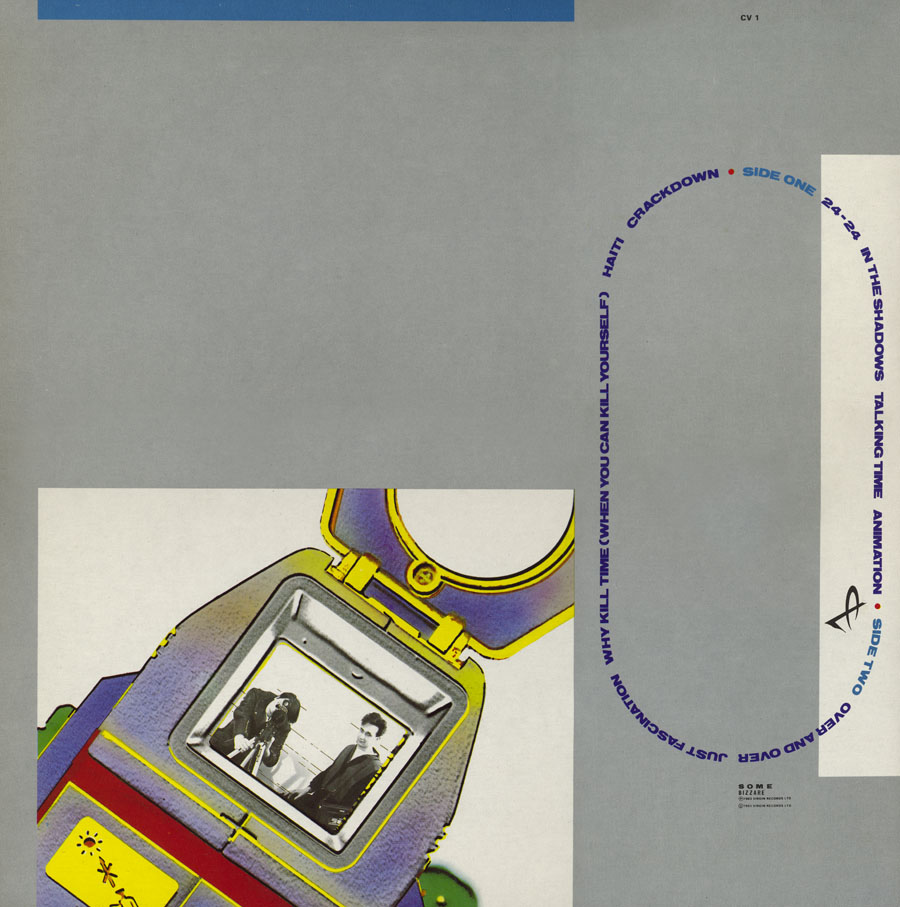
What I liked about this sleeve was the way it gets the most out of the careful arrangement of a few simple elements. The front photo showing Stephen Mallinder and Richard Kirk posing with video equipment (monitoring the viewer) is enlarged and cropped to provide backgrounds elsewhere. The sleeve photos wrap around front and back while the shape made by the titles determines the layout of track titles and credits. (The various CV graphics are credited to Phil Barnes.) The type wasn’t set digitally but was applied by hand using Letraset rub-down lettering which makes me wonder how much planning was required to get the track titles to perfectly fit their intended shape.

crackdown3.jpg

Continue reading “The Crackdown by Cabaret Voltaire”

Weekend links 79

brody-va.jpg

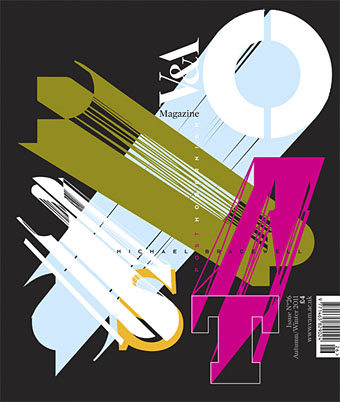
Neville Brody creates a cover design for an issue of the V&A magazine tied to the museum’s current exhibition, Postmodernism: Style and Subversion 1970–1990. Brody’s comment amused me for the way he smartly explained the thinking behind the design whilst also distancing himself from its theme:

For me, Post Modernism felt like a kind of facade built to cover over the cracks of a divided world, a surface of plucked effects and stylistic devices emptied of meaning, an extrusion of hollow traces and flat outlines forcing 2D into apparent depth. I was never a Post Modernist, rather a Modernist exploring humanist lines of enquiry in the collapsing world behind a wall of decoration.

• It’s a common thing today to give images from the past a queer reappraisal, finding homoerotic qualities in pictures which, when they were made, would have seemed free of any sexual subtext. This post finds such a subtext in recruitment posters for US armed forces although none of the examples are as overt as this wartime magazine ad. Over at Front Free Endpaper Callum notes that many vintage photos which people regard today as evidence of gay relationships are unlikely to be quite that. The photo he posts, however, really does appear to show a pair of men who were more than just good friends.

• A play by Ororo Productions of HP Lovecraft’s The Dunwich Horror will be staged at the London Horror Festival from October 25th. Related: Horror Made Delightful: The Strange Stories of Sheridan Le Fanu, MR James, and Robert Aickman. “Aickman never spells out his meaning,” says Greer Mansfield, “His stories end abruptly and inconclusively, and in fact the ‘meaning’ is less important than the utter mysteriousness of what happens.” Which is just what some of us enjoy.

deville.jpg

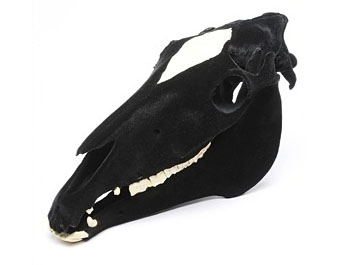
Black Beauty, a decorated horse skull by Julia deVille.

• “Jackpot is a comedic short film about a 14-year-old gay boy in 1994 who sets off on a quest to find a stash of gay porn and get it home before anyone finds out.” Director Adam Baran is requesting completion funds at Kickstarter.

Gendai Shogyo Bijutsu Zenshu (The Complete Commercial Artist), published in Tokyo from 1927 to 1930.

Ishac Bertran tries some analogue sampling by chopping up vinyl discs with a laser cutter.

Steve Jobs does LSD and The Residents pay tribute to Steve Jobs.

• A rare post at Ballardian: Outpost 13: The Atrocity Exhibition.

• It’s all fun and games until Charles Manson turns up…again.

The Edgar Allan Poe Portfolio (1976) by Berni Wrightson.

• RIP David Bedford and Bert Jansch.

John Waters: Roles of a Lifetime.

Octopi Wall Street!

Homocomix.

Poison (1969) by Bert Jansch | Pentangle at the BBC (1970): Train Song | House Carpenter | Hunting Song | Light Flight

William Burroughs interviews

bunker.jpg

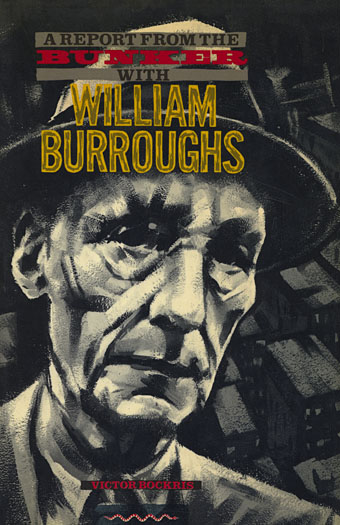
With William Burroughs: A Report from the Bunker (1982) by Victor Bockris. Design by Neville Brody.

If it’s interviews you want, some of the most entertaining are in Victor Bockris’s collection of conversations between El Hombre Invisible and the various New York notables ferried round to sit at Burroughs’ table in his Bowery Bunker. The British edition published by Vermilion was always preferrable for its Neville Brody cover design beside which the US original looks very dull indeed. The encyclopedic Burroughs site Reality Studio has copious lists of earlier Burroughs interviews. They also note the occasions when he put on his journalist hat and went out to interview someone equally famous, usually at the behest of a music magazine. A couple of those pieces are online thanks to the diligence of various fans.

diamond_dogs.jpg

Diamond Dogs (1974), a blend of Lou Reed, George Orwell and William Burroughs.

One such is the 1974 interview with David Bowie for Rolling Stone in which Bowie discusses Burroughs as an influence while Burroughs informs the singer that the heroes of his latest novel, The Wild Boys, favour the Bowie knife as a weapon:

Bowie: Nova Express really reminded me of Ziggy Stardust, which I am going to be putting into a theatrical performance. Forty scenes are in it and it would be nice if the characters and actors learned the scenes and we all shuffled them around in a hat the afternoon of the performance and just performed it as the scenes come out. I got this all from you Bill… so it would change every night.

burroughspage.jpg

A year later Burroughs got together with Jimmy Page for Crawdaddy magazine where the discussion circles around some of the same subjects, notably the writer’s obsession with sound as a weapon. There’s also this comment from Burroughs which is the kind of thing that always gets my neurons firing:

Antony Balch and I collaborated on a film called Cut-Ups, in which the film was cut into segments and rearranged at random. Nicolas Roeg and Donald Cammell saw a screening of the film not long before they made Performance.

Roeg later directed Bowie, of course, and is one of the dinner guests in With William Burroughs, while Jimmy Page and Donald Cammell both appear in Kenneth Anger’s Lucifer Rising. The connections go round and round… Read the whole piece in a post I made a few years ago at the late, lamented Arthur magazine site.

Elsewhere on { feuilleton }
The William Burroughs archive