Rex Ingram’s The Magician

magician1.jpg

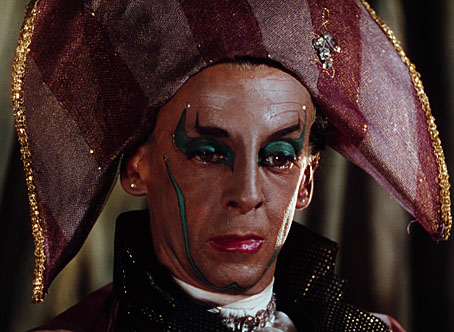
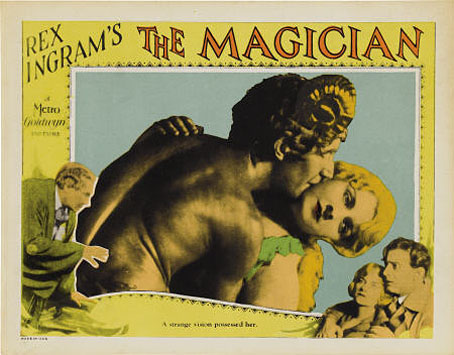
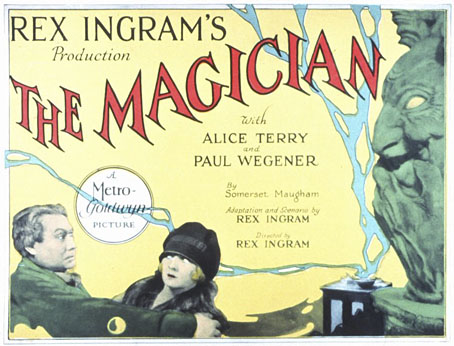
The Magician (1926), Rex Ingram’s curious occult horror film, receives a rare screening with live music accompaniment at the Brighton Fringe Festival on Tuesday, 22nd May. The film is notable for being based on the 1908 Somerset Maugham novel of the same name whose modern-day magus character, Oliver Haddo, was modelled on Aleister Crowley. The screening will feature an introduction by Gary Lachman, and a live soundtrack by the fabulous Ragged Ragtime Band, featuring members of Blondie, Indigo Octagon, Raagnagrok and Time. Booking details and other information here.
magician2.jpg

Maugham’s book has always been easier to find than Ingram’s film, more’s the pity when the film—despite some flaws—is the superior article. Read today, the novel comes across as a template for the standard Dennis Wheatley tale of middle-class innocents imperilled by grandiloquent villainy. A young couple, Arthur Burdon and his fiancée, Margaret, are pitted against Haddo’s extravagant diabolisms; for assistance they have a friend, Dr Porhoët, a Van Helsing type, older than the couple and with a convenient (but purely intellectual) interest in the occult. Haddo kidnaps Margaret and forces her with hypnosis into an unconsummated marriage. Haddo’s goal is to create artificial life—homunculi—and for that he requires a virgin’s blood. Maugham later described his novel as “lush and turgid”, an honest and accurate appraisal. Aleister Crowley was amused at being portrayed as a “Brother of the Shadows” but pretended to be scandalised by Maugham’s alleged plagiarism which he condemned in a Vanity Fair review that he signed “Oliver Haddo”. The best parts of the novel certainly owe something to other authors, usually the scenes concerning the sinister magus and his occult activities; the rest of the characters are lifeless by comparison. Some of the better passages read like HP Lovecraft writing Dorian Gray, and Maugham not only quotes from Walter Pater but also (uncredited) from Wilde’s Salomé.
magician4.jpg

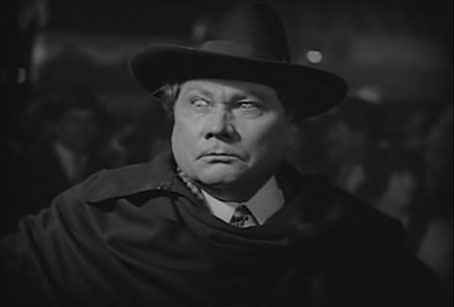
Paul Wegener as Oliver Haddo.
Continue reading “Rex Ingram’s The Magician”

Leslie Megahey’s Bluebeard

bluebeard01.jpg

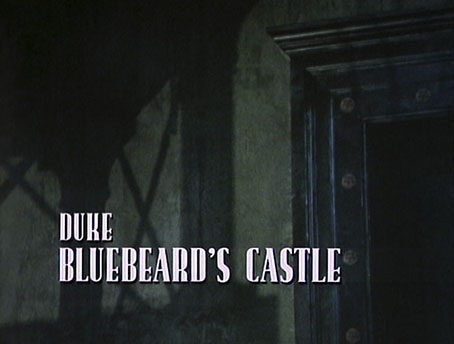
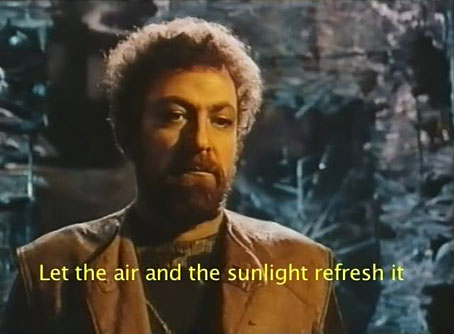
Back in the days when the BBC’s television output challenged its audience rather than pandered to it, Leslie Megahey was a name I always looked out for. During the 1970s and 80s, Megahey was one of the corporation’s outstanding producers and directors, and since his tastes often ran very close to mine seeing his name in a magazine listing was an alert for some essential viewing. Favourite Megahey documentaries would include his Omnibus film about (and interview with) György Ligeti in 1976, and the two-part Arena special about Orson Welles in 1982 that persuaded the director to talk at length for the first time about his career. Megahey’s arts films included drama documentaries about the French painters David and Gericault, and two dramas with painting themes, Cariani and the Courtesans (1987), and Schalcken the Painter (1979), the latter being an exceptional adaptation of the Sheridan Le Fanu ghost story. Duke Bluebeard’s Castle was one of the last of his BBC films, an adaptation of the Bartók opera that had this Bartók obsessive hopping with delight when it was screened in 1988.

bluebeard02.jpg

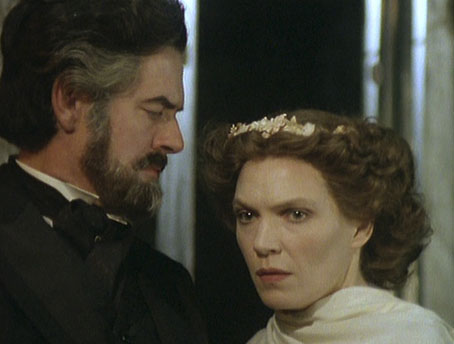
Bluebeard and Judith.

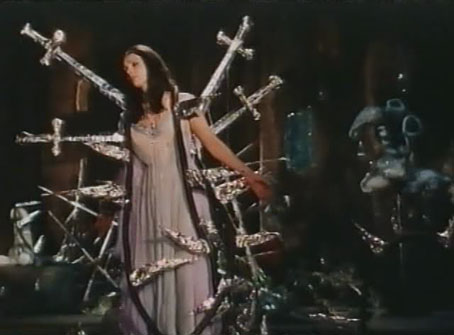
Bartók’s only opera was written in 1911, and is easier to adapt than most, being a single act of an hour or so in length with only two performers, Bluebeard (bass) and Judith (soprano). Given this it’s surprising there haven’t been more filmed versions. I wrote something a while back about the seldom-seen Michael Powell version; then there’s a version from 1981 by Miklos Szinetár scored by the London Philharmonic Orchestra with Georg Solti conducting. Megahey’s film also features the London Philharmonic with Adam Fischer conducting. Robert Lloyd and Elizabeth Laurence are the performers.

bluebeard03.jpg

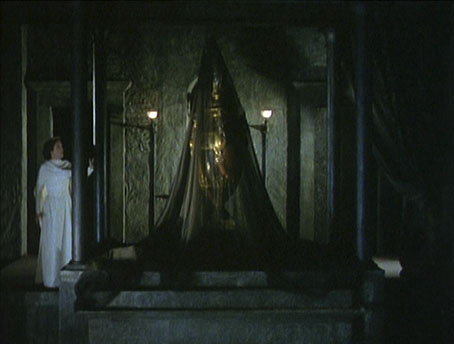
The libretto by Béla Balázs turns the old fairy tale into a psychodrama that’s also one of the first post-Freud operas, with the audience being asked in the prologue “Where is the stage? Is it outside, or inside?” Judith is ushered into the castle by Bluebeard to find seven locked doors: her curiosity and her demands to discover what lies behind the doors (or inside the mind of her husband-to-be) seals her fate. In some of the fairy tale versions the brothers of the bride arrive at the last moment to rescue their sister; not so here.

Continue reading “Leslie Megahey’s Bluebeard”

Weekend links 87

scott.jpg

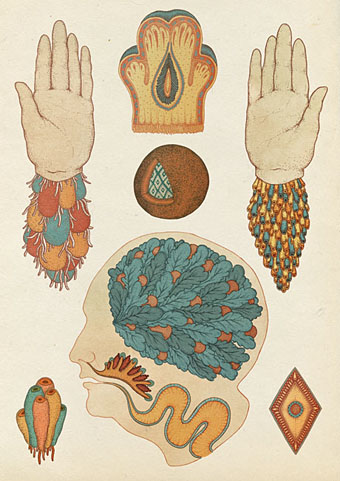
Untitled art by Katie Scott.

“…the very fact that people cannot get published by the big-name publishers in the way that they used to has meant that you’ve got some really interesting and often really beautiful little small publishing houses that are springing up and coming into existence. And the stuff that they’re providing is actually a lot better. I’m thinking of people like Tartarus Press, Strange Attractor and various other commendable small publishers that do a beautiful job and that are producing books that are good to have on your bookshelf.”

Alan Moore discussing books old and new in a lengthy interview at Honest Publishing. In part two he takes to task hardboiled moron Frank Miller and offers his thoughts on the Occupy movement. Elsewhere the Guardian finally paid some attention to the importance of design in the book world. Some of us who do this for a living have been saying for years that if publishers want to see physical books thriving they need to maintain (or improve) the quality of their design and materials. Related: The Truth About Amazon Publishing, Laura Hazard Owen at paidContent examines some the figures behind Amazon’s PR.

• “Tenniel argued for several changes to the characters as conceived by Carroll. The croquet mallets are ostriches in the original drawings, and the hoops are footmen bent over with the tails of their coats hanging down over their bottoms like an animal’s. Tenniel left them out. He told the author that a girl might manage a flamingo, but not an ostrich.” Marina Warner again on John Tenniel, Lewis Carroll and the Alice books.

schoeler.jpg

Untitled painting by Christian Schoeler who was interviewed for a second time at East Village Boys.

Shamanism and the City: Psychedelic Spiritual Tourism Comes Home and Scientists finding new uses for hallucinogens and street drugs. Related: LSD – A Documentary Report (1966), “a totally new kind of record album”.

• More books: Interview with a Book Collector. Mark Valentine, author, biographer and editor was also the co-publisher in 1988 of my adaptation of HP Lovecraft’s The Haunter of the Dark.

• The Priapus Chandelier “features six hand-sculpted phalluses cast in translucent resin, which radiate an atmospheric light.”

Stewart Lee on Top Gear, in which the comedian and Dodgem Logic contributor eviscerates the BBC’s pet trolls.

• The Beinecke Rare Book and Manuscript Library put the Voynich Manuscript online.

• The 432-page SteamPunk Magazine collection with my cover art is now on sale.

Hubble, Bubble, Toil & Trouble: The Haxan Cloak Interviewed

• The Sunn O))) chapter of The Electric Drone by Gilles Paté.

Colonel Blimp: The masterpiece Churchill hated

Submergence (2006) by Greg Haines | Reyja (2011) by Ben Frost & Daníel Bjarnason | The Fall (2011) by The Haxan Cloak.

Powell’s Bluebeard

bluebeard1.jpg

The subject of yesterday’s post, The Tales of Hoffmann, was the closest Michael Powell came to realising his concept of the “composed film”, a work intended to combine performance, music, lighting and set design thereby creating something which was unique to cinema. The central ballet sequence in The Red Shoes is another example of this, and Powell & Pressburger had plans to follow Hoffmann with similar works, including something based on The Odyssey that would have had contributions from Igor Stravinsky and Dylan Thomas. Their plans didn’t work out, unfortunately, Hoffmann was less successful than was hoped and the Archers partnership was eventually reduced to making dull films about the Second World War until P&P went their separate ways. The scandal of Peeping Tom in 1960 finished Powell’s career as a filmmaker in Britain, but he managed to return to the composed film concept in 1963 when production designer Hein Heckroth asked him to direct a production of the Bartók opera Bluebeard’s Castle for German television. Heckroth was responsible for the distinctive character of the later Archers films, including The Red Shoes and Tales of Hoffmann, but was working here with greatly reduced resources. Being a great Bartók enthusiast as well as a Powell aficionado it’s long been a source of frustration for me that this hour-long film is one of the least visible from Powell’s career. To date, the stills shown here are about the only visuals one can find.

bluebeard2.jpg

Bluebeard: Norman Foster.

Bluebeard’s Castle was Bartók’s only opera, a tremendous work and a lot easier to digest than some being a one-act piece for two singers: bass (Bluebeard) and soprano (Judith, his wife-to-be). The fairy tale of the murderous husband is turned into a psychodrama with Judith’s successive opening of the castle’s seven doors revealing more than she wants to know about her suitor’s personality. The libretto by Béla Balázs drops the last-minute rescue of the heroine by her brothers for a darker conclusion. The simple storyline and pronounced symbolism—the doors are often given different colours, while the rooms to which they lead each have a symbolic decor and import—lends itself to a variety of interpretations. Needless to say I’d love to see how Heckroth and Powell presented the drama. To whet the appetite further, one of the P&P sites has this account of a recent screening.

bluebeard3.jpg

Judith: Ana Raquel Sartre.

There are many other filmed versions of this opera, of course, and YouTube has the usual motley selection chopped into opus-ruining ten-minute segments. The BBC screened a fantastically gloomy version in 1988 by Leslie Megahey, director of many fine TV documentaries including the major Orson Welles edition of Arena in 1982 and a chilling adaptation of Sheridan Le Fanu’s Schalcken the Painter. His Bluebeard has been released on DVD in the US, and YouTube has an extract here.

Previously on { feuilleton }
The Tale of Giulietta
Diaghilev and the Ballets Russes
Béla Bartók caricatured

The Tale of Giulietta

hoffmann01

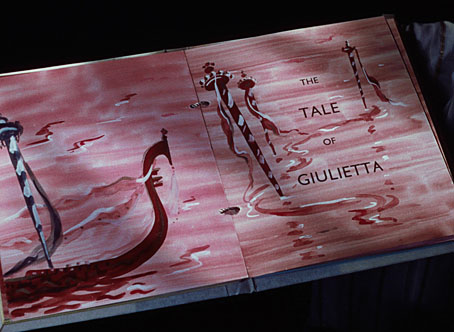
Watching Powell and Pressburger’s The Tales of Hoffmann (1951) again at the weekend it occurred to me that the second act, The Tale of Giulietta, is the closest British cinema gets to the extravagant weirdness of Fellini Satyricon. Or it was until Velvet Goldmine… Lavish costumes and artificial decor, feasts, orgies, lust, betrayal, sorcery, a duel…it’s all there, even a spot of androgyny if you count Pamela Brown’s role as Nicklaus.

• Ludmilla Tchérina as Giulietta
• Robert Helpmann as Dapertutto
• Robert Rounseville as Hoffmann
• Léonide Massine as Schlemil
• Pamela Brown as Nicklaus

If this is on YouTube I don’t want to know. Do the artists a favour, watch their work on DVD.

hoffmann02

Continue reading “The Tale of Giulietta”