Illustrating Frankenstein

holst.jpg

Frontispiece by Theodore Von Holst of the 1831 edition of Frankenstein. The monster in this illustration, which Mary Shelley would no doubt have seen, is closer to the description in the text than the myriad shambling figures that came later.

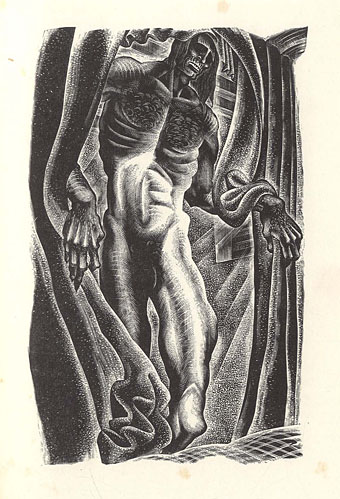
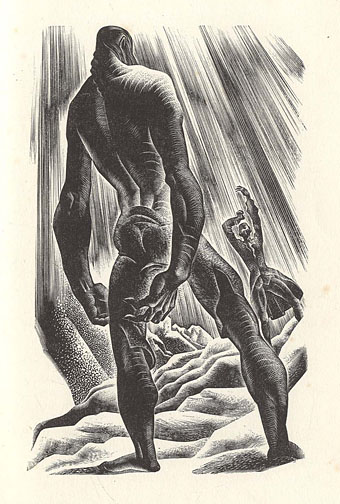
It’s a recurrent feature of commissioned work that you sometimes find yourself illustrating novels or stories you might otherwise have never attempted. Spanish publisher Editorial Alma have just added a new edition of Mary Shelley’s Frankenstein to their series of illustrated classics, convenient timing with this year being the bicentenary of the book’s first publication. Last year I produced 33 illustrations for Alma’s collection of Poe stories, as well as 3 new illustrations for a small Lovecraft collection. For their edition of Frankenstein I’ve created 24 full-page pictures, one for each chapter. (I produced 25 in total, 24 for the chapters and one for the letters at the front, but the Spanish translation is arranged slightly differently so one of the drawings has been omitted.) In the past I’ve given little consideration to illustrating classic books, preferring to look for subjects which were less familiar. Frankenstein is a book that isn’t illustrated as much as some but Lynd Ward in 1934, and Berni Wrightson in 1977/78 both produced sufficiently exceptional sets of drawings for me to regard the novel as almost unassailable. Until last year, that is.
ward1.jpg

Frankenstein by Lynd Ward (1934).

Despite such formidable predecessors, I felt that with this book at least I might be able to offer something new using the blend of collage and drawing that I’ve been evolving recently. There was additional promise in that the story as it’s written is less familiar than the Poe stories, and much less familiar than its fellow horror classic, Dracula. People think they know Frankenstein but what they often know is the manglings the novel has received in various film and TV adaptations. The Ward and Wrightson illustrations stay close to the text, the latter being replete with period detail, and rendered in a style reminiscent of 19th-century wood engravings. Wrightson even copied two of Gustave Dore’s pictures from The Rime of the Ancient Mariner for the opening scenes on the ship, one of which went unused. But Wrightson’s drawings are closer still to Franklin Booth‘s pen-and-ink style which was also derived from wood engraving yet which achieves its effects in a different manner to the engraving process.
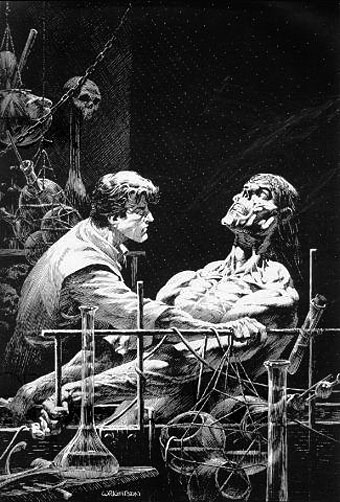
frankenstein2.jpg

Frankenstein by Berni Wrightson (1977/78).

Even when artists follow the text of Frankenstein more closely than the screenplay adapters, personal tastes can’t help manifest themselves. So Ward’s drawings reflect the angular and stylised compositions of his “novels in woodcuts”, while Wrightson’s work still shows evidence of his earlier career as a comic artist. With my illustrations I wanted to reflect the artistic spirit that gave birth to the novel, namely Romanticism. Frankenstein is very much a Romantic tragedy with violent passions set against the overwhelming landscapes of the Swiss Alps, the Rhine valley and the Arctic seas. Three of the illustrations below allude to Caspar David Friedrich’s paintings, while many of the others have had their mundane cloudscapes exchanged for gloom and tumult.

I’ve said before that one of the things I enjoy about the collage technique is being able to use engravings and other graphics from the same period (give or take a few decades) as the story itself. The disadvantage of relying on pre-existing sources is that you’re always limited by the available material, so recently I’ve been pushing the technique further to achieve a hybrid style, something midway between the Ernst/Sätty engraving-collage technique and the very laborious, heavily-shaded pen-and-ink style I used when I was drawing comics. The approach isn’t so different to the one I used in my Lovecraft comics many of whose backgrounds and other details were copied from photographs. The difference is that where I used to spend several days working on a single panel (and two weeks working on a page) I can now create an entire picture in half the time. In these new illustrations I feel the hybrid style is working as I intended, allowing me greater freedom to create the picture I have in mind rather than a picture dictated by the source material. Without incorporating original figures and other drawn elements into the compositions it would have been difficult to illustrate a story with the same characters in so many scenes, a problem I encountered when I was illustrating Lewis Carroll’s Alice books and ran out of pictures of Victorian girls.

The full run of pictures follows below, including the one which was omitted from the print edition. All may be seen at a larger size here. Since the scenes aren’t always self-explanatory I’ve included fragments of text from each chapter.
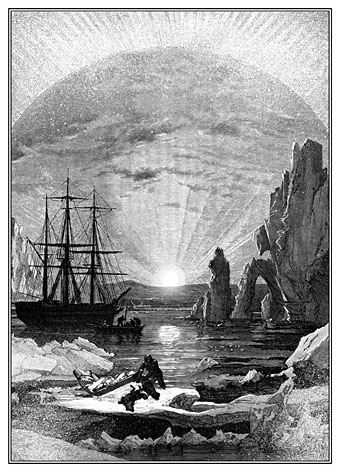
frankenstein00.jpg

“In the morning, however, as soon as it was light, I went upon deck and found all the sailors busy on one side of the vessel, apparently talking to someone in the sea. It was, in fact, a sledge, like that we had seen before, which had drifted towards us in the night on a large fragment of ice.”
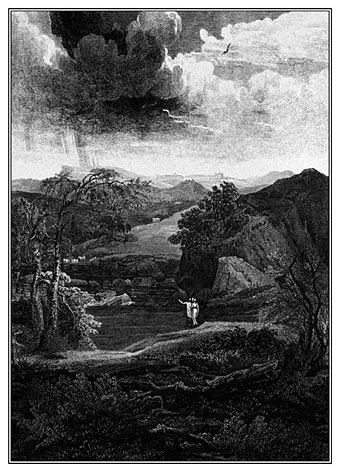
frankenstein01.jpg

“During one of their walks a poor cot in the foldings of a vale attracted their notice as being singularly disconsolate, while the number of half-clothed children gathered about it spoke of penury in its worst shape.”

This one was omitted from the Alma edition. No loss, really, since the scene doesn’t add much to the story.
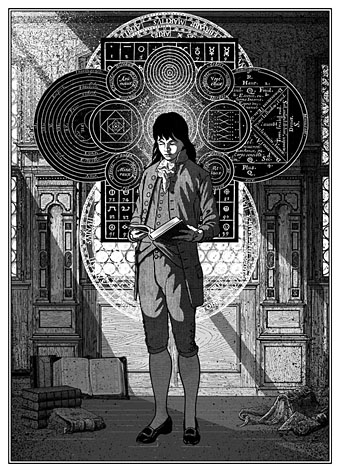
frankenstein02.jpg

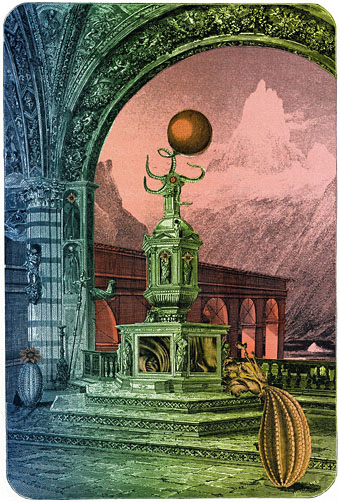
“When I returned home my first care was to procure the whole works of this author, and afterwards of Paracelsus and Albertus Magnus. I read and studied the wild fancies of these writers with delight; they appeared to me treasures known to few besides myself.”

The diagrams here are taken from some of the books the young Victor Frankenstein is reading. There’s an allusion to this in the magic square on the wall in the back of Theodore Von Holst’s frontispiece, the square being the kind of thing seen in books like this one by Cornelius Agrippa, one of the occult philosophers mentioned in the novel.
Continue reading “Illustrating Frankenstein”

Weekend links 394

coin.jpg

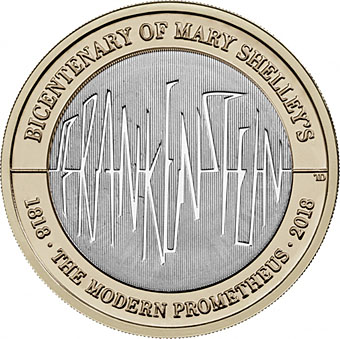
Britain’s Royal Mint acknowledges this year’s bicentenary of the publication of Frankenstein with a commemorative £2 coin.

• A trailer for The Green Fog, a film by Guy Maddin, Evan Johnson and Galen Johnson, which uses clips from over 200 films set in and around San Francisco to create a collage companion to (and critique of) Alfred Hitchcock’s Vertigo. John DeFore reviewed the film for The Hollywood Reporter.

• Downloadable sound files and utilities for the Fairlight Computer Musical Instrument. Should you require it, the file containing the orchestra stab that was a feature of so much pop music in the 1980s is ORCH5. (Click on the “Library/Disk” listing then click “Extract” to download the samples.)

• Radio at the Internet Archive: the BBC adaptations of Mervyn Peake’s Titus Groan and Gormenghast (both adapted by Brian Sibley in 1984); and 554 Sherlock Holmes radio shows.

• Mixes of the week: XLR8R Podcast 523 by Scanner, RA Podcast 605 by Chris SSG, and Secret Thirteen Mix 241 by Jaroska.

• At Discogs: a list of “Experiments, gimmick and concept albums, bands and labels“.

Patrick Cowley The Ultimate Master Megamix

• At Dennis Cooper’s: Karen Black Day.

Events In Dense Fog (1978) by Brian Eno | Fog Animal (2005) by Deaf Center | In The Fog I (2011) by Tim Hecker

Lynd Ward’s Frankenstein

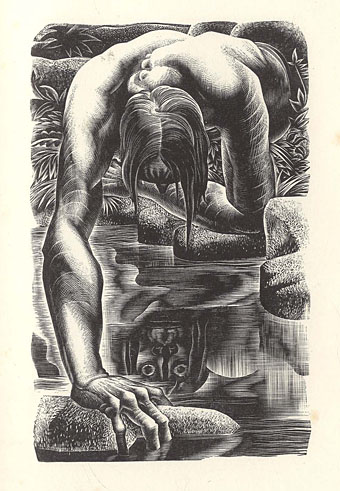
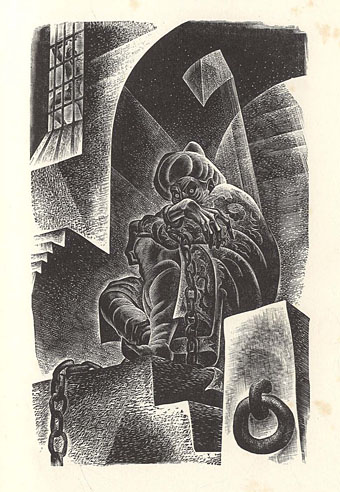
ward1.jpg

Mary Shelley’s novel illustrated in woodcuts by the great Lynd Ward (1905–1985). This edition appeared in 1934, a couple of years after the release of James Whale’s first Frankenstein film whose popularity may have led to its commission. It’s good to see Dover Publications keeping this one in print when first editions go for hundreds of pounds. VTS has more of the illustrations (there’s also this site), and many more examples of Ward’s work.

ward2.jpg

ward3.jpg

ward4.jpg

Elsewhere on { feuilleton }
The illustrators archive

Previously on { feuilleton }
Two Brides
Berni Wrightson’s Frankenstein
Cain’s son: the incarnations of Grendel
Gods’ Man by Lynd Ward

Lovecraft’s Monsters

Lovecraft's Monsters

Graphic for the title page and ends of chapters.

I don’t usually post things so far away from publication, but editor Ellen Datlow put these pictures on her Facebook page a few hours ago so I may as well do the same here.

Back in February I bought a Wacom Intuos drawing tablet, something I’ve been using with regularity for the past few months. The Alas Vegas Tarot cards I designed in the summer were the first major attempt at getting used to working with it; Lovecraft’s Monsters, a forthcoming fiction anthology for Tachyon is the second, and I now feel very comfortable working with it. More than that, I’m increasingly pleased with the way it’s possible to combine the drawing techniques I’ve been using for years with the additional possibilities provided by working in Photoshop. As always, it’s the end result that counts but arriving at an end result can be easy or difficult. Some of these illustrations look no different than they would have done had I used ink on paper but they took half the time to create, a considerable benefit when a deadline is looming.

The stories Ellen Datlow has chosen for this collection all present different aspects of monstrosity seen through the lens of Lovecraft’s fiction and his cosmic menagerie. Some are full-on extensions of the Mythos, others are more allusive; all the pieces bar one have been published before but I’d not read any of them so for me this was fresh material. Having spent the past few years saying I was finished with Lovecraft’s fiction I was excited to be working on this book. The stories are good, and I welcomed the challenge of having to illustrate such a variety of material.

Larger copies of all the pictures can be seen here.

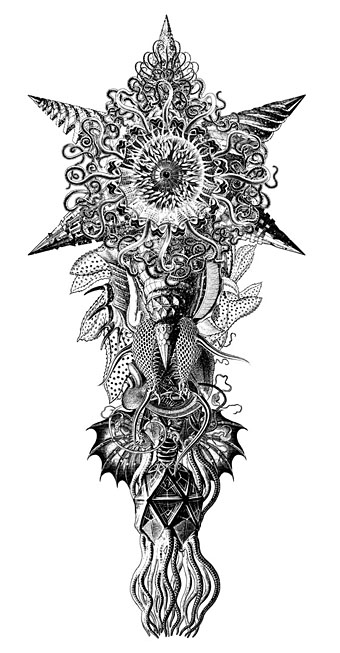
The star-headed thing at the top of this page is another amalgam of elements plundered from Haeckel’s Kunstformen der Natur and other sources. I’ve leaned rather heavily on Haeckel in the past, something I wanted to avoid here; this serves as a kind of visual punctuation separating the stories.

Lovecraft's Monsters

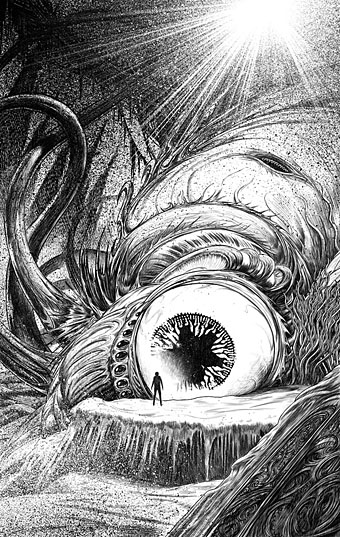
Cthulhu.

The drawing I’ve called Cthulhu is a piece for the introductory pages. Having already produced a lot of Cthulhoid art I didn’t want to repeat myself. The initial idea was of a tiny human figure faced with something enormous and nightmarish; that could be a vast eyeball or it could be a mouth or some other organ/aperture, the vagueness was intentional. Lovecraft continually impresses upon his readers how difficult things are to describe or apprehend but you seldom find this quality in art based upon his stories. Cthulhu especially has devolved into little more than an outsize man-in-a-rubber-suit à la the Creature from the Black Lagoon. In The Call of Cthulhu the figure on the mysterious statuette is described as having a humanoid shape but Lovecraft doesn’t describe the appalling reality in any detail at all. When Cthulhu is struck by a ship at the end of the story it breaks apart and is then seen recombining, the implication being that the creature is corporeally amorphous.

Lovecraft's Monsters

Only the End of the World Again by Neil Gaiman.

Neil Gaiman’s entry concerns a werewolf private detective in Innsmouth. Lovecraft’s decaying fishing village and its inhabitants turn up in several of the stories so care was taken to avoid repetition.

Lovecraft's Monsters

Bulldozer by Laird Barron.

A great story about another detective, a Pinkerton agent this time, hunting his quarry through the Old West. Collin de Plancy’s Dictionnaire Infernal is mentioned so I used some of Louis Breton’s illustrations from the third edition.

Continue reading “Lovecraft’s Monsters”

Weekend links 82

morris.jpg

At the Mountains of Madness (1979) from Halloween in Arkham by Harry O. Morris.

• Golden Age Comic Book Stories always pulls out the stops in the run up to Halloween. In addition to a wonderful collection of Harry O. Morris collages, Mr Door Tree has also been posting Virgil Finlay’s illustrations for Edgar Allan Poe, Lynd Ward’s tremendous illustrations for a collection of weird tales entitled The Haunted Omnibus, Barry Moser’s woodcuts for an edition of Frankenstein, and Virgil Finlay’s illustrations for stories and poems by HP Lovecraft.

• “Eugene Thacker suggests that we look to the genre of horror as offering a way of thinking about the unthinkable world. To confront this idea is to confront the limit of our ability to understand the world in which we live – a central motif of the horror genre. In the Dust of This Planet explores these relationships between philosophy and horror.”

• “…the reader […] becomes a conscious participant in the process of imposing a linear sequence, while at the same time remaining aware that all narrative is an act of memory, and that memory is necessarily random.” Jonathan Coe reviews Marc Saporta’s book-in-a-box, Composition No.1, recently republished by Visual Editions.

• Nearly fifty years after its first performance, Peter Weiss’s Marat/Sade is still disturbing playgoers. And nearly ninety years after its release, Alla Nazimova’s silent film production of Oscar Wilde’s Salomé is touring the UK with live musical accompaniment.

Tom of Sinland at Homotography, in which illustrator Bendix Bauer portrays some of the fashion world’s notable male designers as Tom of Finland-style characters for Horst magazine.

Neil Gaiman Presents is a new audiobook imprint which launches with works by Jonathan Carroll, Alina Simone, Keith Roberts, M. John Harrison and Steven Sherrill.

• The Weird Wild West: Paul Kirchner has put all his Dope Rider comic strips online.

Leonora Carrington prints at Viktor Wynd Fine Art, London, from November 5th.

The Fall to Earth: David Bowie, Cocaine and the Occult.

Photos of New York City, 1978–1985.

Kathy Acker recordings at Ubuweb.

The Occupied Times of London.

The Golden Age of Dirty Talk.

Pushkin silhouettes.

• This week I’ve been lost in the Velvet Goldmine (again): John, I’m Only Dancing (1972) by David Bowie | The Jean Genie (1972) by David Bowie | Drive-In Saturday (1973) by David Bowie.