Weekend links 285

graphic.jpg

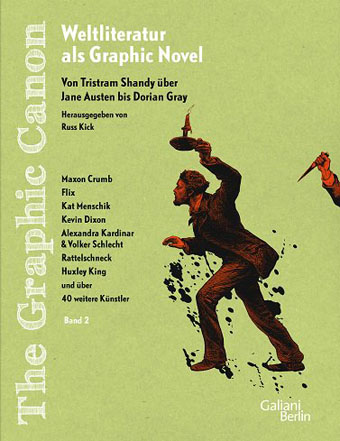
Some of the art from my collage adaptation of The Picture of Dorian Gray appears on the cover of The Graphic Canon: Volume 2, published this month in a German edition by Verlag Galiani. Out next month (although possibly available now) is the same book in a Brazilian edition from Boitempo Editorial. One of the disappointments this year was having to abandon plans to contribute to Russ Kick’s forthcoming graphic canon of crime fiction. I was overstretched during the summer, and what with projects slipping their deadlines and the trip to Providence there wasn’t any time left for other things.

• For those who missed the first edition, a second and final expanded edition of the Penda’s Fen study/celebration The Edge Is Where The Centre Is.

• Whipping up a storm: how Robert Mapplethorpe shocked America; Kevin Moore on the photographer’s Perfect Moment exhibition.

In the best scenario, metaphysical art distributes the work of understanding among cultural traditions and symbolic systems, and it is along these lines that Carrington’s work has been described as a productive combination of Mexican, Egyptian, Hebrew, Celtic, Greek, and Mesopotamian elements. Her paintings, plays, and stories mix the symbols of alchemy, astrology, Tarot, herbalism, magic, witchcraft, and a personal iconography.

Leif Schenstead-Harris on the life, art and fiction of Leonora Carrington

• Mixes of the week: Hieroglyphic Being collects favourite cosmic jazz of the 1970s; NTS Radio presents an hour of Annette Peacock.

• At Kill Your Darlings: Alexandra Heller-Nicholas enthuses about Dario Argento’s delirious masterwork, Suspiria.

Pye Corner Audio releases a new album (only limited vinyl at the moment—boooo!) and remixes Stealing Sheep.

• The Trip Planners: Emily Witt meets the founders behind Erowid, the online drug encyclopedia.

Woven Processional (1985), music on the Long String Instrument by Ellen Fullman.

• “The Paris attacks prove Charlie Hebdo’s critics wrong,” says Dorian Lynskey.

• Photographs by Danila Tkachenko of abandoned Soviet technology.

Come Wander With Me / Deliverance by Anna von Hausswolff.

• The collages of Guy Maddin.

CAN HALEN

Let’s Take A Trip (1965) by Godfrey | Trip On An Orange Bicycle (1968) by The Orange Bicycle | Last Trip (1968) by We Who Are
Temptations

catalogue.jpg

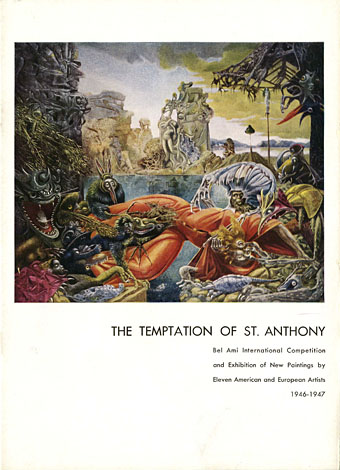
Exhibition catalogue.

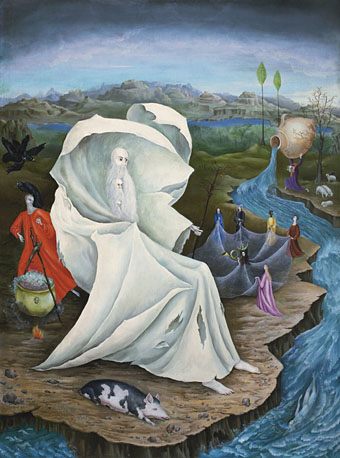
In one of the many recent features about Leonora Carrington I noticed a mention of her Temptation of St Anthony painting from 1945 (see below). This was one of eleven works on the theme submitted by different artists for a competition staged to promote Albert Lewin’s The Private Affairs of Bel Ami (1947), a film adaptation of the Guy de Maupassant novel. Carrington is often mentioned when this competition is discussed, along with the other big names, Max Ernst (the winner) and Salvador Dalí. But you seldom see mention of any of the other competitors, hence this post, an attempt to find all of the competition entries.

carrington.jpg

Leonora Carrington. St. Anthony is often shown with a pig companion but only Carrington depicted the animal for this competition. When asked why the saint had three heads, she replied “Why not?”

Albert Lewin didn’t make many films but he had a predilection for arty subjects, The Private Affairs of Bel Ami being preceded by adaptations of The Moon and Sixpence (1942) and The Picture of Dorian Gray (1945). All three films star George Sanders, and all feature special colour sequences when a painting is revealed. 1945 was the peak of America’s brief infatuation with Surrealism (Hitchcock had Dalí working on Spellbound at this time) so Lewin asked a number of Surrealists to take up the challenge. I was surprised to find that Stanley Spencer was one of the entrants, a name you almost never see in this company; less surprising was Ivan Albright whose painting of the decayed Dorian Gray is one of the highlights of Lewin’s earlier film. Leonor Fini was also asked to take part but she didn’t produce anything. The judges were Marcel Duchamp, Alfred J. Barr, Jr, director of the Museum of Modern Art, and art dealer Sidney Janis. Ernst won a cash prize variously reported as $2500–3000, while the other entrants received smaller sums. The paintings toured the USA and Britain during 1946–7.

As to the film, I can’t say what this is like because it’s one I’ve yet to see but Self-Styled Siren’s witty review goes into some detail. Hollywood apparently had problems with the adult subject matter (Sanders’ character is described as a sexually predatory social climber), and Lewin was forced to tone things down.

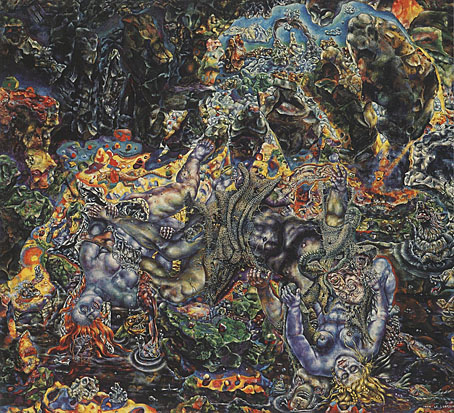
albright.jpg

Ivan Albright.

Albright’s contribution is so frenzied and detailed it approaches psychedelia. Best seen in this large view at Flickr.

Continue reading “Temptations”

Weekend links 255

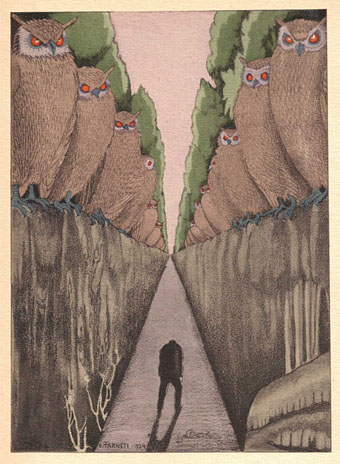
farneti.jpg

The Owls by Carlo Farneti for a 1935 edition of Les Fleurs du Mal. Via Beautiful Century although the scans probably came originally from 50 Watts.

• “…a project that seemed under a curse comprising greed, peculiar French copyright laws, jealousies and grudges, bad judgment, complicated ownership disagreements, a messy estate, and a list of individuals who believed they had some legal, financial, moral, or artistic right to the film itself.” Josh Karp on the tangled history of The Other Side of the Wind, always the most interesting of Orson Welles’ unfinished feature films.

• Producer Conny Plank is remembered for his work with a host of German artists but he also recorded a session with Duke Ellington and His Orchestra in 1970. Grönland Records is releasing the session in July, and they’ve posted Afrique (take 3 vocal) as a taster.

• “And that’s what a lot of social media by authors is starting to look like, to feel like: being smacked in the face, repeatedly, by hundreds of fish.” Delilah S. Dawson wants authors to leave off the incessant self-promotion.

“In everybody, there is an inner bestiary,” she claimed, and her pictures are overrun with animals and animal-headed creatures; sometimes sinister, sometimes acting as guides to the unconscious, as in The Pomps of the Subsoil (1947). As her interests grew more hermetic her paintings abandoned all trace of the world beyond. If the figures occupy any sort of space it’s rarely more than the planes of a room in muted browns or greys, and in many the surface is overlaid with geometric patterns that seem to imply some mystical framework.

Alice Spawls on the art and life of Leonora Carrington

• “How a pro-domme, a Russian diplomat, US intelligence and Mary Tyler Moore’s landscaper conspired to create a dance classic.” Dave Tompkins on The Dominatrix Sleeps Tonight.

• “Battersea, in fact, is a fairly simple climb, made ready by the builders who are destroying it.” Katherine Rundell on climbing Battersea Power Station at night.

• Mixes of the week: Secret Thirteen Mix 148 by Mlada Fronta, and The Ivy-Strangled Path, Volume V, by David Colohan.

Erté illustrates a gay romance in Lytton Strachey’s Ermyntrude and Esmeralda (1913 but not published until 1969).

• Dangerous Minds looks back at “The most unusual magazine ever published”, Man, Myth & Magic.

David Chase on the writing, directing and editing of the final scene of The Sopranos.

Magic Man (1969) by Caravan | The Myth (1982) by Giorgio Moroder | Magick Power (1987) by Opal

Weekend links 249

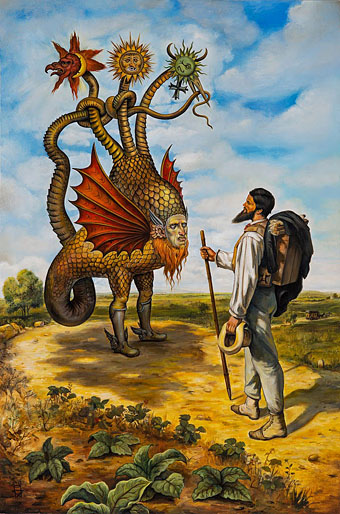
ulrich.jpg

The Philosophers (Homage to Courbet) by Christopher Ulrich. Another great tip from Full Fathom Five.

• “Mushrooms are the only psychedelic drugs that I take, and I don’t take them very often. But I would trust them. Once you’ve done them a few times it’s very easy to feel a sense of entity. You can feel that there is a characteristic in this level of consciousness which almost seems…playful? Or aware, or sometimes a bit spooky.” Alan Moore discussing art and psychedelics in Mustard magazine. Related: “Psychedelics not linked to mental health problems or suicidal behavior: A population study.”

• “Leonora Carrington transcended her stolid background to become an avant-garde star,” says Boyd Tonkin. At the BBC Chris Long looks at Leonora Carrington’s journey from Lancashire to Mexico. The Carrington exhibition at Tate Liverpool opened on Friday.

A Savoyard’s First Brush with Censorship, Clara Casian’s proposed documentary film about Savoy Books, is looking for Kickstarter funding.

Warner suggests that there are four characteristics that define a veritable fairy tale: first, it should be short; second, it should be (or seem) familiar; third, it should suggest ‘the necessary presence of the past’ through well-known plots and characters; fourth, since fairy tales are told in what Warner aptly calls ‘a symbolic Esperanto’, it should allow horrid deeds and truculent events to be read as matter-of-fact. If, as Warner says, ‘the scope of a fairy tale is made by language’, it is through language that our unconscious world, with its dreams and half-grasped intuitions, comes into being and its phantoms are transformed into comprehensible figures like cannibal giants, wicked parents or friendly beasts.

Alberto Manguel reviewing Once Upon a Time: A Short History of Fairy Tale by Marina Warner

De Natura Sonorum (1976) by Bernard Parmegiani: a free download at AGP of the original vinyl recording, something I overlooked several years ago.

• At Dangerous Minds: Real Horrorshow!: Malcolm McDowell and Anthony Burgess discuss Kubrick and A Clockwork Orange.

Meeting Bernard Szajner, a short film about the French electronic musician by Tom Colvile, Nathan Gibson & Abdullah Al-wali.

• Dismembrance of the Thing’s Past: Dave Tompkins on John Carpenter’s The Thing.

That Battle Is Over, a new song by Jenny Hval.

Mushroom (1971) by Can | The Mushroom Family (2010) by The Time And Space Machine | Growing Mushrooms Of Potency (2012) by Expo ’70

Weekend links 244

scarpulla.jpg

MMOB :: Far West (2013) by Alison Scarpulla.

• “…although same-sex love is as old as love itself, the public discourse around it, and the political movement to win rights for it, arose in Germany in the late nineteenth and early twentieth centuries. This message may surprise those who believe that gay identity came of age in London and New York, sometime between the Oscar Wilde trials and the Stonewall riots.” Alex Ross reviewing Robert Beachy’s Gay Berlin: Birthplace of a Modern Identity. Beachy talks about his book here.

• “I was in a room with tube synthesizers, where you had to tune them up to play them. It was unbelievable.” John Carpenter talking to Joseph Stannard about composing with electronics. Carpenter’s album of new music, Lost Themes, may be previewed here.

• From 2010: John Ridpath on Mervyn Peake’s illustrations for Lewis Carroll’s Alice Through the Looking Glass and Alice in Wonderland. Related: “The most twisted version of Alice in Wonderland you’ll ever see.”

I was brought up in a world where art was something owned and insured—usually inherited: but seldom if ever made by anyone one I knew.

I had an early inkling that there was fun to be had over the hill, like the feeling when faced with a sunset that someone’s throwing a mega awesome party just beyond the nearest cloud, and I set off to join the caravan. Let’s just say I was in search of company, headed towards the glow, and I found it.

Tilda Swinton‘s speech at the Rothko Chapel

• “Her art often touches on alchemy and magic; and in her memoir of insanity she writes of misreading an Imperial Chemicals sign as ‘chemistry and alchemy’.” Charlotte Higgins on Leonora Carrington.

Shadows Over Main Street, an anthology of small-town Lovecraftian terror, is out this week from Hazardous Press. 20 stories and poems plus interior illustrations including a contribution of my own.

• “With Fantastic Planet, I felt torn about using it, because it’s…the title of an animated film.” Guitarist Sarah Lipstate, aka Noveller, talks to Ned Raggett about her new album.

Jim Jupp of Belbury Poly and the Ghost Box record label answers 15 questions.

• A DeLorean driving through a Tron cityscape: Retrowave by Florian Renner.

• Powell & Pressburger’s Tales of Hoffmann (1951) has been restored.

Music from Forbidden Planet (1956) by Louis & Bebe Barron | The Four Horsemen (1972) by Aphrodite’s Child | Assault on Precinct 13 (Main Theme) (1976) by John Carpenter