Synapse: The Electronic Music Magazine, 1976–1979

synapse01.jpg

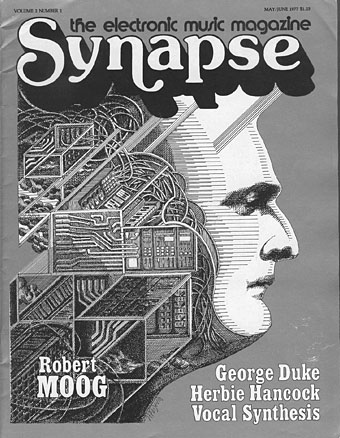
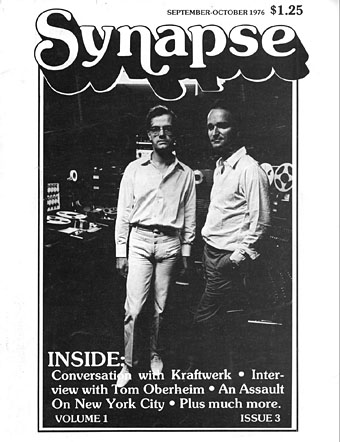
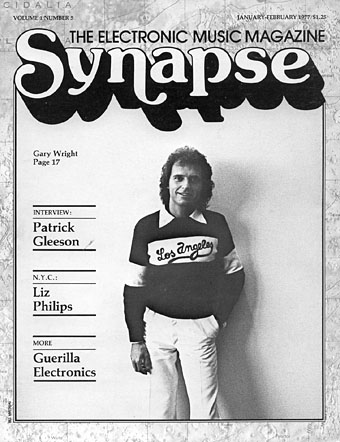
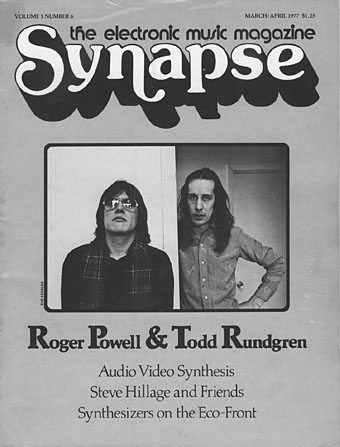
Synapse magazine has been mentioned here before, but only briefly in a weekend post. Looking last week for one of the back issues revealed that the scans of the magazine placed online by the publishers in 2012 have now vanished so this post links to an archive of PDFs at Monoskop. The publishers didn’t have copies of the first two issues so the run begins with issue 3.
synapse02.jpg

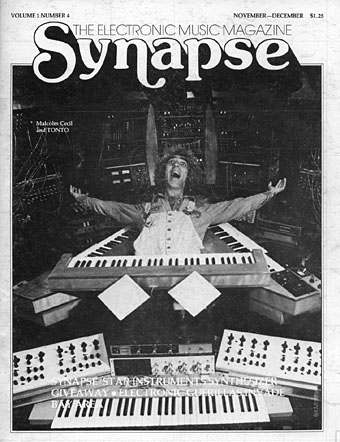
Synapse wasn’t around for very long but it’s of great interest for people like myself who have an enthusiasm for the analogue synthesizer music of the 1970s. The magazine was small but managed to secure interviews with major synthesists of the period (and Stockhausen!), as well as lesser-known figures who you wouldn’t expect to see in the general music press. Tangerine Dream and Brian Eno have never been starved of attention but the interviews with Isao Tomita and Michael Hoenig are valuable ones; the latter discusses his earlier career in the Kosmische band Agitation Free as well as his new album, the very Tangerine Dream-like Departure From The Northern Wasteland.
synapse03.jpg

Elsewhere in the magazine there are the usual technical articles that were common in journals of this type (the border between art and engineering in the early synthesizer world used to be as permeable as it was in the first decades of science fiction); and the latest synth-related albums receive reviews, many of which are more equivocal than you might expect. It’s a surprise seeing an album such as Ricochet by Tangerine Dream being treated with scepticism but then the reviewer evidently preferred the recordings of the group’s pre-Virgin period. Likewise, Kraftwerk were featured in the third issue but their Man-Machine album is given the same “Is this the future we really want?” appraisal they used to receive from the rock press.
synapse04.jpg

As always with old magazines, the ads are often as interesting as the editorial, and Synapse is filled with promotional material for a wide range of synth gear, from the major keyboard manufacturers to tiny electronic companies. It’s not every magazine where you can see a full-page command to “Trade in your Mellotron”.

Synapse contents list at Wikipedia

synapse05.jpg

Continue reading “Synapse: The Electronic Music Magazine, 1976–1979”
Future Life magazine

future1.jpg

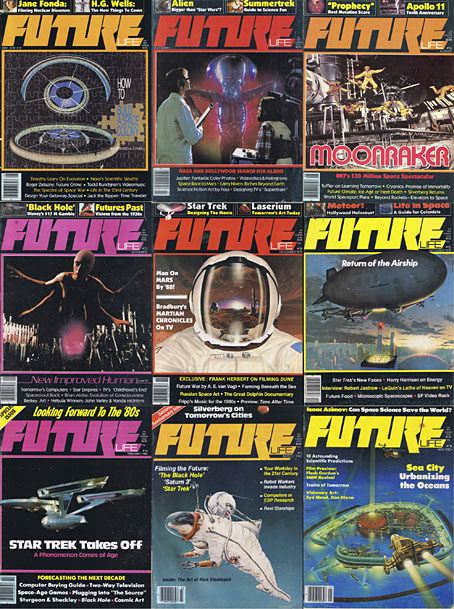
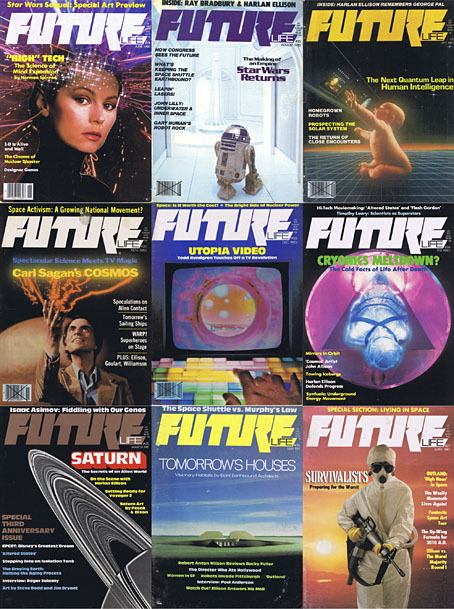
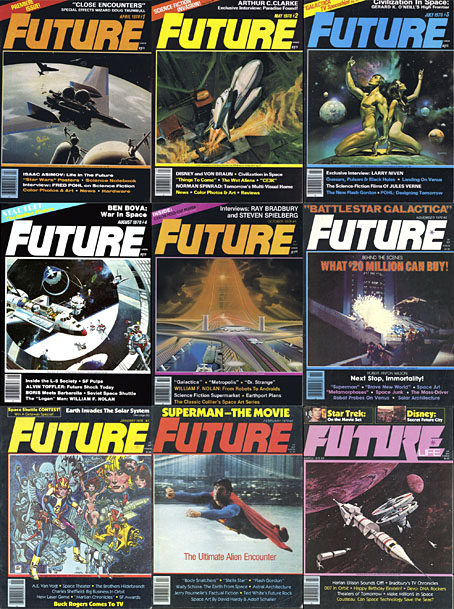
One thing I never expected about the future was that so many of my youthful enthusiasms would keep rising from the past, but here’s another, stumbling into the room reeking of cemetery earth and old newsprint. Future Life was a spinoff from Starlog magazine, and where the parent title concerned itself with science fiction and fantasy in film and television, the focus of Future Life was technology, popular science, scientific speculation, and written science fiction (all from an American perspective, of course); film and TV productions were there to attract general readers but never dominated the proceedings. Future Life ran for 31 issues from 1978 to 1981, and in many ways the magazine was a kind of OMNI-lite: not as lavish as its rival but not as expensive either. For a while this was a magazine I always looked out for (together with Heavy Metal, with whom it shared a music writer, Lou Stathis) but I missed the first nine issues, and many of the later ones before it vanished altogether, so it’s gratifying to find the complete run available as a job lot at the Internet Archive.

future2.jpg

It’s become commonplace today to regard Generation X as the first generation with no optimistic future to look forward to, but Future Life shows how much optimism there was at the beginning of the 1980s. The mood darkened just as the magazine expired, with genuine fears of a nuclear war persisting through much of the decade, and the Challenger disaster reminding everyone that leaving the planet was still a hazardous business. Future Life wasn’t blind to the problems posed by technology—there were features about the dangers posed by nuclear power and climate change—but it remained upbeat about the potentials, especially where space colonies were concerned. Most issues carried an art feature although these were generally about realistic space artists or spaceship painters, with none of the eye-popping weirdness favoured by OMNI. But this magazine was my first introduction to the work of Syd Mead, a few years before Blade Runner made him deservedly famous. On the writing side, many of the articles were by popular science fiction writers—Roger Zelazny on computer crime, Norman Spinrad on a pet theme, the future of drug-taking—which you can now read with the full benefit of hindsight. In later issues there was Harlan Ellison filing a succession of lengthy and inimitable film essays; several pieces by Robert Anton Wilson; and some good music articles with features on Larry Fast (issue 12) and Robert Fripp (issue 14), while Lou Stathis profiled and interviewed Bernie Krause (issue 18), The Residents (issue 19), Patrick Gleeson (issue 22), Jon Hassell (issue 24), Captain Beefheart (issue 25), and everyone’s favourite robots, Kraftwerk (issue 31).

future3.jpg

The Internet Archive currently has all the files stuck on a single page so most people will either have to download everything at once (I’d advise using the torrent file) or sample issues at random. Fortunately there’s a very thorough breakdown of the entire run of magazines here for those who prefer to pick through the detail. In the universe next door we’re reading these back issues while floating above the earth in our L5 space colonies.

Previously on { feuilleton }
Science Fiction Monthly

Weekend links 378

belbury.jpg

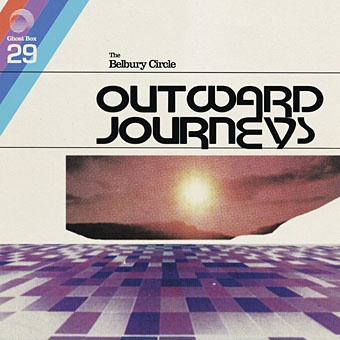
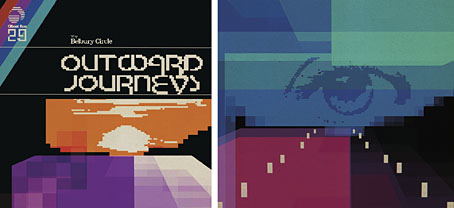
Outward Journeys, which will be released on November 3, is the second album on the Ghost Box label by The Belbury Circle (Belbury Poly with The Advisory Circle). As before, John Foxx is a guest vocalist, and as always, Julian House provides the graphic design.

• Music non-stop: Geeta Dayal in 2012 talking to Rebecca Allen about the challenges of turning Kraftwerk into computer animations.

• At the BFI: Jon Towlson on the sublimity of Close Encounters of the Third Kind; and Stephen King’s favourite films.

Bookogs is the Discogs concept applied to books. Stupid name (Bibliogs would be much better) but there it is.

belbury2.jpg

Julian House goes 8-bit. More artwork for The Belbury Circle.

Iain Sinclair‘s farewell to London. Sinclair talked to Alan Moore about his book earlier this month.

• At Dangerous Minds: Paul Gallagher on the occult art of Austin Osman Spare.

• The places where Cold War numbers stations broadcast spies’ secret codes.

• Rodney Brooks on the seven deadly sins of predicting the future of AI.

Nadja Spiegelman on the peculiar poetry of Paris’s Lost and Found.

• At Wormwoodiana: The rise of secondhand bookshops in Britain.

• RIP Grant Hart and Harry Dean Stanton. (And Dirge Magazine.)

• Mix of the week: FACT mix 618 by Tara Jane O’Neil.

• An introduction to Conny Plank in 10 records.

Reoccurring Dreams (1984) by Hüsker Dü | Canción Mixteca (1985) by Ry Cooder | You Don’t Miss Your Water (1993) by Harry Dean Stanton

Holger’s Radio Pictures

Turn the dials with your hand / Till you find the shortwave band

Kraftwerk

The sounds of the radio, especially the distant voices and atmospheric distortions of the shortwave band, were a continual presence in the work of the late Holger Czukay. The Canaxis piece on his first album outside Can (also known today as Canaxis) opens with a series of electronic bleeps reminiscent of (or maybe derived from) radio signals. In Czukay’s later TV appearances with Can he left the bass playing to Rosko Gee, preferring instead to stand at the side of the stage with a collection of radios and tape machines. On one of his first high-profile collaborations of the 1980s, David Sylvian’s Words With The Shaman, he’s credited solely with “radio”. The radio continued to provide source material for his subsequent collaborations and solo albums.

What you have here is my own mix of some favourite Czukay compositions all of which favour radio signals. The title is derived from the two tracks taken from the Full Circle EP, a collaboration between Czukay, Jah Wobble and Jaki Liebezeit; Full Circle and Mystery are both labelled “RPS” or “Radio Picture Series”. Being numbered pieces this has always begged the question of where the other six in the series might be. Now the composer is gone we may never know.

Tracks:
Jah Wobble, Holger Czukay & Jaki Liebezeit—Full Circle R.P.S. (No. 7) (1981)
Holger Czukay—Music In The Air (1987)
Jah Wobble, Holger Czukay & Jaki Liebezeit—Mystery R.P.S. (No. 8) (1981)
Holger Czukay—Radio In An Hourglass (1992)
Holger Czukay—Traum Mal Wieder (1984)
Holger Czukay—Mirage (1999)

Weekend links 313

oneill.jpg

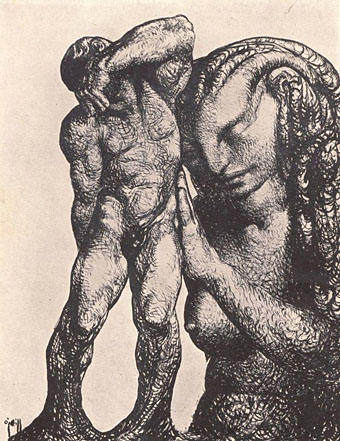
The Sullen Son (1921) by Rose O’Neill from her Sweet Monsters series (also here).

10 hours of Popcorn (1972) by Hot Butter. Related (and linked here before) 79 different versions of Gershon Kingsley’s original. If that’s not enough, there’s at least 100 more out there.

• Mixes of the week: Touristica Mystica Sigillistica by Gregg Hermetech, FACT Mix 554 by The Body, and Secret Thirteen Mix 187 by Dalhous.

• Another electronic cover version: Trans Europe Express by Cobby & Mallinder.

In the 1950s people like Pierre Schaeffer and John Cage were saying: “But there are all these sounds in the world, and if you listen to them carefully enough you will hear the music that they speak.” This immediately opened up a new world; it’s enriching once you’ve educated your ear to that, because when you’re annoyed by the sound of the street you can make music out of it. You can make music out of almost everything!

Eliane Radigue discussing her career with Paul Schütze

Patricia Highsmith’s Snail Obsession and Two Weird Tales of Monstrous Mollusks.

Youth and Alex Patterson remember the making of Little Fluffy Clouds by The Orb.

Strange Flowers pursues Sheila Legge and other Phantoms of Surrealism.

• Revealed: Cambodia’s vast medieval cities hidden beneath the jungle.

Alan Moore describes the cover of epic novel Jerusalem.

Ashgabat: the city of the living and the city of the dead.

• In praise of the tram by Christian Wolmar.

Taxidermists at DC’s

Brian The Snail (1982) by Pigbag | Slow Loris Versus Poison Snail (1996) by David Toop & Jon Hassell | Popcorn (2000) by Gershon Kingsley