Borges in the Firing Line

borges.jpg

Jorge Luis Borges was interviewed on TV a number of times in later life but most of the available appearances are in un-subtitled Spanish. His 1977 meeting with William F Buckley on Buckley’s long-running debate and discussion show, Firing Line, is an exception, and a welcome one for being almost a whole hour of serious discussion. Buckley’s reputation has been reappraised in recent years. Gore Vidal famously accused him on live TV of being a “crypto-Nazi”, a barb that prompted Buckley to momentarily lose his usual composure. With American politics currently beset by actual Nazis, crypto- or otherwise, as well as people who wouldn’t crack open the spine of a book even if you offered them another tax break, Buckley now looks like an impossible figure: an American conservative who was also a genuine intellectual with a passion for literature.

The discussion on this occasion is less about Borges’ works than about language and literature. If you’ve read any Borges interviews then this is familiar territory, but Borges elaborates here on subjects that were only touched on elsewhere, especially the strengths of English over Spanish as a literary language, and the pros and cons of translation. This latter subject is a sore point for Borges readers such as myself who believe that the current translations (made after Borges’ death) are inferior to the earlier ones, many of which were prepared with the approval of the author. It’s painful to hear him say he thought his stories worked better in English, and it makes me wonder again what he might make of the present state of affairs.

Elsewhere, Buckley tries to lead Borges into a discussion of politics, a subject that he generally avoided because it didn’t interest him, and whenever he did mention the subject he’d usually get into trouble by saying something that would annoy one side of the political spectrum or the other. I was pleased to note a fleeting reference to Arthur Machen, mentioned in relation to the Julio Cortázar short story, Casa Tomada (House Taken Over), which Borges, Adolfo Bioy Casares and Silvina Ocampo reprinted in their Antología de la Literatura Fantástica (1977).

Previously on { feuilleton }
La Bibliothèque de Babel
Borges and the cats
Invasion, a film by Hugo Santiago
Spiderweb, a film by Paul Miller
The Library of Babel by Érik Desmazières
Books Borges never wrote
Borges and I
Borges documentary
Borges in Performance

Weekend links 389

adam.jpg

I Had Sweet Company Because I Sought Out None. Collage by Helen Adam.

• Readers of The Library of Babel by Jorge Luis Borges continue to be compelled to either illustrate the impossible archive or create virtual equivalents. The Library of Blabber by nothke is a procedural version for home computers in which each volume on the shelves contains randomly-generated content.

• The Japanese American Toy Theatre of London presents: James Bonk in Matt Blackfinger (1987). Directed by Akiko Hada, with music by David Toop, and a song from Frank Chickens’ Kazuko Hohki (who also co-wrote the script).

• Music, Time and Long-Term Thinking—The Long Now Foundation (and a fair amount of Brian Eno) by Austin Brown, Alex Mensing and Ahmed Kabil.

• A Return to Normilcy: Bernie Brooks talks to post-punk group Normil Hawaiians about their 1982 album More Wealth Than Money which has just been reissued.

• Sound artist and theremin player Sarah Angliss has reworked music by Bernard Herrmann for an upcoming stage adaptation of The Twilight Zone.

• Does the world need another reissue of A Secret Wish by Propaganda? Not really but there’s a “deluxe” vinyl and CD edition on the way.

• “What Would [Bernard] Wolpe Do?” Talking Wolpe, Albertus and book cover design with the Faber & Faber Art Department.

• Mixes of the week: FACT mix 629 by Idle Hands/Chris Farrell, and XLR8R Podcast 518 by Cassy.

• At Phantasmaphile: Neglected collage artist Helen Adam (1909–1993).

Collectors’ corner: photos of book and music libraries

• The Black Meat (Deconstruction Of The Babel-Tower of Reason) (1994) by Automaton | Babel (2010) by Massive Attack feat. Martina Topley-Bird | Branching (2016) by The Library of Babel

Weekend links 382

yoshida.jpg

Raven (2015), a metal sculpture by Taiichiro Yoshida.

• “Lumia: Thomas Wilfred and the Art of Light [at the Smithsonian American Art Museum] restores Thomas Wilfred (1889–1968) to his rightful place in the history of modern art.”

• At Brown Noise Unit: a fascinating, lengthy interview by Philip Kaberry with Stephen O’Malley of Sunn O))) et al, with particular focus on O’Malley’s work with Japanese musicians.

• Erik Davis talks to scholar, writer, and mythographer William Rowlandson about Jorge Luis Borges, magical trees, Yankee mysticism, and the power of the weird and murky.

• The first issue of the world’s first magazine of fantastic art and literature, Der Orchideengarten (previously), has been reprinted in full with additional English translation.

• At Muddy Colors: the month in covers for September/October which includes my cover for Under the Pendulum Sun by Jeannette Ng (and which is on sale now).

• At 3:AM Magazine: Adam Scovell talks to horror author Ramsey Campbell about the ghost stories of MR James.

Paralysis: Live at Silent Night #8, a new release on (limited) cassette and digital by The House In The Woods.

• At Dangerous Minds: Jozef van Wissem buries the dead in his new video, Virium Illarum.

PKD Files — A podcast about the life and work of Philip K. Dick.

• Russell Cuzner on The Strange World of Nurse With Wound.

Clark Collis on the rise and fall of Fangoria.

• The North Star Grassman And The Ravens (1971) by Sandy Denny | Flight Of The Raven (1979) by Emerald Web | Kill The Great Raven (1979) by Snakefinger

Weekend links 353

tuke.jpg

The Critics (1927) by Henry Scott Tuke.

• Geeta Dayal talks to ambient musician Midori Takada about Through The Looking-Glass (1983), an album being reissued this month by Palto Flats/We Release Whatever The Fuck We Want Records.

Jacob Brogan reviews The Abominable Mr. Seabrook by Joe Ollmann, a graphic biography of writer, occultist, explorer and determined cannibal, William Seabrook.

• More from the usual suspects (on these pages at least): Jonathan Meades on his new cookbook and a recent bout of heart surgery; and Iain Sinclair on The Last London.

The law only applied to men, but that didn’t mean same-sex relationships between women were immune to opprobrium. Dorothy Todd was hired as the editor of British Vogue in 1922. Under her visionary stewardship, the magazine became a bastion of high modernist style, swapping petticoats and corsets for Picasso, Cocteau, Man Ray and Woolf. Todd lived with her lover, the fashion editor Madge Garland. Sacked in 1926 because of declining circulation, she planned to sue the magazine, but was silenced when the publisher Condé Nast threatened to publicly expose her “morals”.

In such an inimical climate, it’s not surprising that art became a zone of enchantment as well as resistance. The plenitude of camp aesthetics, the lush excess, the cross-pollination of high and low forms might be conceived as a direct response to the paucity and hostility of the culture at large. From the mannered decadence of Aubrey Beardsley’s naughty woodcuts, to Cecil Beaton’s portraits of Stephen Tennant as a radiant boy prince, to the cabaret high jinks of Danny La Rue, to the wickedly doctored library book covers made by the playwright Joe Orton (a crime for which he received a jail sentence), camp offered a way of remaking the world, cutting it down to size and reassembling it in richly strange and strangely rich new forms.

Olivia Lang on the British artists working in defiance of iniquitous laws prior to the (partial) decriminalisation of homosexual acts in 1967.

• Due for publication later this year, You Should Come With Me Now, a new collection of short fiction by M. John Harrison.

Daniel Marner reviews Scarred For Life Volume One: The 70s, a book about the dark side of British pop culture.

Jay Babcock talks to Erik Davis about the end of Arthur magazine and his new life in the Californian desert.

• The nature photography of Nobuyuki Kobayashi and the ruin photography of Gina Soden.

Jon Forss of design team Non-Format on his time designing The Wire magazine.

Mac McClelland on how doctors treat mental illness with psychedelic drugs.

• Mix of the week: Secret Thirteen Mix 216 by WSR.

Hisham Matar on Jorge Luis Borges.

London Boys (1976) by T. Rex | Last Train To London (1979) by Electric Light Orchestra | London (2004) by Patrick Wolf

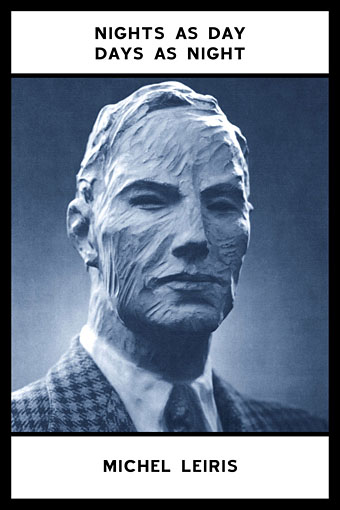
Nights as Day, Days as Night by Michel Leiris

leiris.jpg

“Le rêve est une seconde vie,” says Gérard de Nerval in the epigraph to the dream journal of Michel Leiris, a collection of oneiric texts published as Nuits sans nuit et quelques jours sans jour in 1961, and which appears this week in a new translation—Nights as Day, Days as Night—from Spurl Editions.

If dreams for Nerval were a second life, for the Surrealists they were a life as important as the waking one, their significance distilled in the declared desire of Max Ernst to keep one eye open on the wake world while the other remained closed and fixed upon the interior. Michel Leiris was a friend of André Masson, and was involved with the Surrealists in the early days until a falling out with André Breton saw him expelled from the “official” ranks. The fatuously doctrinaire Breton seemed to fall out with everyone at some point, and Leiris wasn’t alone in being undeterred by any tinpot Stalinism. Nights as Day, Days as Night is a major Surrealist text, a journal covering the years 1923 to 1960 which may be read as a straightforward transcription of one person’s dream life, or as a series of fragmented narratives, anecdotes and fantasies many of which, in their brevity, operate like condensed fictions. Dreams as raw material for fiction have a long history but are seldom presented en masse in an undiluted form. One problem is that a naked description of a dream is unlikely to be interesting to anyone other than the dreamer unless the description is artfully presented. In his lecture on nightmares, Jorge Luis Borges describes his most terrifying dream—an old Norwegian king appearing at the foot of his bed—which he says was terrifying not because of the appearance of a spectral presence but because of the atmosphere in the room, an atmosphere he found impossible to convey to others.

This quality of incommunicability (or a general lack of interest, since “strange dreams” are universal) may be sidestepped if the dreamer is already noteworthy, as with the case of William Burroughs whose My Education: A Book of Dreams is the most obvious equivalent to Leiris’s collection. Burroughs had been mining his dreams for years, however, so the contents of My Education were already very familiar to his readers when the book appeared in 1995. Leiris has the advantage of novelty, and even more than Burroughs he works consciously to make his dreams interesting to a reader. (There’s also some intersection in the Parisian locations; Burroughs included Paris as one of the omnipresent zones in his personal dream landscape.) As with Burroughs, there seem to be occasions when the transcription turns into outright fictioneering. I’ve tried keeping a dream journal myself a few times, and found it difficult to recall anything more than the merest fragments of most dreams. Leiris is selective—many of the entries are separated by several months—but many of his selections run over several pages, and contain detailed descriptions of sequential events. Unless you’re blessed with exceptional recall, some elaboration would seem inevitable given the elusive nature of dreams and their tendency to quickly evaporate in the bleary-eyed morning. From a Surrealist perspective (a non-doctrinaire one, naturally), any subsequent embellishment might be regarded as a literary parallel to the Ernst intention of keeping one eye open while the other remains closed; the dreams become Surrealist texts collaged from Leiris’s dream life and whatever enhancement he applies to the raw transcription. Many of the shorter transcriptions remain faithful to the abrupt disjunctions of the dream state, replete with sudden changes of location, personality and even reversals from subject to object. Literature has the ability to convey these disjunctions much more accurately than other media. Painting, drawing and collage only ever create a single, static image; film has the advantage of movement but, like other visual media, can’t help but make everything seem all too tangible. In film, animation comes the closest to dreams but still lacks the ability to put you inside the consciousness of the dreamer the way that Leiris’s texts do, fictional or otherwise.

Spurl’s Nights as Day, Days as Night is translated by Richard Sieburth, and features a foreword by Maurice Blanchot. Order it here.