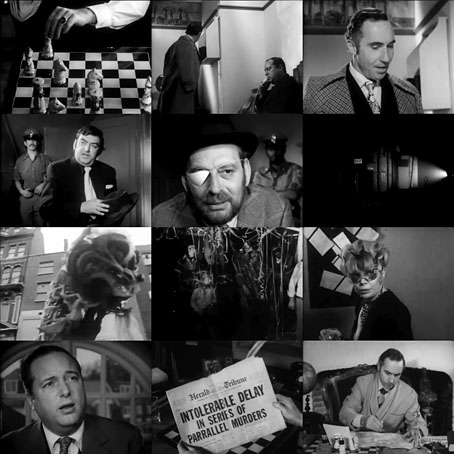
Spiderweb, a film by Paul Miller

spiderweb.jpg

The Spider’s Stratagem (1970) is Bernardo Bertolucci’s adaptation of the Jorge Luis Borges story The Theme of the Traitor and the Hero; Death and the Compass (1992) is Alex Cox’s adaptation of the story Death and the Compass by the same author; Spiderweb (1977) is an earlier adaptation of Death and the Compass which is both shorter than Cox’s film, and also a more successful Borgesian drama.

Borges’ story plays Kabbalistic games with the familiar shapes of detective fiction, creating its frisson in the tension between an elaborate murder mystery and the intellectual puzzle which leads to its solution. In Cox’s extended version this is presented in an overbearing style reminiscent of Terry Gilliam at his most exasperating; despite a decent cast it’s also rather poorly directed in places. By contrast, Paul Miller’s adaptation runs for 30 minutes and conveys the story very smartly and efficiently. The setting is “Borghesia” rather than Argentina but the general style is that of a Hollywood detective story, American accents and all. The always reliable Nigel Hawthorne plays the cerebral detective Erik Lönnrot. Considering this was a graduation film it’s an excellent piece of work which the director himself has made available on YouTube. Watch it here.

Previously on { feuilleton }
The Library of Babel by Érik Desmazières
Books Borges never wrote
Borges and I
Borges documentary
Borges in Performance

Weekend links 208

sungwon.jpg

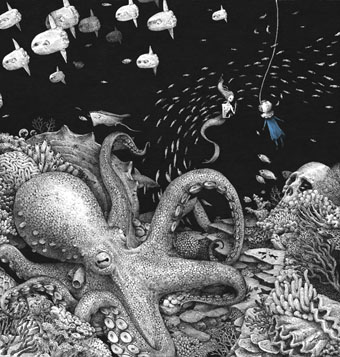
The Blue Girl (2013) by Sungwon.

• “Meanwhile, in her parents’ room [Max] Ernst painted aardvarks eating ants and big human hands around the windows. ‘Sexual connotations, I think,’ she says shyly.” Agnès Poirier talks to Cécile Eluard about her childhood among the Surrealists.

• “Thrilling and prophetic”: why film-maker Chris Marker‘s radical images influenced so many artists. Sukhdev Sandhu, William Gibson, Mark Romanek and Joanna Hogg on the elusive director.

• At Dangerous Minds: Throbbing Gristle live in Manchester in 1980, and Brian Butler talks about the rediscovered early print of Kenneth Anger’s Lucifer Rising. There’s a trailer!

• From 1981: The Art of Fiction No. 69 at The Paris Review, an interview with Gabriel García Márquez. Related: Thomas Pynchon reviewed Love in the Time of Cholera in 1988.

• “Seven years ago, a stolen first edition of Borges’s early poems was returned to Argentina’s National Library. But was it the right copy?” Graciela Mochkofsky investigates.

• “What was Walter Benjamin doing with his shirt off in Ibiza?” Peter E. Gordon reviews Walter Benjamin: A Critical Life by Howard Eiland & Michael W. Jennings.

• A video by Marcel Weber for Måtinden, a track from Eric Holm’s Andøya album. Another album on the Subtext label that I helped design.

• More Ian Miller: Boing Boing has pages from his new book, The Art of Ian Miller, and there’s an interview at Sci-Fi-O-Rama.

Outrun Europa, a free compilation of 80s-style electronic music. There’s a lot more along those lines here.

• Praise Be! Favourite religious and spiritual records chose by writers at The Quietus.

Ralph Steadman illustrated Alice’s Adventures in Wonderland in 1973.

British Pathé is uploading 85,000 of its newsreel films to YouTube.

• Drawings by Lebbeus Woods at The Drawing Center, New York.

• At Pinterest: Ian Miller and Kenneth Anger.

Lucifer Sam (1967) by Pink Floyd | The Surrealist Waltz (1967) by Pearls Before Swine | Which Dreamed It (1968) by Boeing Duveen And The Beautiful Soup

Weekend links 203

budich.jpg

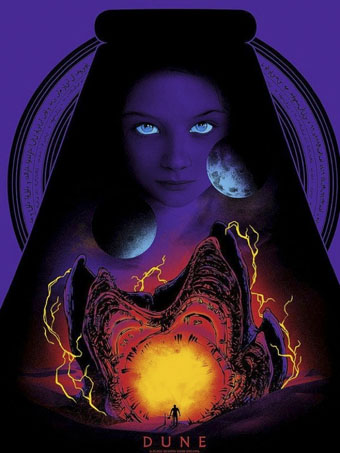
A Dune-inspired piece by Joshua Budich for In Dreams: an art show tribute to David Lynch at Spoke Art.

• “[Montague] Summers was a friend of Aleister Crowley and, like [Jacques d’Adelswärd] Fersen, conducted homoerotic black masses; whatever eldritch divinity received their entreaties was evidently propitiated by nude youths.” Strange Flowers goes in search of the Reverend Summers.

• More Jarmania: Veronica Horwell on the theatrical life of Derek Jarman, Paul Gallagher on When Derek Jarman met William Burroughs, and Scott Treleaven on Derek Jarman’s Advice to a Young Queer Artist.

Robert Henke of Monolake talks to Secret Thirteen about his electronic music. More electronica: analogue-synth group Node have recorded a new album, their first since their debut in 1995.

This hypertrophied response to decay and dilapidation is what drives the “ruin gaze”, a kind of steroidal sublime that enables us to enlarge the past because we cannot enlarge the present. When ruin-meister Giovanni Piranesi introduced human figures into his “Views of Rome”, they were always disproportionately small in relation to his colossal (and colossally inaccurate) wrecks of empire. It’s not that Piranesi, an architect, couldn’t do the maths: he wasn’t trying to document the remains so much as translate them into a grand melancholic view. As Marguerite Yourcenar put it, Piranesi was not only the interpreter but “virtually the inventor of Rome’s tragic beauty”. His “sublime dreams”, Horace Walpole said, had conjured “visions of Rome beyond what it boasted even in the meridian of its splendour”.

Frances Stonor Saunders on How ruins reveal our deepest fears and desires.

Gustave Doré. L’imaginaire au pouvoir: Four short films from the Musée d’Orsay to accompany their current exhibition, Gustave Doré (1832–1883): Master of Imagination.

• At Dangerous Minds: Remembering Cathy Berberian, the hippest—and funniest—lady of avant-garde classical music.

• “Merely a Man of Letters”: Jorge Luis Borges interviewed in 1977 by Denis Dutton & Michael Palencia-Roth.

Luke Epplin on Big as Life (1966), a science-fiction novel by EL Doctorow which the author has since disowned.

The Psychomagical Realism of Alejandro Jodorowsky: Eric Benson talks to the tireless polymath.

• A video essay by Matt Zoller Seitz for the 10th anniversary of David Milch’s Deadwood.

Eugene Brennan on Scott Walker’s The Climate of Hunter (1984).

Dune at Pinterest.

• Prophecy Theme from Dune (1984) by Brian Eno | Olivine (1995) by Node | Gobi 110 35′ south 45 58′ (1999) by Monolake

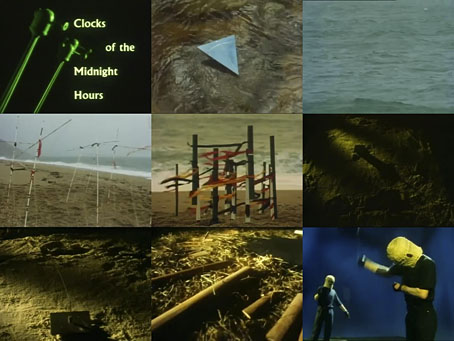
Clocks of the Midnight Hours: The Work of Max Eastley

eastley1.jpg

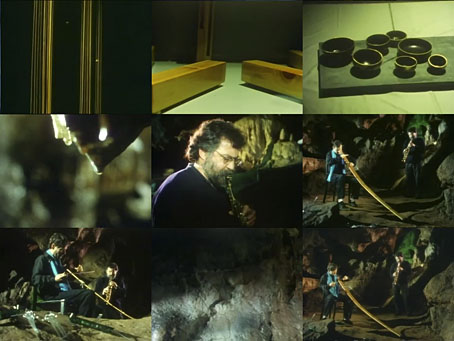
I was hoping this might turn up on YouTube eventually, my copy being stuck on a VHS tape. Clocks of the Midnight Hours (1986) is a 25-minute film about the music of Max Eastley directed by Simon Reynell. The title is taken from a Borges poem. What makes Eastley’s music special is that all his instruments are unique “sound sculptures” that range through autonomous devices, to wind- and water-activated instruments, to creations requiring human performance. Some of the sounds, if not the look of the instruments, will be familiar to anyone who’s heard Buried Dreams, the album Eastley made in 1994 with frequent collaborator David Toop. Both Eastley and Toop appear in the film (the latter masked by a wicker helmet), as does Evan Parker in a performance in Kent’s Cavern, Torquay. An earlier Eastley & Toop collaboration, New and Rediscovered Musical Instruments (1975), may be heard at Ubuweb.

eastley2.jpg

Previously on { feuilleton }
Max Eastley’s musical sculptures

Marienbad hauntings

marienbad1.jpg

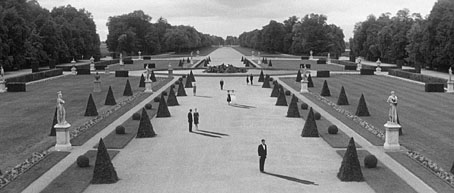
Last Year in Marienbad (1961). Via.

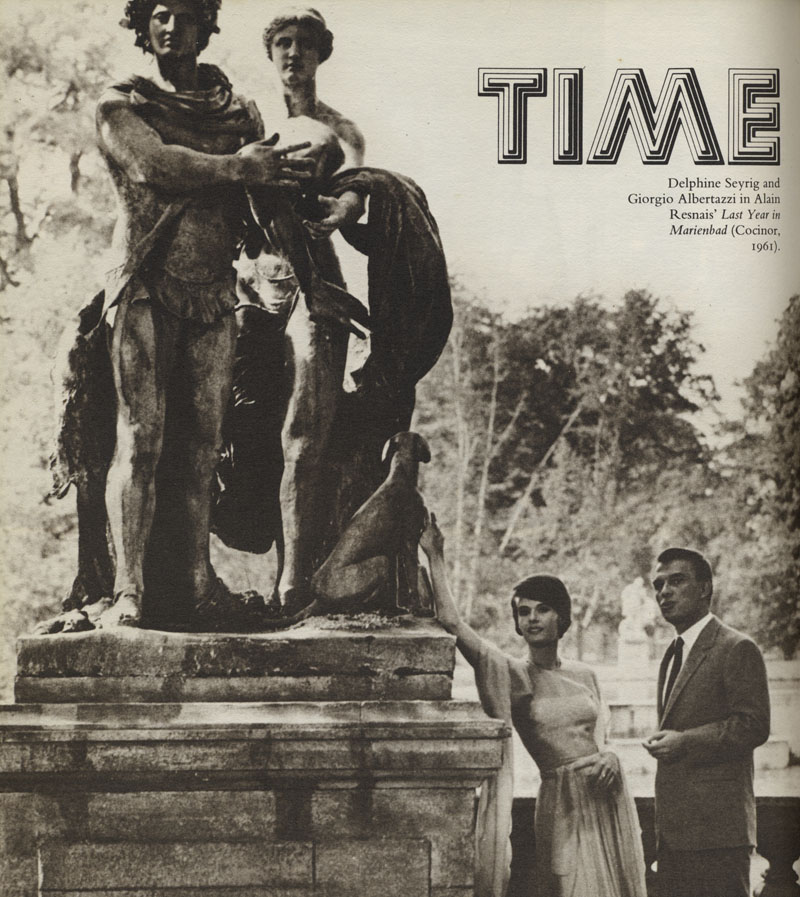
In our age of cultural plenitude it can be salutary to remember the time when many things were easy to discover but often impossible to experience; albums, books, and especially non-American films could all too frequently exist as rumours, referenced but always out of reach. Two films in particular dogged me for years in this remote manner: The Saragossa Manuscript (1965) by Wojciech Has, and Last Year at Marienbad (1961), the film that Alain Resnais made from a very novelistic screenplay by Alain Robbe-Grillet. Philip Strick alerted me to this pair of films with tantalising descriptions in a time-travel chapter of his book-length study, Science Fiction Movies (1976). Marienbad isn’t a time-travel film as such (a later Resnais film, Je t’aime, je t’aime [1968] does deal with the subject, however, and even features an actual time machine), but it is sufficiently open-ended to allow a science-fictional rationale into its enigmatic spaces. Strick’s book covered all the familiar SF territory as well as looking beyond the clichés of Hollywood and the SF genre, hence the inclusion not only of Marienbad and Saragossa, but also Je t’aime, je t’aime, Chris Marker’s La Jetée (1962), Bergman’s The Hour of the Wolf (1968), Pasolini’s Teorema (1968), and Buñuel’s Discreet Charm of the Bourgeoisie (1972). Most of these films, which were seldom shown on TV, I had to wait years to see.
marienbad2.jpg

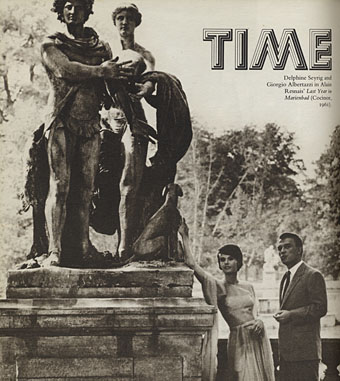
Marienbad page from Strick’s Science Fiction Movies.

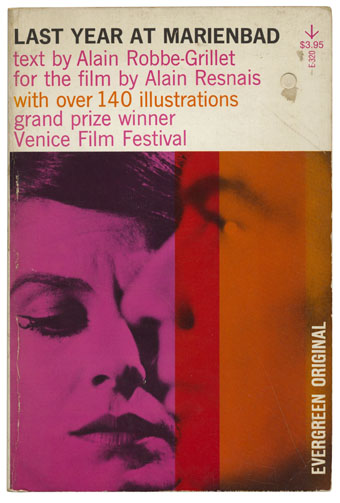
I was reading Strick’s book in 1979, and since I was bored with generic clichés, and also reading a lot of reprinted stories from New Worlds magazine, I became a little obsessed with these inaccessible films, Marienbad especially. It’s difficult to say what was so fascinating about a few words of description, and a single photograph, but the picture seemed an unlikely inclusion amid so many pages filled with robots and spaceships. It promised a film that approached the themes of science fiction at the same oblique angle as many of the stories in New Worlds. A couple of years later I found a copy of the Robbe-Grillet screenplay whose pages of dogged description read like the kind of forbidding and formal exercise that Brian Aldiss had attempted in Report on Probability A (1967), a novel that first appeared in New Worlds. Among other similarities, both works share a dismissive attitude to character, presenting a trio of ciphers indicated by no more than their gender, and some initial letters. This confluence of influences, Marienbad included, fed into the chunks of New Worlds-derived prose I was writing at the time, trying to fix inchoate impressions on the page. I always failed each time I returned to that photo from Marienbad, the real charge—as I didn’t see at the time—being a result of the gap between the promise of the image and the inaccessible film itself. Finally seeing Marienbad in the late 1980s was a curious thing, like meeting somebody face-to-face after years of remote correspondence; the same readjustments needed to be made to accept that this was the reality of the work of art, not Robbe-Grillet’s embryonic version, or my own baroque imaginings.
marienbad3.jpg

Screenplay book, 1962. Cover design by Roy Kuhlman.

If the above seems to strain for association by hauling a celebrated work of the Nouvelle Vague into a disreputable area then this essay by Thomas Beltzer is worth a read. Beltzer’s “Intertextual Meditation” compares Marienbad to The Invention of Morel (1940), a science-fiction novel by Adolfo Bioy Casares which Jorge Luis Borges described as “perfect” (and which I really ought to read). If I’ve not written much about Marienbad itself that’s because it really needs to be experienced rather than described or explained. It’s a film that’s easier to admire than actually enjoy—I need to be in the right mood to accept its formalities—and given the choice I’d often sooner watch Providence (1977). But where Providence and other Resnais films have inevitably dated, Last Year in Marienbad remains out of time, a 20th-century dream held captive in 18th-century architecture where the airless rococo chambers might easily share a labyrinth with the hotel waiting-room at the end of 2001: A Space Odyssey.

• Alain Resnais obituaries: The Guardian | The Telegraph
Last Year in Marienbad at film|captures
Marienbad (2012) by Julia Holter