Weekend links 98

postcard.jpg

The Arcimboldo Effect again. An undated postcard from the image section of A Virtual Wunderkammer: Early Twentieth Century Erotica in Spain.

“I took George Clinton and Bootsy Collins to the Battle Station for the first time, and they left feeling like they’d just had a close encounter,” said the bassist and music producer Bill Laswell, who met Rammellzee in the early 1980s and remained one of the few people who saw him regularly.

Rammellzee’s Work and Reputation Re-emerge

• Also in the NYT: China Miéville on Apocalyptic London: “Everyone knows there’s a catastrophe unfolding, that few can afford to live in their own city. It was not always so.” Reverse the perspective and find Iain Sinclair writing in 2002 about Abel Ferrara’s The King of New York: “A memento mori of the century’s ultimate city in meltdown.”

• The Inverted Gaze: Queering the French Literary Classics in America by François Cusset. Related: Glitterwolf Magazine is asking for submissions from LGBT writers/artists/photographers.

• The vinyl releases of Cristal music by Structures Sonores Lasry-Baschet continue to be scarce and unreissued. Mark Morb has a high-quality rip of the group’s No. 4 EP here.

• Henri’s Walk to Paris, the children’s book designed by Saul Bass in 1962, is being republished. Steven Heller takes a look.

As the critic Jon Savage points out, even rock’n’roll’s very roots, the blues, contained a weird gay subculture. The genre was home to songs such as George Hannah’s Freakish Man Blues, Luis Russell’s The New Call of the Freaks, and Kokomo Arnold’s Sissy Man Blues. “I woke up this morning with my pork grindin’ business in my hand,” offers Arnold, adding, “Lord, if you can’t send me no woman, please send me some sissy man.”

Straight and narrow: how pop lost its gay edge by Alexis Petridis

• David Pelham: The Art of Inner Space. James Pardey interviews the designer for Ballardian.

• BBCX365: Johnny Selman designs an entire year of news stories.

• Sarah Funke Butler on Nabokov’s notes for Eugene Onegin.

• Leslie S. Klinger on The cult of Sherlock Holmes.

• How piracy built the US publishing industry.

• SynthCats

• The Light Pours Out Of Me (1978) by Magazine | Touch And Go (1978) by Magazine | Motorcade (1978) by Magazine | Feed The Enemy (1979) by Magazine | Cut-Out Shapes (1979) by Magazine.
Pleasure of Ruins

beny01.jpg

The ideas ruins evoke in me are grand. Everything comes to nothing, everything perishes, everything passes, only the world remains, only time endures. How old is this world! I walk between two eternities.

Denis Diderot, 1767

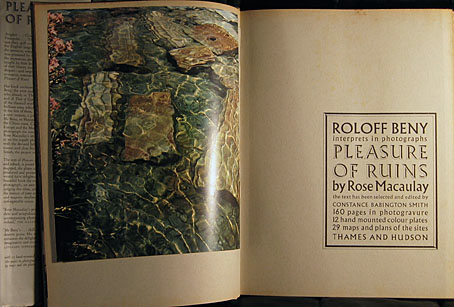
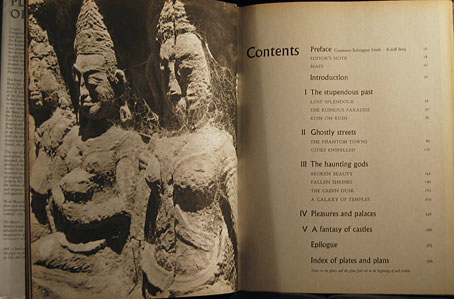
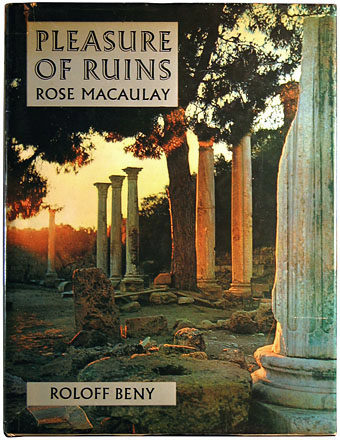
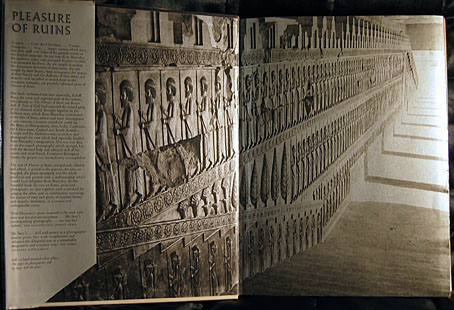
Ruins, as Diderot observed, are the memento mori of civilisations, a reminder that the apparent permanence of architecture is illusory: this too shall pass. Rose Macaulay explored the melancholy pleasure inspired by this contemplation in Pleasure of Ruins (1953), a book I was reminded of on two separate occasions this weekend. Before I get to those I can’t resist showing something of my own copy of Macaulay’s study, a heavyweight volume (286 pp, 346mm x 260mm) published by Thames & Hudson in 1964. This was the third book by Canadian photographer Roloff Beny who made a habit of photographing ancient ruins. Here he visits Angkor, Tintern Abbey, Persepolis, Petra, Baalbek, Leptis Magna, Chichen Itza, Machu Picchu and elsewhere to embellish Macaulay’s text with 160 photogravure pages, 12 tipped-in colour plates, and maps of the locations on fold-out spreads. Beny also designed the book which even in my rather scuffed and damp-afflicted copy is an impressive example of the mass-produced edition as work-of-art.

beny02.jpg

Metallic silver printing on the endpapers.

Rick Poynor provided the first mention of Macaulay’s book in a piece of polemic justifiably disputing the pejorative term “ruin porn”, an epithet that’s appeared recently among critics of those fascinated by photos of abandoned Detroit, or Battleship Island off the coast of Japan. If photos of ruins are “ruin porn” then Roloff Beny’s books must count as hardcore, while my National Trust Book of Ruins is evidently a government-sponsored sex manual. Poynor notes the criticism being a particularly American one, and wonders whether some Americans fail to appreciate the long cultural and political history of the ruin in Europe. Plenty of European cities have ruins in their midst, whether ancient ones like London Wall and the centre of Rome, or more recent ones like the Kaiser Wilhelm Memorial Church in Berlin and Coventry Cathedral, both partially destroyed during the Second World War. An appreciation of ruins began in the 18th century and evolved in tandem with the emergence of antiquarianism. Prior to this, ancient ruins were either a nuisance or a resource to be plundered for their stones. (Or, as can be seen in some of Piranesi’s Views of Rome, a convenient support for shops and houses.)

beny03.jpg

From ruin porn to Ruin lust: our love affair with decaying buildings, an essay by Brian Dillon which covers similar ground to Poynor’s piece, and discusses Rose Macaulay’s interest in ruins, an interest that survived being bombed out of her home during the war. This is a great run through the usual suspects, from the Romantics (with a nod to Fonthill Abbey) to JG Ballard’s obsession with the remnants of the Cold War and the Space Age. Dillon mentions the painting John Soane commissioned from Joseph Gandy showing his Bank of England building as a future ruin. And he also recounts the story (which I heard repeated recently in a Robert Hughes documentary) of Hitler’s demands to Albert Speer during their planning of the future capital of the Third Reich, Germania, that the buildings should make good ruins. It’s impossible to imagine anyone today planning a building as a future ruin even though many will end up that way, if they last at all.

beny04.jpg

If it wasn’t already apparent that ruins are the thing du jour, a current exhibition at Dundee Contemporary Arts is of photographic prints by Jane and Louise Wilson showing views of abandoned Pripyat, better known as the town at the heart of the Chernobyl Exclusion Zone. Rick Poynor refers to Pripyat in his piece, and it’s also an inevitable subject of discussion in Geoff Dyer’s latest book, Zona, an exploration of Andrei Tarkovsky’s Stalker where a disused power station adds a more sinister quality to the pleasure of ruins.

More pages from Roloff Beny’s book follow.

Continue reading “Pleasure of Ruins”

Kafkaesque

kafkaesque1.jpg

Another book design of mine (interiors only) which I completed last September for Tachyon and about which I had this to say at the time:

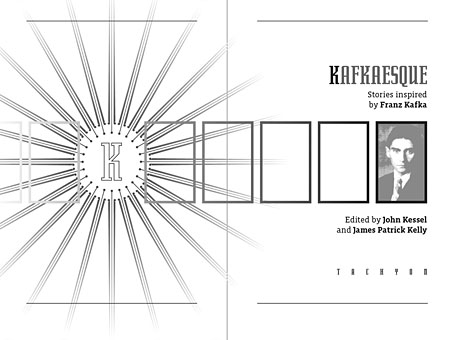
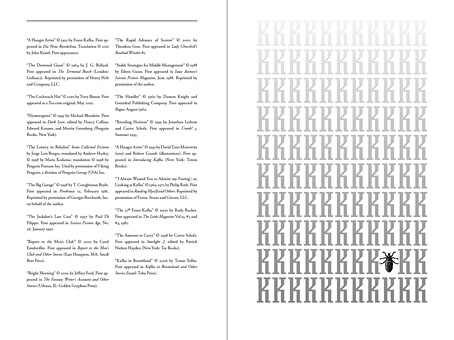
Kafkaesque [is] edited by John Kessel and James Patrick Kelly. It’s a collection of short stories either inspired by Franz Kafka, or with a Kafka-like atmosphere, and features a high calibre of contributions from writers including JG Ballard, Jorge Luis Borges, Carol Emshwiller, Jeffrey Ford, Jonathan Lethem and Philip Roth, and also the comic strip adaptation of The Hunger Artist by Robert Crumb.

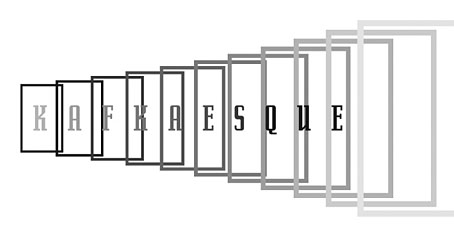
The book gained a positive review at SF Site recently, reminding me that I hadn’t written anything about the design. As with some of my other Tachyon work the interiors take their cue from a pre-determined cover by another designer, in this case Josh Beatman. I followed Josh’s type choices (Senator for the titles and headings) and also extended his use of an insect as a recurrent motif. Before I saw the contents I was fairly determined to avoid any further insect imagery but it became apparent that Kafka’s Metamorphosis is a repeated reference in many of the stories.

kafkaesque2.jpg

As for the recurrent “K”, that seemed inevitable given Kafka’s own use of the letter as well as its presence not only in Kafka’s own name but in the names of the editors. The frames were an idea borrowed from (and referring to) Steven Berkoff’s stage adaptation of The Trial in which portable frames serve on the stage as doorways, windows, corridors, picture frames and so on. I was hoping to do more with this idea but (as is often the case) ran out of time to develop it further.

kafkaesque3.jpg

And while we’re on the subject of Tachyon designs, I don’t seem to have mentioned my interiors for a Joe R Lansdale collection, Crucified Dreams, which also appeared last year. This is a hard-boiled anthology of Lansdale’s favourite stories for which I supplied suitably rough-and-tough graphics comprising scanned scalpel blades and lettering assembled from torn newspaper pages. I’m due to start on some new work for Tachyon this week. More about that at a later date.

Continue reading “Kafkaesque”

Weekend links 90

varo.jpg

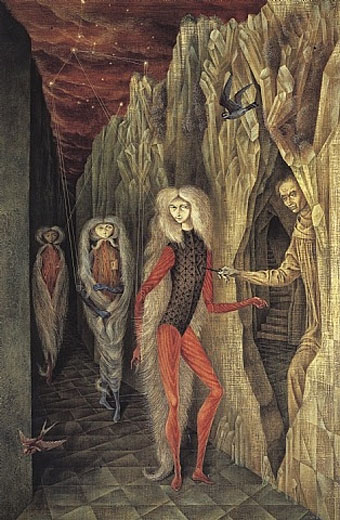
Portrait of Dr. Ignacio Chavez (1957) by Remedios Varo (1908–1963) some of whose Surrealist paintings can be seen at Frey Norris, San Francisco, from 19th January. There’s also In Wonderland: The Surrealist Adventures of Women Artists in Mexico and the United States at the Los Angeles County Museum of Art from 29th January.

The current crop of Republicans jostling for the Presidential nomination have reminded me of the Downunder people in Harlan Ellison’s post-apocalypse novella A Boy and His Dog (1969): a retrograde, fear-ridden community who send troublesome individuals to be exterminated at “the farm”. Rick Santorum (unforgettably pictured here with family in 2006 after losing an election) almost received the majority of Iowa’s votes for his nomination last week, prompting renewed scrutiny of his negative views about gay people, sexually active people, foreign people (especially Arabs and Mexicans), and anyone generally who isn’t a white, Catholic, Downunder person. Santorum is against gay marriage, of course—it’s hard to find a Republican who isn’t—but he also wants to ban abortion even in cases of rape and incest, and given the opportunity would allow US states to prevent any use of contraception. Add to this his pro-torture stance (which offends current Catholic church policy), and his willingness to wage war with Iran, and it’s easy to see why his name prompts reactions such as this:

I have a history with Rick Santorum. In 2003, when Santorum, in an interview with the Associated Press, first compared gay relationships to child rape and dog fucking (have I mentioned that Santorum has compared gay relationships to child rape and dog fucking?), I held a contest to redefine Santorum‘s last name. The winning definition: “the frothy mix of lube and fecal matter that is sometimes the byproduct of anal sex.” (“Sometimes” is the most important word in the new definition of santorum; if you’re doing anal sex correctly, there won’t be any santorum – lower- or upper-case.) And since 2003, the new definition has been the No. 1 Google return when you search “santorum“.

Rick Santorum’s homophobic frothing by Dan Savage

Related: Santorum was named one of the three “most corrupt” Senators in 2006 | “Homohater fosser fram” which is how Dagbladet, Norway’s second largest tabloid newspaper, introduces Santorum to its readers | “Rick Santorum channels Saint Augustine” an article at Slate exploring the Handmaid’s Tale extent of Santorum‘s attitudes towards sex and morality | Rick Santorum quotes as New Yorker cartoons.

marlin.jpg

The Rod (1973) by Brigid Marlin.

• Ballardian posts a long-overdue interview with Brigid Marlin, famous now for having brought two lost Paul Delvaux paintings back to life for JG Ballard, but also a woman with an extensive career as a fantastic artist using Ernst Fuchs‘s laborious mische painting technique.

• Quentin Blake on Ronald Searle, in which Blake notes that his hero was given a full-scale exhibition of his work at the Bibliothèque Nationale, France, in 1973 whilst being ignored throughout his life by the major institutions in Britain.

• Alfred Jarry: A Pataphysical Life by Alastair Brotchie is reviewed by Michael Moorcock who tells me the Guardian cut out his references to Boris Vian, Maurice Richardson and David Britton.

• Ian McKellen stirs things up by suggesting (not for the first time) that Shakespeare was bisexual.

• Ten posters by Only More Never Less inspired by Pink Floyd’s Dark Side of the Moon.

• An end to bad heir days: The posthumous power of the literary estate.

• Peace Eye! Fug! A Long Talk With Ed Sanders.

• Sand sculptures by Carl Jara.

• Letterheady

• Skylab: These Are The Blues (1995) | Beyond The Breeze (1995) | Red Light, Blue Light (1995) | Indigo (Sabres of Paradise remix, 1995) | Seashell (Nobukazu Takemura mix, 1995).

Klapheck versus Ballard

klaphek.jpg

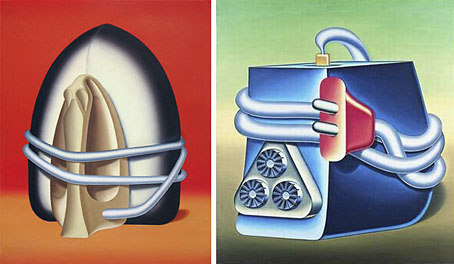
left: The Hostage (1966); right: The Female Terrorist (1971). Both by Konrad Klapheck.

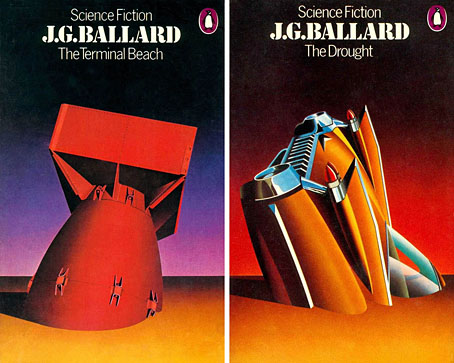
No, I’m not suggesting that David Pelham’s paintings for the Ballard covers he designed in the 1970s are inspired by the earlier work of German artist Konrad Klapheck. But it’s tempting to think of Klapheck’s isolated objects as being intended for Ballard collections that never saw the light of day. Klapheck has connections with late Surrealism, and some of his paintings prefigure the styles and concerns of Pop Art, so I’m sure Ballard would have approved.

pelham.jpg

Three of Pelham’s memorable Ballard paintings were made available as signed and numbered prints earlier this year, together with his design for A Clockwork Orange. For more about the covers see Landscapes From a Dream: How the Art of David Pelham Captured the Essence of JG Ballard’s Early Fiction, an essay at Ballardian. The designer discussed his career at some length in 2007. Then there’s the complete set of covers at the Penguin Science Fiction site, and let’s not forget Konrad Klapheck who’s still painting and who has a website here.

Elsewhere on { feuilleton }
• The book covers archive