The City of the Singing Flame

cas1.jpg

Wonder Stories, July 1931. Illustration by Frank R. Paul.

Looking over Bruce Pennington’s artwork this week sent me back to some of my Clark Ashton Smith paperbacks, many of which sport Pennington covers. One of my favourite Smith stories, The City of the Singing Flame, is also one of his finest pieces, and a story that Harlan Ellison has often referred to as his favourite work of imaginative fiction.

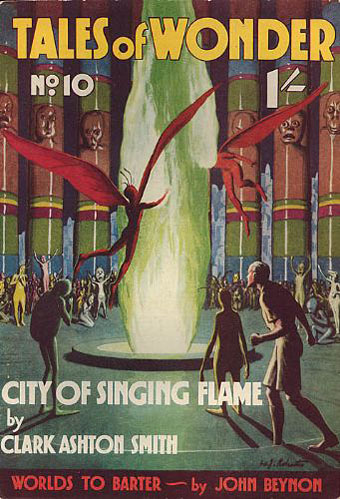
cas2.jpg

Tales of Wonder, Spring 1940. Illustration by WJ Roberts.

The story as it’s known today was originally a shorter piece, The City of the Singing Flame, followed by a sequel, Beyond the Singing Flame; both stories were published in Wonder Stories magazine in July and November of 1931, then as one in Arkham House’s CAS collection Out of Space and Time in 1942. The two-in-one story is now the definitive version.

Smith’s tale concerns the discovery of a dimensional portal somewhere in the Sierras. Beyond this there lies a path leading through an otherworldly landscape to a colossal city peopled by a race of mute giants. A temple at the heart of the city protects the prodigious green flame of the title, an eerie and alluring presence whose siren call draws creatures from adjacent worlds who prostrate themselves before the flame before immolating themselves in its fire. A narrator, Philip Hastane, give us details of diary entries from a friend who discovered the portal, and who subsequently has to decide whether to resist the lure of the mysterious flame or follow the other creatures into the fire. More than this would be unfair to divulge if you’ve never read Smith’s remarkable piece of fiction.

Continue reading “The City of the Singing Flame”

The fantastic and apocalyptic art of Bruce Pennington

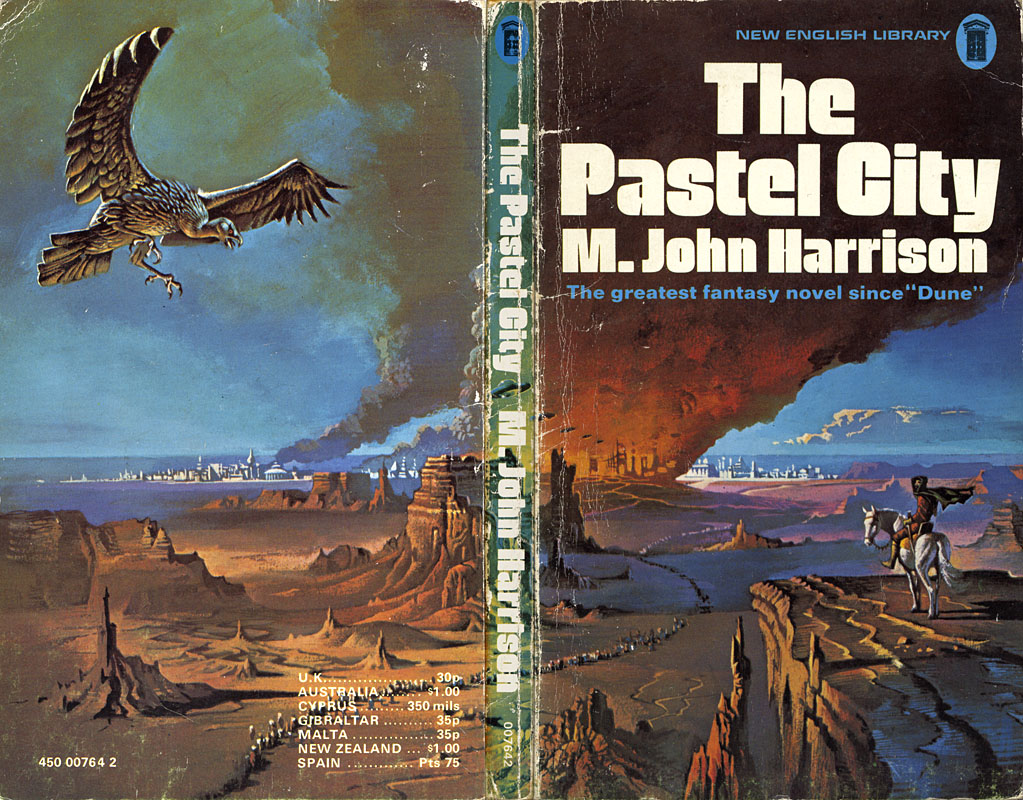
pennington-pastel.jpg

The Pastel City (1971), the first in M. John Harrison’s peerless series of Viriconium books.

Today’s post is another guest entry over at Tor.com. I’d been intending on writing something about Bruce Pennington‘s art for some time, having already covered the work of Ian Miller, my other favourite genre cover artist of the 1970s. (By coincidence both artists have illustrated the work of M. John Harrison and HP Lovecraft.) My hand was forced this month by the news of the first ever exhibition of Pennington’s paintings which is being held at Britain’s foremost occult book emporium, the Atlantis Bookshop in Museum Street, London. There’s a catalogue of the works on display here, many of which will be for sale. If I had the cash I’d consider buying one, Pennington’s work made a big impression on my imagination when I was reading many of the titles he’d illustrated for the first time. His art was unique for me in its occasionally Surrealist overtones, and as a cover artist he was unusual in working across a range of genres. Like Frank Frazetta his imagination and technique were able to suggest a great deal with a minimum of brush strokes.

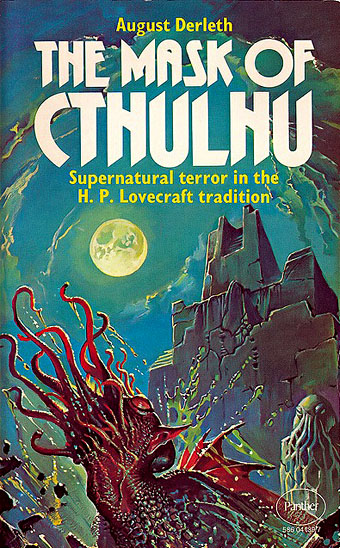
pennington-cthulhu.jpg

The Mask of Cthulhu (1976).

This post can be taken as an appendix to the Tor one which I didn’t want to overburden with pictures. The Derleth cover is purloined from Jovike’s excellent Flickr collection which includes several Pennington covers. Below are some pages from Pennington’s first book, Eschatus, a large-format collection of paintings interpreting the prophecies of Nostradamus as an apocalyptic science fiction narrative taking place in the 24th century.

Pennington has many examples of his work on his website, and there’s also a feature about his paintings in this month’s Fortean Times. The Atlantis exhibition runs to August 27th.

pennington-eschatus1.jpg

Eschatus (1976).

Continue reading “The fantastic and apocalyptic art of Bruce Pennington”

Lovecraft’s favourite artists revisited

hpl.jpg

HP Lovecraft (1937) by Virgil Finlay.

I was asked recently to join the bloggers at Tor.com writing about art as it relates to fantasy and science fiction, so for today’s post your attention is directed to this piece, an expanded version of a rather half-hearted list I put together a few years back concerning HP Lovecraft’s favourite artists. Half-hearted or not, people kept linking to that list so it seemed a good idea to make more of it. I’ll be writing these posts a couple of times a month, provided I have the time to do something worthwhile. Watch this space.

Previously on { feuilleton }
The monstrous tome

Weekend links 58

delpozo1.jpg

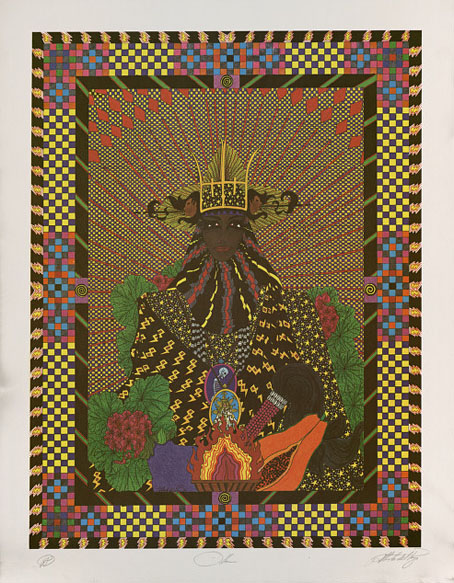
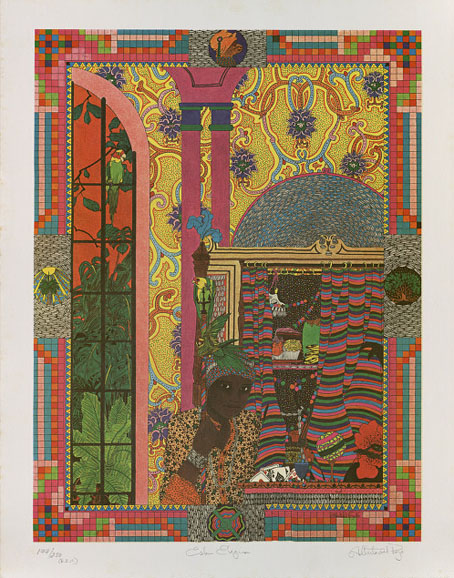
Oya by Alberto del Pozo (1945–1992). Also known as Yansa, Oya is Changó’s third wife. She is the goddess of the winds and of lightning and is mistress of the cemetery gates. Passionate and brave she fights by her husband’s side if needed. Her favorite offerings are papaya, eggplant and geraniums. From Santeria at BibliOdyssey.

Austin Osman Spare is a good example of the dictum that quality will out in the end, no matter how long it remains buried. Overlooked by the art establishment after he retreated into his private mythologies, a substantial portion of his output was equally ignored by occultists who wanted to preserve him as a weird and scary working-class magus. One group dismissed his deeply-felt spiritual interests in a manner they wouldn’t dare employ if he’d been a follower of Santeria, say (or even a devout Christian), while the other group seemed to regard his superb portraits as too mundane to be worthy of attention. Now that Phil Baker’s Spare biography has been published by Strange Attractor we might have reached the end of such short-sighted appraisals and can finally see a more rounded picture of the man and his work:

[Kenneth] Grant preserved and magnified Spare’s own tendency to confabulation, giving him the starring role in stories further influenced by Grant’s own reading of visionary and pulp writers such as Arthur Machen, HP Lovecraft, and Fu Manchu creator Sax Rohmer. Grant’s Spare seems to inhabit a parallel London; a city with an alchemist in Islington, a mysterious Chinese dream-control cult in Stockwell, and a small shop with a labyrinthine basement complex, its grottoes decorated by Spare, where a magical lodge holds meetings. This shop – then a furrier, now an Islamic bookshop, near Baker Street – really existed, and part of the fascination of Grant’s version of Spare’s London is its misty overlap with reality.

Austin Osman Spare: Cockney visionary by Phil Baker.

Austin Osman Spare: The man art history left behind | A Flickr set: Austin Osman Spare at the Cuming Museum | HV Morton meets Austin Spare (1927).

• More quality rising from obscurity: Jerzy Skolimowski’s Deep End. Skolimowski’s drama is one of unpleasant characters behaving badly towards each other. Anglo-American cinema featured a great deal of this in the 1970s when filmmakers disregarded the sympathies of their audience in a manner that would be difficult today. John Patterson looks at another example which is also given a re-release this month, the “feral, minatory and menacing masterwork” that is Taxi Driver.

delpozo2.jpg

Echú Eleguá by Alberto del Pozo. Among the most ancient of the orishas Echú Eleguá is the messenger of the gods, who forges roads, protects the house, and is heaven’s gate-keeper. In any ceremony he is invoked first. He owns all cowrie shells and is the god of luck. A prankster, Echú Eleguá frequently has a monkey and a black rooster by his side. Like a mischievous boy he enjoys gossip and must be pampered with offerings of toys, fruit, and candy.

Minutes, a compilation on the LTM label from 1987: William Burroughs, Jean Cocteau, Tuxedomoon, Jacques Derrida, The Monochrome Set, and er…Richard Jobson. Thomi Wroblewski designed covers for a number of Burroughs titles in the 1980s, and he also provided the cover art for this release.

Mikel Marton Photography: a Tumblr of erotic photography and self-portraits.

From Death Factory To Norfolk Fens: Chris & Cosey interviewed.

NASA announces results of epic space-time experiment.

Oritsunagumono by Takayuki Hori: origami x-rays.

Plexus magazine at 50 Watts.

Mother Sky (1970) by Can | Late For The Sky (1974) by Jackson Browne.

The Vengeance of Nitocris

weirdtales.jpg

Cover illustration by CC Senf.

In her mind the queen Nitocris was seeing a ghastly picture. It was the picture of a room of orgy and feasting suddenly converted into a room of terror and horror, human beings one moment drunken and lustful, the next screaming in the seizure of sudden and awful death. If any of those present had been empowered to see also that picture of dire horror, they would have clambered wildly to make their escape. But none was so empowered.

Everyone today will be marking the Tennessee Williams centenary by noting his theatre work, of course, or his subversive celebration of outsiders and, yes, the gays. I’ll confine myself to reminding people that Williams’ first published work was a short story entitled The Vengeance of Nitocris in Weird Tales for August 1928, written when he was only 17. The story reads like the work of a teenager but editor Farnsworth Wright evidently enjoyed an atmosphere of lurid Egyptian melodrama which you can appraise for yourself here. Also in this issue was the debut appearance of Robert E Howard’s Solomon Kane, and The Demoiselle d’Ys by Robert Chambers. Seeing the name Nitocris I have to wonder whether Williams chose it after reading HP Lovecraft who used the name twice in earlier stories published in the same magazine, Imprisoned With the Pharaohs (1924) and The Outsider (1926). That last piece was one of Lovecraft’s most popular tales, and it’s easy to imagine its grotesque parable of alienation making an impression on a would-be writer who, as a gay youth, would have looked upon himself as another kind of outsider.

Previously on { feuilleton }
The King in Yellow