The Dukes declare it’s 25 O’Clock!

dukes1.jpg

25 O’Clock (1985). Andy Partridge’s great cover design.

The DUKES say it’s time…it’s time to visit the planet smile…it’s time the love bomb was dropped…it’s time to eat music…it’s time to kiss the sun…it’s time to drown yourself in SOUNDGASM and it’s time to dance through the mirror. The DUKES declare it’s 25 O’CLOCK.

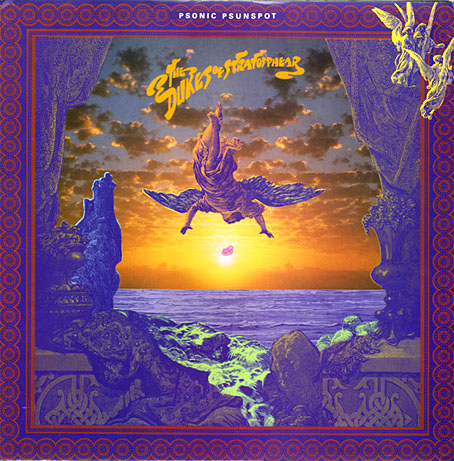
It was twenty-five years today—April 1st, 1985—that Virgin Records released what was supposed to be a reissue of a lost psychedelic album from the late 1960s, 25 O’Clock by The Dukes of Stratosphear. The catalogue number was WOW 1 and the vinyl label was printed with the old black-and-white Virgin logo by Roger Dean even though Virgin Records wasn’t founded until 1972. No one was supposed to know that the album was really a pastiche project by XTC but I don’t recall anyone actually being fooled by this, all the reviews acknowledged XTC as the originators, and band members Andy Partridge and Colin Moulding were happy to give interviews enthusing about their musical obsessions. As well as being incredibly successful artistically the album was a surprising commercial success which led the bemused record label to ask for a sequel. Psonic Psunspot followed two years later, and the Dukes’ vibe infected XTC’s own work for a while, with their 1988 album, Oranges & Lemons, pitched somewhere between the pastiches and XTC’s more usual sound .

dukes2.jpg

Psonic Psunspot (1987). Design by Dave Dragon and Ken Ansell.

Continue reading “The Dukes declare it’s 25 O’Clock!”

Edmund Teske

teske1.jpg

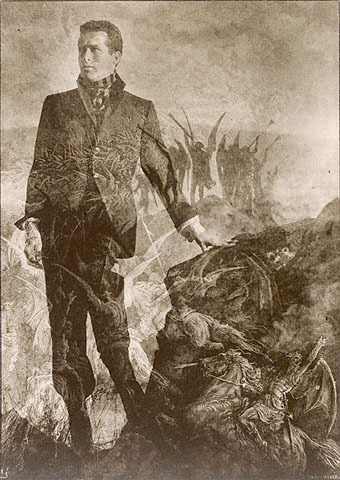
Kenneth Anger, Topanga Canyon, California, Composite (1954).

This portrait of a dashing Kenneth Anger juxtaposes the filmmaker with an engraving by Gustave Doré for Paradise Lost. Like his contemporary Emil Cadoo, photographer Edmund Teske (1911–1996) often concealed the homoerotic nature of his pictures by rendering them “artistic” through double-exposure. Teske was friends with rock group The Doors, and a number of his studies of Jim Morrison and co. are very familiar from histories of the band.

Via Bajo el Signo de Libra.

teske2.jpg

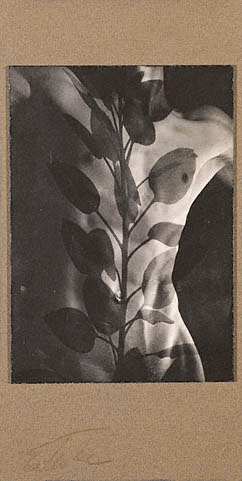
Nude, Davenport, Iowa, Composite with Leaves (1941/46).

Previously on { feuilleton }
Emil Cadoo
The art of Robert Flynt

Harry Lachman’s Inferno

inferno1.jpg

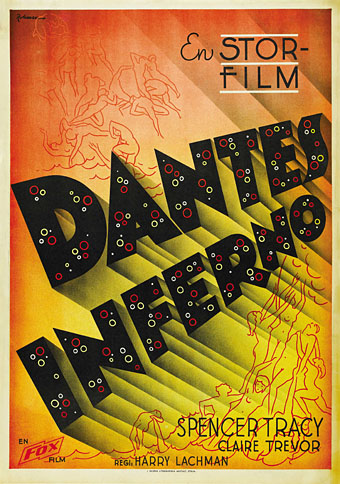
Looking at Willy Pogány’s work last week I was reminded that as well as illustrating books he worked in Hollywood for a while as an art director and set designer. Among those jobs was a credit for “Technical staff” on the only film for which director Harry Lachman is remembered today, a curious 1935 melodrama, Dante’s Inferno. This stars Spencer Tracy as a fairground barker whose talent for drawing an audience helps an old showman boost the attendance at his moralising “Dante’s Inferno” attraction.

inferno2.jpg

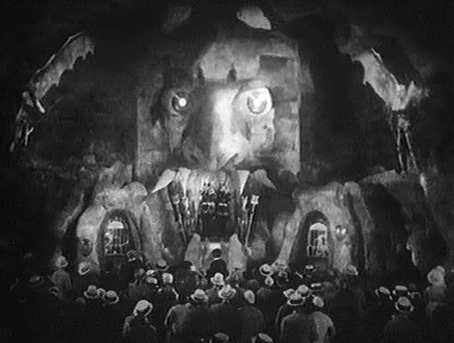
Entrance to the fairground attraction.

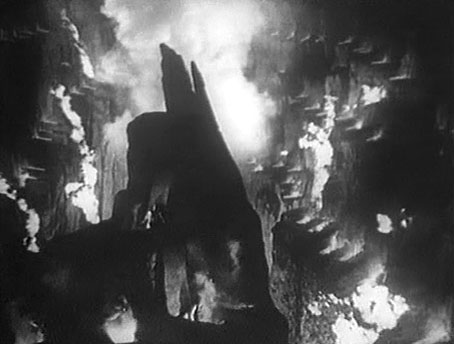
A hubristic rise and fall follows for Tracy, and the film spends much of its running time in routine business and family scenes. What sets it apart is some striking fairground designs (no doubt Pogány’s involvement) and a truly startling self-contained sequence when the old showman describes for Tracy the true nature of the Inferno. This sequence takes Gustave Doré’s celebrated illustrations and brings them to life in a series of atmospheric tableaux which even manage to contain brief glimpses of nudity. Hell, it seems, is the one place you can get away with not wearing any clothes. I’ve read many times that this sequence was borrowed from an earlier silent film, also called Dante’s Inferno, but have yet to come across any definite confirmation. It’s certainly possible since studios at that time treated other films in a very cavalier fashion; when a film was remade the studio would try to buy up and destroy prints of the earlier film. If anyone can point to more information about the origin of the Hell sequence, please leave a comment.

inferno3.jpg

Stone tombs from the Inferno sequence.

If the Inferno sequence wasn’t already stolen in 1935, it works so well that it’s been plundered many times since; Kenneth Anger borrowed shots which he mixed into Inauguration of the Pleasure Dome (1954), Derek Jarman did the same for TG: Psychick Rally in Heaven (1981), and Ken Russell slipped some tinted scenes into Altered States (1980). I tinted the entire sequence red and dumped it into the one-off video accompaniment I made for Alan Moore and Tim Perkins’ stage performance of Angel Passage in 2001; it wouldn’t surprise me if it’s been used elsewhere. As with many of Hollywood’s products, Lachman’s film pretends to condemn prurience—Tracy’s character exploits Hell’s lurid attractions for gain—while revelling in the opportunity to show as much bare flesh as the censors would allow. As with Doré, Lachman’s Inferno seems populated solely by men and women in the peak of physical fitness.

Inevitably, you can see the Inferno sequence on YouTube here and here. The film doesn’t seem to be available on DVD but it’s worth seeking out to watch in full. In addition to the infernal delights, you also get to see 16-year-old Rita Hayworth’s screen debut as a dancer on a cruise ship.

Previously on { feuilleton }
Willy Pogány’s Lohengrin
Willy Pogány’s Parsifal
Maps of the Inferno
A TV Dante by Tom Phillips and Peter Greenaway
The art of Lucio Bubacco
The last circle of the Inferno
Angels 4: Fallen angels

Poe at 200

poe.jpg

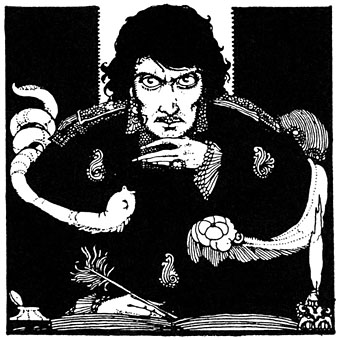
Poe by Harry Clarke.

Happy birthday Edgar Allan Poe, born two hundred years ago today. I nearly missed this anniversary after a busy weekend. Rather than add to the mountain of praise for the writer, I thought I’d list some favourites among the numerous Poe-derived works in different media.

Illustrated books
For me the Harry Clarke edition of 1919 (later reworked with colour plates) has always been definitive. Many first-class artists have tried their hand at depicting Poe’s stories and poems, among them Aubrey Beardsley, Gustave Doré, Arthur Rackham, W. Heath Robinson and Edmund Dulac; none complements the morbid atmosphere and florid prose as well as Clarke does. And if it’s horror you need, Clarke’s depiction of The Premature Burial could scarcely be improved upon.

Honourable mention should be made of two less well-known works, Wilfried Sätty’s The Illustrated Edgar Allan Poe (1976) and Visions of Poe (1988) by Simon Marsden. I wrote about Sätty’s collage engravings in Strange Attractor 2, and Sätty’s style was eminently suited to Poe’s work. Marsden’s photographs of old castles and decaying mansions are justly celebrated but in book form often seem in search of a subject beyond a general Gothic spookiness or a recounting of spectral anecdotes. His selection of Poe stories and poems is a great match for the photos, one of which, a view of Monument Valley for The Colloquy of Monos and Una, was also used on a Picador cover for Blood Meridian by Cormac McCarthy.

Recordings
These are legion but among the outstanding one-off tracks I’d note two poems set to music, Dream Within a Dream from Propaganda‘s 1985 album, A Secret Wish, and The Lake by Antony & The Johnsons. The latter appeared on the landmark Golden Apples of the Sun compilation and also on Antony’s own The Lake EP.

Among the full-length works, Hal Willner’s 1997 2-CD collection Closed on Account of Rabies features lengthy readings set to music from a typically eclectic Willner line-up: Marianne Faithfull, Christopher Walken, Iggy Pop, Diamanda Galás, Gavin Friday, Dr John, Deborah Harry, Jeff Buckley (one of the last recordings before his untimely death) and Gabriel Byrne. Byrne’s reading of The Masque of the Red Death is tremendous and the whole package is decked out in Ralph Steadman graphics.

Antony Hegarty appears again on another double-disc set, Lou Reed’s The Raven (2003), a very eccentric approach to Poe which I suspect I’m in the minority in enjoying as much as I do. An uneven mix of songs and reading/performances, Reed updates some Poe poems while others are presented straight and to often stunning effect by (among others) Willem Defoe, Steve Buscemi, Laurie Anderson, David Bowie, Amanda Plummer and Elizabeth Ashley.

Films
Once again, there’s too many films but The Masque of the Red Death (1964) has always been my favourite of the Roger Corman adaptations, not least for the presence of Jane Asher, Patrick Magee and (behind the camera) Nicolas Roeg. I wrote last May about the animated version of The Tell-Tale Heart from UPA. That adaptation, with narration by James Mason, is still on YouTube so if you haven’t seen it yet you can celebrate Poe’s anniversary by watching it right now.

Elsewhere on { feuilleton }
The illustrators archive

Previously on { feuilleton }
The Tell-Tale Heart from UPA
William Heath Robinson’s illustrated Poe
The art of Harry Clarke, 1889–1931
Darkness visible

pandemonium.jpg

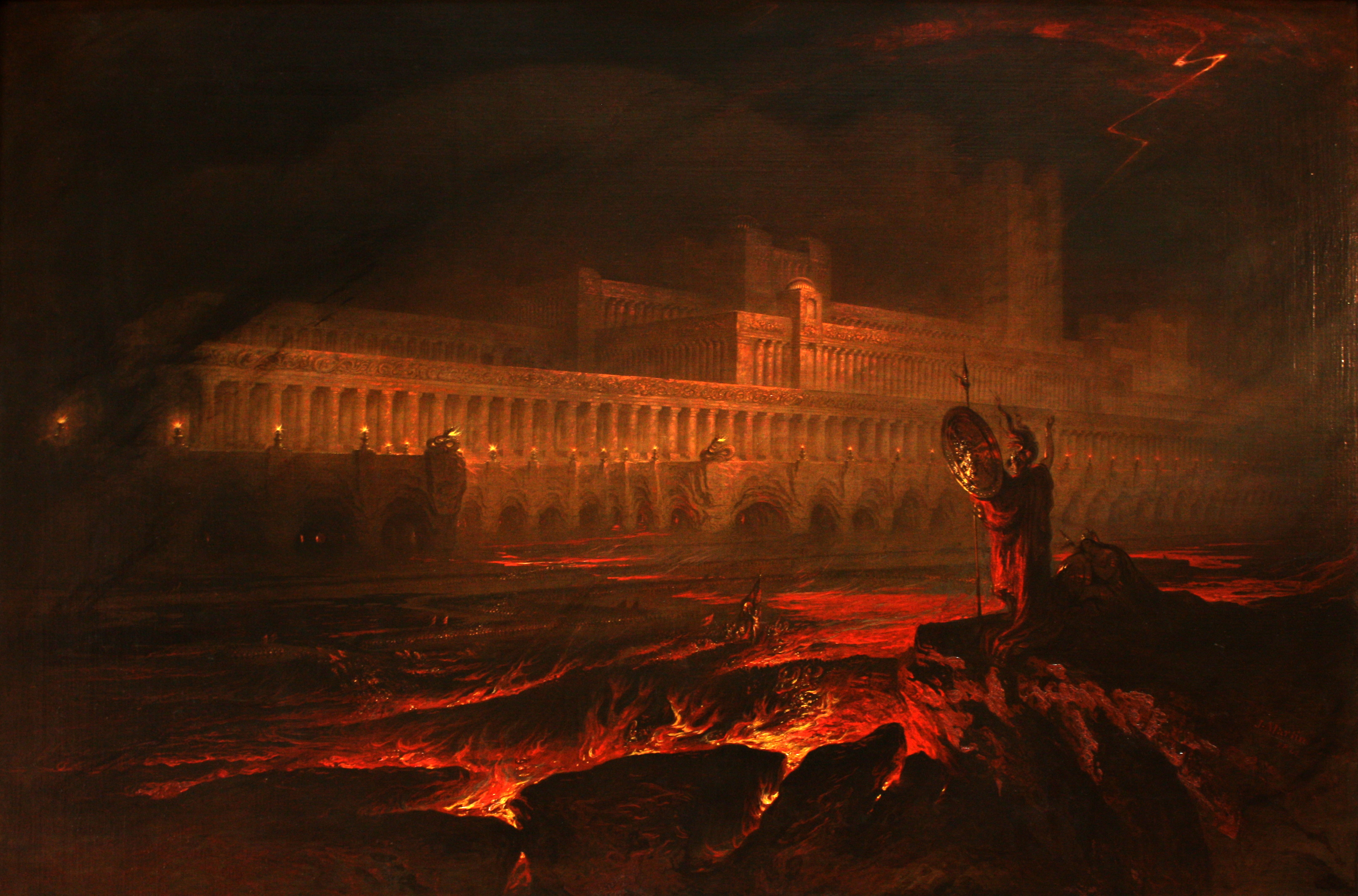
Pandemonium by John Martin (1841).

Happy birthday to John Milton, 400-years-old today.

dore.jpg

“High on a throne of a royal state, which far / Outshone the wealth of Ormus and of Ind” by Gustave Doré (1866).

Elsewhere on { feuilleton }
The etching and engraving archive

Previously on { feuilleton }
Chiaroscuro II: Joseph Wright of Derby, 1734–1797
Angels 4: Fallen angels
Death from above
The apocalyptic art of Francis Danby