Two new covers

rockhill.jpg

My latest cover designs have arrived in time for Spook Month, although the first of these suits the season more by association than its appearance. Jim Rockhill’s A Mind Turned in Upon Itself is a study of the work of J. Sheridan Le Fanu, Ireland’s leading writer of ghost stories and Gothic fiction. This is another design for Swan River Press which adheres to the publisher’s preferred format of a dustjacket that wraps a small hardback with textured and illustrated boards. The brief was fairly straightforward, to present a rare photograph of Le Fanu in a suitably attractive manner. My initial idea was to create a frame that would reflect to some degree various aspects of Le Fanu’s fiction, but it quickly became apparent that the portrait photo was too tall and narrow to sit easily inside a frame that matched the ratio of the book. A better option was to look for a frame which could fit the shape of the book while also filling in the space around the photo.

dore.jpg

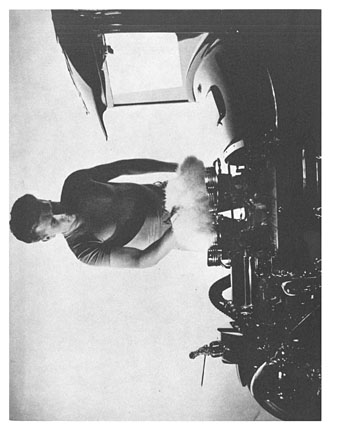
A page from The Workshop: a Monthly Journal Devoted to Progress of the Useful Arts.

When Le Fanu was writing in the mid-19th century book design had become very lavish, with a proliferation of presentation volumes gold-blocked and embossed on their covers and spines. The Heztel editions of Jules Verne are prime examples, as are the many editions of Gustave Doré’s books. My cover is an adaptation of a German edition of Doré’s Bible which had an unusual panel in the centre that happened to be a good size and shape to accommodate the Le Fanu photo, although I still had to extend the design a little. My version also includes a pair of small Le Fanu monograms embedded in the frame.

outline.jpg

For the board illustration I followed the form of an earlier Swan River book with an Irish theme, The Far Tower, whose boards I covered with an engraving collage. The end result, which looks like a single illustration, is a composite of two smaller illustrations from a book of views of Ireland, together with a quantity of foliage which frames the design and joins the pictures together.

ppc.jpg

The second cover is for a book I’m working on at the moment, Lovecraft’s Brood, a sequel to Tachyon’s well-received Lovecraft’s Monsters. I was very pleased to be asked to work on this one, the earlier book is a favourite of mine from among the books I’ve done for Tachyon, and Ellen Datlow is an expert at compiling well-chosen story collections. There’s not much I can say about the cover which follows the form of the previous book. As with Lovecraft’s Monsters, the framed face will also appear as one of the interior illustrations. You’ll have to wait a while to see the results of this, however. Watch this space.

brood-cover.jpg

Meanwhile, I’ve neglected to mention another Tachyon book whose interiors I’ve designed which is available now. The Essential Horror of Joe R. Lansdale is a great introduction to the work of a master of horror fiction whose stories manage to be grim and witty in equal measure. Very grim at times; visceral horror is Lansdale’s forte. The collection includes his best-known story, Bubba Ho-Tep, and features cover art by another Swan River Press cover artist, Dave McKean.

Previously on { feuilleton }
Lovecraft’s Monsters

Back in Doré’s jungle

dore.jpg

This illustration by Gustave Doré (with engraving work by Louis Sargent) is a beautiful example of how to fill a scene with detail and texture without losing a sense of depth or control of the light and shade. Piranesi’s etchings, especially his views of Roman ruins, are often as skilfully rendered, resisting the tendency of concentrated shading to turn into a depthless field of grey. Doré’s scene is from one of his illustrated editions that seldom receives a mention in lists of his works, Atala, a novella by François-René de Chateaubriand set among the Native American peoples of Mississippi and Florida. Those vaguely Mesoamerican ruins are an invention of the artist, being barely mentioned in the text. Doré’s illustrations often exaggerate details when they have to depict the real world; he even took liberties with the views of London he published following his visit to the city in 1869. This combination of ruined architecture and verdant foliage is something I’ve always enjoyed even though I’ve never worked out why the imagery is so appealing. Doré’s illustration is as close as he usually gets to Piranesi’s views of overgrown Roman ruins, only in this case the elements have been reversed, with foliage dominating the carved stonework.

larrinaga.jpg

Production sketch by Mario Larrinaga from The Making of King Kong (1975).

Last week I mentioned Jean Cocteau’s enthusiasm for Doré’s illustrations, their influence being apparent in the set designs for La Belle et la Bête. Doré’s influence was even more visible in another Beauty and the Beast story filmed a decade earlier, King Kong, as described in The Making of King Kong by Orville Goldner and George Turner:

[Willis] O’Brien’s idea of emulating Doré as a basis for cinematographic lighting and atmosphere may have originated with the pioneer cameraman and special effects expert, Louis W. Physioc, who in 1930 stated that “if there is one man’s work that can be taken as the cinematographer’s text, it is that of Doré. His stories are told in our own language of ‘black and white,’ are highly imaginative and dramatic, and should stimulate anybody’s ideas.”

The Doré influence is strikingly evident in the island scenes. Aside from the lighting effects, other elements of Doré illustrations are easily discernible. The affinity of the jungle clearings to those in Doré’s “The First Approach of the Serpent” from Milton’s Paradise Lost, “Dante in the Gloomy Wood” from Dante’s The Divine Comedy, “Approach to the Enchanted Palace” from Perrault’s Fairy Tales and “Manz” from Chateaubriand’s Atala is readily apparent. The gorge and its log bridge bear more than a slight similarity to “The Two Goats” from The Fables of La Fontaine, while the lower region of the gorge may well have been designed after the pit in the Biblical illustration of “Daniel in the Lion’s Den.” The wonderful scene in which Kong surveys his domain from the “balcony” of his mountaintop home high above the claustrophobic jungle is suggestive of two superb Doré engravings, “Satan Overlooking Paradise” from Paradise Lost and “The Hermit on the Mount from Atala.

kong.jpg

King Kong (1933).

I’m sceptical of Goldner and Turner’s suggestion that this illustration of the two goats inspired King Kong’s tree-bridge, the only thing the two scenes share is a piece of wood spanning a chasm. The Chateaubriand illustration is much more redolent of King Kong, as is evident from some of the films’s marvellous production sketches by Byron Crabbe and Mario Larrinaga.

mdg.jpg

The Most Dangerous Game (1932).

The tree-bridge scene has another precedent in a very similar bridge that appears briefly in The Most Dangerous Game, a film made by King Kong’s producer and director in 1932 using the same jungle sets, and featuring many of the same actors and crew. The jungle scenes in the earlier film show a similar Doré influence, with many long or medium shots framed by silhouetted vegetation. The film even includes the animated birds that are later seen flapping around the shore of Skull Island.

harryhausen.jpg

Atala’s fallen tree makes at least one more notable film appearance in Ray Harryhausen’s Mysterious Island, another film about a remote island populated by oversized fauna. Harryhausen’s island doesn’t have much of a jungle but he always mentioned King Kong and Willis O’Brien as the two greatest influences on his animation career. He also picked up on O’Brien’s use of Doré’s work, something he often mentioned in interviews. If Charles Schneer’s budgets hadn’t restricted the films to Mediterranean locations I’m sure Harryhausen would have made greater use of Doré’s jungles.

Previously on { feuilleton }
Uncharted islands and lost souls

Cocteau’s effects

cocteau01.jpg

Chez Cocteau.

“Effects” in the sense of possessions rather than aesthetic or creative effects. I’ve been reading Jean Cocteau’s The Difficulty of Being, an essay collection in which the author muses on a variety of subjects, from his own life, his work, and people he knew, to more general considerations of the human condition. In one of the chapters Cocteau describes his rooms at 36 rue de Montpensier, Paris, where he lived from 1940 to 1947, offering a list of the objects that occupied the shelves or decorated the walls of his apartment. I always enjoy accounts of this sort; the pictures (or objects) that people choose to hang on their walls tell you things about a person’s tastes and character which might not be so obvious otherwise. The same can’t always be said for published lists of favourite books or other artworks when these may be constructed with an eye to the approval of one’s peers. The pictures decorating your living space are more private and generally more honest as aesthetic choices.

I already knew what a couple of these items looked like: the Radiguet bust, for example, may be seen in documentary footage. This post is an attempt to find some of the others. If you know the identity of any of the unidentified pieces then please leave a comment.


cocteau03.jpg

The most engaging bits of such wreckage, thrown up on this little red beach, is without doubt the Gustave Doré group of which the Charles de Noailles gave me a plaster cast from which I had a bronze made. In it Perseus is to be seen mounted on the hippogryph, held in the air by means of a long spear planted in the gullet of the dragon, which dragon is winding its death throes round Andromeda.

“the Charles de Noailles” refers to Charles and his wife, Marie-Laure, a pair of wealthy art patrons who helped finance Buñuel’s L’Age d’Or and Cocteau’s Le Sang d’un Poète. Doré’s illustration (showing Ruggerio from Ariosto’s Orlando Furioso reenacting the heroic rescue) is very familiar to me but I was unable to find any sculptural copies of the work. In addition to decorating Cocteau’s room some of Doré’s illustrations also served as inspiration for the sets in La Belle et la Bête.

cocteau05.jpg

This group is on a column standing between the so-called castor window and a tall piece of slate that can be moved aside and that conceals a small room which is too cold to be used in winter. It was there that I wrote Renaud et Armide, away from everything, set free from telephone and door bells, in the summer of 1941, on an architect’s table above which one sees, saved from my room in the rue Vignon where it adorned the wall-paper, Christian Bérard’s large drawing in charcoal and red chalk representing the meeting of Oedipus and the Sphinx.

Bérard’s drawing is large indeed (see the photo at the top of this post). The artist was a theatrical designer, also the designer of La Belle et la Bête, and one of several of Cocteau’s friends who died young.

cocteau11.jpg

On the right of my bed are two heads, one Roman, in marble, of a faun (this belonged to my Lecomte grandfather), the other of Antinoüs, under a glass dome, a painted terracotta, so fragile that only the steadiness of its enamel eyes can have led it here from the depths of centuries like a blind man’s white stick.

A third head adorns that of my bed: the terracotta of Raymond Radiguet, done by Lipschitz, in the year of his death.

And speaking of premature deaths… Antinous was the celebrated youth beloved of the emperor Hadrian whose death by drowning in the Nile caused Hadrian to establish a cult of Antinous that spread across the Roman Empire. Many busts and full-figure statues survive as a result, but I was unable to find a photo of the one owned by Cocteau. Raymond Radiguet, meanwhile, died of typhoid fever at the age of 20. Radiguet was a precocious talent who managed to write two novels before he died, including Le Diable au corps at the age of 16.

Continue reading “Cocteau’s effects”

Kenneth Anger, 1927–2023

anger.jpg

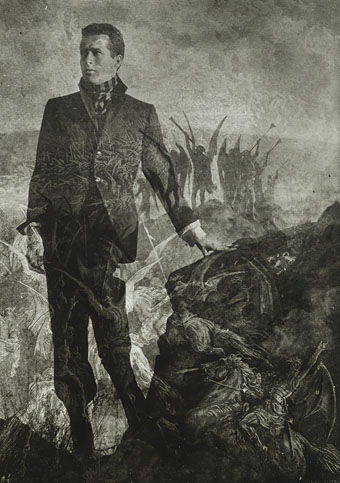
Kenneth Anger, Topanga Canyon (composite with Gustave Doré engraving) (1954) by Edmund Teske.

The other day…I had a date with Tom Luddy at a New York hotel in the East Fifties to meet Kenneth Anger, the genius who made Scorpio Rising and whose New York flat is a shrine to Valentino.

Michael Powell, from A Life in Movies, 1986

There’s not much I can add to all the plaudits, especially when Kenneth Anger has been a continual fixture here since 2007, with the last post about him going up only two weeks ago. I always find it impossible to make one of those lists where people name their ten favourite films but Anger’s Magick Lantern Cycle is one of the very few titles I could add to such a list, and it probably sits in the top five. What the other four might be depends on changes of mood or weather.

The most Anger recent post came about after I’d been re-reading the unofficial Bill Landis biography, a book I’d dipped into over the years but not gone all the way through again since it was published in 1995. It’s an uneven study of Anger’s life and erratic career, detailed yet slapdash, but Landis did at least interview many of Anger’s colleagues and acquaintances while they were still around. Even though Anger himself hated the results of the often gossipy investigation the book will remain an invaluable resource for future writers.

Some links:
Kenneth Anger’s Hollywood Babylon (1991). In which Nigel Finch persuaded a reluctant Anger to drive around Los Angeles in a hearse visiting sites of death or disaster mentioned in Anger’s first book. I suspect Finch was more interested in discussing Anger’s films, which are also featured, but needed the scandalous stuff to get the thing made at all. The BBC hadn’t done anything about Anger before this, and haven’t done anything since.

Kenneth Anger–Magier des Untergrundfilms (1970), a 53-minute documentary made for WDR by Reinold E. Thiel. A frustrating film, being a mix of awkward interviews (Anger didn’t like Herr Thiel very much) with priceless footage showing the filming of parts of Lucifer Rising. A shame, then, that all the copies which have been circulating for the past decade are low-grade and blighted throughout by one of those proprietary signatures that idiots stick onto footage they don’t own. WDR must still have the film so maybe we’ll get to see a better copy one day.

Sex, Satanism, Manson, Murder, and LSD: Kenneth Anger tells his tale. Paul Gallagher recounts his own meetings with Anger and also posts several Anger-related pages from Kinokaze zine, 1993.

Hollywood Bohemia: An interview with Kenneth Anger by AL Bardach for Wet magazine, 1980.

Previously on { feuilleton }
Anger Magick Lantern Cycle, 1966
Don’t Smoke That Cigarette by Kenneth Anger
Kenneth Anger’s Maldoror
Donald Cammell and Kenneth Anger, 1972
My Surfing Lucifer by Kenneth Anger
Inauguration of the Pleasure Dome: The Eldorado Edition
Brush of Baphomet by Kenneth Anger
Anger Sees Red
Kenneth Anger’s Hollywood Babylon
Lucifer Rising posters
Missoni by Kenneth Anger
Anger in London
Arabesque for Kenneth Anger by Marie Menken
Edmund Teske
Kenneth Anger on DVD again
Mouse Heaven by Kenneth Anger
The Man We Want to Hang by Kenneth Anger
Relighting the Magick Lantern
Kenneth Anger on DVD…finally

Anger Magick Lantern Cycle, 1966

magick01.jpg

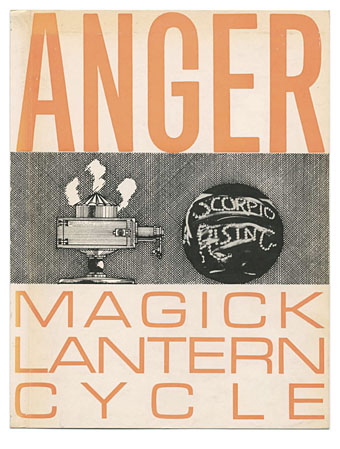
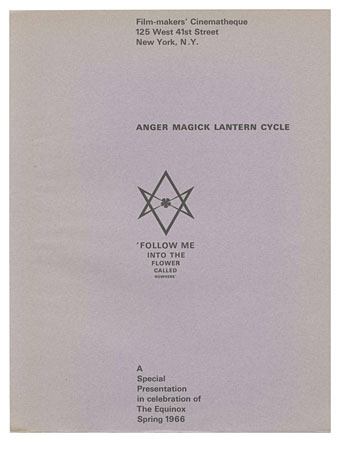
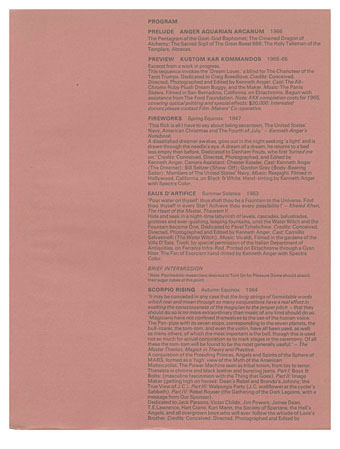
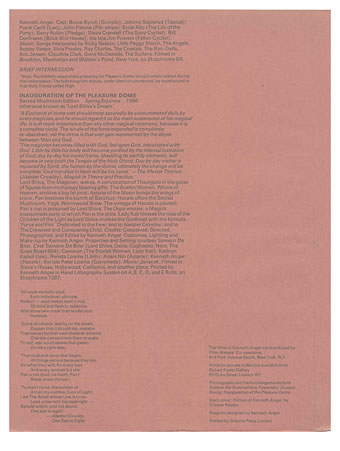
Here’s a rare thing: Kenneth Anger’s programme (PDF) for a Spring Equinox screening of his films in New York in 1966, an event that saw the first public appearance of Magick Lantern Cycle as a collective title. This small publication is described at some length by Bill Landis in the unauthorised Anger biography, while the cover design appears on the first page of the booklet inside the BFI collection of Anger’s films. There are 13 pages in the scan, the original item being a collection of loose sheets inside a folded cover.

magick02.jpg

Among the many points of interest are Anger’s evocative production notes and dedications for the films, comments which have been recycled ever since in articles about the director and his work. There’s also a page of biographical detail which includes a list of Anger’s preferences and interests, a Crowley-style piece of hyperbolic self-description, and a collage bearing the title The Golden Grope of Marilyn Monroe. The latter features a Gustave Doré illustration which prefigures the appropriation of Doré for the first Lucifer Rising poster.

magick03.jpg

This being early 1966, LSD was hip and still legal, so the screening information suggests the ideal time for psychedelic voyagers in the audience to ingest their sugar cubes. The evening was to begin with the Anger Aquarian Arcanum, a prelude comprising a display of various magical symbols and iconography. Some writers have taken this to be a lost film but Landis says it was a slide show, presumably with Anger’s explanatory commentary. Enough of the programmes for the event were printed that you can still find them for sale today, although if you want to buy one the cheaper copies start at around £500.

magick04.jpg

magick05.jpg

Continue reading “Anger Magick Lantern Cycle, 1966”