Weekend links 348

wright.jpg

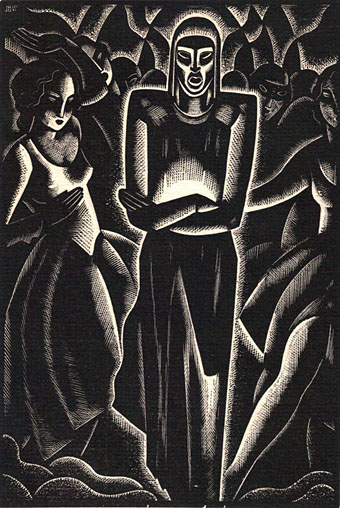
The Masque of the Red Death (1932) by John Buckland Wright.

• Thanks to MeadesShrine I’ve been working my way through Jonathan Meades’ television essays so this is timely: The Plagiarist in the Kitchen, an “anti-cookbook” by the man with forthright opinions.

• “‘Decopunk’ deserves to be bigger than Steampunk,” says Sam Reader. I consider my work on Bruce Sterling’s Pirate Utopia to be more Futurist than Deco but the period is right.

• “Celebrating the cinematically surreal, bizarre, cult, oddball, fantastique, strange, psychedelic, and the just plain WEIRD!”: 366 Weird Movies

But Fascism is also a political and economic system. Why, then, cannot we have a clear and generally accepted definition of it? Alas! we shall not get one—not yet, anyway. To say why would take too long, but basically it is because it is impossible to define Fascism satisfactorily without making admissions which neither the Fascists themselves, nor the Conservatives, nor Socialists of any colour, are willing to make. All one can do for the moment is to use the word with a certain amount of circumspection and not, as is usually done, degrade it to the level of a swearword.

George Orwell discussing the imprecise application of the “F” word

• At The Psychedelic Museum, a report on this month’s art show, Alice’s Adventures in Underground Culture.

M. John Harrison announces a new story collection which will be published later this year by Comma Press.

• Mixes of the week: Iceland: Foreboding Joy by Abigail Ward, and Secret Thirteen Mix 211 by Fluxion.

Daisy Woodward on how LSD adventures inspired John Waters’ Multiple Maniacs.

• More Moomins: Graeme Miller talks to Patrick Clarke about his soundtrack music.

• Some recent cultural highlights as chosen by Timothy J. Jarvis.

Benge presents a list of his favourite electronic albums.

Is this the underground Everest?

Strange Things Are Happening (1968) by Rings & Things | Strange Magic (1975) by Electric Light Orchestra | Strange (1977) by Wire |
Weekend links 214

/sfsound.jpg

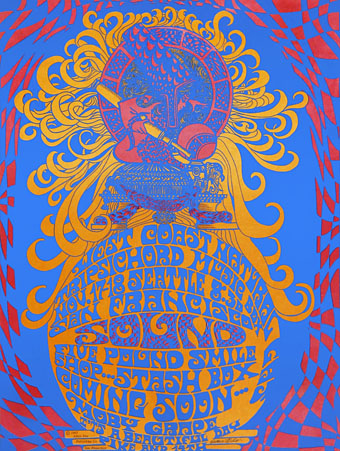
San Francisco Sound (1967). Art by Wallace Studio, Seattle.

• RIP gay porn pioneer Peter de Rome. BUTT posted de Rome’s surprisingly daring Underground (1972), a film in which two men have an unfaked sexual encounter on a New York subway train. That film and others are available on the BFI’s DVD collection. Related: Brian Robinson remembers a director of films whose supporters included Andy Warhol, William Burroughs and John Gielgud.

• “My stuff is implicitly critical of television as it is now,” explains Jonathan [Meades], “Television used not to be as openly moronic as it has become…” A lengthy and typically pugnacious Meades interview with Remy Dean.

Thurston Moore remembers the Burroughs-themed Nova Convention staged in New York in 1978. William Burroughs 100—Nova Convention is a retrospective exhibition running at Red Gallery, London, next month.

How are we expected to take seriously…any work which appears to have engaged less than the whole passionate attention of its author? To be fobbed off, at the last, with something which we feel to be less true than the author knew it to be, challenges the importance of the whole art of writing, and instead of enlarging the bounds of our experience, it leaves them where they are.

Katherine Mansfield was also a book reviewer.

• JG Ballard’s Crash is reissued in August by Fourth Estate with an introduction by Zadie Smith. There’s a tantalising extract from the intro at the NYRB or you can read the whole thing if you’re a subscriber.

• “Between 1959 & 1980 Shirley Collins changed the course of folk music in England & America. Thirty years after disappearing, she’s back.”

Photos by Anne Billson of one of the more attractive Parisian arcades. Related (in a flâneur sense): Christina Scholz‘s Vancouver dérive.

• “Why did Borges hate soccer?” asks Shaj Matthew. Related: George Orwell on the same subject.

• Mixes of the week: FACT mix 447 by Forest Swords, and Programme 13 from Radio Belbury.

• At Dangerous Minds: Roland Topor’s cheerfully violent illustrations from Les Masochistes.

• Rainy Day Psychedelia: Ben Marks on Seattle’s neglected 1960s poster scene.

• Strange Flowers looks at Oskar Schlemmer‘s Triadic Ballet designs.

• A Journey to Avebury: Stewart Lee interviews Julian Cope.

It’s All Over Now (1963) by The Valentinos featuring Bobby Womack | It’s All Over Now (1964) by The Rolling Stones | It’s All Over Now (1974) by Ry Cooder

Weekend links 164

panikanova.jpg

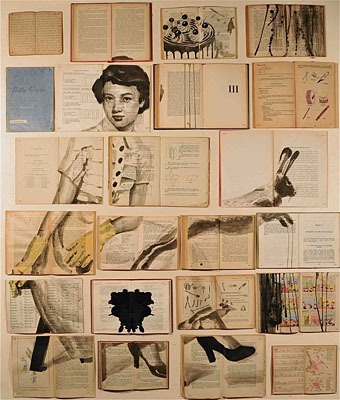
Ekaterina Panikanova paints on books.

Back in 2009 I bought a book of Art Nouveau illustration and design which contained an intriguing drawing by an Austrian artist, Franz Wacik (1883–1938). At the time there was little of Wacik’s other work online so I was delighted by the latest post at 50 Watts which showcases a selection of his illustrations. Wacik was a contemporary of British illustrator Sidney Sime, and both artists share a predilection for the comic and the grotesque.

• “The outlawing of drugs such as cannabis, MDMA and LSD amounts to the ‘the worst case of scientific censorship since the Catholic Church banned the works of Copernicus and Galileo’, the former Government drugs advisor Professor David Nutt has claimed.” Related: “At last, the edifice of drugs prohibition is starting to crumble,” says Amanda Feilding.

Alan Johnston on “A gay island community created by Italy’s Fascists”, and at Another Nickel In The Machine a report on The Gateways Club, one of the few meeting places for London’s lesbians in the 1960s. Alex Park wonders “Why Is Gay Porn So Popular In Pakistan?”

• If it’s June 16th then it must be Bloomsday: The Irish Times has a page of Joyce-related links to mark the anniversary. This year there’s a global reading of Ulysses taking place.

• “Now we can concentrate on album number nine,” says Kraftwerk’s Ralf Hutter. The rest of us will impatiently count the passing seconds.

• After a week in which George Orwell’s Nineteen Eighty-Four has seen an increase in sales, a look at its cover designs old and new.

Aleister Crowley: Wandering the Waste is a 144-page graphic biography of the Great Beast by Martin Hayes and RH Stewart.

Barnbrook Design‘s presentation of Taxidermy, a book by Alexis Turner, is rather splendid.

• FACT Mix 386 is a great collection of dubby grooves compiled by Young Echo.

• From 2001: Michael Wood in the LRB reviewing Apocalypse Now Redux.

• The first recording of Allen Ginsberg reading Howl.

Rejoyce (1967) by Jefferson Airplane | The Sensual World (1989) by Kate Bush | Molly Bloom (2013) by Alan Munde

Wildeana 9

dine.jpg

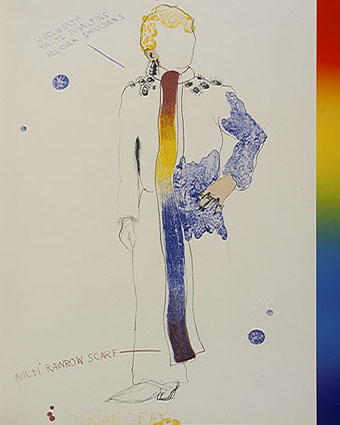
Dorian Gray (1968) by Jim Dine; one of a series of prints for an illustrated edition. Rainbows didn’t become a gay symbol until Gilbert Baker’s flag design ten years later.

Continuing an occasional series.

• “…the Public is a very curious thing; it is sometimes perverse, and even obstinate, and it has evidently made up its mind to like the plays of Mr. Oscar Wilde.” Callum at Front Free Endpaper found a sceptical review of The Importance of Being Earnest in The Sketch for 20th February, 1895.

• “Wilde’s vision of Socialism, which at that date was probably shared by many people less articulate than himself, is Utopian and anarchistic.” George Orwell, writing in 1948, looks back at Wilde’s The Soul of Man Under Socialism.

Oscar Wilde between Paris and Brighton: Research at the excellent Charles Ricketts & Charles Shannon blog following Wilde’s travels in the early months of 1891.

Wilde Ride by Anthony Paletta: “Oscar Wilde spent a year in the US and met the likes of Walt Whitman and Henry James.”

• There’s plenty of Wildeana at Pinterest.

Elsewhere on { feuilleton }
The Oscar Wilde archive

Nigel Kneale’s Nineteen Eighty-Four

1984-1.jpg

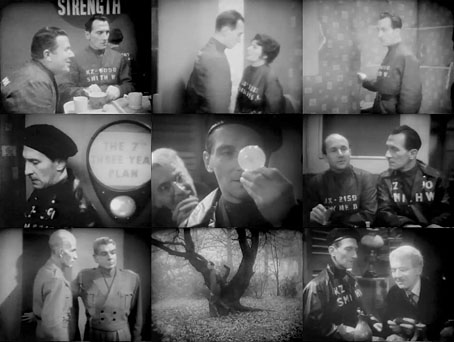
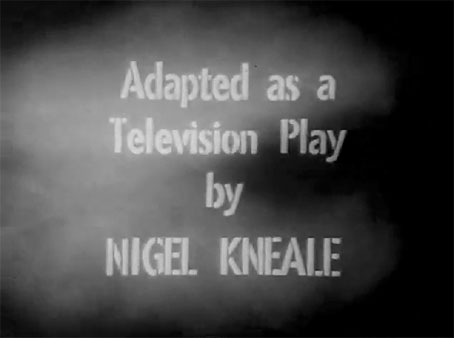
If I’d been more diligent I would have posted this yesterday which happened to be the UK’s first George Orwell Day. The Quatermass Experiment and this adaptation of Nineteen Eighty-Four are the two outstanding dramas from the very early days of British television. Both were written by Nigel Kneale and directed by Rudolph Cartier, an expatriate Austrian who brought to the small screen skills honed at the UFA studios before the war. The Quatermass Experiment was the first major collaboration between the pair after which they adapted Wuthering Heights. Nineteen Eighty-Four followed, a production that was screened twice in November 1954, and which caused considerable controversy at the time on account of its oppressive atmosphere and the scenes of Winston Smith’s torture.

1984-3.jpg

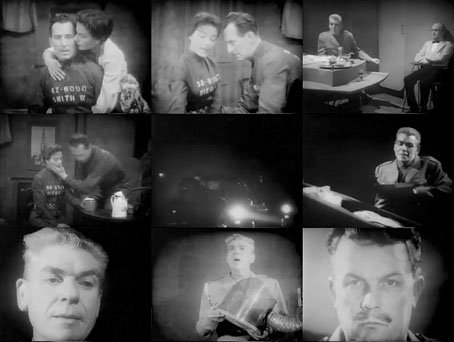
Kneale’s drama, which was performed live in the studio on both occasions, looks primitive compared to everything that’s followed but in many ways I prefer this adaptation to Michael Radford’s glossier feature film. For a start it has a great cast: Peter Cushing plays Winston Smith, Yvonne Mitchell is Julia, Donald Pleasence is Syme, and André Morell (who later played Professor Quatermass in the BBC’s Quatermass and the Pit) is O’Brien. Also among the cast there’s Wilfrid Brambell in two minor roles, one of them a precursor of the crusty old man he’d spend the rest of his life portraying. Neither Cushing nor Pleasence were known as film actors at this time; both would no doubt have been surprised to be told that their subsequent careers would involve a great deal of horror and science fiction.

1984-2.jpg

Cartier and Kneale didn’t have the budget to compete with feature films but for once the claustrophobic nature of a studio production works in the favour of a drama where there’s little intimacy or privacy. With the exception of a few filmed inserts almost everything is close shots. As the story grows more desperate so the shadows close in, until the final scenes are all spotlit faces in darkened rooms. The power of Cushing’s performance still resonates today, and gives an idea of how shocking this must have been to a home audience expecting little more than light entertainment on a Sunday evening. The YouTube copy is the entire 107-minute film, and is worth a watch if only to see Donald Pleasence when he had an almost complete head of hair.

• From 2009: Robert McCrum on The masterpiece that killed George Orwell.

Previously on { feuilleton }
The Stone Tape