JK Potter and HP Lovecraft

hm1.jpg

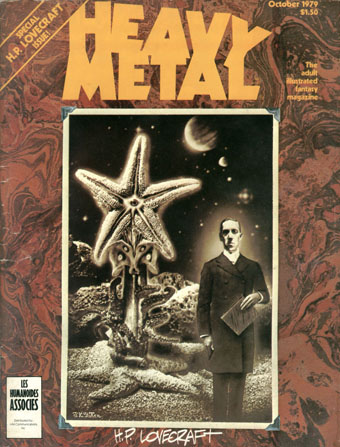
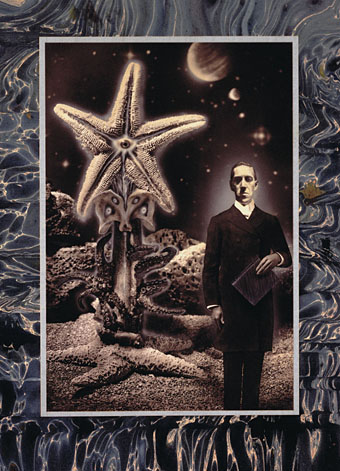
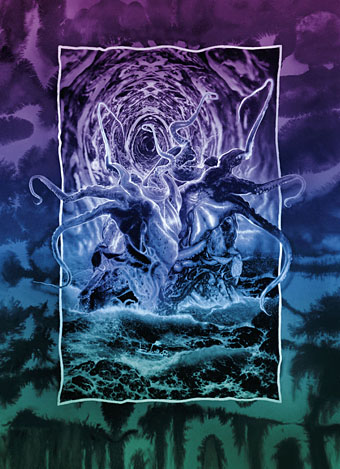
American artist JK Potter is another photo-montagist whose work since the 1970s has been very popular as illustration for books of horror, fantasy and science fiction. Potter’s portrait of HP Lovecraft on the October 1979 issue of Heavy Metal was my first introduction to his work. The original version of that picture can be seen below. Despite Potter’s flair for horror imagery there’s fewer Lovecraft illustrations than you might expect, certainly fewer than I used to hope there might be, although tentacles—real ones—do feature in a number of his other pictures.

While we’re on the subject, HPL continues to dog my footsteps. I recently autographed an enormous block of contributor signing sheets for a new doorstop anthology from Centipede Press. A Mountain Walked is a 636-page collection edited by Lovecraft scholar ST Joshi which will be published in March, 2014. Be warned that like many other Centipede volumes it won’t be cheap! Meanwhile I’m currently working on a new series of illustrations for a completely different anthology of Lovecraftian fiction. That will also be out early next year. It’s going to be a good one but I’ll say more about it at a later date.

potter1.jpg

potter2.jpg

potter3.jpg

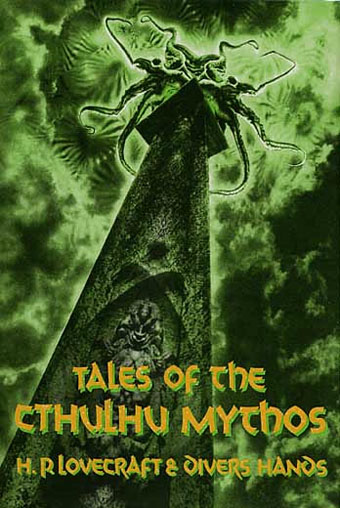
Tales of the Cthulhu Mythos (1990).

Elsewhere on { feuilleton }
The Lovecraft archive

Weekend links 174

ikuma.jpg

Dress (2012) by Nao Ikuma.

• Two of my Cthulhu artworks can currently be seen in the Ars Necronomica exhibition at the Cohen Gallery, Brown University, Providence, RI. The exhibition is part of NecronomiCon, and runs to September 13th. In related news, my steampunk illustration has been nominated in the Visual category of this year’s Airship Awards. Winners will be announced at Steamcon V in October.

• “…the story of how a small cabal of British jazz obsessives conducting a besotted affair with the style arcana of Europe and America somehow became an army of scooter-borne rock fans…” Ian Penman looks back at the culture of Mod for the LRB.

• “What is it about the writer in the First World that wants the Third World writer to be nakedly political, a blunt instrument bludgeoning his world’s ills?” Gina Apostol on Borges, Politics, and the Postcolonial.

If someone had designed a work regime perfectly suited to maintaining the power of finance capital, it’s hard to see how they could have done a better job. Real, productive workers are relentlessly squeezed and exploited. The remainder are divided between a terrorised stratum of the, universally reviled, unemployed and a larger stratum who are basically paid to do nothing, in positions designed to make them identify with the perspectives and sensibilities of the ruling class (managers, administrators, etc) – and particularly its financial avatars – but, at the same time, foster a simmering resentment against anyone whose work has clear and undeniable social value. Clearly, the system was never consciously designed. It emerged from almost a century of trial and error. But it is the only explanation for why, despite our technological capacities, we are not all working 3–4 hour days.

On the Phenomenon of Bullshit Jobs by David Graeber

Ron Rosenbaum talks to Al Pacino about all the usual stuff, and reveals some detail about the actor’s obsessive interest in Oscar Wilde’s Salomé.

• More queer history: The Brixton Fairies and the South London Gay Community Centre, Brixton 1974–6.

• At Dangerous Minds: Anthony Burgess and the Top Secret Code in A Clockwork Orange

• Every day for 100 days, Jessica Svendsen redesigned a Josef Müller-Brockmann poster.

LondonTypographica: Mapping the typographic landscape of London.

• Mix of the week: Secret Thirteen Mix 083 by Demdike Stare.

• At Strange Flowers: Alfred Kubin the writer.

Derek Jarman’s sketchbooks.

Rick Poynor on Collage Now.

• Thomas Leer: Private Plane (1978) | Tight As A Drum (1981) | Heartbeat (1985)

Weekend links 168

bell.jpg

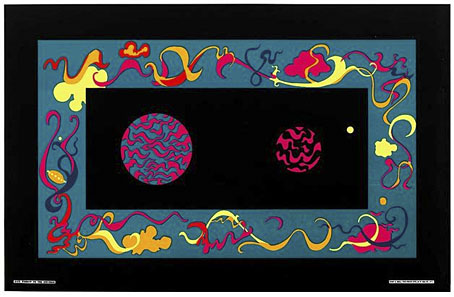
Window to the Universe (1967) by Roberta Bell. From Summer of Love: Psychedelic Posters from SCMA currently showing at the Smith College Museum of Art, Northampton, MA.

Sympathy for the Shoggoth: China Miéville’s Revolution of the Weird Tale, an essay by Christina Scholz which features one of my Cthulhu pictures among its embellishments. Related: “‘New Strange’ stories hold a chilling mirror to life” says Rick Kleffel discussing Robert Aickman and others. And speaking of Aickman (so to speak), Reese Shearsmith has recently recorded Aickman’s Cold Hand in Mine for Audible.

• An erotic alphabet book from the Soviet Union circa 1931, created to promote adult literacy. Who says porn can’t be educational?

Angelystor is a new 39-minute composition by Phil Legard which he describes as “often heavy, Saturnine and melancholic”.

• James Ward’s postcards of the Post Office Tower. Related: film of the revolving restaurant at the top of the Tower in 1967.

•You Might Never Find Your Way Back: Shirley Jackson’s Hangsaman by Nicholas Rombes.

satty.jpg

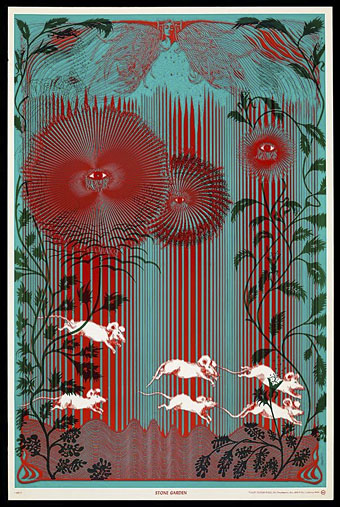
Stone Garden (1967) by Wilfried Sätty.

High Over Blue is “a mind-warping 20-minute freakout” by Moon Duo.

• Queer Visual Splendour: Jon Macy discusses his erotic comics.

The Origin of the Pilcrow, aka the Strange Paragraph Symbol.

• Mix of the week: the Kranky 20th Anniversary Mixtape.

Ten Amazing Cheeses and their Literary Counterparts.

PingMag looks at the past and present of Ginza.

Mind Gardens (1967) by The Byrds | The Garden (1981) by John Foxx | The Toy Garden (2006) by Helios

Underground labyrinths

wallinger.jpg

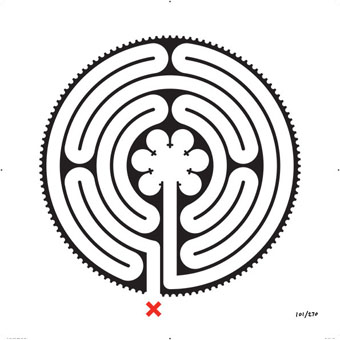
Labyrinth (Westminster) by Mark Wallinger.

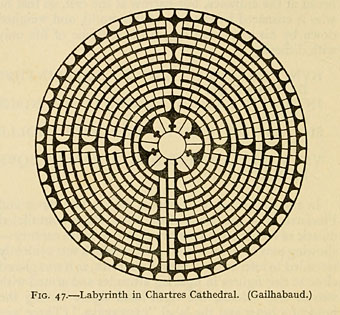
A mandatory post, this one, seeing as how it combines two continual sources of interest: labyrinths and the London Underground transport system. Transport for London commissioned artist Mark Wallinger to create something for the 150th birthday celebrations of the Tube, the result being a series of 270 different labyrinth designs, one for each of the capital’s stations. Needless to say, I like the idea, and it’s been interesting to see that some of Wallinger’s designs hark back to earlier labyrinths. The one for the Westminster station is notable for the way it references the famous Chartres Cathedral labyrinth (below)—a nod to Westminster Abbey, perhaps—and also features an enclosed and inaccessible loop, a possible comment on the irresolvable dealings occurring across the road in the Houses of Parliament.

maze02.jpg

It’s Nice That has more of Wallinger’s designs while Creative Review draws attention to an earlier maze design on the wall at Warren Street station.

Previously on { feuilleton }
Cthulhu Labyrinth
The labyrinth of Versailles
Maze and labyrinth panoramas
Mazes and labyrinths
Labyrinths
Jeppe Hein’s mirror labyrinth

Cthulhu Labyrinth

cthulhulabyrinth.jpg

Something I was working on last August when I was putting together new pictures for the Cthulhu calendar, I’d actually forgotten about this until this week. The idea was to do something that was more of an abstract design than the rest of the art; having got this far I was undecided whether I wanted to try and incorporate the labyrinth shape into a larger picture. With time running out and nothing resolved I ended up using the Keep Calm Cthulhu design which, looking back, I feel this alone could easily have replaced. (They both share the same Cthulhu glyph.) As it is I may make this one available as another CafePress design since it’s more suited to T-shirts and things. If it needs a justification then consider the story of The Call of Cthulhu as a labyrinthine investigation which reveals Cthulhu dreaming at its centre.

Elsewhere on { feuilleton }
The Lovecraft archive