Weekend links 301

ruscha.jpg

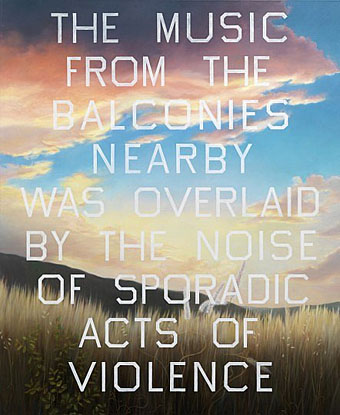
The Music from the Balconies (1984) by Edward Ruscha.

• At The Quietus: High-Rise director Ben Wheatley runs through his favourite films. Kudos for mentioning Elem Klimov’s Come and See (1985) among the more familiar fare, a nightmarish masterwork that everyone should watch at least once. On the same site, author Joe R. Lansdale also lists some favourite films while discussing the new TV series of his Hap and Leonard books.

Electric Hintermass (Sound Apart) by Hintermass, a track from The Apple Tree, their debut album on the Ghost Box label.

Michael Mann’s Heat: “A complex, stylistically supreme candidate for one of the most impressive films of the Nineties”.

• Despair Fatigue: David Graeber on how [political] hopelessness grew boring, and what happens next.

• Mix of the week: FACT Mix 541 by Tortoise, and Blowing Up The Workshop 56 by Eric Lanham.

• At Dennis Cooper’s: “Some books (1961–1975) that either faked ingesting LSD or did”.

• David Litvinoff again: “Was he only an opportunistic hustler?” asks David Collard.

John Carpenter’s The Thing rescored with one of the director’s Lost Themes.

Overlooked: a book by Marina Willer about the manhole covers of London.

• Pam Grossman (words) and Tin Can Forest (art) ask What is a Witch?

• A long way down: Oliver Wainwright on JG Ballard and High-Rise.

• A conversation with designer and typographer Erik Spiekermann.

• The BFI compiles a list of “The 30 Best LGBT Films of All Time“.

• Decoding the spiritual symbolism of artist Hilma af Klint.

Sabat Magazine

Heat (1983) by Soft Cell | The Heat (1985) by Peter Gabriel | Heat Miser (1994) by Massive Attack

Weekend links 299

blanco.jpg

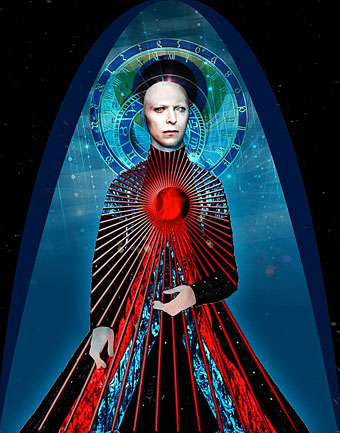
Starman (2016) by Nyahzul Blanco. From the Saint Bowie exhibition at Stephen Romano Gallery, NY.

• “…[Dashiel] Hammett’s first-hand experience of political sleaze, industrial violence and the everyday routine of an agent allowed for a realism that brought hard-boiled fiction to new heights.” Oliver Harris reviews a new life of Hammett, a history of the American detective, and a study of film noir.

• Mixes of the week: Secret Thirteen Mix 177 by Vladislav Dobrovolski, The After-School Club by Melmoth The Wanderer, and Perfect Monolake by Rich Ears.

Inside High-Rise: product designs by Michael Eaton and Felicity Hickson for Ben Wheatley’s feature film.

Yeats is not the only respected writer to make use of the tarot: Italo Calvino, Salvador Dalí, and even Charles Williams, a novelist and theologian who belonged to the Inklings literary circle, also drew on the cards. Still, the cards remain firmly associated with the occult—and, while [Jessa] Crispin is sympathetic to that tradition, she aims to bring tarot to those who may be skeptical of that way of thinking. Her references are more literary than arcane.

Peter Bebergal talks to Jessa Crispin about making the Tarot literary again

Legowelt’s best free paranormal synth samples, occult instruments and lo-fi effects.

• At Dangerous Minds: a smorgasbord of sorcerous bad taste via Vintage Occult.

• Free download: Cavern of Anti-Matter live at Acad, Berlin, 2015.

• Conversing with your Subconscious: The Art of Adrian Cherry.

Diagonal Science is the debut album from Black Helicopters.

111 Photographs of 111 Westminster Street in Providence, RI.

• More magick: occult documentaries of the 1970s.

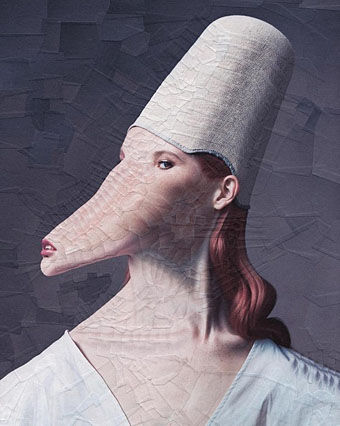
• A Bosch-themed fashion feature by Tim Walker.

Cycloid Drawing Machine

Dark Star (1984) by Harold Budd | Dark Start (1994) by ELpH vs Coil | Dark Star Blues (2004) by Acid Mothers Temple & The Melting Paraiso U.F.O.

Weekend links 298

liu-wong.jpg

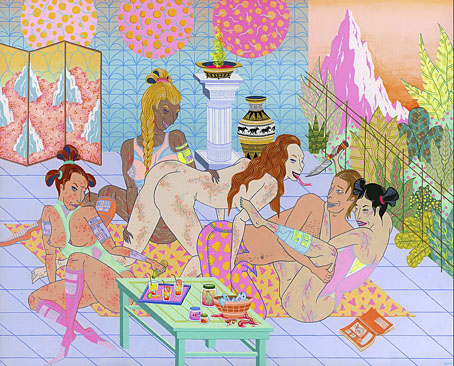
The Gathering (2015) by Kristen Liu-Wong.

• Tom of Finland’s house in Echo Park, Los Angeles, “is a trove of homoerotic masterpieces“. The house and its former owner are celebrated in Tom House, a book by Michael Reynolds with photos by Martyn Thompson. Related: Tom House exposed by Rizzoli.

• “Underlying the heightened nature of the films was a deep, questioning soulfulness related to literary antecedents coupled with a vision of cinema open to shifting levels of perception and fantasy.” David Thompson on Andrzej Żuławski.

• Memories of the Space Age: Photos by Roland Miller of the ruins of NASA’s old launch pads, bunkhouses and research facilities. A British equivalent (and a much more modest affair) is the Highdown Rocket Site on the Isle of Wight.

• Statues allegedly made for the John Huston film of The Maltese Falcon are among the most expensive props in cinema history even though there’s still dispute about their authenticity. Bryan Burrough investigates.

• Mixes of the week: The Solar Gate: Female Private Press New-Age Music – Vol.1 by Michael Tanner, and an “alchemical” Bowie selection by The Ephemeral Man.

• “What Does It Take To Be A ‘Bestselling Author’? $3 and 5 Minutes.” Brent Underwood on why Amazon ratings can’t be trusted.

Edward Gorey/Derek Lamb title sequences from the PBS/WGBH show Mystery! (1981).

• A Painter Possessed: Kate Kellaway on the occult abstractions of Hilma af Klint.

Invertebrate Harmonics: a new composition by Chris Watson.

• Frozen in time: Inside Bangkok’s first ever department store.

Roly Porter’s Favourite Space Records

• Space-Age Couple (1970) by Captain Beefheart & His Magic Band | Space Age Batchelor Pad Music (Mellow) (1993) by Stereolab | Space Age Ballad (2001) by Acid Mothers Temple & The Melting Paraiso U.F.O.

Bosch details

bosch01.jpg

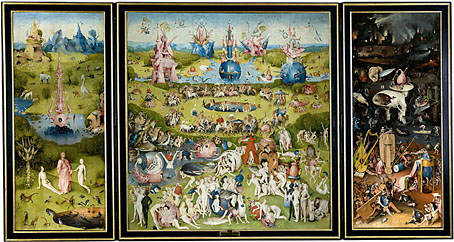
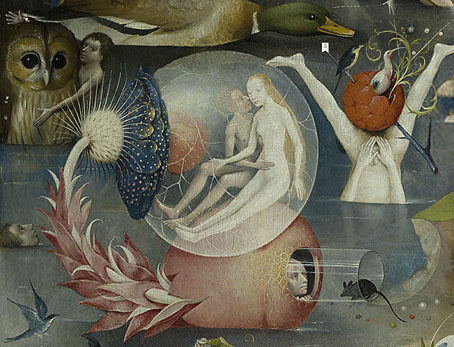
In which the indelible strangeness of Hieronymus Bosch’s triptych, The Garden of Earthly Delights (c. 1490–1510), is presented to us in the highest resolution. (I should say presented again since Google’s Art Project/Cultural Institute/whatever-it’s-called-this-week had a browsable version of their own in 2009 but this seems to have vanished. So much for the primacy of the Googleverse, etc, etc.) I’d always encourage people to see paintings in situ when possible but it remains a fact that very old and well-known works of art are difficult to study for any length of time in a crowded gallery. The more valuable works are also closely guarded by attendants who dissuade anyone from getting too close to those fragile surfaces, so it’s left to books or websites such as this one to give us the details. Not all paintings warrant this kind of attention, of course, but the crowded panels of Bosch and Brueghel the Elder certainly do. In addition to wandering among the figures you can also opt for a guided tour although bear in mind that the meaning (if any) of many of these details has never been resolved. Via MetaFilter.

bosch02.jpg

bosch03.jpg

Continue reading “Bosch details”

Weekend links 295

dupre.jpg

Untitled (2014) by Lola Dupré. Via.

Announcement of the week (if not the month/year) is the news that the BFI will be releasing all of the BBC dramas directed by Alan Clarke on DVD/Blu-ray in May. In addition to the long-awaited appearance on disc of Penda’s Fen (1974) we can expect a previously unseen director’s cut of Clarke’s last TV film, The Firm (1989), the DVD premier of Baal (1982) with David Bowie, plus many other works including some from the 1960s that were believed lost. (And it should be noted that this isn’t everything of Clarke’s; he also worked occasionally for ITV and later directed feature films for Channel 4.)

The BFI attention is a tribute to an exceptional director that’s overdue. Clarke has long been a cult figure among the British actors who worked with him, and among directors such as Harmony Korine and Gaspar Noé, but the tendency of TV to give one-off dramas a single screening has meant that much of his best work has been unavailable for years outside old VHS tapes. Clarke is important for having persistently chosen difficult subjects which he directed with a flair and intensity usually only found in cinema. When he died in 1990 the BBC repeated a handful of his films but the only ones given repeated DVD release have been the violent dramas with the big names attached: Scum (1979, with Ray Winstone), Made in Britain (1982, with Tim Roth), and The Firm (with Gary Oldman). Clarke’s oeuvre is much more than a parade of nihilistic villains, as will become evident later this year.

• A psychedelic video directed by Peter Strickland for Liquid Gate (ft. Bradford Cox) by Cavern of Anti-Matter. The debut album from Cavern of Anti-Matter, Void Beats/Invocation Trex, will be out later this month.

Celebrating Dusseldorf, the city that birthed Krautrock. (Article loses points for not mentioning producer Conny Plank.)

All Rivette’s features might be regarded as different kinds of horror films; Céline et Julie vont en bateau is his first horror comedy. The anxiety and despair of Paris Nous Appartient and La Religieuse, L’Amour Fou and Spectre seem relatively absent, yet they perpetually hover just beyond the edges of the frames. We still have no privileged base of ‘reality’ to set against the fictions, each of which is as outrageous as the other; and along with Borges, we can’t really say whether it’s a man dreaming he’s a butterfly or a butterfly dreaming he’s a man—although we may feel, in either case, that he and we are just on the verge of waking.

Jonathan Rosenbaum on work and play in the house of fiction: Jacques Rivette’s Out 1 and Céline and Julie Go Boating

• Mixes of the week: Finders Keepers Radio Show Krautrock Special, and The Ivy-Strangled Path Vol. XV by David Colohan.

• At Dangerous Minds: Super strange sculptures (by Shary Boyle) only the dark and demented could love.

• Beautiful Brutalites: S. Elizabeth questions Arabella Proffer about her paintings.

KTL is a musical collaboration between Peter Rehberg and Stephen O’Malley.

• Why study art when you can make it? The strange world of…This Heat.

Sarah Galo on the explicitly sexual female artists that feminism forgot.

Irmin Schmidt‘s favourite music (this week).

• LSD: My life-saving drug by Eric Perry.

The Occult Activity Book

Twenty Tiny Cities

Der LSD-Marsch (1970) by Guru Guru | Krautrock (1973) by Faust | Düsseldorf (1976) by La Düsseldorf